Bird watching at the foundation dig across from the blueberry farm….


Bird watching at the foundation dig across from the blueberry farm….


I am happy to see that the state legislature is close to adopting a domestic partnership law. The law will recognize same-sex domestic partners in committed relationships, and give domestic partners a wide range of rights, privileges, and responsibilities previously associated only with marriage.
I’m in favor of this, because I feel everyone deserves to have a partner that will share in their successes, and care for and protect them in times of crisis. No one should have to go through this life alone, regardless of their sexual orientation or gender identity.
Many of the provisions of the law are rights that most of us take for granted, such as having the person closest to us able to stay by our side in the hospital. Without this law, same-sex partners have found themselves limited to short visits, and treated like non-family members.
Additionally, the new law will allow the recognized domestic partner to give medical consent if their partner is unable. Today, hospitals with an unmarried and unconscious adult patient will try to locate next-of-kin, tracking down a patient’s siblings or children, then sort through complicated familial relationships, to obtain approvals. If the patient’s committed life partner is sitting out in the waiting room, this makes no sense. And it puts the life-partner in a cruel and fearful position; even though they may have the most intimate understanding of their partner’s life and wishes, and the most to lose in a medical emergency, they are unrecognized as an advocate, and treated as less important than far-away blood relatives.
The new law will also remedy problems and confusion in inheritance procedures when there is no will. Today, domestic partners that have set up a home together can lose all or part of it to their partner’s relatives if their partner dies. This can create fear and uncertainty during times of crisis, which is very difficult for loved ones and is contrary to the state’s desire to keep the peace. With the new domestic partnership law, same-sex partners will make an official public commitment, at a time when they are of sound mind, regarding who they chose to care for them and their estate. At the time of committing to the partnership, and not in a hospital crisis, they can resolve financial questions with siblings and children.
I’ve personally known wonderful people that have been caught up in all of these predicaments, and none of them deserved the way life unfolded for them. I am very glad that Washington state is joining with a rapidly growing legion of other states and nations around the world to resolve these issues.
The world has many problems that can only be solved by everyone pulling together. And we need all our citizens to be at their most productive in order to meet these challenges. This new law is going to help.
Randy Corman
Local News: Friday, March 02, 2007
Domestic partnerships likely a done deal in state
By Andrew Garber and Janet I. Tu
Seattle Times staff reporters
OLYMPIA — A domestic-partnership bill for gay and lesbian couples appears headed for state law, but supporters say their ultimate goal — same-sex marriage — is likely years away.
The state Senate on Thursday passed the measure by a 28-19 vote after a heated debate that boiled over when a Republican senator made references to bestiality and necrophilia.
The bill is expected to easily pass the House, though it’s not clear when it will come up for a vote. Gov. Christine Gregoire has said she supports the measure.
The legislation would give gay and lesbian couples the right to visit a partner in the hospital, inherit the partner’s property without a will and make funeral arrangements, among other things. That right also would be extended to unmarried heterosexuals in which at least one partner is 62 or older.
Who could qualify
Partners must:
• Be part of a same-sex couple,
or if in a heterosexual partnership, one person must be at least 62.
• Share a residence.
• Be at least 18.
• Not be married to another person or in a domestic partnership with anyone else.
• Be capable of consenting.
• Not be blood relations.
Supporters say older heterosexuals were included because they face the possibility of losing pension rights and Social Security benefits if they remarry.
Currently, three states, plus the District of Columbia, have domestic partnerships or similar provisions, according to the Washington, D.C.-based Human Rights Campaign, a national gay- and lesbian-advocacy group. One state, Massachusetts, allows same-sex marriage; three others allow civil unions.
Advocates see the domestic-partnership bill as a step to gay marriage. However, the lead sponsor of Senate Bill 5336, Sen. Ed Murray, says that’s not likely to happen soon.
A coalition of gay lawmakers in the state House and Senate introduced legislation this session that would allow gay marriage, but it died in committee.
What the bill allows
The bill would allow partners to:
• Have the same hospital-visitation rights as a spouse.
• Give consent for health care if a partner isn’t competent.
• Inherit property when there is no will.
• Administer a partner’s estate when there is no will.
• Authorize organ and tissue donation.
• Make burial and other arrangements after a partner’s death.
Source: Washington state Legislature
“We’ll keep coming back, and keep telling the story and hope people go ‘Geez, let’s just get it over with, let’s pass marriage,’ ” Murray, D-Seattle, said after Thursday’s vote.
Josh Friedes, advocacy director for Equal Rights Washington, thinks extending the right to marry to gay and lesbian couples can happen within five years.
“It depends on whether the gay and lesbian community is able to keep up its momentum and continue to do the education work it’s doing,” he said. “It depends on who is in elected office in the Legislature and who is the governor.”
Conservative groups opposed to gay marriage and the domestic-partnership bill said they were disappointed by the Senate vote. But it’s not clear whether they’ll try to challenge the legislation at the ballot if it becomes law.
“I think the support is there, but I don’t know if we can translate it into signatures” to get a referendum on the ballot, said Gary Randall, president of the Faith and Freedom Network.
A referendum last year to overturn a gay-rights law passed by the Legislature failed to attract enough signatures to qualify for the ballot.
The bill that passed Thursday requires a central state registry of domestic partnerships that would be kept at the Secretary of State’s Office. Couples would have to file an affidavit of domestic partnership with the office and pay a filing fee.
Hugh Spitzer, a Seattle attorney and gay-marriage advocate, has said a state Supreme Court ruling last year that upheld the ban on gay marriage also cleared the way for a domestic-partnership law that covers only gays and older heterosexuals.
In essence, Spitzer said, the justices said “the Legislature can do what it wants” when it comes to marriage and domestic partnerships.
During Thursday’s Senate debate, opponents said the bill threatened the sanctity of marriage.
“Call it what you want, but this bill is absolutely conferring rights that are reserved for married couples,” said Sen. Don Benton, R-Vancouver.
Sen. Val Stevens, R-Arlington, said, “This bill is not about equal rights, it is about changing society in ways that will ultimately harm it.”
Stevens then launched into comments about last year’s bill that banned discrimination against gays and lesbians.
Murray jumped to his feet and objected when Stevens recalled that she tried to amend the gay-rights bill to exempt “societal-destroying practices” such as bestiality and necrophilia.
“Citizens of this state should not be described in those derogatory terms,” Murray said. “She’s not speaking to the bill.”
Murray spoke at length, quoting James Madison, the fourth U.S. president, and the Declaration of Independence.
He tried to get lawmakers to understand why he believes the law should be approved. “Imagine for a moment your spouse is in the hospital and dying, and you could not go into your spouse’s room and hold her hand,” he said. “This bill will do the work of justice and end that hurt.”
Murray noted that the state Legislature in 1998 passed a law, the Defense of Marriage Act, banning gay marriage. “You have prevented us from marrying,” he said. “Please do not prevent us from caring for each other.”
After an emotional hourlong debate, the measure passed easily.
Four conservative Democrats voted against the bill: Sens. Jim Hargrove, D-Hoquiam; Brian Hatfield, D-Raymond; Marilyn Rasmussen, D-Eatonville; and Tim Sheldon, D-Potlatch.
Rasmussen said the bill should provide domestic-partnership benefits to anyone who cares for others, including grandparents and siblings.
“Why can’t it be for everyone?” she asked.
One Republican, Dale Brandland, of Bellingham, voted for the bill.
The final vote was almost anticlimactic compared with last year’s gay-rights legislation, which took 29 years to get through the Legislature.
Senate Majority Leader Lisa Brown, D-Spokane, said it was easier to get the domestic-partnership bill passed for one reason: a much larger majority in the state Senate.
Democrats picked up six seats in November, giving the party a 32-to-17 majority. That allowed them to lose the four Democratic votes and still easily pass the bill. Two lawmakers didn’t vote on the measure.
Murray said he hopes, once the law is passed, that lawmakers will get used to the idea of gays and lesbians having these rights and move the debate toward extending the right to marry.
But that won’t be easy, he said.
“It’s very clear there are people willing to go much further than we went today, but are not willing to remove DOMA,” he said, referring to the Defense of Marriage Act.
The Associated Press contributed to this story. Andrew Garber: 360-943-9882 or agarber@seattletimes.com


By Erik Lacitis
Seattle Times staff reporter
It was with a palpable sigh of relief that the National Weather Service announced Friday that Clyde Hill, 44, of Burien, was the winner of its “Name the Wind Storm” contest.
Now the agency can get back to predicting the weather.
Fun projects have a way of becoming very complicated, very fast, especially when 6,255 e-mails are received.
“Hanukkah Eve Wind Storm of 2006” was Hill’s winning entry in officially naming the storm that hit Puget Sound on Dec. 14 and 15, leaving 1.5 million people without electricity.
By the time the contest was over, meteorologists had spent some 100 hours compiling and discussing the entries, often taking them home.
“We underestimated how much interest there’d be in the contest,” said Brad Colman, meteorologist in charge of the weather service’s Seattle office. All those e-mails had to be laboriously put into an Excel spreadsheet.
And then there was the bemused reaction from those familiar with Judaism about the winning entry.
Storm names
The National Weather Service whittled down the nominations to 17 finalists:
Winner: Hanukkah Eve Wind Storm of 2006
Other finalists: December Howler of 2006; December to Remember; Fall Finale of 2006; Blackout Storm of 2006; Great Storm of 2006; Holiday Storm of 2006; Ides of December Wind Storm; Mid December Blast of 2006; Nature’s Fury of 2006; Windstorm of 2006; Fall Fury of 2006; Holiday Howler of 2006; Remember December of 2006; Seasons Greetings Wind Storm of 2006; Twelve Oh Six; Mix of 2006
A complete list of nominations in the weather service’s Name the Wind Storm contest can be found at www.weather.gov/seattle.
Last year, Hanukkah, an eight-day holiday that begins in late November or in December, started at sunset Dec. 15.
One scholar said the prior 24 hours aren’t really considered part of the holiday, although Rabbi Dov Gartenberg, with the Jewish outreach organization Panim Hadashot, said the Hebrew word for “eve” — “erev” — can have multiple meanings, including the day before.
He took it all in good humor: “You don’t expect a storm to be named after a Jewish holiday in America.”
At a ceremony Friday, Hill, a business-systems analyst, was given a plaque.
Actually, 38 other entries also had suggested the winning name, but his was chosen in a random drawing.
Hill said that when he phoned home after being told the news Monday — and asked to keep quiet about it until the official announcement — his two daughters asked, “Did we win a million dollars? Did we win a trip?”
He said his wife, Julie Hill, had to explain to the children, “It’s an honor.” Hill said he might put up the plaque at his cubicle at work.
He said that when the contest was announced Dec. 21, he went to his computer, logged onto Google and searched for holidays on Dec. 14 and 15. Immediately, “Hanukkah” popped up.
Hill, just like the weather service, wanted to name the storm after something of significance and not joke about it, given the property damage and 14 deaths it caused.
Still, the weather service was inundated with plenty of entries that took a droll approach to the storm:
Firewood for the Next 10 Years Storm. Overtime for Utility Workers Storm. I Can’t Find My Inflatable Santa Storm. Chainsaw Massacre. Bouillabaisse Day Storm. Blowzilla. I Hate My Neighbor Because He Has Power Storm. Why I Lived in Southern California Storm. Party’s Canceled Storm. Stephen T. Colbert Wind Storm of Truthiness. When the Evergreens Got Mad Storm. It Wasn’t Such a Wonderful Life Storm. Incompetent Utilities Storm. There’s No Place Like a Dark Home for the Holidays Storm. Lawn Chair Launcher Storm. Kiss Your 80-Year-Old Tree Goodbye Storm. Douglas Firs Are Shallowly Rooted Storm. Columbian Blow. Hey, Buddy, Can You Spare a Presto Log Storm. A Sliver of Armageddon. Chief Sealth’s Revenge.
One man sent in this explanation of his choice:
“It was a ‘gloomy dark’ you weren’t even sure you’d ever get out of, it was bitterly cold … there was a constant piercing shrieking sound that made your head feel like shards of broken glass were being driven into it, by the end it had cost an enormous amount of money, and it had sucked all the energy out of thousands of people…
“So, I say we name it Lori, after my ex-wife!!!”
In the 6,255 e-mails, including entries from Canada, England and Australia, nearly 8,000 names were suggested, with some names or their variations getting numerous nominations:
The Big Blow; something with the word Grinch in it; Lights Out Storm; the Ides of December Storm; something with the name Nostradamus (it was his birthday); many with the word Seahawks; Holiday Storm of 2006; Gone With the Wind Storm; many with “Christmas Storm” in them.
At first, three weather-service staffers began itemizing the entries.
Soon, said Colman, it became obvious the agency was getting overwhelmed. Eventually, a dozen staffers and two student volunteers were helping out.
The list of possible winners was whittled down to 18, with “The Great Storm of 2006,” “Mid-December Blast” and “The Blackout Storm” getting particular attention.
But “Hanukkah Eve Wind Storm of 2006” was compelling, said Colman, because it’s an important symbol, and because it’s a festival of lights.
“That was the most convincing point, the use of candles,” he said, “And here we had 1.5 million people without power, using candles.”
As for a contest for some future big storm, Colman said that next time, e-mails could have only one entry, and the name would have to be typed in the subject line so the e-mail wouldn’t need to be opened.
Still, 6,000-plus e-mails is 6,000-plus e-mails.
“The next time,” said Colman, “we’d do it very carefully.”
Erik Lacitis: 206-464-2237 or elacitis@seattletimes.com
Copyright © The Seattle Times Company
We covered many, many items in our annual council offsite this year. Sonics Arena, Jet Center, Sam Chastain Trail, transporation planning, our annexation approach, redevelopment, Renton Business Plan, code enforcement, Highlands clean up and revitalization, finance planning, public safety, the council committee structure, open public meetings act, and more…..simply too many issues to describe all at once. I’ll touch on several of them in upcoming journal entries.
I’ll start with a short entry on the Jet Center. This topic generated more visitors to our Council off-site than any other…it was clearly a concern for our citizens and Mercer Island citizens alike. To make a long story short, the council and Administration have agreed to revise the airport business plan to remove the language that lead up to talk of a jet center. We had language about making the airport an economic engine, that was perhaps intended to refer to Boeing, but was being used to promote the concept of a jet center.
We also agreed to pursue a Memorandum of Understanding with Mercer Island, to jointly fund and manage noise studies to determine the most neighborly way to manage the airport, while still complying with FAA requirements that the airport remain an active aviation facility.
And we seemed to reach a consensus that we consider constructing city-owned, attractive hangers that we would lease to individuals on a month-to-month or annual basis, for parking private airplane. This would give us better control than making 20-year ground leases to private parties.
We were also told that FAA wishes to work with us on all-weather approach concepts, but not until the end of this year or in 2008. While a one year delay will be disappointing for some, it will provide some breathing room for the public and city leadership to work methodically and cooperatively on our future plans.
The representatives from Mercer Island and nojets.org that were present seemed relieved by the resetting of the city’s plans and approach, and I think we are back to a truely productive diologue.
Dear Madame Mayor and City Council Members,
I’d like to share a quote by Arthur Hays Sulzberger, who was an American newspaper publisher in the early 1900’s.
“Obviously, a man’s judgment cannot be better than the information on which he has based it. Give him the truth and he may still go wrong when he has the chance to be right, but give him no news or present him only with distorted and incomplete data, with ignorant, sloppy or biased reporting, with propaganda and deliberate falsehoods, and you destroy his whole reasoning process.”
While this addresses more the importance of well rounded journalism, the concept of the importance of readily having available complete and unbiased data is important in any decision making process and especially applicable to decisions related to how we want to run the Renton Airport.
A plan was developed that too quickly focused on a corporate jet center, without financial forecasting, environmental studies, or understanding the impact on the high density residential areas surrounding the airport. A decision has been made to slow the process down a bit to start collecting this much needed information. But for how long?
As you enter your council retreat this week, and talk about the airport, I hope that you will begin to ask substantive questions about the process and the other options available for the airport. The quit claim deed and the grant assurances are pointed to, by our airport manager, as the reasons why we are limited in our options and the FAA is too easily noted as limiting our options. Don’t fall for this. When you actually read these documents, they are not as limiting as you are led to believe and I have found officials in the various agencies to be far more reasonable than described.
We are concerned with the airport being self-sustaining. We are concerned with filling the area being vacated by Boeing. We hear too often that there are “scary” businesses that want to lease space, so we need to build the corporate jet center to protect ourselves. But there isn’t full disclosure of who these “scary” businesses are. Fear, without knowing if it’s based on anything real, is not a sound basis for making a decision.
Boeing is a manufacturer. There are other companies that are aviation related that make products or provide services to Boeing that would welcome the opportunity to locate on this property. I had lunch recently with one such company that would be a wonderful addition to Renton, adding to the employment base while its employees participate in our community and support our local economy. There are businesses that would enhance our quality of life in Renton rather than damage our quality of life.
Renton is proud of the 2004 survey results where the community commented so positively about how greatly improved (up to 2004) this quality of life was in Renton. But for so many, the corporate jets running 24/7 with absolutely no ability to control noise levels creates hell on earth and damages our city’s quality of life.
We must make decisions regarding the airport based on sound, complete, and unbiased presentation of all options and with substantive comment by our citizens. We must dig deep to understand the assumptions to data and information presented regarding the airport and remove “the spin” that promotes one option while excluding others.
I urge each council member to keep this in mind at the retreat. Decisions regarding the Renton Airport will impact generations to come.
Thank you!
Elizabeth Stevens
I grew up in Livermore California…a city whose population in the 1960’s and 70’s seemed an “odd couple” pairing of cattle ranchers and nuclear physicist’s families.
My father and my wife’s father were nuclear phsicists at “the Lab” as we locals referred to The Lawrence Livermore National Laboratory, and our dad’s and their colleagues helped our nation win the Cold War. It was sometimes controversial work, as no one knew where the arms race and the policy of Mutual Assured Destruction (MAD) would ultimately take us. Scares like the Cuban missile crisis kept us grade school kids practicing duck-and-cover drills.
When my dad retired in 1993, like the rest of us he was very glad the arms race was over, and disarmament had truly begun. (My dad died at age 65 from thyroid cancer that the government believes may have been related to his witnessing nuclear testing in Nevada.)
My wife’s father, six years yonger than my dad, spent the next decade doing the important work of technically assisting nuclear disarmament negotiations, and seeking funding to help Russia dismantle its weapons.
But now some are saying a new Cold War is beginning. Today, the New York Times reports that the Bush administration is seeking to build new nuclear weapons for the first time in twenty years.

Any intelligent fool can make things bigger, more complex, and more violent. It takes a touch of genius — and a lot of courage — to move in the opposite direction.” Albert Einstein
Why would we build new nuclear weapons, after so much work to reduce the nuclear threat? The weapons we already have are powerful enough to destroy the planet many times over.
Personally, I don’t think we should spend one penny designing new ones.
Article Tools Sponsored By
By WILLIAM J. BROAD
Published: March 3, 2007
The Bush administration announced yesterday the winner of a competition to design the nation’s first new nuclear weapon in nearly two decades and immediately set out to reassure Russia and China that the weapon, if built, would pose no new threat to either nation.
If President Bush decides to authorize production and Congress agrees, the research could lead to a long, expensive process to replace all American nuclear warheads in the next few decades with new designs.
The first to be replaced with the new Reliable Replacement Weapon would be the W-76, a warhead for missiles deployed on submarines.
Officials said the Lawrence Livermore National Laboratory in California would design the replacement warhead based on previously tested components, allowing the administration to argue that no new underground tests would be necessary before deploying the new weapon.
Officials said, however, the Livermore design might eventually draw on technical contributions from a more novel approach on the drawing boards at Los Alamos Laboratory in New Mexico, Livermore’s longtime rival.
The surprise choice of a single laboratory reversed a tentative decision, reported in January, to combine elements of the Livermore and Los Alamos designs. In a behind-the-scenes debate over the last two months, nuclear experts inside and outside the government faulted the hybrid approach as unusual and technically risky, with some calling it a “Frankenbomb.”
Administration officials said the Livermore design had won primarily because its main elements were detonated beneath the Nevada desert decades ago, making it a better candidate under the nuclear test ban treaty, which the United States has signed but not ratified.
Thomas P. D’Agostino, acting administrator of the National Nuclear Security Administration at the Energy Department, told reporters that the Livermore design was “the most conservative approach.”
Administration officials said the hybrid had been rejected after senior members of the Navy, which will manage the W-76 replacement, worried that members of Congress would perceive it as more likely to require explosive testing.
The announcement of the research path had been expected in early January but was delayed, officials said, because of last-minute Navy concerns over control of financing and dividing the scientific labor.
The potentially expensive initiative faces an uncertain future and has generated much criticism from skeptics who argue that a new design for the nuclear arsenal is unneeded and is a potential stimulus to a global nuclear arms race.
“This is a solution in search of a problem,” said Daryl G. Kimball, executive director of the Arms Control Association, a group in Washington. “There is an urgent need to reduce these weapons, not expand them. This will keep the Chinese, the Russians and others on guard to improve their own stockpiles.”
Among lawmakers who declared their opposition was Senator Dianne Feinstein, Democrat of California.
“What worries me,” Mrs. Feinstein said, “is that the minute you begin to put more sophisticated warheads on the existing fleet, you are essentially creating a new nuclear weapon. And it’s just a matter of time before other nations do the same thing.”
Critics had ridiculed the hybrid approach as a compromise dictated by the politics of survival for the nuclear laboratories, rather than technical merit. In an unusual move, even senior arms designers spoke out publicly against what they called serious risks of merging differing designs from different laboratories.
“A hybrid design by inexperienced personnel, managed by committee, is not the best approach,” John Pedicini, technical head of the design team at Los Alamos, said last month in a public blog entry.
Mr. Pedicini conceded that the Livermore design had features “that are an advance over ours, and if we get the assignment, I would incorporate them in our design.”
“If this is what is meant by hybrid,” he said, “then the outcome would be good.”
The goal is to replace the arsenal of aging warheads with a generation meant to be sturdier, more reliable, safer from accidental detonation and more secure from theft.
The replacements will have the same explosive yields and other military characteristics of the current weapons, officials said, a point that senior administration officials have made to Russia in arguing that the new weapons do not represent an expansion of the American arsenal.
Mrs. Feinstein cited a report in December saying plutonium pits have a lifespan of at least 85 years, leading critics to question whether the new weapons are necessary.
David E. Sanger contributed reporting.
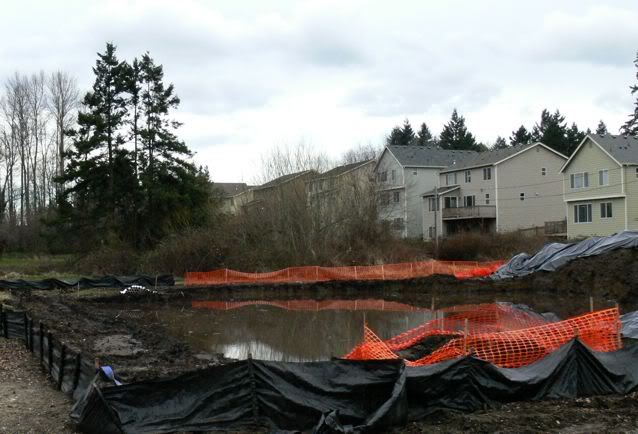
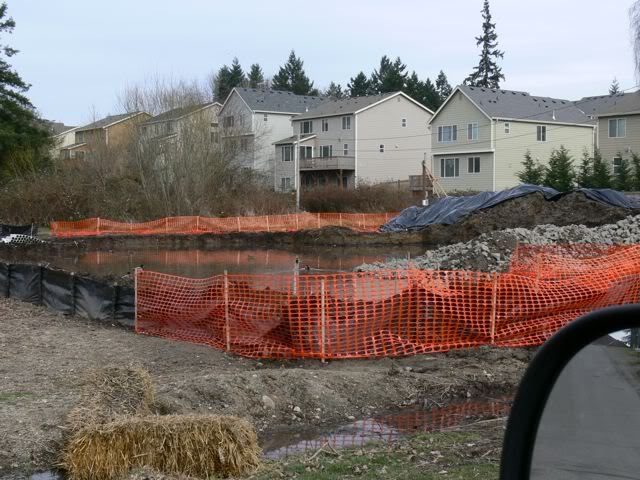
The excavation site across the street from the blueberry farm continues to fill with groundwater. It appears that the water table must be just a few inches below the level of the soil. (I think the pond shwon below is approximately two feet deep.)


I have to admit, I don’t really understand the motivation. If you have a 3.5 acre piece of property in an urban area, with willow trees, ponds, creeks, and acres of naturally watered blueberries….why would you want to give that up to put in one more home lot. A building lot in Renton is worth maybe $150,000, and there are potentially tens of thousands of them. The 3.5 acre U-Pick Blueberry farm, with it’s charming farm house, beautiful grounds, and loyal customer base is probably worth closer to a million dollars, and is entirely unique. (In order to build the new house, the property will have to be subdivided and a long private road will have to be built to reach the only dry upland section suitable for building.)
While I do not share the property owner’s enthusiasm for replacing a blueberry farm with one new home lot, I actually voted against this rezone because we do not have a good understanding of the underlying wetland. We had been told that the new R4 zoning will allow the blueberry farm wetlands to be protected, but I have several reasons to be concerned this may not happen. For instance, the property across the street from the blueberry farm is being legally excavated, and it is filling with ground water faster than it can be pumped out…leaving many wondering exactly when the wetland protections apply. And there appears to be risk of differing opinions as to whether a centuries-old peat bog qualifies for a wetland where it is not actually under water. City staff believe it is a wetland, but they are not legally qualified to make the determination…so we may have skirmishes over this issue in the future.
We also received a petition tonight, signed by 75 residents, asking us to get a wetland delineation before taking any action. I gave this weight in my decision.
In addition, the Washington Department of Fish and Wildlife wrote to council a few days ago, asking us not to rezone the property without a wetland delineation. Our city attorney says we don’t have to follow their suggestion, but I have seen this department demand attention elsewhere, such as when they added extensive fish mitigation to the billion dollar I-405 expansion project. And even if we can bully our way past Washington Fish and Wildlife, I don’t understand why we would burn bridges with this important department in an unpopular effort to turn a blueberry farm into a house, when we will need State Fish and Wildlife support for projects like our lake boardwalk trail in front of Boeing (the Sam Chastain Trail), toxic cleanup efforts at a polluted lakefront site, the rebuilding of Coulon park boardwalks and boat ramps, and on-going dredging of the Cedar River.
Finally, even with the R4 zoning, I am not sure if the required wetland buffers will even let one additional house be built. So if the property is sold, and the new buyer expects to subdivide, they could be very disappointed; they would likely be asking the question…why would council rezone property for four units to the acre if it won’t support anymore homes. A wetland delineation, prior to the rezone, would have eliminated this uncertainty.
We simply should have obtained more information on the wetland before proceeding.
Even though I voted against the rezone, it still passed. Not the first time (and probably not the last time) that I vote in the council minority. I hope the city is successful in providing good stewardship of the wetlands, and if possible, the blueberries.
The owner of the Kennydale Blueberry farm has applied for a rezone from RC to medium density R8, to allow additional homes to be built on the 3.5 acre site.
Council is considering allowing the property to instead be zoned to low density R4, which would allow one or two new homes, and would require that a biologist survey the wetland and put it into a protected status at the time of development.

Many members of the public have expressed concern that waiting to survey the wetland until the development may be too late; they have specifically pointed to the site shown below, which is directly across the street from the blueberry farm. Some have speculated that the wetland peat bog may extend from the blueberry farm right under 20th street, to this site. ( I snapped the picture below last weekend)


While R4 would require wetland protection, we’ve been told that RC zoning would not require wetland protection, and that dog kennel runs or horse paddocks could be built on the low lying areas.
Personally, I would like to see the 2.25 acre damp area remain a blueberry farm, regardless of whether an additional home is built on the uplands. We have many homes in Renton Highlands, but only one U-Pick Blueberry farm.

I love the simile Jerry Large uses in this column …”is the world driving itself while we pretend to steer, like kids in a carnival ride?”
Classic!
____________________________________________________________
Monday, February 19, 2007
Feeling powerless? You aren’t
By Jerry Large, Seattle Times staff columnist
A person could be forgiven for thinking life around here has gotten out of hand.
Neighborhoods change overnight, and big civic issues seem beyond the touch of average people. Big decisions about the viaduct, the Sonics, Iraq and development happen on a level most folks can’t reach. The paper seems full of anti-civics lessons.
Is the world driving itself while we pretend to steer, like kids on a carnival ride?
READ MORE »
I’ve recently been asked about Washington’s open public meetings act, and how it affects email. I have attached a great article about it from Washington’s Municipal Research Center.
Even though council email is a recognized public record, an exchange of emails from a majority of council members can actually constitute an illegal non-public meeting. It’s not wrong to send an email to all council members….but it is wrong for a majority of council members to respond back using their reply-to-all function. Furthering this risk, emails can also get appended and forwarded, from one council member to another, which can inadvertantly create a “meeting” via an email daisy chain.
I’m solidly within the spirit and letter of the law with this blog, as long as I don’t have a majority of council members replying to my articles. I like this blog format because it keeps my thoughts and discussion out there for all the public to see, without citizens having to trek down to city hall to read email. But, as I promised at the start of the year, the email I do recieve is available for everyone to see.
___________________________________________________
Here is the article:
Municipal Research & Services Center
Ramsey Ramerman, Attorney
Foster Pepper, PLLC
Communicating with today’s technology is faster and easier than ever. But this ease poses new pitfalls for officials subject to the Open Public Meetings Act, 42.30 RCW (“OPMA” or the “Act”). Unless proper safeguards are in place, the careless use of emails, instant message, chat rooms, electronic bulletin boards and other electronic communications can lead to the unintended and unknowing violation of the OPMA. Accordingly, public entities subject to the Act should have rules and procedures in place to ensure that unintended violations do not occur.
The OPMA requires that all “meetings” of a “governing body” be open to the public unless expressly exempt. RCW 42.30.030. Most multimember bodies of public agencies will be subject to the statute. RCW 42.30.020(1)(b). A meeting occurs when a majority of the government body meets to take “action.” RCW 42.30.020(4). The term “action” is expansive and includes not only the transaction of official business, but also simple discussion about official business, and the taking of testimony about official business. Accordingly, the OPMA will usually apply when a majority of any board, commission or council gathers for any official purpose.
Under the plain language of the statute, as well as opinions from the Supreme Court, the Act does not apply if less than a majority meet.1 The Attorney General and Supreme Court have also recognized that the Act does not apply, even when a majority gather, if no “official business” — business that could come before the governing body for a vote2 — is conducted.3 But the Act is not limited to in-person gatherings — a conference call could also amount to a meeting.4
Conceptually, emails land in a gray area. Like letters, emails create their own record that is subject to disclosure under the Public Records Act, so they will already be exposed by the sunshine laws. For example, the Virginia Supreme Court held that an email exchange is like an exchange of letters, already subject to public disclosure, but not amounting to a “meeting.” 5 Unlike letters, however, the exchange of emails can be nearly instantaneous, allowing for a practically real-time exchange. For other forms of communication, like chat rooms and instant message, the exchange is instantaneous, and no “record” is necessarily kept.
The Council needs to recieve details on the Sonics Arena proposal as soon as possible. Several of us on council have expressed our support of having the Sonics in town, but we are getting nervous about not getting formal information from the Mayor’s office, and not having a chance to discuss the options. When we ask questions, we get fierce lobbying instead, which is not what we need to develop a winning package. Meanwhile, today’s Times makes it sound as if Renton is being eyed for more than one-hundred million dollars, when council has in fact not approved any expenditures for this project. While we have a great site, and a beautiful proximity to new shops, restaurants, and parking at the Landing, and a council willing to work with the Sonics, we only have 58,000 residents….one-hundred million dollars is a lot of money for 58,000 people!
I would like to see the council get involved in the problem solving for this project, so that we can examine every possible way to make this successful. Pushing us out of the decision-making is not going to work.
__________________________________________________________________________________________
Here is an email I recieved from my colleague Denis Law on this topic on Friday.
Dear Colleagues,
I want to share some of my observations regarding the meeting the mayor convened
this morning regarding the Sonics. Please call me if you wish to discuss this so
that we don’t violate the Open Public Meetings Act. My intention is to just
inform you of what seems to be taking place from my point of view.
Those invited this morning were primarily business owners who would have a
predictable opinion on the value of having the Sonics locate in Renton. We did
have representation from the Kennydale Neighborhood Assoc., North Renton and
Highlands. There was no well-planned presentation and most of the the time was
devoted to asking the opinion of those in attendance as to whether or not there
is community benefit to have the Sonics in our community. The majority reaction
could have been predicted without attending the meeting.
What I see that is wrong with our process is that we’re asking local restaurant
owners or the chamber if there is a benefit of having the Sonics in our
community. Duh………………… of course there is benefit. What is
concerning to me is to have a restaurant owner call me after the meeting and
relay that he was asked by a member of the mayor’s staff what he thought about
the Sonics announcement. He replied that he thought it was great, and was then
urged to share his thoughts with the council since there are council members
clearly concerned about the Sonics coming to Renton.
I have heard some very legitimate questions raised by council members but have
not heard one word that we should not work with the Sonics to make this happen
if possible. Why would the administration spread the rumor that the council is
against the Sonics, or to try and influence community leaders to pick a side?
Our role is to understand what it will cost Renton residents in real dollars,
impacts and long-term debt to build a stadium in our community. We need to
determine if we can truly mitigate the impacts to neighboring communities and
also generate enough revenues to support the cost of city services needed to
support this facility while also repaying the bonded indebtedenss that we may
decide to incurr.
I have stated in emails to Jay and to Toni that I feel strongly that the council
needs to have the opportunity to weigh all of the information in order to make a
decision that is in the best interest of our citizens. I want to reiterate my
opinion that we should not spend any money on studies or consultants until the
council has had the opportunity to understand what will be expected of us, in
terms of financial support, and the proposed use of the facility in order to ask
questions regarding mitigating impacts to our neighborhoods. It’s my
understanding that Alex’s staff is prepared to move forward with hiring a
consultant without council approval or input.
It’s my opinion that the city council needs to be the driver of how we solicit
public input, time-frames and other aspects of this process. Right now, it
appears to me that we’re merely an inconvenient nuisance that needs to be dealt
with at some point in this process.
It’s my sincere hope that the city council will be the driver to all processes
involving the potential stadium being located in our community.
Thanks for listening!
Denis
—
Denis Law, Publisher
The Business Report
Renton Magazine
15 S. Grady Way, Suite 514
Renton, WA 98055
Time for another Blueberry Bog Blog 🙂

We had a lengthy and interesting discussion at Monday night’s council meeting concerning the Kennydale Blueberry Farm rezone. The owner of the decades-old 3.5 acre farm is ready for retirement, and desires to rezone the property to an R4 or R8 (four to eight units per acre), from its current RC (resource conservation). She also says that the Blueberry plants are dying as a result of the dramatic development all around her farm, and the de-watering of the farm’s natural basin thanks to the city’s new storm-water drainage system.
The city staff, the Planning Commission, and the council’s Planning and Development subcommittee have all recommended R4 zoning for the property, which allows up to four homes per acre on the dry, buildable portion of the property (estimated to be 1.25 acres). Much of the past citizen testimony, however, has been in favor of keeping the zoning at RC, which would not allow subdivision but would allow the existing home, one accessory home, and (as we learned on Monday) several other rural type uses including professional dog kennels, professional stables, and other rural businesses.
But it turns out that the RC zoning would not ever require that the owner delineate the most delicate feature of the property, the peat bog (fen) fed by underground springs, which appears to be thousands of years old and forms the headwaters for Kennydale Creek. In a worst case type scenario, it sounds like RC zoning would allow for a future owner to bulldoze the blueberry plants, and put kennel runs on this peat bog if they were so inclined.
R4 zoning would require wetland delineation, but not until the property owner applied for subdivision. At that time, the wetland peat bog (estimated at 2.25 acres) would be delineated and documented by biologists in a wetland report, marked as a nature zone, and protected against building or any active uses. The remaining dry upland property would accommodate one to three new homes, in addition to the existing home.
Several citizens expressed concern that if the wetland delineation is not done before rezoning, then the character of the property may be altered before the biologists have a chance to survey the wetland. So the council asked the Mayor and the administration to contact the property owners, and see if the city could obtain permission to perform the wetland delineation now, in order to know specifically what the impact of the rezone will be. The report could then be provided to the property owner, and she in turn could share it with potential buyers, to eliminate all unknowns about the wetland when the property changes hands. In addition, council asked the administration to explore whether the owner would be interested in selling the wetland section back to the city, to protect it in perpetuity. ( This is a very common action along creeks and other bodies of water.)
The council has agreed to take up this issue again at Committee of the Whole, in two weeks.
Jesse Tanner’s Memorial Service
Cathy, Andy and I attended Jesse Tanner’s memorial service today. The service was held in our church, St Mathews Lutheran, not far from our home. Kirby Unti (our loving, popular pastor who reminds us of Garrison Keillor) performed the service; he was assisted by two of Jesse’s grandchildren, our City Executive Jay Covington, and Renton’s Events Coordinator Sonya Maylander (who sang a beautiful solo -“How Great though Art”). The speakers all did a wonderful job of describing Jesse’s life, and sharing many memories. I was laughing and crying during the service, as I so often do when Kirby performs a celebration of someone’s life.
After the service, Cathy and I joined the police-escorted procession to Greenwood Cemetary, for the graveside memorial. There, in a light rain, Jesse was given a 21 gun salute by the Veterans of Foreign wars, as well as a flag ceremony by the police honor guard. Kirby also lead a prayer service.
Lastly, we attended a reception in the Spirit of Washington Pavillion Events center downtown, the building Jesse and I and others had worked so hard to save and remodel. The sunny, bright setting, with its 1930’s era bow-truss wooden ceilings and warm interior was a beautiful venue for Jesse’s reception. There was again lots of story sharing and celebrating of Jesse’s life. Along with Jess’s wonderful family and many friends, and many diginitaries from the city, I had a chance to see others I have not seen in a while. My old friend and campaign manger Dan Lynch, who also managed Jesse Tanner’s successful Mayoral election campaign, sat with us during the service. (Dan is actively raising his young family in Woodinville now, so we do not see him enough) Bob Edwards, my first council office partner, and current Seattle Port Commisioner sat with Cathy and I, and swapped home-schooling stories. We also enjoyed visiting with former mayor Don Custer, a funny charming man who sold us our duplex in Renton highlands. And Rob McKenna, State Attorney General, came down from Olympia to attend the service. And so many other friends…just too many to mention.
Janice Tanner was so kind and so brave, and my heart breaks for her–she loves her husband so much. Jesse’s grandson Brandon, who brought us all to tears during the service, was also fun to visit with….Jesse was so proud of Brandon when he ran with the Olympic torch some years ago, and Brandon had been one of Katie’s swim teachers.
We also met Jesse daughter Linda, a Texas resident who has become a successful author and sold a script to hollywood in a million dollar deal. Even though she and I had never met, she knew me by reputation, telling me how much I had meant to her dad. ( My eyes are tearing up as I write this).
Jess Tanner meant a lot to me and this city. I will miss him very much. He’s probably working on some economic expansion plan in Heaven right now, making it a better place for when we all see him again.
Thanks for all the memories Jesse…we love you.
Here is another summary of the Jet Center issue from my brilliant and hard-working colleague Marcie Palmer. Marcie has been working to gather input from the community on this issue. She also makes the important point that at Wednesday’s Transportation meeting we figured out that the Jet Center was called the preferred alternative only by a consultant, not by the council or the RAAC. Council and staff want more data before making a decision.
This issue is not decided, and all inputs are appreciated and accepted.
_______________________________________
Click here for Marci’s email (sent in response to Mark Hancock’s note):
Hi, I’m Randy Corman. Welcome to my blog! I served on Renton City Council for 28 years, 1994-2021, with six years as Renton Council President. I’m also a mechanical engineer and manager, and worked for the Boeing Company for 33 years, from 1984- 2017. My wife and I have five kids and six grandkids, and we all live in Renton. I’ve kept this blog for 19 years, and get thousands of readers each month. Please share your feedback, ideas, and opinions in the comments.
Your comments are very appreciated and they add value to this blog. You may comment anonymously by leaving your name and email out of the comment form (there is no sign-in required). Please keep your comments civil and respectful; policy discussions are encouraged but avoid personal attacks. No threats of violence against anyone, or inciting violence in any form. No racist, sexist, or hateful comments of any kind. Be truthful. Do not make allegations of criminal, unethical, or other personal wrongdoing that you do not have proof to back up. Avoid profane, obscene, vulgar, lewd, discriminatory, or sexually-oriented language. Honest, respectful, good-faith discussion of public officials’ actions and their results are protected speech. Private persons deserve more discretion, so avoid any unfair criticism of them.
Admin login • EvoLve theme by Theme4Press • Powered by WordPress Renton Community Update
News from former Councilmember Randy Corman, your Renton City Hall insider. (All views expressed in journal entries are Randy Corman's personal views, and not the official position of the City of Renton or other city employees. Views expressed in reader comments are those of the commenter)

Recent Comments