
 Written by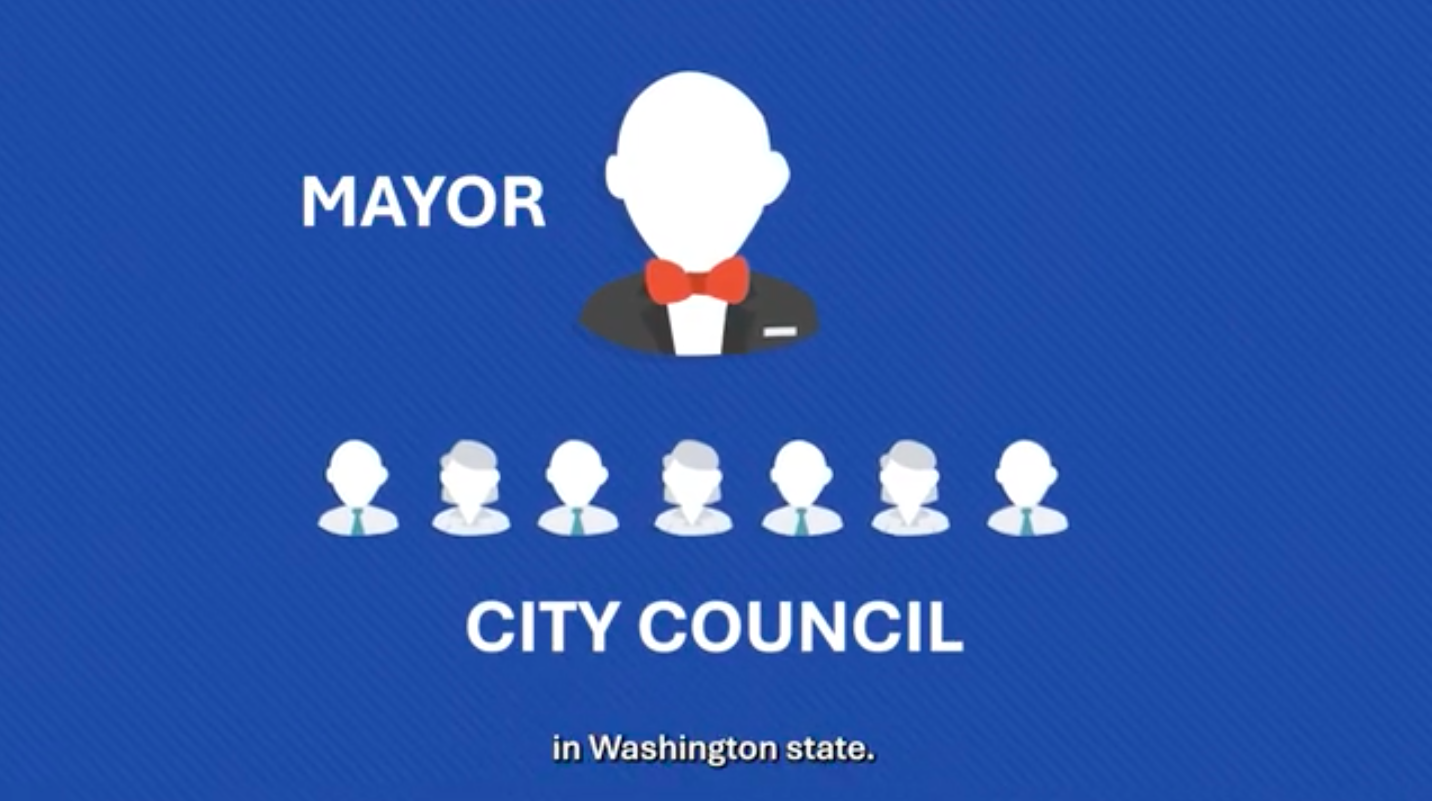
This screenshot from a Renton public information video is an incorrect representation of Council-Mayor form of government. Previous Renton Councils would not have approved a video that made them falsely appear subordinate to the Mayor.
[At last night’s Committee of the Whole meeting, Council Members were trying to learn whether a lease had been extended to a new tenant in the City-owned Piazza building, and they were not getting a straight answer. Since Renton Council is responsible for leases, this was just the latest episode of Council having relinquished control of an important responsibility. This inspired me to write this blog post.]
Revised Code of Washington 35A.11.020 gives all of the City of Renton’s power to our City Council with these words:
“The legislative body of each code city shall have all powers possible for a city or town to have under the Constitution of this state, and not specifically denied to code cities by law.”
RCW 35A.12.100 lays out the Mayor’s administrative, executive and ceremonial duties, including these words “He or she shall report to the council concerning the affairs of the city and its financial and other needs, and shall make recommendations for council consideration and action.”
But while the Council has been granted all the power by the state, you would not know it by watching a Renton Council Meeting. And you won’t learn about the Council’s authority from the new public information video that Renton created and published two weeks ago.
Our current Mayor often refers to Renton’s government as a “Strong Mayor City,” potentially implying that the Mayor has authority over the Council. But the Council actually wields the power in Renton’s “Council-Mayor” form of government. “Strong mayor” is an informal insider term used to differentiate a mayor who provides daily management of city workers (in a Council-Mayor system) from a mayor with a more ceremonial role in a “Council-Manager” system.
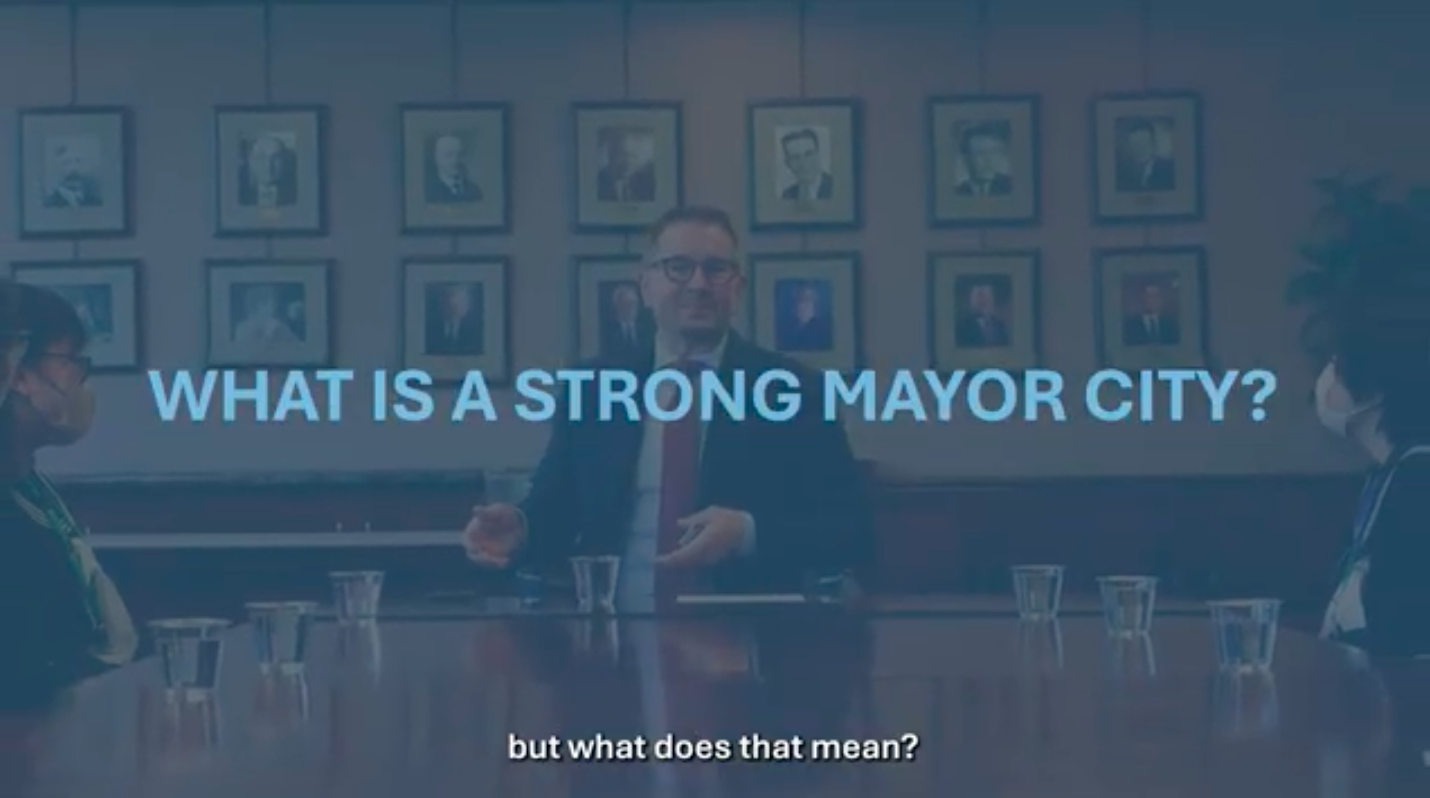
The new video about Renton Council Meetings uses the “strong mayor” language, even though it does not show up in state law. Renton’s system is legally a “Council-Mayor” system, and the Council wields the city’s ultimate power.
The Renton City Council is a legislative body, not a department of the City that the Mayor runs. And the Council should not let their role be diminished.
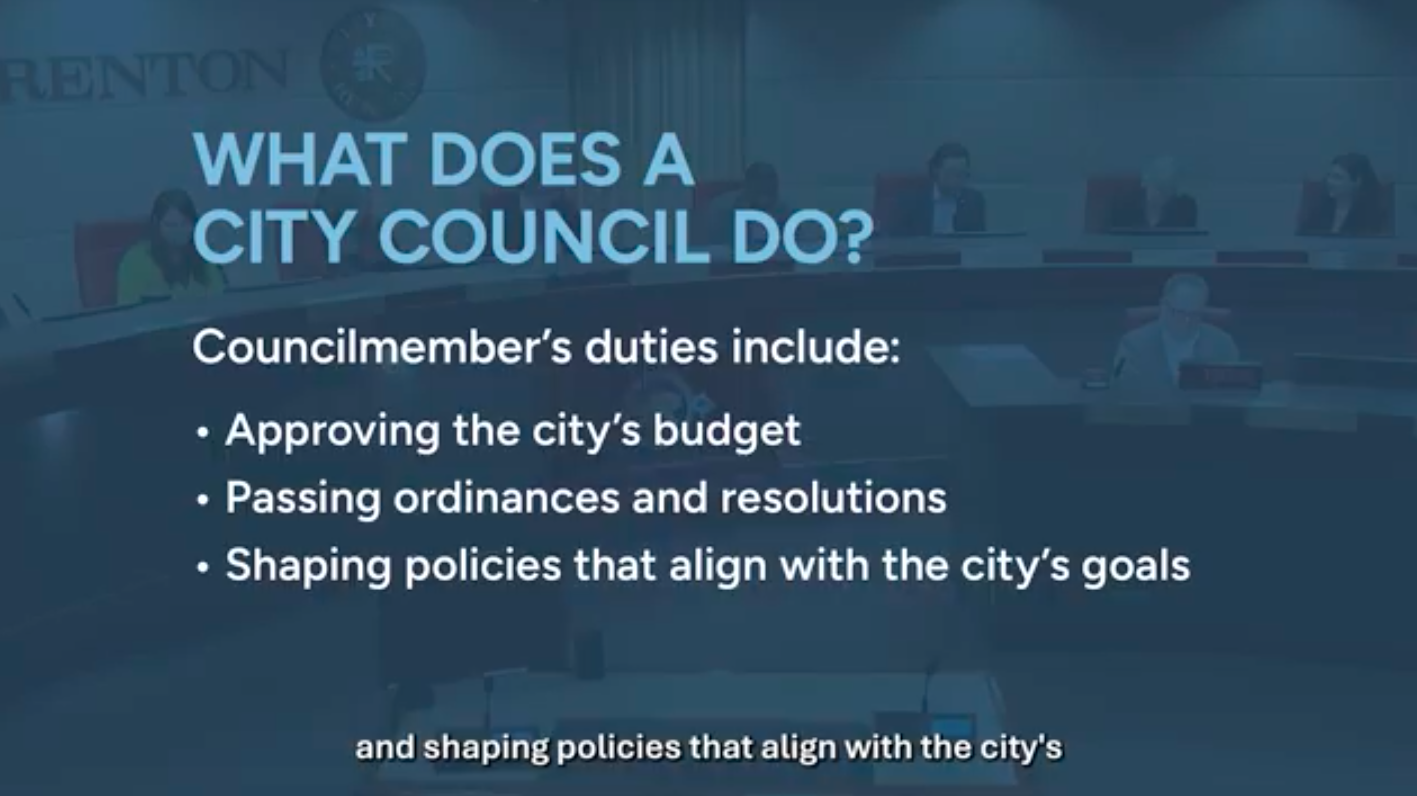
This chart from the new video greatly diminishes the power and responsibilities of the City Council.
Every bullet in the screenshot above from the new City video is misleading.
The Council doesn’t just “approve” the city’s budget; they own the budget. They set priorities for the budget, review and refine draft budget documents, set tax rates and fees, and hold the Mayor and staff accountable to staying on budget.
They don’t just “pass”ordinances; they determine the need for ordinances, define them, review and debate drafts, decide on penalties for violating them, and then vote on them.
The Council doesn’t just “shape policies that align with the city’s goals,” they define the city’s goals.
Council also has many other authorities given to them by the Revised Code of Washington covering everything from zoning to delivering municipal services. For example, just half of one sentence of the code gives Council (not the Mayor) control of “the acquisition, sale, ownership, improvement, maintenance, protection, restoration, regulation, use, leasing, disposition, vacation, abandonment or beautification of public ways, real property of all kinds, waterways, structures, or any other improvement or use of real or personal property …”
By law, Council also has authority over the agenda and execution of every Council Meetings. The Council can alter the agenda and the rules at any time with a majority vote– the Mayor does not get a say in it.
These are, after all, City Council meetings. Our Mayor has all week to perform his administrative duties and talk with his constituents. But under the open public meetings act, Council Members can only discuss issues and take action in public meetings. That is why we have scheduled Council Meetings. The Mayor presides over the meetings as one of his administrative functions, since Council members are part-time, not because he is a boss over the Council.
In fact, the Mayor typically never gets to vote on anything. About once per year or so the Mayor might get a chance to vote to break a tie, but only if the issue does not involve any spending.
In rare 4-3 split Council decisions the Mayor theoretically has a veto power. But a single Councilmember switching sides can undo the Mayor’s veto, since it only takes five council members to overrides a veto. In 28 years I might have seen maybe one veto.
When I was on Council, we knew it was our meeting. It was a time to speak to each other about topics of concern to us, and a time to interact with constituents who had not received satisfaction from city staff or the Mayor.
A year ago Renton Council threw away their ability to provide speedy low-cost appeals of hearing examiner decisions, saying they preferred these matters go straight to King County Superior Court. Past Renton Councils knew this was an option, but always chose to hold onto appeal authority, as one of the many council powers to protect. This decision by the current Council reflects a broader pattern of the Council stepping away from authorities that past Councils deliberately protected.
Renton’s Council does a disservice to its residents by giving away its power. While we still pay for eight elected officials, we only get decisions from one of them– the Mayor. A single individual, even the mayor, will be wrong some of the time.
Council Members can begin to take back their power by asking questions of the Mayor, of staff, and of each other at council meetings. They should not stop asking questions until they fully understand all the implications of any decision they are making. And they should not shy from debating these issues with their colleagues during their council meetings. If the Mayor attempts to shut down the questions or debate, Council should use a “Point of Order” under Robert’s Rules, to remind the Mayor that Council is in charge of the agenda and the meeting. Any Councilmember can move to suspend the rules to give extra time or seek more data on an important issue, and if four other council members agree, the agenda will change. Past Council Members have been known to instruct the Mayor “go get us the data…. we’ll wait for it.”
Councilmembers should also study 35A.11.020 to remind themselves of the power they wield. Then they should publicly engage their council colleagues to use this power wisely and effectively to improve the quality of life for residents and businesses in Renton.






Recent Comments