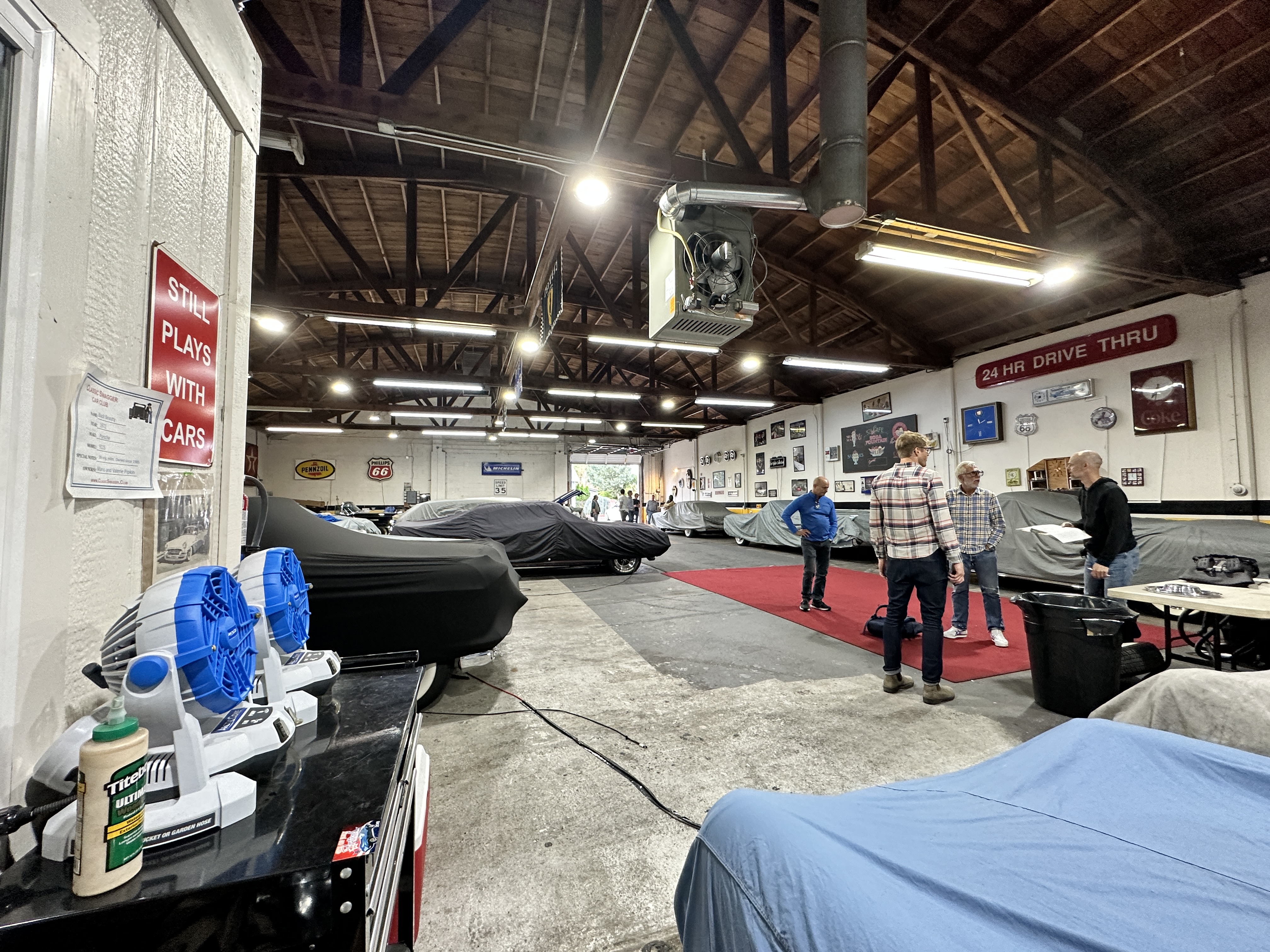
Billy O’Neill, “Dale Chihuly’s right hand man,” (in white sneakers) selecting the large facility on Airport Way for his decorative glass making studio. The venue was going to teach youth and adults the art of Chihuly style glass making. The large open-bay building features the same old-growth historic bowstring-trusses that caused our city council to save the Pavilion building in the 1990s.
It was a dream come true for Renton’s Arts Community, our youth, and our Economic Development department. A world-class glass studio was relocating to Renton, headed up by the vice-president and operations manager of Chihuly’s workshop in Seattle. Billy O’Neill, who Seattle Times calls Dale Chihuly’s right hand man, was working on a gift for Renton that would have taught new generations of Rentonites how to create beautiful glass sculptures and containers. Mr. O’Neill has served on the Seattle Arts Commission, as secretary on the Executive Board of Directors of the Seattle International Film Festival (SIFF) and on advisory boards for the Seattle Sounders and other non-profits– a perfect fit in Renton. He was instrumental in creating Chihuly’s Garden of Glass at Seattle Center.
But the exciting glass art studio fell victim to a School District Eminent Domain taking, along with numerous other businesses and homes, with no acknowledgment by the School Board of the glass studio’s extraordinary significance.
The business, called “Glass Eye” already has a permanent sales location at Pike Place Market, which would have soon been selling the Made in Renton glassworks. We would have a new Made-in-Renton products we could share with visitors and far-away family, to replace our much-missed Uptown Glassworks.
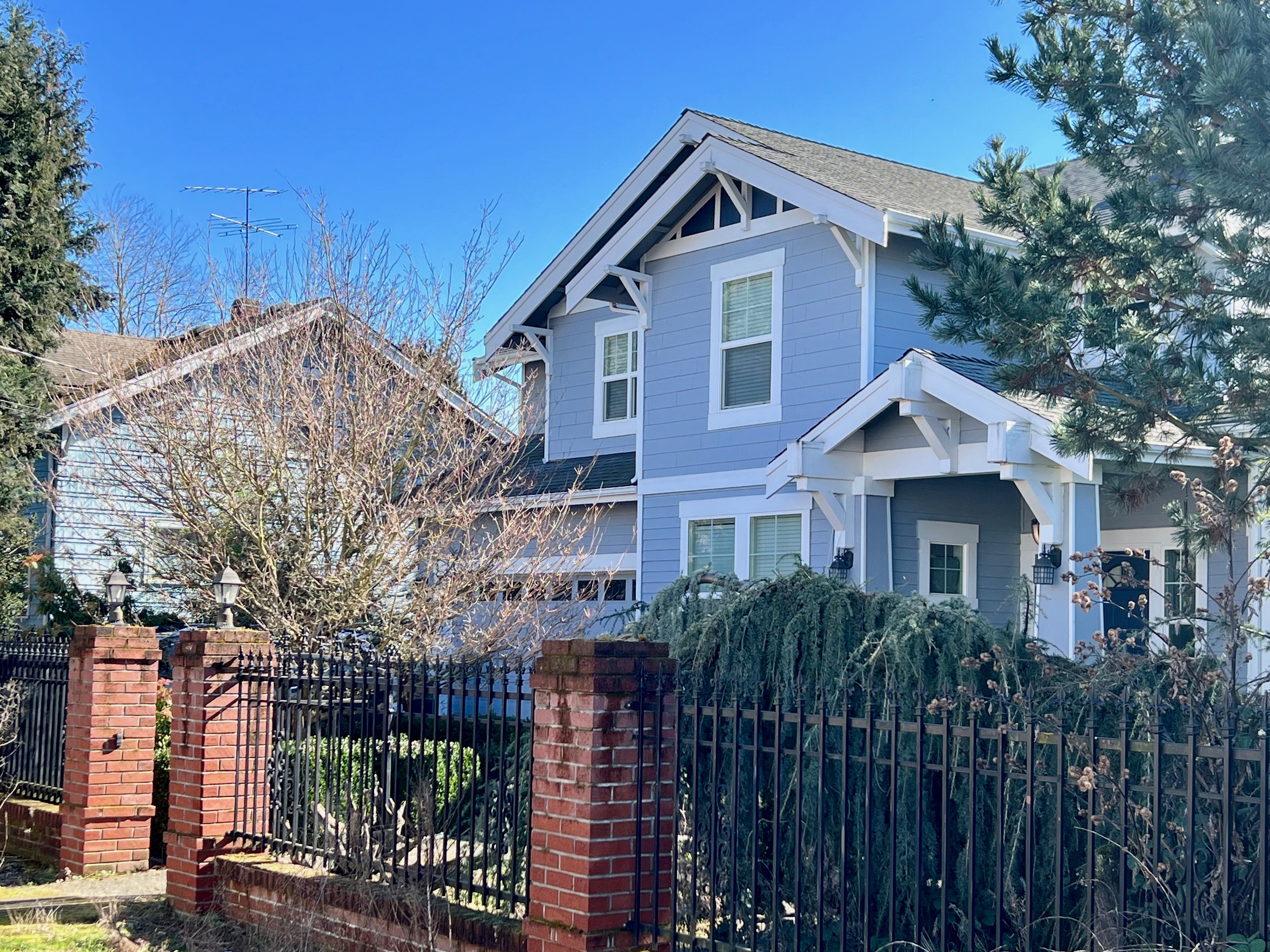
A home on Tillucum Street in Renton; one of many that the School District is attempting to purchase to build a new softball field
As I’ve discussed previously in this article concerning Renton Airport, the Renton School District has been buying up properties north and east of Renton High School to expand the school’s site.
Some owners of homes and business owners have reached an agreement with the district– reluctantly in some cases. The map below shows the status of the purchases to date. Some of the early agreements were commercial or rental properties, which are somewhat easier to price.
But there are many homeowners shocked and saddened that the district is pressing them to turn over their homes. Some of them have preserved the property in their families for many years, and some are families who financially stretched to buy a home of their own. This neighborhood’s residents have have been part of the fabric of our downtown for decades, and many are deeply rooted in our schools, clubs and other organizations. For most, their homes are not just a roof and four walls on a lot– they are their histories, futures, hopes, dreams, and connections.
Important! The two-day Council offsite Feb 27-28 is at Maplewood Golf Course, Magnolia room, not at Renton City Hall. The public is welcome to attend, and there should be comfortable seating. However the public will typically not be allowed to comment at the meeting.
The City has reworked their website, and the new version currently is missing an enormous amount of important information.
For instance, Public Meetings are not properly identified on the new Council Calendar. There is a two-day council off-site that is occurring tomorrow and Friday but not found on the calendar. I’ve attached the agenda below.
At Monday’s council meeting, a Council member essentially characterized this data as misinformation, and said that an Administrative press release would be issued by the Mayor’s office with more details about why this scientific data was misinformation.
I’m looking forward to critiquing this issue paper, if it ever comes out. I have doubts about whether it will, because I don’t believe the City of Renton will be able to find an engineer who values their reputation and license and is willing to guarantee that Renton’s water will never incur pollution threats from the asphalt plant. The city may be able to find “story tellers,” willing to say the plant is going to always be safe, but the scientific reports will prevent conscientious engineers from doing it. Partially treated runoff being injected into our aquifer recharge zone is bad enough. But add in the additional risks, from landslide,fire, floods, earthquakes, and coal mining sinkholes, all familiar events in this area, and the asphalt plant is an obvious poor engineering fit on this aquifer recharge zone.
RCW 8.12.030. Every city and town …within the state of Washington, is hereby authorized … to condemn land or property… either within or without the limits of such city …for the purpose of protecting such supply of fresh water from pollution.
But on the other hand, I strongly recommend the City reconsider issuing such a press release. At the end of the day, residents need their Council to step up and purchase this site to protect our water supply. Every day the Mayor’s communication specialists spend writing a fictional story about why the plant is not a bad thing, it costs the city more money that could be spent on purchasing the site. Furthermore, by creating such a document, it will become a lobbying tool for the applicants of the asphalt plant, regardless of how much of a scientific farce it is.
Citizens to Save the Cedar River, an organization that has spent $300,000 opposing this plant, report that the plant would have already been stopped if Renton had provided an amicus brief (a friend-of-the court statement) opposing the plant. They say Renton would not do it, and I don’t know if this was the decision of the Mayor, or someone whispering into his ear. If the Administration now issues a press release which pretends their hands are tied, I hope this press release includes an explanation of why they passed on this very clear opportunity to protect our aquifer for future generations. Such an explanation will take a while as it requires some very creative storytelling.
And this time, please include the author of the press release. Residents and our City Council deserve to know specifically who is misleading them.
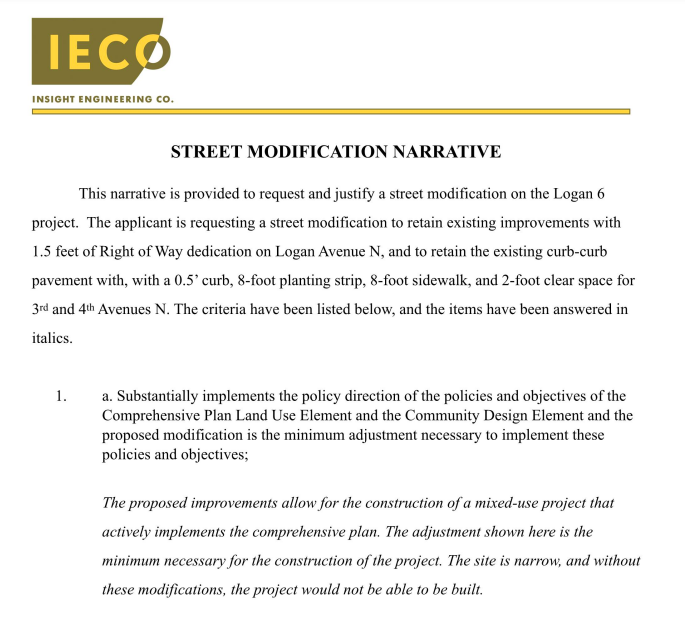
The initial submittal for Logan Six in 2022 included a street modification request. Final line of item 1: “The site is narrow, and without these modifications, the project would not be able to be built.” Council could have questioned the scale of the project on the record.
At last night’s council meeting, a Council Member told the audience that the State of Washington forced Renton to approve the Logan Six development with only one parking spot per unit.
While the State of Washington did implement parking regulations in 2020 that could potentially supersede a city’s parking regulations, the state standards specify a minimum standard of one spot per BEDROOM, as opposed to the lesser standard of one spot per unit that Renton has imposed on Logan Six. Here’s the State law on this topic. (Presumably the 0.75 spots per unit applies to studio “no-bedroom” units)
Cities planning under RCW 36.70A.040—Minimum residential parking requirements.
In counties and cities planning under RCW 36.70A.040, minimum residential parking requirements mandated by municipal zoning ordinances for housing units constructed after July 1, 2019, are subject to the following requirements:
….
(3) For market rate multifamily housing units that are located within one-quarter mile of a transit stop that receives transit service from at least one route that provides service at least four times per hour for twelve or more hours per day, minimum residential parking requirements may be no greater than one parking space per bedroom or .75 space per unit. A city or county may establish a requirement for the provision of more than one parking space per bedroom or .75 space per unit if the jurisdiction has determined a particular housing unit to be in an area with a lack of access to street parking capacity, physical space impediments, or other reasons supported by evidence that would make on-street parking infeasible for the unit.
Reason 2: the Council probably had an easy opportunity to stop this project after the first submittal in 2022 if they had wanted to. In the initial submittal for the project, the applicants provided a letter making it absolutely clear that they were concerned the site might be too small for the project.
In the relatively brief two page letter, the applicant says they need a Street Modification because of their overly narrow site. Then they say three times that without this modification, they could not build the project. Here are some excerpts:
“STREET MODIFICATION NARRATIVE
This narrative is provided to request and justify a street modification on the Logan 6 project. The applicant is requesting a street modification to retain existing improvements with. 1.5 feet of Right of Way dedication on Logan Avenue N, and to retain the existing curb-curb. pavement with, with a 0.5’ curb, 8-foot planting strip, 8-foot sidewalk, and 2-foot clear space for. 3rd and 4th Avenues N…..
The site is narrow, and without. these modifications, the project would not be able to be built….
The modification also allows for the project to be built at all, given the narrowness of the site….
The shown modification is required for the building to be done without incurring additional. costs. The site is narrow and if much more were given, the project would likely not pencil….”
Any of Renton’s eight elected officials could have questioned the requested modification, on the record, and consequently questioned whether the project may be too large and dense for the site. Even the rules governing quasi-judicial hearings do not bar Council members from asking questions about a project, on the record. Since the developer said three times they were concerned the project would not fit on the site, this would have been an opportune time to scale it to a better size.
Instead, Council did not ask any questions and City Staff appear to have approved the modification request, enabling the project to go forward.
So no, the State did not require this project to take its present form, pushing the street boundaries set for the zone with consequent minimal parking. That appears to be just a story.
As several controversial projects and long-festering problems reached a boiling point in last night’s Council Meeting, residents urgently requested more detailed and specific information, and intervention from their elected officials. But at the meeting and its aftermath, it’s clear that most residents felt they were just getting a story from the council, not the facts.
This appears to have been by design by the City, and it failed pretty spectacularly last night.
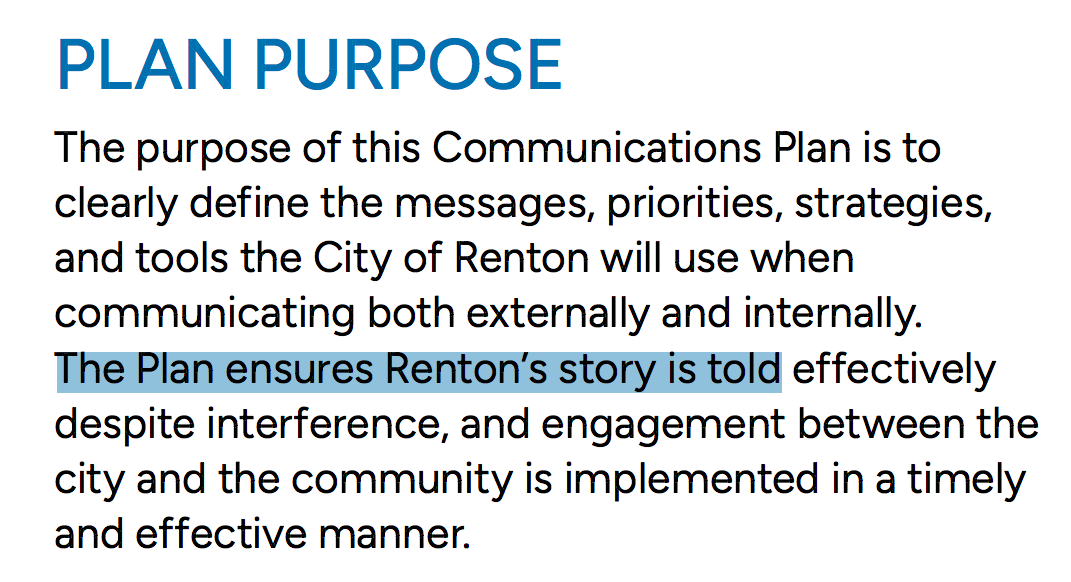
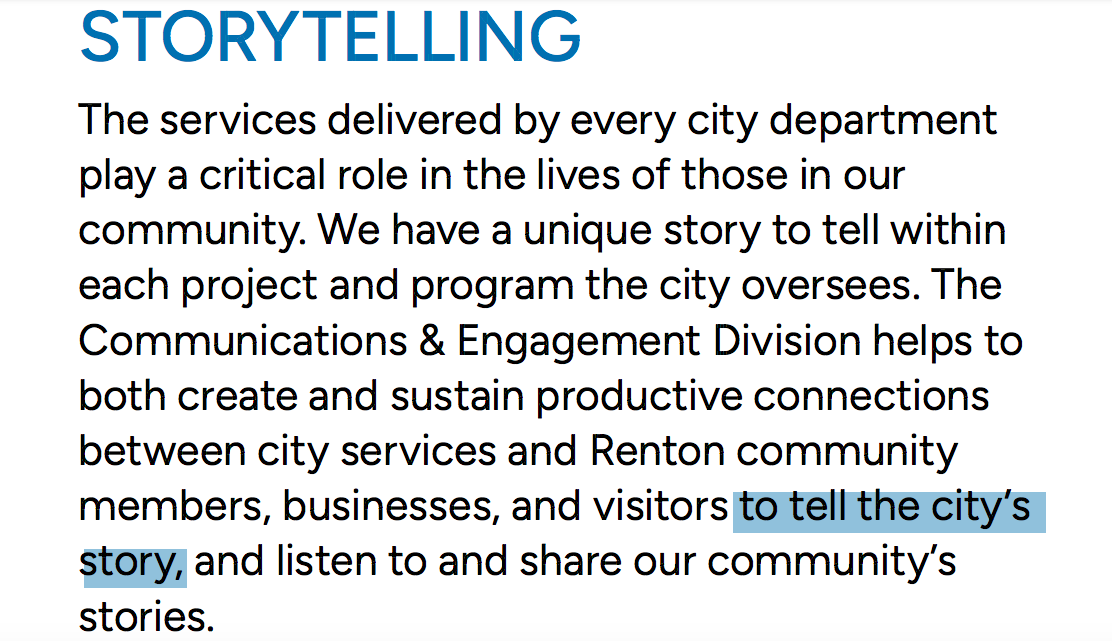
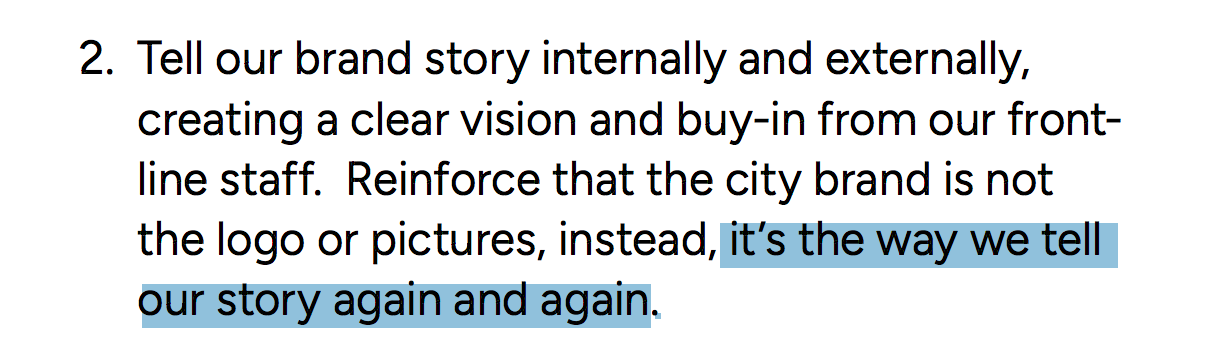
The Council has recently adopted a new communication plan and funded two additional new communication positions in the Mayor’s office (adding to several already there). The plan literally focuses on “storytelling”, and very little on providing comprehensive information and easy-to-find public records.
Perhaps “Storytelling” has a place in a marketing campaign, but this Communication and Engagement plan provides the structure for government officials and city employees to communicate with their constituents. We’re looking for data and assistance, not a story. Large companies get in trouble when they tell stories to their regulators.
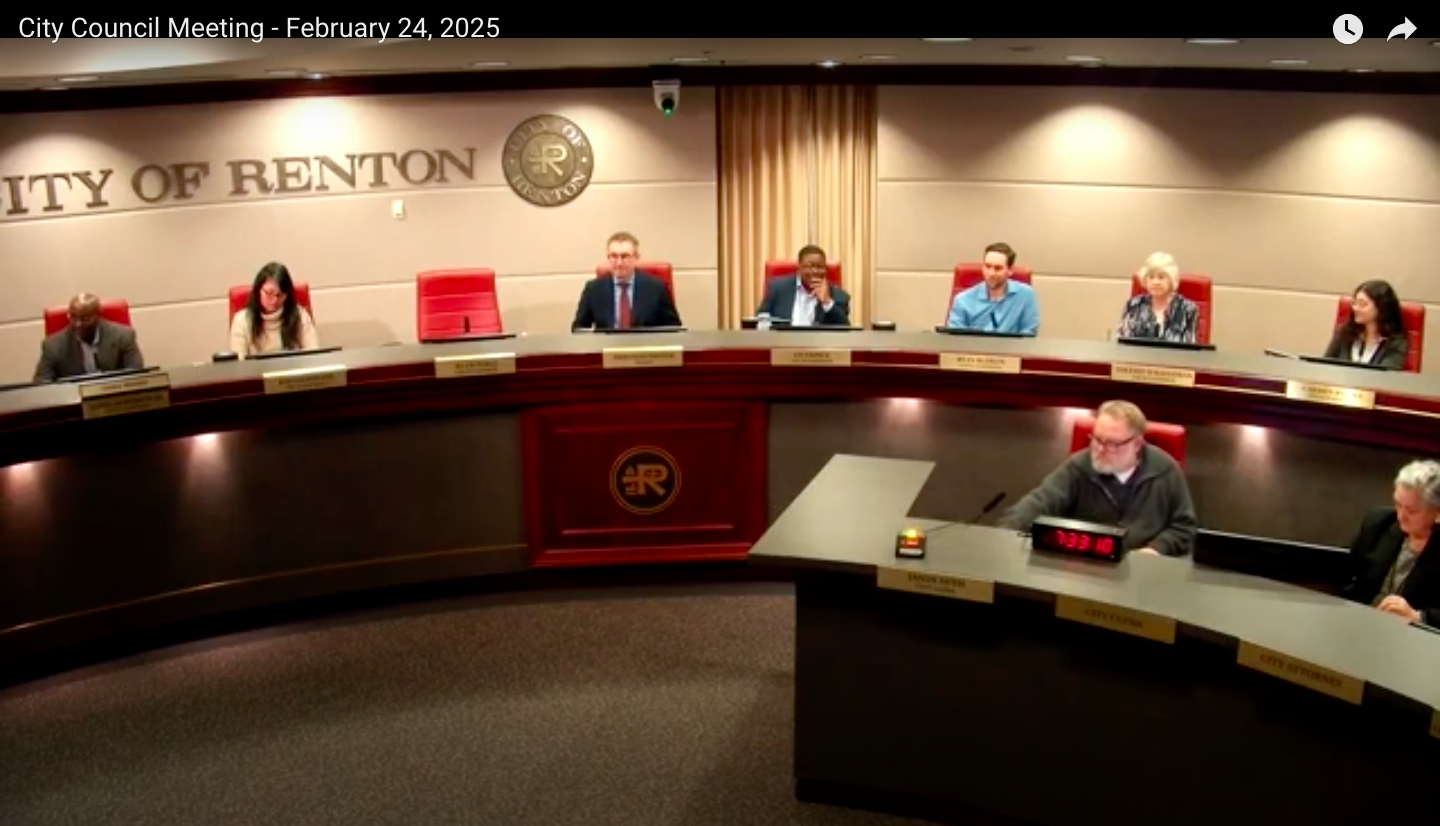
Last night’s Council Meeting featured a large number of residents speaking out on a broad selection of topics. They shared the concerns about the controversial Logan Six project, the taking of homes for Renton High, the derelict Sixth and Park buildings, the Asphalt Plant, open drug use near Sartori Elementary school, the general condition of downtown, and other issues.
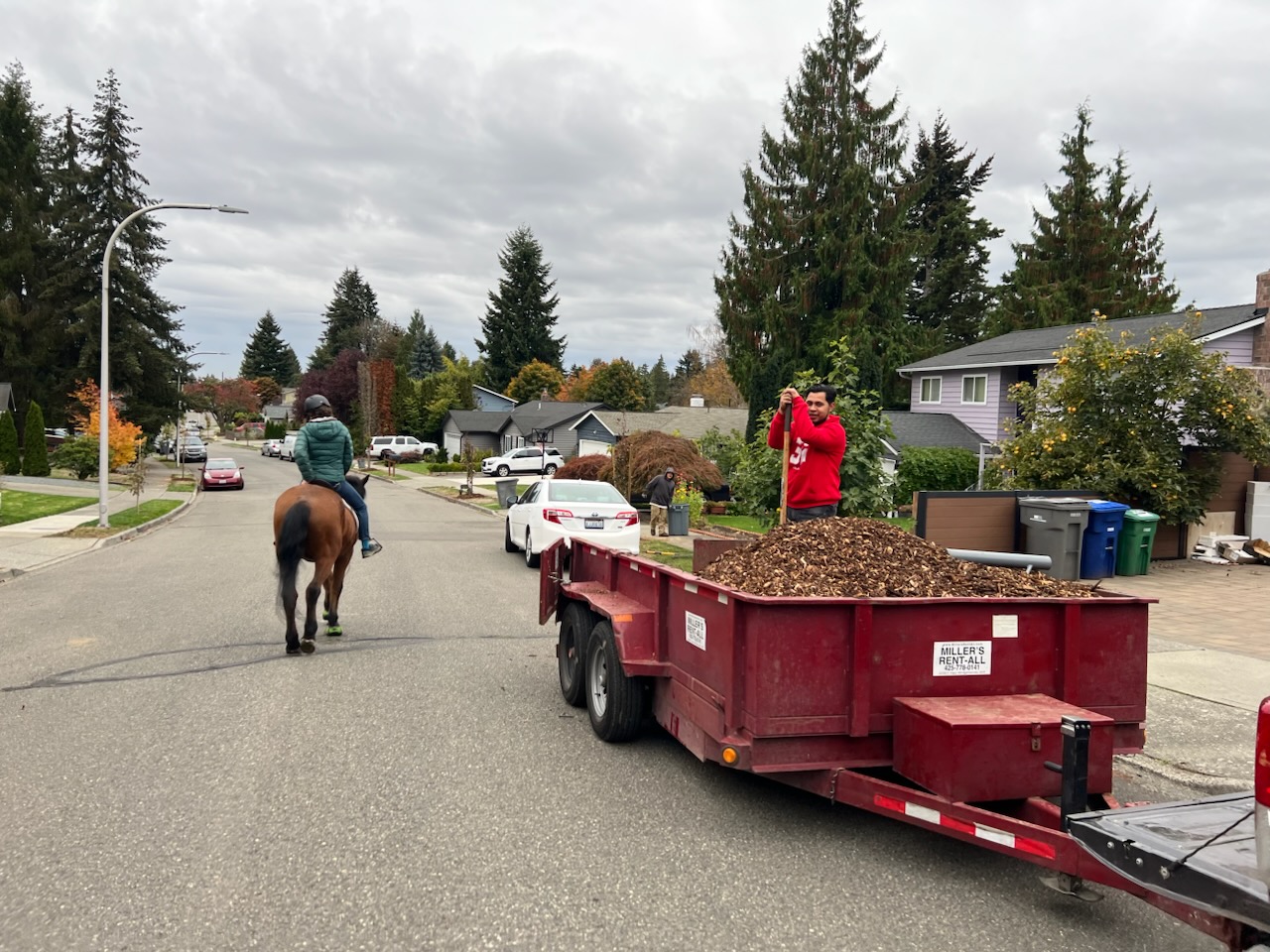
A landscape contractor working for Renton takes a break from mulching around his newly planted street trees to greet us and our horse Zeus, last October 17.
I’m way overdue to share a purely positive story on this blog, and there is no shortage of such stories to tell. Our City and our region are teeming with caring, beauty, hard work, and achievement.
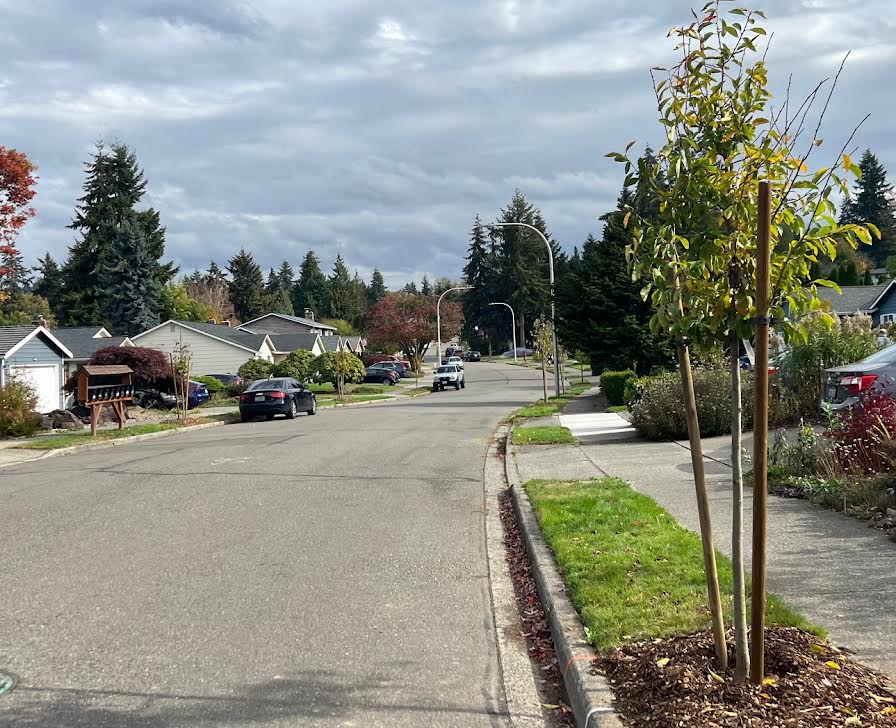
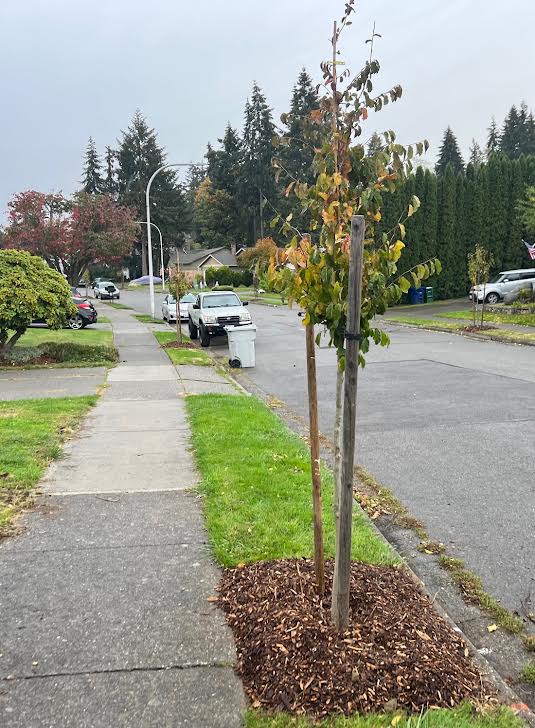
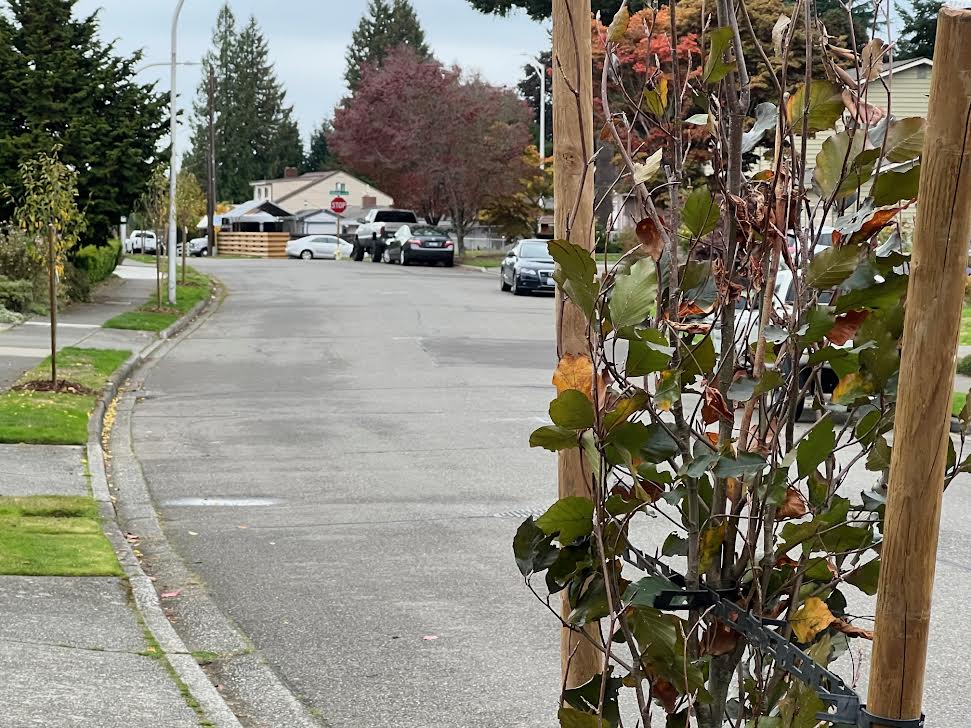
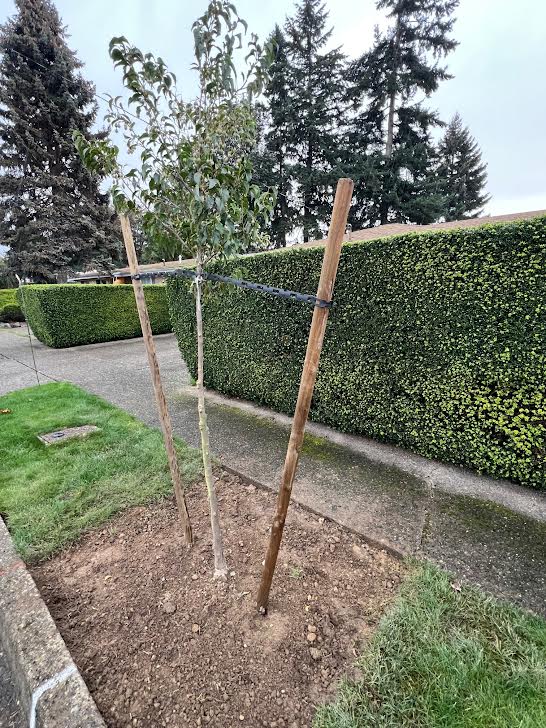
Last October our City’s arborist and street department planted some lovely new street trees along NE 23rd Place and NE 24th Street, not far from my home, in the North Renton Highlands. This was just one of their ongoing planting projects. I caught the work in progress when I was out on a walk.
The trees consisted of Japanese Snowbell and Persian Parrotia, and they will noticeably add to the street canopy as they mature. Most of the neighbors were excited to see the trees, although there were a couple concerns from residents who had landscaped the planting strip just the way they liked it. Hopefully when the trees bloom this spring everyone will be as pleased as I was to see them.
These trees were planted as part of Renton’s Urban Forestry program, overseen by Urban Forester Ian Gray and Inspecting Arborist Gabriella Golzarian. This neighborhood was a good candidate for the new street trees, as it had city-owned planting strips on both sides of the street, and didn’t already have trees in these strips.
This spring they are planning to plant some trees near Redmond Avenue Northeast and Shelton Avenue Northeast between Northeast 10th Street and Northeast 12th Street on the Renton Highlands.
Renton’s Urban Forestry website reminds us that there are many advantages to maintaining a healthy tree canopy:
Improves air quality by filtering pollutants and producing oxygen
Helps fight climate change
Helps control flooding and soil erosion
Provides and improves wildlife habitat
Provides shade and decreases heating and cooling costs
Increases real estate values
Attracts shoppers and other business activities
Reduces crime rates
Improves mental and physical health
Enhances community spirit
To learn more about Renton’s Urban Forestry program you can click here
Newly planted trees line a block of NE 23rd Place, one tree per home, in Renton Highlands.
New street tree on NE 24th Street, prior to mulching.
In a quasi-judicial hearing, Renton Council would look for errors in the building application process. Renton Council just decided to no longer conduct these hearings, after the North Renton neighborhood had been told for years that it would happen.
The Renton City Council swiftly made a major policy change at their last Council meeting, sending all land-use appeals to King County Superior Court instead of the Renton City Council.
While the council may have had good intentions with the change, they followed a flawed implementation process that left the North Renton neighborhood feeling betrayed and put in an unfair position.
For three years the Council has told North Renton residents that residents can’t discuss the Logan Six project with Council because it would eventually be sent to the Council for a quasi-judicial review. At that time, the Renton Council, acting as judges, would formally review all aspects of the entire record of the project and make sure that residents had not been victimized by any errors in the process. But after three years of telling North Renton residents this, a mere month before the long-awaited quasi-judicial hearing by Council would occur, the Council surprised virtually everyone by canceling their role in the appeals process and all future appeals processes. Many North Renton residents understandably now feel hurt and betrayed.
The City made at least three errors in their implementation of this policy change that led to this betrayal. (The policy change may have been reasonable, except for these errors.)
(1) The Council should have given the public better awareness and opportunity to comment on this policy.
This policy change was made swiftly, gliding through Renton’s Planning Commission and then two readings on Renton City Council in less than a month’s time. Unless Renton residents were carefully monitoring the Planning Commission, which very few do, they would have missed virtually all discussion on this topic. The group most severely impacted, those concerned about the Logan Six project (which many feel is too large with too little parking), did not have awareness this was coming.
Policy decisions benefit immensely from public input, and this change is so far-reaching that Council should have given ample time for the public to be notified and give input to council. This is a change that has been discussed by Council in decades past, and has positive and negative ramifications, which the public could have been educated on, and commented on, with leads to my second complaint about the process:
(2) The administration should have presented both pros and cons of the policy change to the Planning Commission and City Council.
The Planning Commission was given a staff statement to base their deliberations on, which gave a positive account of how this change would improve communication between Council and residents concerned about a nearby project. Council would not have quasi-judicial constraints on their communication with residents during the life of the project (i.e. not every communication would have to be formal and on-the-record).
But the administration left out the negative consequences of the change– the reasons that Council has never changed this policy in past decades: The quasi-judicial council review gives residents an easy and efficient way to appeal Hearing Examiner decisions, that does not require the extraordinary time, complexity and expense of going to Superior Court. In addition, the Council appeal process ensured that the legislative body itself, the very ones setting the rules and codes, made a thorough review of all documents, and then a determination regarding whether the rules– that they had set– had been followed. Without this Council review, residents and the King County Superior Court are left to try to try to surmise for themselves what the legislative intent is for specific rules, while residents typically must pay attorneys somewhere between $20,000 – $100,000 to represent them.
The Planning Commission and Council should have been presented with both sides of this argument. Then Council should have notified the public of a possible change with a press release, and held it long enough to give ample opportunity to hear from residents and builders. They could have scheduled a council public hearing on the topic, since the existing policy has been in place for many decades, and the change is so far reaching. An open public discourse regarding this change would have assured that all factors were taken into consideration. No matter what the final policy choice, Council, residents, and home builders would have understood the rationale without suspicion.
(3). Most important of all, Council should have set the policy for new applications, but not changed the policy mid-process for projects in work.
They especially should not have changed the process for a project just a month away from it’s Council review, after refusing to discuss the project with residents for three years. This amounts to a complete denial of legislative representation for the residents impacted.
Renton’s Mayor Barbara Shinpoch (1980-1988), is pictured here with her predecessors Don Custor, Charles Delaurenti, and Avery Garrett. She was an inspiring regional leader and a visionary force in protecting Renton’s water supply from contamination. In this 1982 photo she is dedicating the new Coulon Beach Park, converting 1.5 miles of industrial lakefront to park use.
Renton Mayor Barbara Shinpoch was an inspiring leader in Renton and our region. In addition to many other enduring accomplishments, she left a legacy of protection of Renton’s water supply.
In 1984 Mayor Shinpoch and her City Council commissioned the first comprehensive scientific study of Renton’s aquifer, and then energetically implemented the many recommendations for protecting Renton’s precious drinking water. Mayor Shinpoch fearlessly confronted the State, the County, numerous filling stations, dry cleaners, Stoneway Concrete, Metro, and many others to ensure Renton’s success.
Her successor and friend, Earl Clymer, Mayor from 1988-1996, continued her hard work on Renton’s aquifer protection ordinance, with unanimous support of Renton’s dedicated City Councilmembers. (I was elected to Renton Council in 1993, and had the opportunity to join the team with the work already in progress.)
The study commissioned under Mayor Shinpoch in 1984 became our blueprint, and it contains guidance which remains relevant today. The study recognized that protecting our water was our highest calling. Recommendations included using tax money to buy business property and convert it to parks if it was upstream of our wells along our aquifer.
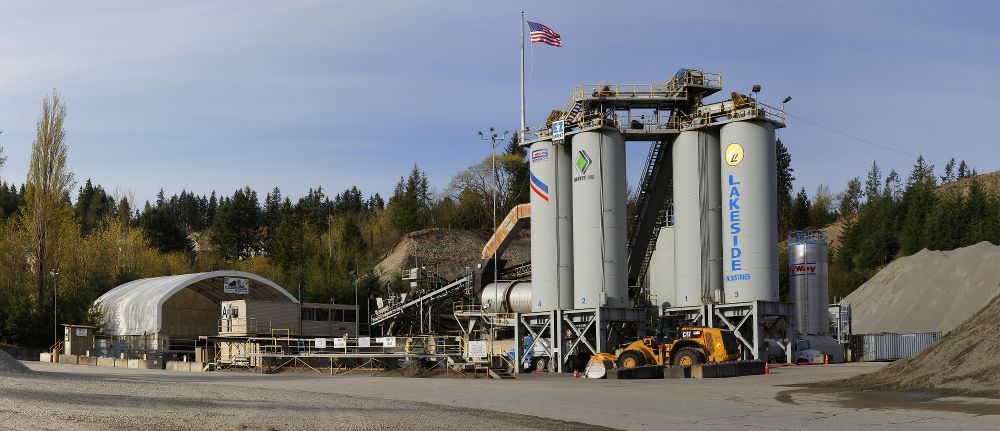
Mayor Shinpoch charted the course for clean water for our residents, and our council should retain the same vision today when it comes to the Lakeside Industries Asphalt Plant proposed upstream of our Maplewood Wells.
The US Environmental Protection Agency’s Hot Mix Asphalt Plant Emission Assessment Report provides the pounds-per-year of pollutants expected from typical asphalt plants.
In our toxic world, the only safe drinking water is that which evaporates from the ocean, condenses in a cloud, and drops as rain or snow in a clean, natural environment. This is what Seattle drinks, and it is what Renton residents deserve as well.
Treated industrial runoff will never be healthy drinking water. Industrial runoff is treated to a level that will minimize harm to wildlife as the water returns to the ocean. It’s not treated to a standard that makes it safe enough for human consumption. Only evaporation and condensation will make treated industrial runoff safe to drink again.
With their proposed new Asphalt plant, Lakeside Industries is planning to remove about 30-60% of the contaminants from their runoff using onsite treatment. They will then inject the remaining waste-water, still containing 40-70% of some of the worst pollutants, into Renton’s sole source aquifer. This is per poor instructions from the County, in a flawed approval process that has acknowledged the responsibility to protect salmon but not Renton’s residents.
Airborne contaminants from asphalt production will settle on equipment and pavement throughout Lakeside’s industrial site. Rainstorms will flush the poisons into a central catch basin, along with waste water from hosing down equipment and pavement. Contaminants will include toxins like benzene, arsenic, lead, and mercury, along with dangerous PAHs that can cause cancer and autoimmune diseases, including fatal blood diseases. Approximately half of the deadliest contaminates, those that are fully dissolved into the drinking water, will pass right through the “Enhanced basic” on-site filtration system–by design.
King County has required Lakeside to meet an “enhanced basic” standard in treating their runoff, which lets 30-60% of heavy metals pass right through. The partial-treatment comprises an oil separator, a sand vault, and a small retention pond. The 50% or so of dangerous contaminants that flow right through these simple systems will be infiltrated into our aquifer recharge zone.
There’s widespread misunderstanding about the capability of the on-site system to clean the water. The treated water is considered too dirty to dump in the Cedar River. Renton should not allow water deemed too dirty for the Cedar River to be intentionally pumped into our sole source aquifer.
Looking east across the site of the proposed Logan Six development (field in lower third of photo), toward the adjacent historic homes in the North Renton neighborhood. Residents are concerned their neighborhood streets will be inundated with cars from the 100-unit Logan Six, which they fear has too little parking for its size. They are also worried about traffic in and out.
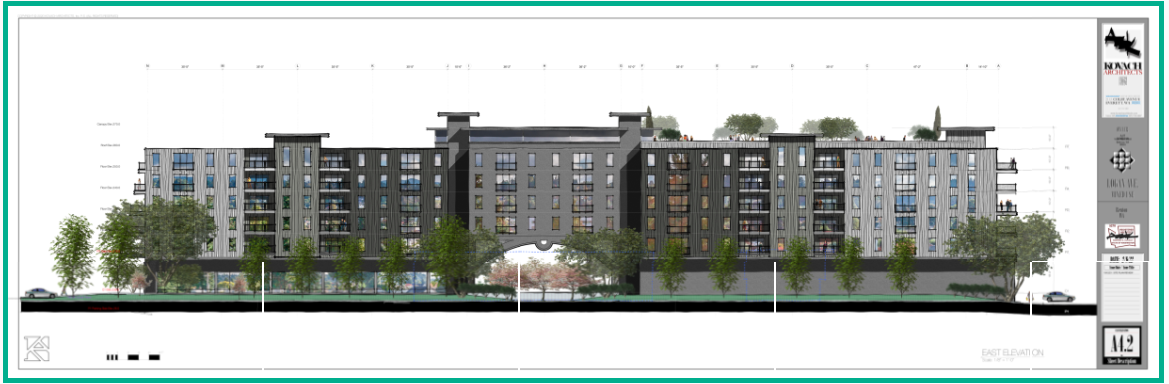
Architects rendering of proposed Logan Six Development. The project includes 1, 2, and 3-bedroom apartments, but has only one parking spot per unit.
North Renton residents have brought the long-simmering issue of Renton’s parking requirements back to the forefront. They are rightfully concerned about parking in their neighborhood. As the new Logan Six project makes its way through the process, it would be a good time for Renton Council and staff to reevaluate our parking standards to prevent the kinds of parking controversy that this project has generated.
The recommendations were controversial, because Metro was encouraging Renton and other suburbs to reduce our number of parking spot requirements to Seattle levels, even though our level of transit service was nowhere near as good as Seattle’s. Some of Renton’s Planning Commissioners, Council members, and staff embraced the recommendations, and some of us didn’t.
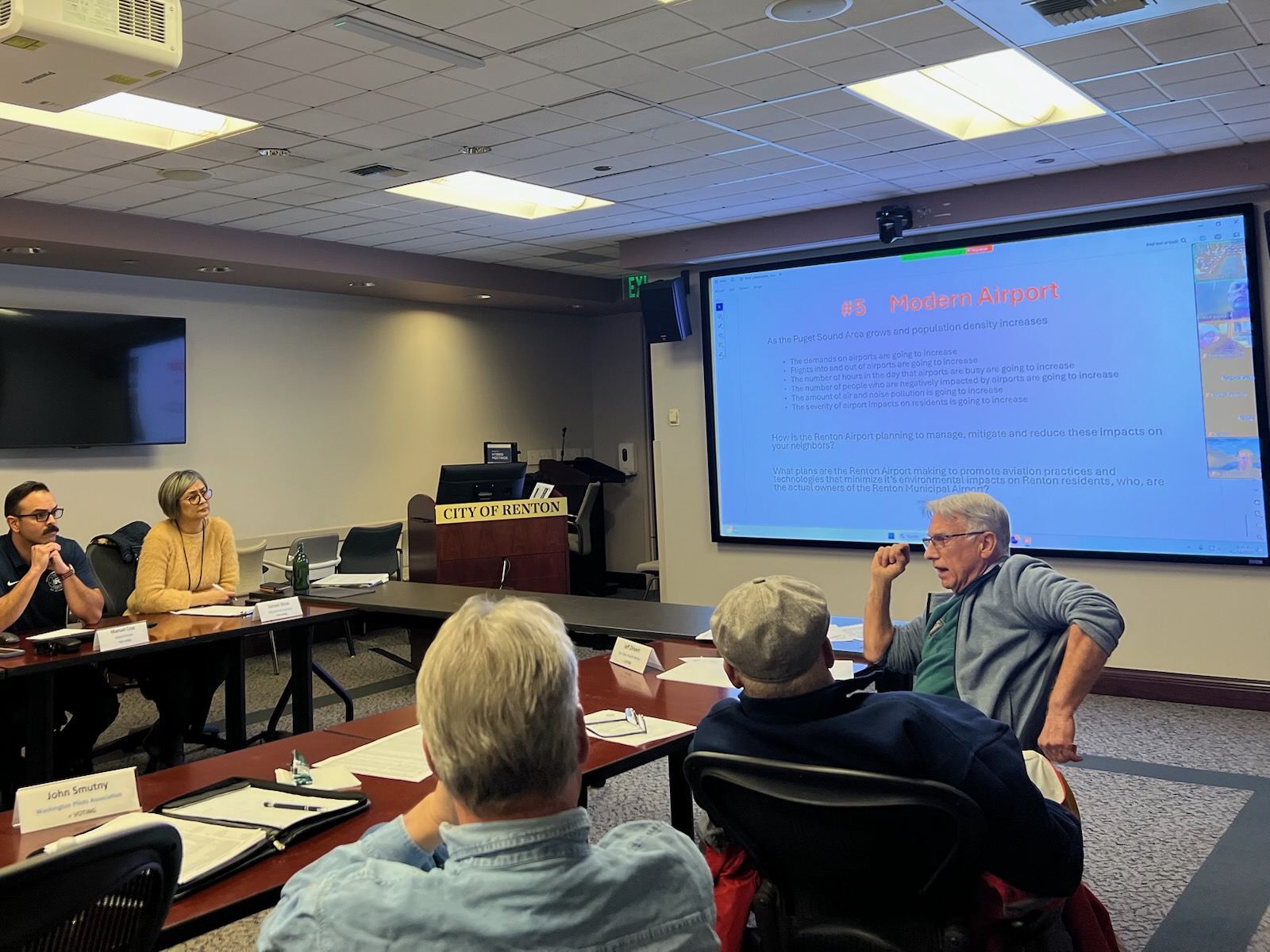
Members of the Renton Airport Advisory Committee (RAAC) and Airport leadership discuss the future plans for Renton’s airport at last Tuesday’s quarterly RAAC meeting. Some participants were on Zoom, visible on the right side of the meeting screen.
[Note: There was also some valuable information shared at the Tuesday meeting, including a thorough report from the South Renton neighborhood representative. I’ll cover this content in a separate article. ]
At the Tuesday meeting of the Renton Airport Advisory Committee, I was surprised and disappointed by the controlling, questionable guidance given by airport management to the Committee’s hard-working volunteer members.
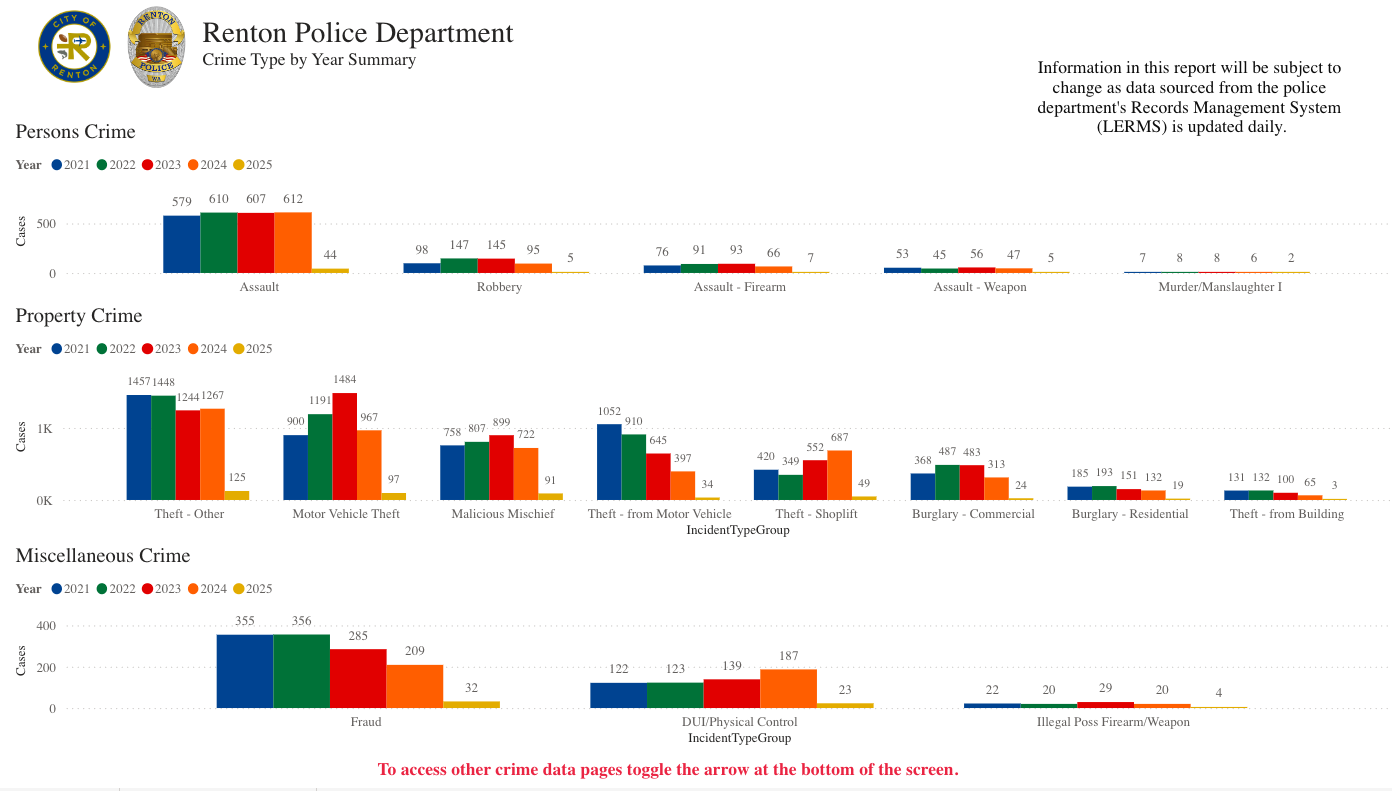
Renton motor vehicle thefts, burglaries, and robberies all spiked as police pursuits were curtailed in 2021; then declined when police were reauthorized to pursue in 2024. Reckless driving injuries and fatalities are not shown on this chart but they also climbed dramatically with the non-pursuit law.
Washington State legislators undertook a deadly experiment in 2021, and residents of our state suffered immeasurable pain and suffering as a result. The Legislator limited the ability of police to pursue criminals, and consequently increased motor vehicle thefts, burglaries, robberies, and (most tragically of all) reckless driving fatalities. Their ill-conceived law empowered perpetrators of these dangerous and destructive crimes to simply drive away from police, even in stolen cars if they chose to, without worry about being pursued. Many of us spoke out vehemently about the harm this was causing our residents, but it took years of heartbreaking tragedies to finally persuade enough of our legislators to undo their foolish law.
Washington legislators were determined to show that they could reduce the 3 to 6 deaths that occur statewide from police chases, and instead of altering that trend, they got hundreds of new fatalities as criminals sped recklessly with abandon through all our streets and highways. The latest statistics show Renton saw hundreds of additional crimes during this time period, as can be seen in the chart above. Rates of crimes in these categories finally began falling in 2024, when the police pursuit limitations were repealed.
Currently our legislature is looking at reduced penalties for perpetrators caught in child sex stings, as well as reduced sentences for a large number of other crimes. They are also considering preventing officers from pulling over cars for broken equipment and/or lapsed registrations (and typically insurance). I hope they put more analysis and thought into their deliberations this year than they did in 2021, when they effectively sentenced many of our innocent residents to beatings, burglaries, robberies, assaults and even death on our roadways and elsewhere.
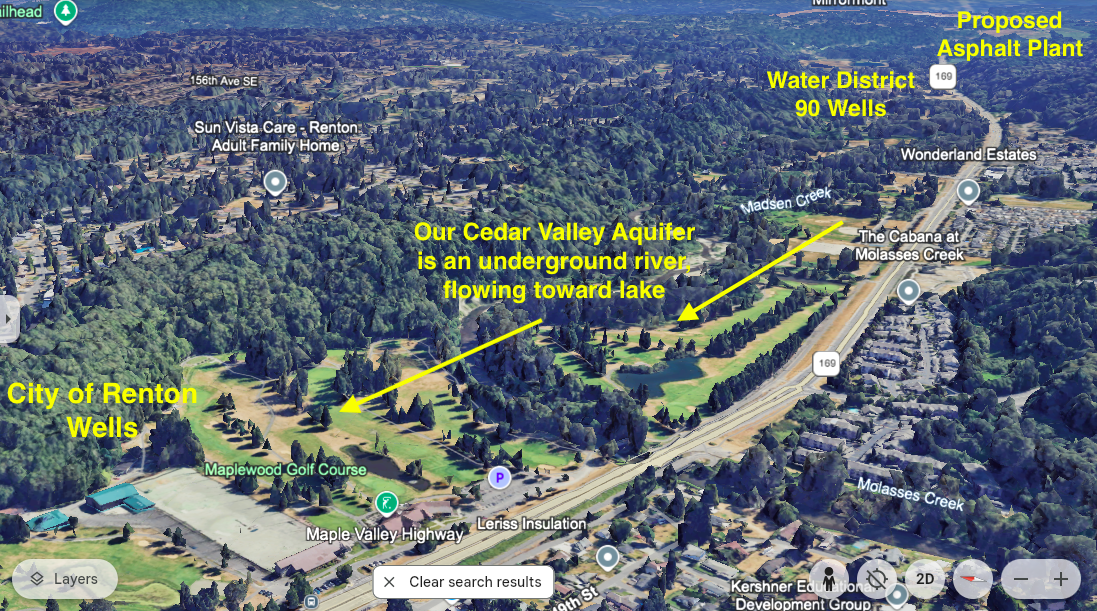
Water District 90 is planning to take their wells offline due to contamination from the proposed asphalt plant, at a cost of $500,000 per year. Renton’s wells are just downstream and the cost to Renton would be $10,000,000 (ten million) per year. Renton Council could end the risk for both water districts by purchasing the proposed asphalt plant property for about $15 million, using state grant money.
Water District 90 has three wells in the Cedar Valley Aquifer, a short distance upstream of Renton’s wells. District engineers have determined that their wells are threatened by the proposed Lakeside Industries asphalt plant. In 2018, they determined the chemical poisoning risk would likely make their wells unusable within ten years. This was before it was established that the Asphalt plant would purposefully inject their runoff into the ground. If Water District 90 can’t replace the wells, they will begin paying Seattle $500,000 per year to supply the water to the equivalent of 6000 residents. (Water District 90 already buys 70% of their water from Seattle, and they are serving a total of 20,000 residents).
Water District 90 resolution opposed to asphalt plant due to poisoning of their wells
Renton’s wells serve 20 times as many people as Water District 90’s wells, so Renton customers would have to pay ten million dollars a year to Seattle to replace our poisoned water. Even worse, our wells are sized for our city’s future growth projections, capable of delivering water to 60 % more Renton population. And this water would also have to eventually be replaced by purchases from Seattle. Given past rationing during droughts, Seattle may not even have this excess capacity.