“Pathfinder” statue of Clayton Scott standing in front of Renton’s Aerodyne complex where Mr. Scott had his last Renton office. Our airport’s official name is Renton Municipal Airport Clayton Scott Field.
For the third time in two years, a thriving decade’s-old aviation business is being pushed out of Renton Airport unfairly, with Renton airport officials giving fake or grossly misleading rationalizations. The latest falsehood is printed on a letter with the Mayor’s name in the letterhead. It appears to have been contrived by the Airport Manager and Public Works Director, and is easily disproved with a city document. It’s past time for Renton Council to investigate and stop this pattern, and require these city employees to stick to the truth. The continued dishonesty reflects negatively on city government, and leaves many residents wondering if there is a hidden agenda at the airport.
Renton’s Aerodyne hangar and office complex has hosted many thriving aviation business ventures and significant aircraft for 42 years. Clayton Scott, namesake for Renton’s airfield, had an office at Aerodyne. Aerodyne’s long success is linked to its many strong leaders and partners, including some powerhouses in aviation circles. The company and its leaders have promoted aviation in Renton, advanced aerospace research and design, supported aviation education, modeled high standards for aircraft service and maintenance, and demonstrated overall commitment to advancing safety and efficiency in air travel.
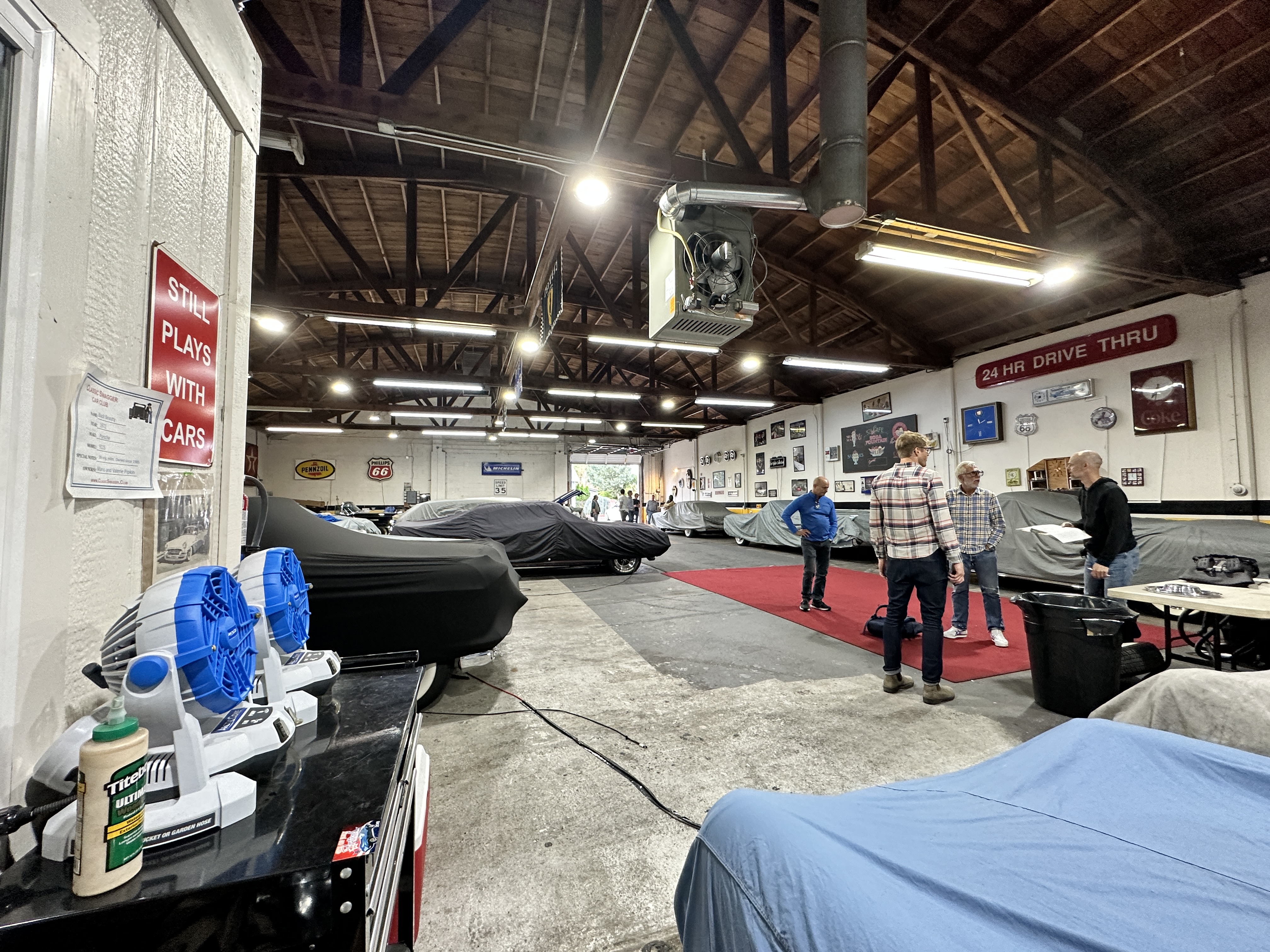
On a tour of Aerodyne’s hangar in 2019
But Renton Airport Management now wants Aerodyne’s facilities vacated by next month, to then sit abandoned and producing no aviation activity and revenue, probably for years. This is the path that the former Rainier Flight Services Headquarters, the Landing Gear Works Manufacturing Building, and the Landing Gear Works installation hangars have been on for up to two years and counting.
Aerodyne’s hangar (Photo courtesy of Gary Palmer)
THE PHONEY REASON FOR ENDING AERODYNE’S 42-YEAR LEASE:
Renton Airport Management sent a letter to Aerodyne stating that Aerodyne must leave specifically “to meet runway safety area requirements as they relate to the goals of the Airport Layout Plan.” But this is not true.
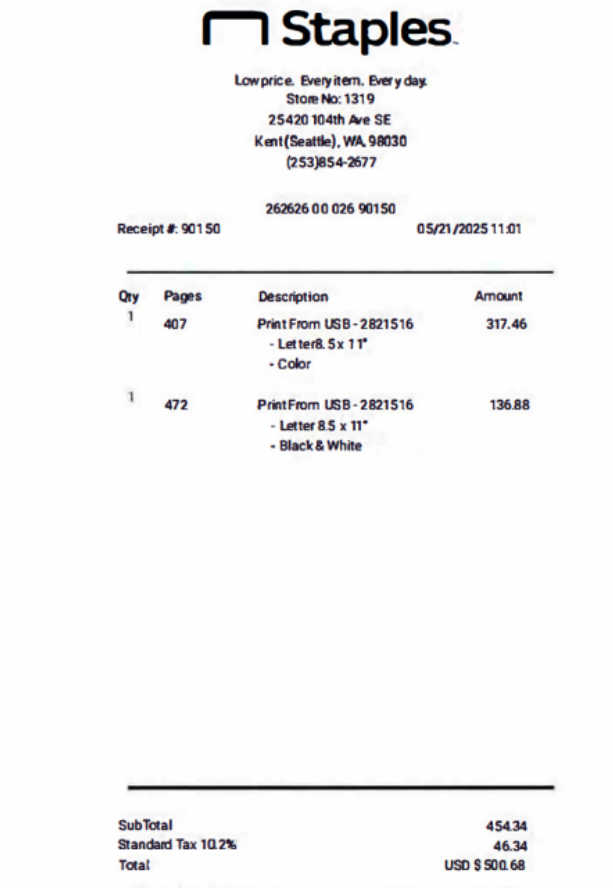
Staples receipt for costs Renton outsourced while supplying records to Superior Court; Logan Six applicants have been asked to pay this, even though it’s five times the published fee schedule.
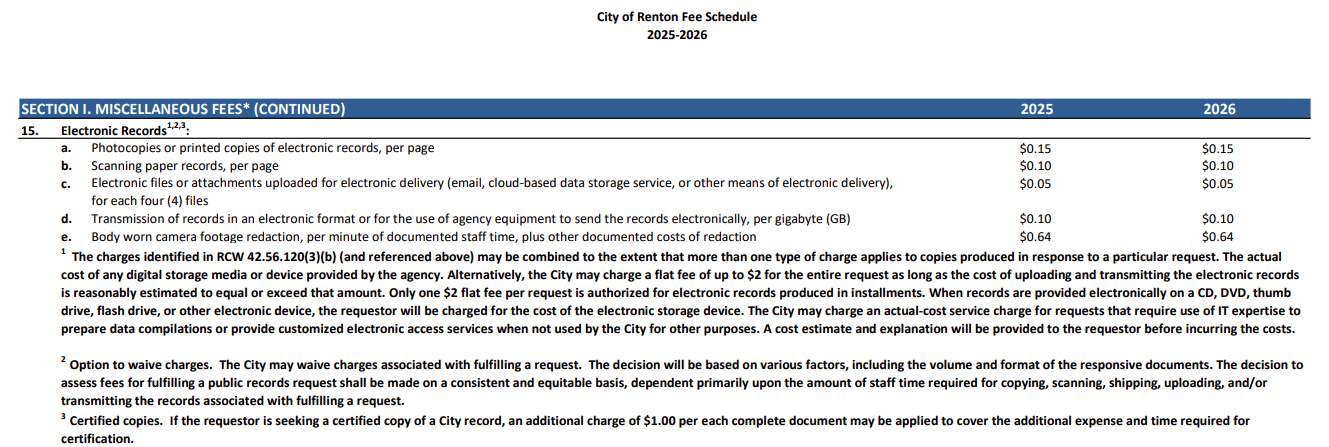
The Renton Fee Schedule, approved by Renton City Council, is pretty clear. The City can charge residents 15 cents per page for printed or photocopied pages. The City Clerk can also waive these charges, and often does, for residents that have not used an excessive amount of photocopying or printing services in the past.
So why is the city charging 78 cents per page to Renton residents appealing the Logan Six project? The question has North Renton residents justifiably perturbed. They’ve been paying taxes to fund the Renton City Clerk’s office for decades, and now the first time they need copies of some city documents the city is gouging them. The City is not even using the photocopiers that taxpayers funded– they’re having the copies made at Staples, a retail store.
The high charge is five times the city’s published fee schedule, which is arguably illegal. But just as upsetting to North Renton residents, the usurious charge looks like an effort on the part of someone in the city to make it even more expensive and difficult for Superior Court to review this appeal. When the Council made the last-hour change to send appeals to superior court instead of hearing them themselves (claiming it was an improvement) they didn’t mention that the city would charge 78 cents per page for data sent to the court.
Even more frustrating, by using Staples, a retail store, instead of the Clerk’s office, the bill for the copying now includes sales tax which would ordinarily be exempt on public records per RCW 82.08.02525.
The grass field in the center lower-half is the site of the proposed Logan Six development. The site was a former railroad easement, that has utilities buried in it.
It’s rare in Renton for neighbors to actively picket a new property development, like North Renton residents have with the new Logan Six project. Even Renton’s Hearing Examiner has said“The proposal has drawn more opposition from neighbors than any project the City has seen in several years”. So what has made Logan Six so controversial, even while Renton has so many apartments going in with few complaints in many other areas?
The answer springs from new policy interpretations that are unmanaged and unchecked by Renton City Council. And because of new “Missing Middle” zoning that is currently in work, this failure on the part of Renton Council to provide needed oversight, if not corrected, will soon grow until we see similar protests city-wide.
Here is the Hearing Examiners Final Decision regarding the file Logan Six – LUA-22-000283 dated 3/3/2025. You can also find the Hearing Examiner’s decision at this link – LUA-23-000283. Also here is the HEX folder with the Land Use link (LUA-23-000283)
North Renton residents were protesting on Logan Ave yesterday. They’ll be doing it again today, starting at 3:30 PM.
North Renton residents have taken the unusual step of organizing protests after being denied an opportunity to work with Renton City Council on their concerns over two years.
Because of Renton City Council’s last minute change to their Hearing Appeals process, residents feel like they’ve never had a proper opportunity to discuss their concerns with the council, and may never get one. The residents consequently asked the Council this past Monday night to implement a moratorium to buy some time for Council and the community to work together on the North Renton concerns, but the Council rejected the motion in a 5 to 1 vote.
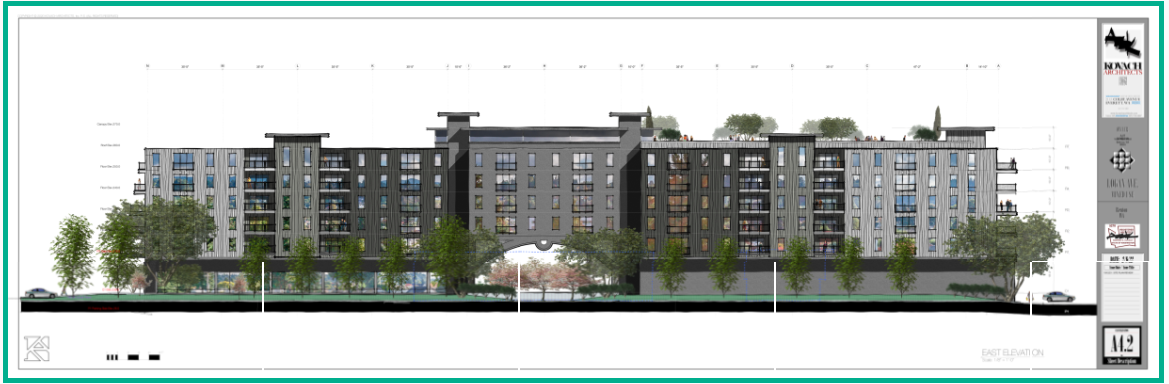
Residents feel the planned 100-unit Logan Six apartment project is oversized for its site, has inadequate parking, and should be using the Logan Ave arterial for access as opposed to residential side streets. For over two years City Council had said they were going to review the project on appeal if the residents had concerns following the Hearing Examiner’s review, but then the Council changed their minds on the eve of the Hearing Examiner’s review.
Everyone is currently awaiting the Hearing Examiner’s decision, due for release any day.
Billy O’Neill, “Dale Chihuly’s right hand man,” (in white sneakers) selecting the large facility on Airport Way for his decorative glass making studio. The venue was going to teach youth and adults the art of Chihuly style glass making. The large open-bay building features the same old-growth historic bowstring-trusses that caused our city council to save the Pavilion building in the 1990s.
It was a dream come true for Renton’s Arts Community, our youth, and our Economic Development department. A world-class glass studio was relocating to Renton, headed up by the vice-president and operations manager of Chihuly’s workshop in Seattle. Billy O’Neill, who Seattle Times calls Dale Chihuly’s right hand man, was working on a gift for Renton that would have taught new generations of Rentonites how to create beautiful glass sculptures and containers. Mr. O’Neill has served on the Seattle Arts Commission, as secretary on the Executive Board of Directors of the Seattle International Film Festival (SIFF) and on advisory boards for the Seattle Sounders and other non-profits– a perfect fit in Renton. He was instrumental in creating Chihuly’s Garden of Glass at Seattle Center.
But the exciting glass art studio fell victim to a School District Eminent Domain taking, along with numerous other businesses and homes, with no acknowledgment by the School Board of the glass studio’s extraordinary significance.
The business, called “Glass Eye” already has a permanent sales location at Pike Place Market, which would have soon been selling the Made in Renton glassworks. We would have a new Made-in-Renton products we could share with visitors and far-away family, to replace our much-missed Uptown Glassworks.
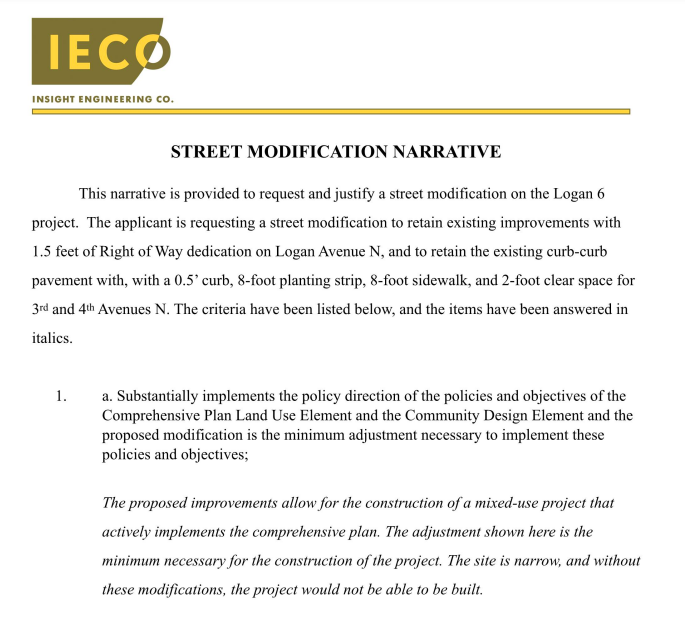
The initial submittal for Logan Six in 2022 included a street modification request. Final line of item 1: “The site is narrow, and without these modifications, the project would not be able to be built.” Council could have questioned the scale of the project on the record.
At last night’s council meeting, a Council Member told the audience that the State of Washington forced Renton to approve the Logan Six development with only one parking spot per unit.
While the State of Washington did implement parking regulations in 2020 that could potentially supersede a city’s parking regulations, the state standards specify a minimum standard of one spot per BEDROOM, as opposed to the lesser standard of one spot per unit that Renton has imposed on Logan Six. Here’s the State law on this topic. (Presumably the 0.75 spots per unit applies to studio “no-bedroom” units)
Cities planning under RCW 36.70A.040—Minimum residential parking requirements.
In counties and cities planning under RCW 36.70A.040, minimum residential parking requirements mandated by municipal zoning ordinances for housing units constructed after July 1, 2019, are subject to the following requirements:
….
(3) For market rate multifamily housing units that are located within one-quarter mile of a transit stop that receives transit service from at least one route that provides service at least four times per hour for twelve or more hours per day, minimum residential parking requirements may be no greater than one parking space per bedroom or .75 space per unit. A city or county may establish a requirement for the provision of more than one parking space per bedroom or .75 space per unit if the jurisdiction has determined a particular housing unit to be in an area with a lack of access to street parking capacity, physical space impediments, or other reasons supported by evidence that would make on-street parking infeasible for the unit.
Reason 2: the Council probably had an easy opportunity to stop this project after the first submittal in 2022 if they had wanted to. In the initial submittal for the project, the applicants provided a letter making it absolutely clear that they were concerned the site might be too small for the project.
In the relatively brief two page letter, the applicant says they need a Street Modification because of their overly narrow site. Then they say three times that without this modification, they could not build the project. Here are some excerpts:
“STREET MODIFICATION NARRATIVE
This narrative is provided to request and justify a street modification on the Logan 6 project. The applicant is requesting a street modification to retain existing improvements with. 1.5 feet of Right of Way dedication on Logan Avenue N, and to retain the existing curb-curb. pavement with, with a 0.5’ curb, 8-foot planting strip, 8-foot sidewalk, and 2-foot clear space for. 3rd and 4th Avenues N…..
The site is narrow, and without. these modifications, the project would not be able to be built….
The modification also allows for the project to be built at all, given the narrowness of the site….
The shown modification is required for the building to be done without incurring additional. costs. The site is narrow and if much more were given, the project would likely not pencil….”
Any of Renton’s eight elected officials could have questioned the requested modification, on the record, and consequently questioned whether the project may be too large and dense for the site. Even the rules governing quasi-judicial hearings do not bar Council members from asking questions about a project, on the record. Since the developer said three times they were concerned the project would not fit on the site, this would have been an opportune time to scale it to a better size.
Instead, Council did not ask any questions and City Staff appear to have approved the modification request, enabling the project to go forward.
So no, the State did not require this project to take its present form, pushing the street boundaries set for the zone with consequent minimal parking. That appears to be just a story.
In a quasi-judicial hearing, Renton Council would look for errors in the building application process. Renton Council just decided to no longer conduct these hearings, after the North Renton neighborhood had been told for years that it would happen.
The Renton City Council swiftly made a major policy change at their last Council meeting, sending all land-use appeals to King County Superior Court instead of the Renton City Council.
While the council may have had good intentions with the change, they followed a flawed implementation process that left the North Renton neighborhood feeling betrayed and put in an unfair position.
For three years the Council has told North Renton residents that residents can’t discuss the Logan Six project with Council because it would eventually be sent to the Council for a quasi-judicial review. At that time, the Renton Council, acting as judges, would formally review all aspects of the entire record of the project and make sure that residents had not been victimized by any errors in the process. But after three years of telling North Renton residents this, a mere month before the long-awaited quasi-judicial hearing by Council would occur, the Council surprised virtually everyone by canceling their role in the appeals process and all future appeals processes. Many North Renton residents understandably now feel hurt and betrayed.
The City made at least three errors in their implementation of this policy change that led to this betrayal. (The policy change may have been reasonable, except for these errors.)
(1) The Council should have given the public better awareness and opportunity to comment on this policy.
This policy change was made swiftly, gliding through Renton’s Planning Commission and then two readings on Renton City Council in less than a month’s time. Unless Renton residents were carefully monitoring the Planning Commission, which very few do, they would have missed virtually all discussion on this topic. The group most severely impacted, those concerned about the Logan Six project (which many feel is too large with too little parking), did not have awareness this was coming.
Policy decisions benefit immensely from public input, and this change is so far-reaching that Council should have given ample time for the public to be notified and give input to council. This is a change that has been discussed by Council in decades past, and has positive and negative ramifications, which the public could have been educated on, and commented on, with leads to my second complaint about the process:
(2) The administration should have presented both pros and cons of the policy change to the Planning Commission and City Council.
The Planning Commission was given a staff statement to base their deliberations on, which gave a positive account of how this change would improve communication between Council and residents concerned about a nearby project. Council would not have quasi-judicial constraints on their communication with residents during the life of the project (i.e. not every communication would have to be formal and on-the-record).
But the administration left out the negative consequences of the change– the reasons that Council has never changed this policy in past decades: The quasi-judicial council review gives residents an easy and efficient way to appeal Hearing Examiner decisions, that does not require the extraordinary time, complexity and expense of going to Superior Court. In addition, the Council appeal process ensured that the legislative body itself, the very ones setting the rules and codes, made a thorough review of all documents, and then a determination regarding whether the rules– that they had set– had been followed. Without this Council review, residents and the King County Superior Court are left to try to try to surmise for themselves what the legislative intent is for specific rules, while residents typically must pay attorneys somewhere between $20,000 – $100,000 to represent them.
The Planning Commission and Council should have been presented with both sides of this argument. Then Council should have notified the public of a possible change with a press release, and held it long enough to give ample opportunity to hear from residents and builders. They could have scheduled a council public hearing on the topic, since the existing policy has been in place for many decades, and the change is so far reaching. An open public discourse regarding this change would have assured that all factors were taken into consideration. No matter what the final policy choice, Council, residents, and home builders would have understood the rationale without suspicion.
(3). Most important of all, Council should have set the policy for new applications, but not changed the policy mid-process for projects in work.
They especially should not have changed the process for a project just a month away from it’s Council review, after refusing to discuss the project with residents for three years. This amounts to a complete denial of legislative representation for the residents impacted.
I was surprised to see an article in the Seattle Times today featuring a photo of one of Renton’s newest apartment buildings under a headline that included the words “Ponzi scheme.” The Seattle Times story (behind a paywall) describes the far-reaching bankruptcy of Bellevue firm iCap and their associated LLCs, including Colpitts Sunset LLC which developed the Sunset Terrace Apartment building in Renton Highlands.
Seattle Times iCap bankruptcy story features a photo of the Sunset Terrace Renton Apartment building overlooking the climbing pyramid at Sunset Neighborhood Park
The painful bankruptcy has apparently come as a shock to many investors, who believed that they were loaning money at a fixed interest rate to help build needed housing, and that the loans were safely secured with substantial equity in real estate.
Instead, iCap, Colpitts Sunset LLC, and their other inter-related business holdings have apparently been operating in the red for many months, and have allegedly used new investor cash to cover interest payments to past investors. This realization has led some investors to file a lawsuit against iCap, and even describe the arrangement as a Ponzi scheme, although the authorities have not called it that at this point.
The lawsuit filing describes the complex nesting of LLC’s that form iCap, and provide some background regarding why investors could have believed these were safe investments. There are people that have put significant savings into these companies, and have been severely hurt by this.
I’ve also attached the Colpitts Sunset LLC bankruptcy filing document, which includes a matrix of hundreds of creditors, investors, and tradespersons that might be left holding the bag for construction costs of the Renton apartments after the Colpitts bankruptcy.
While this is indeed a sad story for those who have lost their investment money or performed uncompensated work, I am hopeful the Sunset Terrace Apartments and their occupants will be okay. Colpitts Sunset LLC had sold this apartment complex to new investors last July, around the time they filed their bankruptcy paperwork. The new investors payed $44,000,000 for the building, and they seem to be doing a fine job of running it.
The details in the lawsuit suggest the apartments in Renton may have been completed in part with money investors thought was targeted at Senior homes in Kenmore and student housing at University of Washington, both projects that have apparently not even broken ground. If this is the case, this sad situation is another unfortunate reminder about how hard it is to put the money together to fund needed housing in today’s expensive, high-interest-rate environment.
I’m not an attorney, and it is up to the courts to decide whether this was a fraudulent scheme or a case of desperate money managers working to keep a real estate enterprise afloat. It’s grim news in any case.
Sunset Terrace was sold on July 25, 2023 to Olympia Hotel Group for 44 million dollars, per King County Records