After amazing grass-roots campaign, Renton Cedar River Library wins 76 % to 24 %!

After an exciting three-month campaign full of passion, door-belling, blogging, information booths, a parade enty, and letters to the editor– covering subjects such as library patrons desires and needs, conflicting cost estimates, conflicting parking predictions, and discussion of many other “unknowns,”– Renton citizens have overwhelmingly selected “Over the Cedar River” as their favorite location for a library. The first returns were showing the Cedar River locations leading the Piazza location by 76% to 24 %.

Cedar River Library Campaign Chair Stuart Avery summarized the sentiment tonight at an election-watch/victory party by restating the theme the campaign had adopted, “there really is no better place.”

As a special treat, former Renton Mayor Don Custer, a charming, witty, senior statesmen for our city who presided over Renton when the library was built in 1966, stopped by the party tonight. Don shared stories of the original library construction, and reminded us the project was accomplished for about $300,000 . He said the inspiration for the library came from Italy and England, where he and others had seen shops on bridges. He said one of the original architects also took their inspiration from a building on the US East Coast that was located on a bridge over the freeway, but none of these buildings were libraries.

Some of the supporters of the competing Piazza Library site had expressed a desire to move the library to stimulate revitalization of downtown. At tonight’s party, there was a prevailing sentiment that downtown revitalization was a worthy goal deserving of city emphasis, but that moving the library was not the right approach– several citizens were eager to share other ideas for bringing improvements to the areas near the Piazza.

The Renton Patch has other details on the election which can be found here.

Thank you to all who participated in this campaign, and thanks to the voters of Renton for supporting our unique, treasured library.


Cedar River Library supporters in the River Days parade ten days ago

I’ve always like parades. I’m walking (and waving) next to Marcie Palmer who serves with me on City Council– Stuart Avery, Cedar River Library campaign chair, is to the far right leading the procession (in white campaign T-shirt)

Four specific reasons to disregard today’s Renton Reporter editorial supporing the Piazza library location

The Renton Reporter posted an editorial today in favor of the Piazza library location. There are four specific reasons for disregarding this editorial:

Reason number 1– The editor opens the editorial by showing he is out of step with the Council, the Mayor, and the citizens on this topic

The editor begins his editorial by saying that he personally would not have let the library location go to a vote. In this regard, he disagrees with all seven Renton council members and the Mayor of Renton, who felt that the public should be heard on this issue when we placed the issue on the ballot two months ago. The Renton Reporter editor also disagrees with the 15 % of registered Renton voters who signed a petition asking for a vote. This seems quite out of step with the desires of the community.

Reason number 2– The editor’s track record for accurate library information is not good

The editor claims voters knew, or should have known, they were voting for two new libraries when they voted to annex to KCLS. His statements include “From the beginning it’s been clear that in all formal documents Renton’s elected leaders agreed to build two new libraries.” and “.. it was clearly spelled out that the city would build two replacement libraries for KCLS if annexation should occur.” and “It was also clear (in the 2010 voters’ pamphlet and elsewhere) at the time of the vote that annexation would mean the city would have to build two new libraries for KCLS. “

But two years ago before the KCLS election, the Renton Reporter never informed voters that a vote for KCLS was a vote for closing Cedar River library. In the Renton Reporter editorial of January 27, 2010 a week prior to the KCLS annexation, Dean Radford wrote: “Renton residents will have some local control over whether the city builds a new library, perhaps in the Highlands, if and when a levy to do so is placed on the ballot. That’s a glimmer of local control, although the building would belong to KCLS.” Beyond this editorial, there were four special reports on the KCLS annexation issue; in these reports, the Renton Reporter never once mentioned that the Cedar River Library would be subject to closure with annexation to KCLS. Yet this possibility of closure is obviously an issue of paramount importance to thousands of trusting citizens. (See more on this issue by clicking here) One must conclude that either the editor did not know all the facts when he wrote his editorial of January 27, 2010, or else he was trying to mislead the public. I like Mr. Radford, so I want to believe it was a misunderstanding on his part, but voters need to keep that in mind as they review today’s library editorial.

Reason number 3– The editor cites the lack of clarity in this election, but goes on to support the people who brought us the lack of clarity

In today’s editorial Mr. Radford says, “Unfortunately, what’s really missing today is clarity, especially about the cost to renovate the library over the Cedar.” Of course we lack clarity because (A) there was a deliberate push by the Piazza library supporter to force this library choice too fast, when the plans including re-purposing were far from complete; and (B)the Renton Reporter has swallowed a rushed, secret KCLS study with blatant errors, including double-dipping on contingencies, incorrect mitigation fees, wrong assumptions, and other problems. I agree that this is “Unfortunate,” but throwing support to the people that created this lack of clarity is foolish, especially when they have been found responsible for similar misinformation before.

Reason number 4– The editor uses a circular argument to try to dismiss re-purposing costs, a dis-service to taxpayers

The editor’s words speak for themselves here. Read them carefully. He says; “Don’t be misled by assertions that it will cost the city $10 million (or more) to upgrade it for another use. That’s only true for a state-of-the-art library. The city could continue using the building right away, with no renovation. When the time is right, it could seek the dollars needed to upgrade for a specific use, just like any other city-owned building.” Okay. So Mr. Radford is saying we can continue to use the building as is (as a library?), and we won’t have to pay the millions more until we want to upgrade if for another specific use (like an environmental center). He is agreeing with the exact assertion he is trying to dismiss. It would be laughable except that taxpayers will be on the hook for this future re-purposing expense and they may not know it. They will also be on the hook for annual operating costs for another facility, and there is no budget for this.

Parking difficulties downtown would be worsened by new Piazza library

(This article is part of a series I am writing to help ensure voters have as much information as possible before the August 7 library election. Like all my other entries, these are my personal views. I am never speaking for the Renton Council or the City of Renton as a whole in this privately-funded website. Please scroll down for other library entries. Thanks for reading)

This photo was taken last Thursday, about 100 feet from the site proposed for the Piazza library. Highland resident Jennifer came out of a downtown Renton restaurant after a one-hour lunch to find her car hooked up to a tow truck. She had to give the towing company $137 to get her car unhooked, even though she was in a marked parking spot and the lot does not appear to be correctly posted for immediate towing. Jennifer is now involved in a dispute to get her money back, and there are two Renton businesses (the lot owner and the towing company) she will never do business with in the future. If the library is moved to this location, library patrons would be encountering a worse situation daily as they jockey to find spots where they can dash in and pick up or drop off books, while customers of downtown business, apartment visitors, and parents dropping kids for daycare will face new competition for existing spots.

The parking plan for the proposed new Piazza library is not clear. Proponents of the move say that there will be sites on the street dedicated to the library, and that the parking garage will easily handle all the rest of the need. But there are numerous problems with this.

First, if we dedicate existing public parking in the downtown to a new library, we take it away from nearby businesses including restaurants, shops, and even a daycare. And by posting it specifically for library patrons, we take away the number one reason that some downtown business owners have given for wanting us to move the library downtown– that library patrons will visit other businesses on their library outings. In other words, if a patron drives up to the library, and sees a spot marked “For library patrons only– others will be ticketed”, there is virtually no chance of seeing that patron stop into a restaurant for lunch before getting back into his or her car. And once in their car, they will head to their favorite lunch spot, whether that is three blocks or two miles away.

On the other hand, if anyone expects library visitors to readily use the downtown Renton garage, they are in for a disappointment. This garage, which Diamond Parking has overseen for Renton since 2008, is a distance from the library and requires that users register their vehicles even when parking for only a few minutes. Anyone who fails to register their vehicle even for the first two hours of free parking is subject to a $30 fee, which goes to $60 if not paid within 15 days. For parents already juggling kids and books, this step will be an additional frustration on top of the two to three block walk — not to mention the stairs in the garage. And patrons and business owners won’t be happy about another detail. If a library patron decides to walk a few blocks for cupcakes or coffee after their library visit, they will have to anticipate this BEFORE they leave the parking lot. This is because the parking fee for stays longer than two hours must be paid in advance– overstays are subject to a 30 dollar fee, rising to 60 dollars if not paid in 15 days. This will certainly discourage lingering in downtown Renton after a library visit.
Diamond Parking rules posted within the City Center Parking garage. Hourly users must pay in advance, and not overstay, or face a $30-$60 fee. (The parking garage works better for monthly users and transit riders, who bypass the hourly meter and park at higher levels with window permits)

Note that this is in stark contrast to the existing Cedar River Library, which has generous free parking of unlimited duration. Patrons with only a few minutes can make a quick dash in for a convenient pick-up or drop-off. Visitors with more time available can browse the library, play at the playground, and then walk down the street for coffee, cupcakes, or lunch if they feel so inclined. No tow-truck drivers will be stiffing them $137 for a one-hour overstay, nor will Diamond Parking be billing them $60 for failing to respond to the first notice that they forgot to register their car when the parked for 15 minutes to drop a book off. In addition, downtown restaurant owners won’t have to post awkward signs asking library patrons not to park on their property, or even worse having patrons’ cars towed. (Each time a business has a car towed or confronts a library patron, they should plan on losing about 20 customers for life thanks to the tell-a-friend effect)

When we built the city center parking garage in 2003, it cost Renton taxpayers about $18,000 per parking spot. We did this to get transit users and employees cars out of the way, so that businesses had ample parking for their customers. At 18,000 dollars per parking spot, Renton is providing an additional gift worth 1.2 million dollars to KCLS if we turn over sixty-five parking spots for free in this high-density area (in either the garage or the street). This should be booked against the cost of the Piazza library, driving its cost up from 9.3 million to 10.5 million dollars, exceeding the 10.1 million dollar cost to remodel the Cedar River Library.
With Cedar River library parking north and south of the river, and generous overflow at the City’s 200 Mill Building (pictured above) and the east side of liberty park, library patrons never have any issues with parking at the present site.

City of Renton library cost estimates were accurate; KCLS estimates have serious errors

In this photo I shot on Sunday, library patrons can be seen entering the library from the center of the bridge, while others stop and watch the river for salmon. Flotillas of rafts and geese can be seen cruising down the river. KCLS wants to close this library entrance and put the library entrance on the south parking lot– adding to the costs and making the north parking lot less convenient. This brand-new and unrequested change is one of several bad assumptions and errors that form the basis of a letter KCLS sent to Renton citizens, wrongly stating that Renton’s previous estimates for the library were incorrect.

Some readers have asked about the letter that KCLS recently sent to Renton residents challenging the city’s official cost estimates for the Cedar River Library remodel. In this letter, Library Director Bill Ptacek asserts that Renton officials underestimated the costs of the remodel, and he claims that a study by the Miller Hull architecture firm shows the actual costs will be 13.1 million instead of the city-estimated 10.1 million dollars. (I have attached the letter here)

There are several critical flaws in Mr. Ptacek’s letter and analysis, and readers should continue to respect and use the City of Renton’s official published cost figures for the comparison of the library options. The City’s numbers were prepared by an excellent estimating firm that has accurately predicted costs for five thousand public buildings, including King County Libraries. In addition these city estimates were prepared in a deliberate, careful, unbiased, public process with well-vetted assumptions, and provide a direct apples-to-apples comparison between the two sites. The cost of the Cedar River Library remodel is 10.1 million for a 22,000 square foot building, vs the cost of a new library at the Piazza for 9.3 million for a 15,000 square foot building.

Flaws with the KCLS estimates:

With regard to the recently released KCLS letter, the first thing to note is that KCLS’s Miller-Hull study (linked here) actually predicts only 8.1 million dollars in hard costs of the library, including labor, materials, 15% contingencies and 5 % cost escalations. The other 5.0 million dollars is a summation of additional costs that was created by KCLS and never shared with the public– I only have it because of a freedom of information request that was served on KCLS (click here to see it). I’ll discuss each of these two estimate components separately.

The 8.1 million in hard costs:

Miller-Hull estimated 8.1 million dollars in hard costs, about 1.4 million more than the City’s estimate of around 6.7 million. If one wades through the details of both studies, the difference can be largely traced to two major contributors, both of which appear to be more appropriately handled in the City of Renton (Robinson Company ) estimate. These differences are that the City’s estimate assumed that the front entry of the library would remain on the bridge in the current location. In my opinion, this is an excellent assumption, since it was the designer’s original plan for library patrons to walk out over the water to enter the library, it makes excellent use of parking lots on both the north and south sides of the library, and it keeps the library entrance well-connected to the playground. Furthermore, we have never publicly discussed moving this entrance, and voters would reasonably assume it is in the same place. The KCLS estimate, on the other hand, makes a brand-new assumption that the entrance of the library will be moved to the south end of the building to directly face the south parking lot. They recommend this because they feel patrons won’t want to walk the 75-foot distance of half of the bridge to enter the library. This recommendation is ironic, as it is contrary to the KCLS position that users of a new library at the Piazza would have no objections to walking two or three blocks and up stairs in a parking garage. Without the assumption of relocating the entrance, much of the interior reconfiguration costs of the library drop in line with the city estimate.

The other big contributor to the difference between Renton’s and KCLS’s estimates is the floor reinforcement. The City estimates assume that we double the capacity of the floors across the span of the library, from their current 60-65 pounds per square foot, to 125 pounds per square foot, as was first agreed to with KCLS (and is the current load-bearing capability under our book stacks above land.) This would be more than ample to give KCLS flexibility with book stacks, and would in fact be strong enough to accommodate most any non-industrial use (see seismic report here) But for some reason, in the recent KCLS estimate, they have included the costs of reinforcing the floors even further, up to 150 lb per square foot– 250 % higher than today’s floor strength. This exceeds code, and it exceeds their needs. Without these two big cost contributors, which are both faulty assumptions from KCLS and not desired by Renton taxpayers, the Miller-Hull and Robinson estimates are not much different.

The 5.0 million in additional KCLS estimated costs:

When Miller-Hull completed their 8.1 million dollar estimate, they specifically included construction contingencies of 15%, and escalations of 5% right in their estimates. However, KCLS added these numbers AGAIN to their estimate, clearly “double-dipping” on this expensive line-item. This adds 1.3 million to their estimate which is completely unjustified or fabricated.


Above: Miller Hull comments remind report-users that 15 % contingency and 5 % additional escalation IS already included in grand total construction cost of 8.08 million

Above: KCLS adds 15 % construction contingency into the estimate a second time, breaking it into 10% unanticipated “work orders” plus a 5 % contingency– the same 15% that Miller Hull Architects already included. (except the dollars are EVEN HIGHER because it is compounded as a contingency on a contingency on a contingency)

In addition, KCLS added hundreds of thousands in utility and traffic mitigation costs that would be required with a new building, but not a remodel with the same use.

KCLS also appears to have added the $60,000 they paid for the Miller-Hull study, and perhaps even the $8000 they spent sending the pre-election letter to Renton residents– these appear to add up the the $68,000 “feasibility study” shown in the spreadsheet. Renton citizens appear to be getting charged for KCLS pre-election study/literature in this line item from page 2 of the KCLS spreadsheet.

Most of the other line-items in KCLS estimates are generally okay, but all get scaled from the difference in the building cost of 6.7 million and 8.1 million, which was based on faulty KCLS assumptions.

In Summary, the three million dollar difference between Renton’s and KCLS’s estimates is:

1.3 M- Moving library entrance away from river and making floors stronger than 2012 code
1.3 M- KCLS double-dipping (charging the architect-recommended contingency 15 % TWICE)
0.2 M- Applying non-applicable traffic/utility mitigation fees (not for remodel)
0.13 M- Percent-based cost numbers that are scaled up, due to all of the errors above
0.07 M- KCLS charging Renton taxpayers for feasibility study and letter (not our costs)

Sadly, KCLS has been found guilty of misleading the public before. Click here for the PDC report. They have also had trouble staying within the law in managing their projects (click here for the state auditor’s report). The city of Renton has not had such difficulties with the PDC or State Auditors office. So the bottom line is, trust the numbers from the City of Renton (in the official voters pamphlet), not those sent out in the KCLS letter.

New Piazza library plan is far from complete, and could create a 25 million dollar hole in Renton’s budget over the next ten years

(This journal entry is part of a series relative to an upcoming Aug 7 vote on Renton libraries. To see my earlier entries for more background on this topic click here )

The proposed Piazza Park library (depicted artistically above) could create a twenty-five million dollar deficit in Renton’s budget over the next ten years by requiring us to build and operate an environmental interpretive facility that we have no money for.

The larger existing Cedar River Library (above) could be brought up to “brand new” KCLS standards with money already bonded plus a one-time expenditure of $800,000. This $800,000 (which equates to just 8 weeks of our tax payments to KCLS) could come from either KCLS in recognition that our libraries are serving many non-Renton residents, from sale of the old highlands library property since the Highlands library is being relocated, or by making the libraries a little less fancy.

Many Renton citizens vividly remember the financial picture that brought us to the KCLS-annexation election two years ago. With the on-going recession and revenue cut-backs, the city could barely afford to keep spending the 1.8 million dollars a year to keep the library open. (Click here for the story in the Renton Reporter). As explained in the Renton Reporter story, when we lost staff we could not afford to replace them, and the buildings were falling into disrepair. With this sad story, the city set the stage for an extremely close election to annex to KCLS. Now that the annexation is complete, Renton taxpayers are funding KCLS with five million dollars a year, a 280% increase over the 1.8 million dollars reported as the 2008 library budget. In addition, the City still collects the 1.8 million dollars per year from Renton taxpayers (that we said we could barely afford), and we have dedicated it to pay off bonds $19,000,000 dollars in bonds to upgrade the library buildings themselves. And by the way, the economy is still bad, and we are still having to cut costs in the City of Renton.

The $19,000,000 we secured in bond money will build us an all-new much larger highlands library (which serves many non-renton KCLS residents who live east of the City of Renton), but falls about $800,000 short of doing the desired just-like-new remodel of the Cedar River library “to the modern KCLS standards.” This $800,000 one-time deficit could easily be bridged by KCLS contributing this amount, which is about eight weeks worth of the taxes they collect from us; this would be a small contribution considering Renton taxpayers are paying nine million dollars to triple the size of the highlands library in part to serve out-of-city residents better. As an alternative, we could cut back the fanciness of the Cedar River Library remodel and get it done without a KCLS contribution.


The Renton Highlands library will move to an all-new building (depicted above) that is triple-the-size on Sunset Avenue/ Highway 900, so that it can more easily accommodate both Renton and non-Renton (east-plateau) KCLS users. Renton residents alone are paying the entire nine-million dollars in cost for this new building.

But just when Renton taxpayers might assume they have paid more than enough to fix the library problem, advocates of the “New Piazza Library” are ready to add countless millions of dollars of additional costs to Renton’s already over-stressed budget– they want to move the downtown library to a new location with no concern about finding the money to either operate or remove the iconic library building over the Cedar River. Piazza library advocates are generally repeating a simplistic message– that the Cedar river building can be repurposed as an environmental interpretive center. But no one knows how much this would cost, or what it would take annually to operate, or where the money would possibly come from. If we don’t use our library bond to renovate it, then there is no money to pay for the new roof it needs, the heating and plumbing issues it has, or any of the renovations required to make it an environmental interpretive center. And the 1.8 million we were using to heat it and staff it when it was a city of Renton library is now dedicated to paying off bonds, and the five million a year we give to KCLS has maxed out our property tax collection capability. If we can not find the money to operate this building and we abandon it, we face the very real possibilities that federal or state agencies could force us to remove it. This cost would also be in the millions of dollars, and would either cut Liberty Park off from parking on the other side of the river, or require that we replaced the library with a new bridge for millions of dollars more. Any way you deal with the unused building, you are looking at millions of dollars of unbudgeted costs.

In the face of all these unknown costs, Councilmembers Greg Taylor, Marcie Palmer, and I felt that we should hold off making any changes to the downtown library until we had a complete plan. The pre-annexation agreement with King County Library System sets no required timeline for these renovations, and no one could expect us to go forward with a renovation without a complete plan and a means to pay for it . However, the three of us were outvoted, and the split-council put the incomplete Piazza Library plan in work.

Concerned citizens circulated petitions so that Renton voters could have the final word on this decision. This was good news, but unfortunately voters have a shortage of information (since the Piazza Library plan is still incomplete) and there are parties that seem to have no qualms about glossing over this fact. For instance, KCLS prefers the Piazza library idea, largely because it is smaller and therefore more efficient to run (less staff and fewer books on site). As far as I can tell –with a still unfulfilled Freedom of Information Request in the pipeline– KCLS is about ready to send out a mailing at taxpayer expense to tell every Renton resident about the economies that the library district will enjoy with this new building WITHOUT reminding residents that they will be on the hook for new costs from the City of Renton. Meanwhile, some Renton business owners are in favor of the Piazza library plan because they like the impact of city investment in this part of town, and they probably assume taxpayers will find some way to deal with the costs at the old library site. These business owners are starting to broadcast this revitalization message, while glossing over the fact that the proposal is short by millions and millions of dollars.

I’ve tried to find out what I can about the anticipated costs of an environmental interpretive center. What I have found is that modest ones cost about the same as libraries. For instance, here is some information about a built-from-scratch environmental Center in Pittsburgh. It costs about the same per square foot as a KCLS library. Closer to home, Seward Park now hosts a smaller fairly new environmental center (click here for info) that was accomplished for two million dollars in a historic park building– but the building is much smaller than Renton’s, it started out in fundamentally good condition, and did not need the three-million dollars in earthquake retrofitting that Renton’s building would require. These comparisons would suggest a price range of five to ten million dollars to remodel Renton’s Cedar River building into an environmental interpretive center.

Looked at another way, the Robinson Company prepared an itemized report of the upgrades that are desired to turn the Cedar River Library into a modern building for KCLS, and came up with 10.1 million dollars. When I look at this report, item for item, almost all of the features look applicable in an environmental interpretive center. For instance, the building needs a new roof for about a half million dollars, new plumbing and electrical for about a half million each, etc. Things like bathrooms upgraded to ADA standards would be the same, etc. The part that is different between an environmental center and a library would be the final outfitting and furnishings, and these are not in the Robinson Company estimate because they are KCLS responsibility. Hence, the ten million dollar figure might be about right, or perhaps even on the low side, to outfit an environmental interpretive center.

Note that this assumes a fairly modest environmental interpretive center that lacks some of the features that were discussed/pictured in a Renton library-repurposing committee report prepared last spring. For instance, the committee report includes the possibility of a “green roof,” which would be a growing carpet of grass or other plantings to absorb and transpire roof rain water–certainly a neat feature on such a building. But such a feature is also very heavy, weighing up to 25 pounds per square foot for all the drainage gravel, soil, sod, and membrane layers, and the extra structural requirements combined with the complexity could add significant additional cost to the building beyond the rubber membrane roof that we would use on the library. As another example, a photo on page 15 of the report seemingly depicts a large aquarium in the facility– and perhaps we would want amphibians, insects and other animal life. This type of vision for the building is both beautiful and costly. From personal experience, last year I visited an excellent example of such a building in San Fransisco. The city has remodeled their historic Academy of Science Building into a modern environmental interpretive center, complete with a green roof–along with aquariums, insects, reptiles, amphibians, taxidermy-preserved mammals and many, many displays. The building is about 18 times larger than Renton’s library, and the renovations cost came in at about 500,000,000 dollars (half a billion dollars). At this level of cost/quality/complexity, outfitting a building the size of Renton’s Cedar River building would cost 28 million dollars.

Again, I think ten million dollars would be modest to renovate our Cedar River building into a environmental interpretive center.

With regard to staffing and maintaining it, I don’t see how it would be much less expensive to maintain than the library was, and in fact it could cost more if it included significant living displays. In 2008 our total library budget was about 1.8 million, which included operating the 4000 square foot highlands library. I would guess that in 2013, if we wanted to field a high quality environmental interpretive facility, and we looked for every economy possible, we could possibly operate it for 1.5 million. This amount of money would roughly cover about 14 full-time equivalent staff (which would be two shifts of seven to staff the building and manage exhibits for 70 hours per week, minus vacations, sick leave, training etc), keep the exhibits fresh, and provide about a few-hundred-thousand a year for janitorial service, utilities, maintenance, insurance, and and other miscellaneous expenses. This budget would assume that we could recruit volunteers to interact one-on-one with visitors where we have interactive displays.

So in summary, we would need about 10 million dollars capital plus 1.5 million a year indefinitely to turn our Cedar River Library building into an environmental interpretive center, and we do not have this money or any plan to get it. Without the money, the building will likely go dark if the library moves out, and could be considered abandoned and we could get increasing federal and state pressure to remove it. If we were forced to remove the building, that would require millions of dollars more because we are demolishing over a river with endangered salmon, and because we would probably need to put a bridge back in place of the library. KCLS leadership never mentions the repurposing or demolishing of the existing library in any of their information, as they will not help us with this expense. Renton businesses in favor of the library move have also left this out of their literature.

Fortunately, the voters pamphlet addresses this issue, but the word count was limited– so if you know people looking for additional information please send them to this blog.

And no matter how you feel about this issue, please be sure to vote on August 7th. A large voter turn-out will assure that we are all in this together, whatever the outcome of the vote.

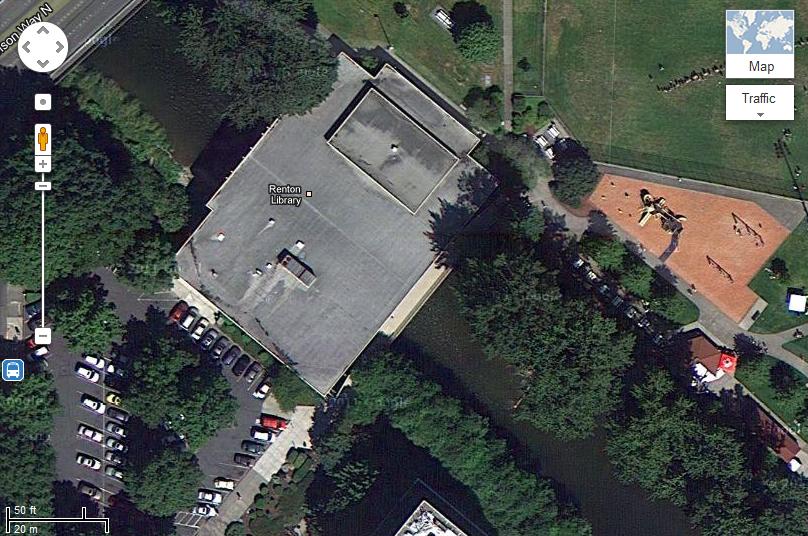
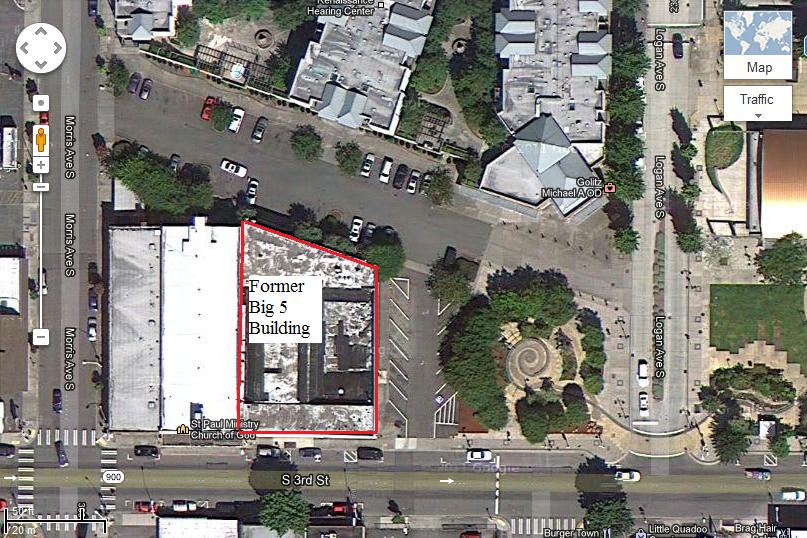
Size comparison of library sites

Citizens for Cedar River Library have raised the issue of physical library space and proximity to a park as major reasons to maintain the existing library site when we update our downtown library.

This issue can be easily understood simply by looking at two same-scale aerial photos of the two completing sites.

Existing Cedar River Site (above): the library site over the river was approved by voters of Renton in 1964 after three previous library replacement proposals at other sites were rejected. The large building footprint, generous dedicated parking, and proximity to the park are apparent in the picture.


West-of-the-Piazza/former Big-5 site (above): while the former Big 5 building will be replaced with another one-story building, this photo (which is the same scale as the one above) shows that the building could never have the proportions of the Cedar River Library. Note that the two buildings immediately west (left) of the Big 5 building are privately owned and the city does not have plans (or funds) to purchase them for library construction. In addition, the diagonal swath of land north (above) the Big 5 building contains a 5-foot diameter Seattle water pipeline, and can not be built upon.

The building proposed for the Big 5 site is therefore restricted to 15,000 square feet. This compares to the 22,500 square foot building over the river (which also has city-owned land around it for expansion if it is ever required.)

Citizens recognized the siting challenge in 1964, when they wanted to replace the 50-year-old Carnegie library but could not find a suitable location after three election tries. Finally, the Chamber of Commerce and League of Women Voters got together to conceive and promote the unique solution of the over-the-river library in liberty park. See below for more details.

______________________________________________________________________________

The KCLS website hosts a PDF of the HISTORY OF THE RENTON LIBRARY, as compiled by the Renton History Museum. It states in part:

“As early as the 1930s, Renton began to outgrow its library; with the explosion of Renton’s
population during the war years, the Carnegie Library was bursting at the seams. A study
conducted by the Washington State Library found that the city’s population had increased by
257 percent between 1940 and 1950. The library built for 8,000 books now held 68,000. In
1944 the King County library established a branch in the Renton Highlands to serve the new
residents of wartime housing there; on January 1, 1947, the Highlands branch became part of
the Renton Public Library. The addition of the Highlands branch further strained the library’s
resources, so much so that the Library Board briefly considered closing that branch for lack of
resources. As early as 1947, the Library Board began discussing affiliation with the county
library system as one solution to the lack of funds, a question that they raised repeatedly
during their meetings in the 1950s.

Nevertheless, cautious voters defeated three bond issues before a $150,000 bond issue was
passed in November 1964. As with the Carnegie Library, two factors were uppermost in the
minds of voters: cost and building site. A survey indicated that many Renton residents
preferred a site closer to downtown businesses and pedestrian traffic, but the City Council
insisted that only city-owned sites, though few in number, could be considered. The successful
bond issue was championed by the Greater Renton Chamber of Commerce and the League of
Women Voters and had at its center the vision of a civic complex on the Cedar River. This
vision made all the difference. Renton residents were captivated by the prize-winning design
for a new library that would straddle the river, near a new City Hall, senior center, community
auditorium, and park grounds.”

Library location ballot wording and voters pamphlet statements are complete

Proponents for both library locations have now submitted their voters pamphlet statements and rebuttal statements to the King County Elections Department in preparation for the Aug 7, 2012 election.

While it is possible that the Elections Department could make some final edits, the complete ballot and voters pamphlet statements will basically read as follows:

BALLOT WORDING

CITY OF RENTON
PROPOSITION 1
VOTE TO SELECT LOCATION OF LIBRARY SITE DOWNTOWN

After Renton voters chose to join King County Library System (KCLS), Renton contracted with KCLS to provide a state of the art library in downtown Renton. The library will be located at EITHER the existing library location over the Cedar River (100 Mill Ave. South), OR West of the Renton Piazza (508 South 3rd Street). If the Piazza site is chosen, Renton will keep the existing library building for alternative public use in the future.

Which location should be the site of the downtown library?

Over the Cedar River?_____ OR West of the Piazza?_______


VOTERS PAMPHLET WORDING

Explanatory Statement:

In 2010, Renton citizens voted to annex to the King County Library System (KCLS). The annexation required Renton to fund and construct two new state of the art libraries to replace Renton’s two existing libraries. Initially, the city proposed to locate the new downtown library at the site of the old Big 5 store west of the downtown Piazza and purchased that land. Since then, the Renton City Council decided to conduct a popular vote regarding the location of the new library in downtown. Voters are being asked to choose the location for the new downtown library construction. There are two locations under consideration: The existing library over the Cedar River (100 Mill Ave. So.), and the site West of the Piazza (508 South Third Street). The city has projected it will cost $10,100,000 to substantially renovate the existing Cedar River library to state of the art library standards. There may be an additional $400,000 cost for temporary relocation of the library during that construction. The combined amount exceeds the current budget for the downtown library development. The proposed new downtown location west of the Piazza is projected to cost, including land acquisition, $9,300,000. This is the amount budgeted. If voters choose the site west of the Piazza, the existing library bUilding will be repurposed for future alternative public use. If the Cedar River location is chosen, the site west of the Piazza would be repurposed or sold. Repurposing of either location will require additional undetermined funding.

Statement in favor of “Over the Cedar River”

Suggestions that the Cedar River location would exceed the budget are misleading. Two clauses in the agreement with KCLS allow for changes to the project/design to keep within budget. A 22,500 sq/ft State-of-the-Art library on Cedar River will be 50% larger than the 15,000 sq/ft proposal at the other location and cost 32.9% less per sq/ft. Renovating Cedar River Library amounts to a family-sized bargain for taxpayers, and good stewardship of revenue. The “real cost” of building a SMALLER library at the other location, rather than keeping and renovating Cedar River Library, would include millions of unbudgeted tax dollars to repurpose the vacated Cedar River Library for “alternate use.” That repurposing could double our cost. A renovated flagship KCLS library over the Cedar River at Liberty Park will continue to be a cornerstone tying our community together. With ample dedicated off-street parking, family-friendly open spaces free of traffic, and many surrounding recreational opportunities, there really is no better place. Consider the real costs. The Cedar River Library will be “state-of-the-art”, be 50% BIGGER, be CHEAPER costing 32.9% less per sq/ft and will eliminate the need to repurpose a vacated city property at future taxpayer expense. Vote Cedar River Library.

Statement in favor of ” West of the Piazza”

Renton’s new library location next to the Piazza provides Renton great opportunities for several reasons. A new light-filled state of the art library with great visibility, onsite parking, centrally located in the downtown business district immediately extends the downtown hub adjacent to the Piazza and the Pavilion. This new library will provide expanded services to our citizens while lowering building and operating costs. This also allows the existing library building over the river to be re-purposed as an environmental center, giving Renton two fantastic assets for just slightly more than the cost of one extensive remodel to the existing library. Being centrally located the new library would open onto the Farmers Market, downtown festivals, car shows, Renton Art Walk and other great community events. Patrons can easily walk to and take advantage of Renton’s nearby downtown businesses. The library also becomes a key component to redevelopment of the downtown.
The clear choice for the new library providing the highest level of service with minimal investment is the new library location west of the Piazza Park. Please vote for the Piazza Park Library that will serve our community and future generations for the next 50 years.

Rebuttal to statement in favor of “Over the Cedar River”:

The West Piazza Library (15,000 Feet) and existing library (22,500 Feet) total 37,000 feet for little more than the costly, complex remodel of the old building, likely subject to cost overruns. Costs to repurpose for a non-library use are significantly less. This is nearly TWICE as much area and avoids a minimum two year closure. The library professionals of KCLS have designed an exceptional Piazza library. Vote for the right location: West of Piazza Park.

Rebuttal to statement in favor of “West of the Piazza”

Don’t be misled again. Libraries don’t drive commerce. Downtown revitalization deserves effective solutions. Moving our library isn’t the answer. The opposition wants you to believe you can have two buildings for one price, but it’s impossible. The city doesn’t have, $5-10 million to repurpose the existing library as an environmental center, nor millions more each year for operating costs. Moving the library would mean more taxes and less library. Vote for the Cedar River Library.

Remodeling of Cedar River Library was presented by city as an option before and after KCLS annexation election

In my previous blog entry about the library, I explored the often-repeated myth that voters in the February 2010 KCLS annexation election knowingly voted to move the downtown library. In that blog entry, I covered the fact that the Renton Reporter, our only local newspaper at the time of the election, never ran a single story that indicated that a vote for KCLS was a vote to move the library– and in fact they implied the opposite in one of their editorials a week before the election.

In this blog entry, I simply want to document that the city information to the public has always presented the remodeling of the Cedar River Library as a viable option for meeting the needs of KCLS. Consider this presentation to the City Council Committee of the Whole in May 2011, fifteen months after the KCLS annexation election. Clearly, the city was continuing to consider the Cedar River location viable. KCLS representatives even participated in the presentation of these site options at the May 2011 council meeting.

Here is an excerpt:

Note that the first site option for the downtown library is the “Existing Library.” Since the city and KCLS were obviously still discussing site options fifteen months AFTER the KCLS election, and the existing site was on the list of options, there is simply no way that anyone can support a claim that voters knew they were choosing to move the downtown library when they cast a vote to join KCLS. No one could have “known” such a thing, because the council had not made the decision.

(The council, not the voting citizens, made the decision on the proposed library location in a 4-to-3 split vote, on June 21 2011–16 months after the KCLS annexation election)

I’ll be blogging regularly to ensure readers get accurate, complete information about the Aug 7 Library election

All of us in city leadership roles, including council members, the mayor, city staff, chamber of commerce staff, partner jurisdictions, and newspaper editors share a common goal to keep our city prospering and our citizens working together. This is as true with our libraries as with anything else.

Often it works best to put controversial decisions behind us quickly, and move on. This approach can minimize times of conflict and keep things moving forward. This works well when everyone agrees that we reviewed all the information before we made a decision.

But powering ahead will not work when large groups of decision-makers feel they have not been given relevant information, or not consulted at all. This is why we find ourselves driving up on an August 7 library election. This is also why it is desperately important for citizens to have access to accurate, complete information before voting.

In yesterday’s Renton Reporter, the editor offered to help provide this information, and “to clear up any half-truths and untruths” regarding the library. I commend the editor for this, but I also issue him the challenge to truly investigate the issues.

The Renton Reporter has not had a perfect track record informing voters about this issue. For instance, three recent Renton Reporter editorials have claimed that voters have already made the informed decision to relocate the downtown library. Here are some quotes: (March 22, 2012) ” majority rules…the city administration was then obligated, legally, to carry out the public’s wishes and negotiate… the details of building two new libraries in new locations.”; (April 6, 2012) “We would argue that the public’s voice was heard two years ago, when a majority of voters decided to annex to KCLS, knowing that new libraries were on the horizon.“; (April 19, 2012) “The Renton Reporter has argued that the City of Renton and the King County Library System had already signed a contract to build a new library somewhere other than over the Cedar River. The plan was clear in election literature and in all the documents approved by the City Council”

But with all these bold (and controversial) assertions that voters two years ago clearly knew they were voting to close the Cedar River Library, had the Renton Reporter ever actually informed voters that a vote for KCLS was a vote for closing Cedar River library in 2010? No. The Reporter instead informed the public there might be a single new library, in the highlands, that the public would get to vote on. Here is an excerpt from the Renton Reporter editorial of January 27, 2010 a week prior to the KCLS annexation: “Renton residents will have some local control over whether the city builds a new library, perhaps in the Highlands, if and when a levy to do so is placed on the ballot. That’s a glimmer of local control, although the building would belong to KCLS.” Beyond this editorial, there were four special reports on the KCLS annexation issue, which you can find linked here; in these reports, the Renton Reporter never once mentioned that the Cedar River Library would be subject to closure with annexation to KCLS. Yet this possibility of closure is obviously an issue of paramount importance to thousands of trusting citizens.

In fairness to the Renton Reporter, I don’t think they knew anything different at the time. But this is an example of where the public needs to see some digging and investigative reporting before they make their decision in the upcoming August 7, 2012 election.

The last 20 percent of the city’s explanatory statement for the August 7 ballot is dedicated to re-purposing issues that go along with the library choices. These (admittedly incomplete) plans require “additional undetermined funding”. If the Piazza library site is chosen, this additional undetermined funding would be three to ten million dollars of one-time money, plus another million or two annually, for maintenance and operation of the Cedar River library building. The newspaper owes it to the readers to make an effort to scope this funding, and not simply refer to the Piazza site as the least expensive one.

As a council member, I am glad this is going to the voters for a decision, and I am happy to implement either location choice. While I prefer the Cedar River Library, I can see why some others like the Piazza location. My real concern is that everyone has the information they need for an informed choice and that they understand what they are signing up for. With less than 90 days before the ballots must be returned, there is no time to lose in terms of getting information out there.

For this reason, I’m going to post some blogs on this topic with the facts as I personally know them, and I’ll ask readers to give them peer review by affirming or challenging them in my comment section. I will be sharing opinions too, and trying to remain disciplined about keeping facts and opinions separated– please feel free to agree or disagree with these opinions. As long as there is a public airing of all the issues, I’ll be pleased with the election outcome. I am confident that this is a feeling city-wide.

Please let me know if there are any specific topics you would like to see covered.

Library location ballot title is being drafted; cost figures still being heavily debated

On Friday I posted the following on Renton Patch in an effort to give as many people as possible an opportunity to participate in the development of the downtown library location ballot wording:

The Renton City Attorney’s Office has published a memo with a proposed library ballot title for council to consider on Monday. Council President Rich Zwicker wants the public to have a chance to review this proposal and make comment before council discusses at our Monday night meeting. Here is a link to this memo.

In addition, Mayor Law has published a memo with an explanation of the cost approach used to evaluate the costs of renovating the existing library. Here is a link to this memo.

I would encourage citizens with an interest in the ballot title wording to review these two memos, and email your comments to the city council at the city website here

_________________________________________

Late Friday afternoon the Renton Reporter ran a story on the topic, which can be found here

While I am glad that Renton Reporter ran a story on this topic to get the word out, I did feel compelled to comment on the story’s headline which read: “Cost estimates show Piazza library downtown is less costly.” Here is the comment I left on the story:

Comment from Renton Councilman Randy Corman:

I feel that the headline is misleading as it currently reads: “Piazza library downtown is less costly.” This headline gives the false impression that because I am a council member who favors keeping the library over the Cedar River, then I am trying to spend MORE money than my council colleagues who wish to move the library to the Piazza. But as an earlier commenter pointed out, construction of the Piazza library would also include remodeling and re-purposing of the existing library, which has not been accounted for in the cost figures. Given no other data, it is reasonable to assume that this remodeling for another purpose would be similar to the cost of remodeling the building as a library. For instance, the cost estimates of roughly half a million dollars for roofing, half a million for new plumbing, half a million for electrical, etc would not change if we did something else with the building.

Hence, this is a more accurate full accounting of the costs:

Library move to Big 5 costs:
New building costs: $9,337,159.
Costs to repurpose CR bldg: $10.1MM.
Total costs to tax payers: $19.4MM.

Remodel existing bldg: $10.1MM.
Temp relocation: $400M.
Total: $10.5MM

It is significantly less costly to the tax payers to keep the library at it’s present location. Put another way, the Piazza library will cost the taxpayers almost twice as much money.

As a final note, I think if we built the new highlands library first — nearly tripling it’s size– we could avoid temporarily relocating the downtown library during construction– we could simply close it temporarily. This would save another $400,000 with the remodeling option.

I don’t normally do my debating in the newspaper comment section, but I just do not want the public to get the false impression that remodeling the Cedar River library is the expensive option, or that I am being careless with their money just to preserve a beloved library building.

(End of newspaper comment)

_________________________________________________________

As a final note, the city has been receiving Freedom of Information requests for library cost and remodeling data, and my understanding is that our City Clerk is working to provide the requested data and get as much data posted to the city’s website as quickly as possible.

Renton starting to do what we do best… working together to find our way

It’s been a turbulent twenty-four hours for everyone involved in the Renton libraries. Last night’s council meeting comprised two hours of testimony and council deliberations, ending in a 3 to 4 council split. I was in the minority, while the majority voted to take no action on the citizen library petition. The complete story on the debate can be found in Renton Patch here and Renton Reporter here.

But before the council chambers cleared, there were conciliatory overtures and mutual expressions of desire to resolve this– no one felt comfortable with so much division in our community. And by this afternoon Mayor Law was working with KCLS, city officials, and councilmembers to find a way to put the location of the library on the ballot.

I’m relieved to see us all pulling in the same direction again, and I know other Renton officials feel the same. We are an amazingly effective community when we are all working together– our Renton citizen/business/government collaborations and partnerships are the envy of the region.

So I’m hopeful and appreciative tonight. I’m also inspired by the people in our community, who were eloquent, informative, and even poetic in the council meeting, and made me proud to live in Renton.

When we start to look towards a vote on the library location, we should also consider options for improving our downtown. If you have not read it yet, I described work in my hometown in this blog here. Perhaps we can find a way to take some similar steps in downtown Renton.

All of your ideas are appreciated. Thanks again everyone.

I believe Council must either adopt the library petitioner’s proposed ordinance, or send it to the ballot

First, two quick disclaimers: (1) my preference would be to keep the downtown library over the river (as I explained here ), so I carry a bias; (2) I am not a lawyer, so I read and understand laws the way a typical legislator or citizen reads them– And I can not give legal advice.

Now, on to my understanding of the current library situation.

Fifteen percent of Renton’s registered voters have signed a petition asking for an election to decide the location of the downtown library. The County auditor has verified the signatures, and the petition now is now going to come back to Renton City Council for action. With such a petition, we are ordinarily supposed to send it to the ballot for a vote of the people, or adopt the ordinance the petition calls for.

The Renton City Attorney and an attorney hired by the Petitioners are battling one another over the constitutionality of the ordinance proposed by the petition (see their conflicting memos near the bottom of this entry). The City Administration has suggested that the City Attorney’s doubts about the wording are a reason for the council to not send the petition to the ballot. But it seems clear to me that the constitutionality of the petition is an issue for the courts to decide, not the city council. The RCW (state law) tells me (as councilmember) to do as follows:

____________________________________

RCW 35A.11.100
Initiative and referendum — Exercise of powers.

Except as provided in RCW 35A.11.090, and except that the number of registered voters needed to sign a petition for initiative or referendum shall be fifteen percent of the total number of names of persons listed as registered voters within the city on the day of the last preceding city general election, the powers of initiative and referendum in noncharter code cities shall be exercised in the manner set forth for the commission form of government in RCW 35.17.240 through 35.17.360, as now or hereafter amended.

[1973 1st ex.s. c 81 § 3.]

RCW 35.17.260
Legislative — Ordinances by initiative petition.

Ordinances may be initiated by petition of registered voters of the city filed with the commission. If the petition accompanying the proposed ordinance is signed by the registered voters in the city equal in number to twenty-five percent of the votes cast for all candidates for mayor at the last preceding city election (Randy’s note: this is 15 percent of registered voters in a code-city such as Renton…see above), and if it contains a request that, unless passed by the commission, the ordinance be submitted to a vote of the registered voters of the city, the commission shall either:

(1) Pass the proposed ordinance without alteration within twenty days after the county auditor’s certificate of sufficiency has been received by the commission; or

(2) Immediately after the county auditor’s certificate of sufficiency for the petition is received, cause to be called a special election to be held on the next election date, as provided in *RCW 29.13.020, that occurs not less than forty-five days thereafter, for submission of the proposed ordinance without alteration, to a vote of the people unless a general election will occur within ninety days, in which event submission must be made on the general election ballot.

[1996 c 286 § 4; 1965 c 7 §35.17.260 . Prior: 1911 c 116 § 21, part; RRS § 9110, part.]

_______________________________

I don’t see anything which tells me to make a ruling on the constitutionality of the wording of the ordinance in the petition. As far as I can tell, such judicial-style rulings are neither a state-granted power of the council nor an area of expertise of the council.

If we do not put the petitioner’s requested ordinance on the ballot, or adopt an ordinance as requested by the petitioners, the RCW spells out a remedy for the citizens as follows:

________________________________________

RCW 35.17.290
Legislative — Initiative petition — Appeal to court.

If the clerk finds the petition insufficient or if the commission refuses either to pass an initiative ordinance or order an election thereon, any taxpayer may commence an action in the superior court against the city and procure a decree ordering an election to be held in the city for the purpose of voting upon the proposed ordinance if the court finds the petition to be sufficient.

_______________________________________________________________________

In summary, regardless of how one feels about the library location or the wording of the petition, I don’t see any place in the RCW that instructs council to arbitrarily decide not to either hold the election or adopt an ordinance because we don’t like or agree with the petition wording. Like we’ve frequently seen in state-wide initiatives, the constitutionality of the wording would normally be decided by a court (if there is still a dispute) AFTER the election, and only if the ballot measure prevails. Our only decision as a council is whether to adopt the petitioner’s proposed action, or forward it to the ballot.

Here is the Renton City Attorney’s memo:
Cityattoneymemo

Here is the memo from the Petitioner’s attorney:
cedarriverlibraryattorney

If any of you readers see this differently (including you attorneys out there), please let me know. Thanks, Randy

On the losing side of 4-3 vote as council choses to move library from river to transit center

Both the Renton Patch and Renton Reporter ran stories about the very significant library vote (and the discussion preceding it) at last night’s council meeting.

I had explained my opposition to this move in my previous blog entry here.

Here is the story in Renton Patch.

Here is the story in the Renton Reporter.  (Update:  This article seems to have disappeared from cyberspace; here is an earlier related article by the Renton Reporter)

We all share desire to revitalize downtown, but it’s not clear to me that moving the library is the answer


Cathy and her Dad at the Ale House on First Street in Livermore, California. Livermore’s award winning downtown has undergone the type of transformation we have been working to obtain in Renton


Fountain on First Street in Livermore California

I don’t have to look any further than my own home town of Livermore California (pop 81,000) for a success story of downtown revitalization. Livermore’s downtown struggled for decades as outlying shopping malls and big box stores stripped away its customers and revenue. In the 1970’s and early 1980’s, Cathy and I would steer away from downtown First Street when shopping or going on a date. But in the last decade they have successfully made major changes. Their shops and restaurants are now bustling, and in 2009 they won a national award for their astounding turnaround. When Cathy and I were in Livermore last month, we waited forty minutes to get seated at a popular new downtown restaurant, and it was worth the wait. While we waited we enjoyed a joyful street scene that would be the envy of any city planners. Read more about their award winning transformation in this article from “Main Street News” here. (Or read Livermore’s official downtown plan, with background data, here. )

Interestingly, during the years they were planning and rebuilding their downtown, they also rebuilt their Public Library– but they did not move it to the heart of their downtown. Their gorgeous new library is actually further from the center of town than the old library was, approximately ten blocks away instead of six. Their old library, which is a beautiful building built when I was young, is now used only for storage.

Since I have so much family in Livermore, I’ve visited the city often over the years and watched the change almost as if it is time-lapse photography. The new Livermore downtown is a result of intensive planning, coordinated traffic revisions, major streetscape improvements, and strong business leadership and partnering.

Renton has taken some of these actions, but we have not gotten as much traction as Livermore at bringing customers to our businesses. In Renton during the last 15 years we purchased a downtown car dealership for about half a million dollars, and then spent a few million dollars to create the downtown Piazza Park and the Pavilion Building (which was remodeled from the dealer showroom). Then, we spent about ten million dollars on a parking garage downtown. We spent about half a million partnering with Renton School District, IKEA, and others, to build the IKEA Performing Arts Center. We purchased and tore down a derelict building near the Historical Museum, and then built the Veterans Memorial for about half a million dollars. We rezoned to encourage residential construction on top of businesses, and we worked with private developers to bring some of this about. In addition, in a move I’ve often wished we could take back, we gave Metro the land to build the Transit Center. All of these moves were intended to provide more people pedestrian traffic in downtown.

While we have had some successes in downtown, we clearly have a long ways to go to achieve the successful restaurant and shopping climate that we are looking for. Lately, I now recognize that this is because simply creating traffic does not assure the creation of customers. People have to be immediately interested in shopping or dining when they pass one of our restaurants or stores, or else they will not add to our customer base. It’s the same reason Google makes billions of dollars on the internet, while most newpapers have been losing money on the internet: People visiting Google are often searching for merchants or trying to find service providers, so they respond readily to Google’s ads– but people reading the New York Times are looking for news– ads are just a distraction.

In the case of business districts or the internet, traffic generated by people who are not looking to make purchases will use up road capacity/band width, but will not generate revenue. Common examples of these types of users of Renton’s downtown include motorists driving through from South Seattle to Issaquah, motorists avoiding I-405, bus-riders making tight connections at our transit center, and commuters using our transit center as a park-and-ride. We get tens of thousands of these per day, and we are lucky if we can sell one-in-fifty of them a cup of coffee.

What we really want, and what Livermore has succeeded in capturing, are people headed to downtown BECAUSE they want to go to a downtown restaurant, shop, or entertainment venue… the same reason they are going to Renton’s Landing. To get to this point, the streetscapes, restaurants, shops, and entertainment venues all have to offer what customers are looking for.

One immediate question Renton City Council is facing is whether moving the library downtown will help bring customers to Renton businesses, or at least do it better than other options we might have before us. I am not convinced that moving the library will help. In fact, I think it is possible that library patrons will simply use up more parking and road capacity in our central business district without adding to the business customer base. Like readers of the newspaper in my internet example above, library patrons can not be assumed to be in a “buying” mood. They are very likely to spend no more than a user of the transit center while they are in our downtown. And while it may seem funny to worry about parking now, if the downtown developed the way we would like it to, library parking demand could conflict with business parking demand.

I share the Mayor’s and the rest of Council’s concern about improving our downtown. And I think we should work hard on the next phase of our plan for doing so. I don’t claim to have all the answers, but I do have some ideas. When I look at the Livermore example, the amount of spending we have dedicated to landscape and streetscape in downtown has been minimal. Our 1.5 million dollars spending on Piazza landscape and Veterans Park together accounted for only about ten percent of the 15 million dollars Livermore spent making improvements to beautify their streets and sidewalks in the central business area. We spent most of our money on parking (ten million dollars), something that was important for us but less of a problem in Livermore (which had large undeveloped lots for parking). This makes me think we are overdue for a major streetscape update. But I would not want to do this without something else Livermore enjoyed– a strong commitment by property owners to update/replace their aging buildings as required. We should not commit taxpayer funds without confidence that the private sector is going to do their part. If property owners are not ready to make this commitment this year because of the recession, we may have to wait until enough of them ARE ready to commit.

In addition, we need to continue the Mayor’s current emphasis on crime prevention. I’m glad we are moving toward zero-tolerance of nuisance crimes in the transit center– this facility has generated too many complaints for too long. (If we can’t stop the complaints, I would even be open to the idea of closing the transit center and working with Metro to make the Grady Park and Ride the new place to catch a bus. It would be a shame to let criminals and punks cause us to close the transit center when it is used by so many people– but it would also be wrong to continue to let people get hurt or frightened while trying to use a public facility.) For now, we should see if the new emphasis on crime prevention is going to work.

Lastly, if we decide to move the library downtown, it should be part of a comprehensive plan, with broad consensus, that we collectively feel is our best hope to revitalize our downtown and make the business climate thrive– The same type of planning that revitalized the downtown in my home town. I don’t feel that we are there yet, so I am not ready to vote to move the library.

Cathy’s Mom and Dad at the Ale House in Livermore


Four Generations: Cathy’s Mom, Cathy, our daughter Katie, and her daughter Carolyn enjoying coffee at an independant coffee house on Livermore’s revitalized first street

Livermore’s First Street in 1955

Livermore First Street in 2006

Livermore’s First Street in 2011


Livermore’s old first street buildings are almost hidden behind new landscaping that a Parisian would be proud of


Even the alleys were included in Livermore’s downtown makeover; Public Works price tag for the whole job– about 15 million dollars.


Livremore’s transformation required a strong buy-in and donations from the public


Livermore’s new public library is further from the center of town than the old library


Livermore’s old library– used only for storage since it’s replacement about ten years ago