An agenda bill at Monday’s Council Meeting announced that Renton taxpayers will have to pay even more money for having hosted a King County Shelter in our former Red Lion Hotel.
Renton’s former Red Lion Hotel and Convention Center, once a vital anchor of our Renton Village Shopping Center before it got destroyed during use as a pandemic-era shelter, continues to cost Renton taxpayers money. As of this week the hotel will cost Renton taxpayers another $600,000, and will cost Renton’s insurance carrier another $900,000, for a total of $1.5 million. The money settles a lawsuit that the hotel owners filed against Renton asserting that Renton’s 2020 zoning changes, which restricted the size of homeless shelters, lessened their opportunities and profits on the property.
While I have not been party to the legal negotiations and won’t comment to the validity of any of their specific claims, I will point out that the public record shows they purchased the hotel for about $8.8 million, and sold it to King County less than ten years later for $36.2 million. This represents more than 400 % return, or about 40% per year on their investment. They also reportedly rented the property to King County for $330,000 per month for several years, for an additional payoff of somewhere between 6-10 million dollars.
This Renton School District chart is deceptive. It shows taxes dropping on a home “valued in 2025 at $750,000.” But the value of the unrealistic house in this chart is $750,000 every year (not just 2025). Real Renton houses doubled in value during these ten years and had major increases in their taxes.
Renton School District is preparing to ask voters to renew operating and technology levies on the November ballot. While I support schools, I’m alarmed (again) by the misleading and unethical way District leaders are making the case for the money.
Their current website has a chart for an “Example home valued in 2025 at $750,000,” and shows the taxes dropping from $4,012 in 2016 to an expected $2,542 in 2026. That sounds great, except it is completely wrong.
A typical home worth $750,000 in 2025 would have been valued at about half that in 2016, or approximately $375,000. Hence the Renton School District local taxes would have been $2006, not $4012 back then.
So 2026 taxes on an “Example home valued in 2025 at $750,000” have risen about 25% over the time period, NOT dropped by 37% as errantly shown.
This chart has earned an “F” in both mathematics AND in ethics.
A Renton reddit user recently posed a question on a Renton reddit page asking “could we please have light rail connectivity in Renton?”
Click here to see the complete Reddit thread on this topic.
One commenter says Renton Councils and residents of the past didn’t want light rail, some point to unfair lack of Renton representation on the Sound Transit board when key decisions were made, some point to Renton’s lower density than Seattle, some say our topography is to blame, and some say we’re not working hard enough to get it today. One made an interesting point that Boeing, our largest employer, has many workers with shifts starting too early in the morning for Sound Transit trains (although Everett has a similar workforce and it is scheduled to eventually get Link light rail).
I’ve covered Renton’s concerns regarding Sound Transit extensively in the past, and I don’t agree with some of the reddit comments. For instance, I always wanted Link light rail during the time I was on council (first writing about Renton’s struggles with the agency in 2007), and I don’t think our topography or density are less suited than other areas like Redmond or Issaquah. I also agree with many of the comments, and I’m happy to see our community discussing it. I’m impressed with the level of interest and engagement by our community.
As I’ve said in my previous blog entries, I would like to see Sound Transit complete the five million dollar study that voters agreed to as part of Sound Transit 3 to determine an alignment and layout for a future Link light rail station in Renton. This study should be completed soon, to make sure Renton is not left out of any future Sound Transit 4 planning.
Renton resident Sarah Becker presented to Renton City Council last night regarding the eminent domain takings around Renton High School. Her notes are attached below.
Renton School Officials have repeatedly said that Renton High School is built on “a small parcel of land” and should have 30-40 acres to be competitive with other high schools. But Renton resident Sarah Becker put together data showing Renton High has more property than many high schools in our region, especially when taking into account the nearby 17-acre Renton Memorial Stadium that is available for Renton High use.
She presented the data at last night’s Renton City Council Meetings, and asked the City Council to help stop the destruction of 32 homes and eight businesses being taken by Renton School District by threat of eminent domain.
While Renton Council did not initiate the eminent domain takings, the Council arguably has the power to stop the takings because the plan requires the Council to give the school district three public streets. If Council said “no” to the street taking, the District’s plan could not go forward (the School District can’t take city-owned property by eminent domain). And in addition to saving 32 homes and 8 businesses, Council has good reason to keep these streets. South Tobin Street is an important alternative to Airport Way in a high traffic area constrained geographically by Renton High School, Renton Airport and Lake Washington. Without South Tobin, any disruption to Airport Way could gridlock Renton.
Ms. Becker also put together a listing of all the affected properties purchased so far under threat of eminent domain, and noted that the cost has exceeded 38 million dollars even before the School District has acquired the ten most-contested properties; the takings of these ten properties have now been turned over to the School District’s pricey outside law firm, who is initiating a potentially costly legal fight with the owners of the land. If the District wins these court fights, this land will end up costing taxpayers 10-20 million more.
If Renton ultimately submits to giving up streets, the School District should pay Renton for the land. The streets belong to City of Renton taxpayers, and the School District has larger geographic boundaries extending into Newcastle, Kent, Tukwila and King County. City of Renton voters have never agreed to donate this property to the larger school district. The fair market value of the land under these streets is probably another ten million dollars or more.
All told, the district has over 38 million invested with potentially as much as another 20-30 million to pay out to acquire land before they even break ground. The purchases will allow them to move the ball fields a few hundred yards east, where they might be allowed to have lights on them– but 100 or so residents and eight businesses will have lost their homes. As I showed in a previous entry, this is likely the most expensive high school baseball complex ever built.
Here are Ms. Becker’s charts:
Acreage data summarized by Renton resident Sarah Becker and presented to Renton City Council
Sales data of properties around Renton High School summarized by Renton resident Sarah Becker
“There was once a Countryman who possessed the most wonderful Goose you can imagine, for every day when he visited the nest, the Goose had laid a beautiful, glittering, golden egg.
The Countryman took the eggs to market and soon began to get rich. But it was not long before he grew impatient with the Goose because she gave him only a single golden egg a day. He was not getting rich fast enough.
Then one day, after he had finished counting his money, the idea came to him that he could get all the golden eggs at once by killing the Goose and cutting it open. But when the deed was done, not a single golden egg did he find, and his precious Goose was dead.
Those who have plenty want more and so lose all they have”
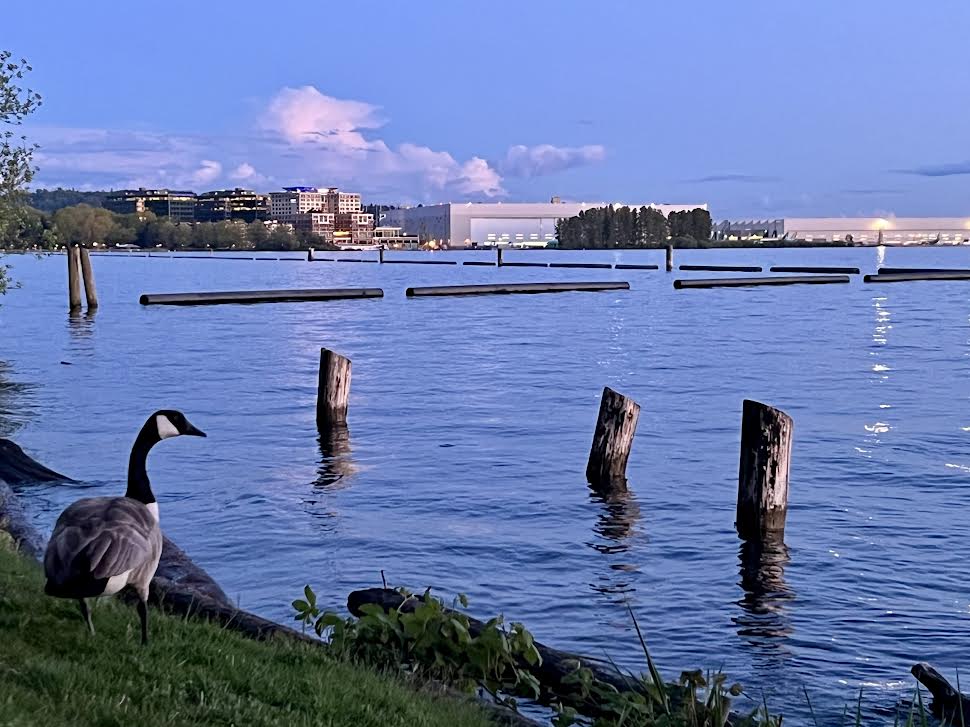
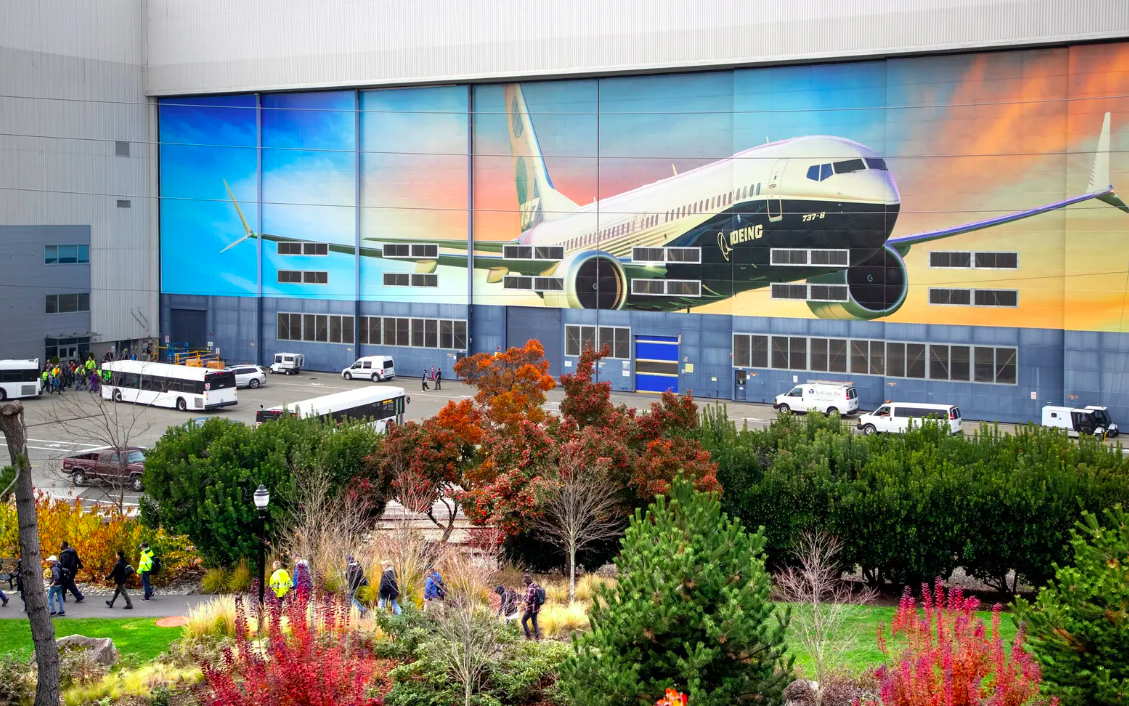
For decades Renton’s prosperity has been supercharged by the Boeing Company, which provides thousands of living-wage, union-represented, machinist and engineering jobs to Renton residents and their families. Boeing also employs pilots, scientists, supply-chain specialists, logistics professionals, managers, administrators, and many others. And they typically give their employees benefits that include health care, vacation, sick leave, parental leave, life insurance, and 401K packages.
This money comes to Renton from global sources– everywhere in the world where 737’s are sold. The Boeing Renton factory can assemble three billion dollars worth of product per month. This outside revenue coming into Renton fuels economic activity throughout our region, as Boeing keeps local suppliers in business, and the money they distribute in payroll flows from aerospace workers to homebuilders, retailers, restaurants, service providers, and local and state governments. Boeing’s international revenue allows Puget Sound’s other successful large companies to flourish, like Starbucks, Costco and Amazon, as well as countless small Renton businesses like Common Ground Coffee and Cupcakes, Boon-Boona, and The Sub Shop.
But after the MAX crashes and the Alaska door plug blowout, Boeing’s worldwide prominence and reputation have taken a severe beating. The story has now been extensively covered by everyone… New York Times, BBC, Seattle Times, 60-Minutes, Congress, even Boeing themselves. Boeing’s 1999 merger with McDonnel Douglas sparked an identity crisis in their executive ranks in which a new focus on “shareholder value” overtook their historic culture of innovation, achievement, and excellence. Now Boeing and the FAA are working to fix things. Among their various efforts, Boeing keeps trying new CEOs, working to find one that can help them regain the safety-culture that propelled them to technical and economic prominence. Most of their engineers and machinists never lost this culture, so it’s more a matter of elevating it back into the top ranks. It is something Boeing can do, and needs to do, with a current backlog of 6,200 airplanes, and as our nation’s only builder of air transport jets for the future.
Boeing’s reputation had sunk so low that even before a door plug blew off a 737, Seattle’s progressive newspaper “the Stranger” was already seriously suggesting that the Boeing factories should be sold to Amazon.com to serve as warehouses. While I’ve heard this notion suggested before, I was surprised to read it in such a progressive newspaper. Only about ten percent of Amazon’s jobs are union, while the majority of Boeing Renton’s factory and engineering jobs are union. And while the average machinist will soon be earning six-figures and have full benefit packages under their newest 2024 contract, Amazon warehouse workers frequently make close to minimum wage, and are only eligible for benefit packages if working full-time in some jobs. Replacing career union machinist and engineering jobs with Amazon warehouse work is hardly progressive.
But “the Stranger” is not alone in suggesting Boeing has a limited life span left in Renton. Business journals like Leeham News predict Boeing may leave Renton in 2033, just eight years from now. If this happens, the future of the Boeing property should be of serious concern to all residents of Renton. Back in the 1990s, when a rumor broke that Boeing was considering consolidating in Everett, Renton’s Mayor Tanner spearheaded a plan to put overlay zoning on the Boeing property to turn it into a biotech research office center if Boeing moved out. Southport office towers were part of this plan. But pandemic-era work-from-home changed the landscape for office projects, and it’s doubtful this plan would work.
The most likely outcome would be the one predicted in “The Stranger,” a combined Amazon/Fed Ex facility that utilized the airport and the massive Boeing production hangars. These companies would likely be high-bidders for the property. And they would get political support from King County Port Commissioners and King County Council Members who need to free up space at Seatac and Boeing Field– moving air freight to Renton would help them immensely.
But Renton’s environment would suffer dramatically from this change. Instead of having two brand-new empty 737 takeoffs per day, we could have day and night air cargo operations using older airplanes. Much of downtown Renton would find itself in a noise zone, with windows rattled regularly by older jets and turboprop aircraft. In short order, FAA would be leaning on Renton, again, to extend the runway right into the newly rebuilt Renton High School. We would succeed in bringing the noisiest operations of Boeing Field and Seatac into the heart of Renton’s historic downtown. There is nothing desirable about this scenario.
“The Stranger” alternatively suggests that the Boeing Renton property could be used for low-income housing, which is certainly a possibility. I don’t think that non-profits or governmental organizations would outbid Amazon for the property, but perhaps they might. While this could help the regional housing shortages, Renton Council and residents must be aware that even market-rate housing is a net drain on Renton’s resources, costing more to provide services to than the users of the housing pay in taxes. In contrast, Boeing is a net producer of tax revenue, giving more to the city than they use in services. Replacing Boeing with housing would directly negatively impact the City of Renton’s budget by millions, and possibly tens of millions, of dollars per year. Along with losing thousands of living-wage jobs, this would deliver a one-two punch to Renton’s finances, and the impact would have to be made up with higher taxes on everyone in Renton.
The scenario for this property that works out best for Renton is for Boeing to rediscover its quality and safety culture, and to continue to build jets in Renton. And this includes the new small-medium airplane that eventually replaces the 737s and 757s that were always built in this factory.
Yes, Boeing has space in Everett where they could consolidate, and they’ve also shown a tendency to move work to South Carolina which has lower labor costs. But Boeing has historically thrived in Renton, running the most efficient airplane factory on the planet. And as their current home, Renton ought to be working to retain them here. If Boeing announced they were holding a contest to locate the production line for a 737 replacement, every city in America would be competing to win the factory. And Renton is the incumbent… the one to beat. Renton should be working NOW, doing everything reasonably possible, to remain the preferred site for Boeing’s small-medium (single-aisle) airplane manufacturing.
Unfortunately, that has not been happening lately.
Taxes:
In 2016, during a time of budget challenges in Renton, the City of Renton implemented a B&O tax for the first time. With a three billion dollar monthly revenue stream from 737 sales, Boeing was understandably concerned that they would pay the lion’s share of the proposed tax. Mayor Law reached an agreement with Boeing that Boeing would not fight the tax if Boeing’s share was capped at five million dollars per year, and the tax was imposed with Boeing’s acquiescence. In 2022, the City of Renton approximately tripled Boeing’s B&O taxes, escalating their rate over three years from the pre-agreed capped five million per year to 12 million per year plus a small fraction of their annual revenues. Renton already has one of the highest property taxes in the area, with schools getting the biggest share.
A four year step-up in Boeing’s Renton B&O taxes was implemented in 2022, and has now approximately tripled this tax (approximate because it is now based partly on confidential revenue data).
And Renton’s 2025 total property tax levy rate (including schools, county, city, hospital, library, and others) is $10.02 per thousand in assessed valuation. This is about 10% higher than Everett’s and Seattle’s rates of about $9.00, and 30 % higher than Bellevue’s rate of $7.30.
Currently the State Legislature is developing a suite of new B&O, payroll, and property taxes they may levy on Boeing and other large employers which would be additive to Renton’s new tax increases.
Airport Facilities:
Renton Airport and Boeing traditionally have worked together to keep as much property available for general aviation as possible, while supporting Boeing production as necessary to meet world-wide demand for airliners. Over the years Boeing has vacated leased airplane parking aprons and facilities they’re not currently using, but by mutual understanding, Renton Airport puts these properties in limited-term leases in case Boeing needs them again for airplane production. But new airport management, and a new focus on having tenants pay to completely rebuild airport-owned buildings, will require new 40-year leases with non-Boeing tenants. This will limit the options for Boeing in the future. Furthermore, an increased focus on Business jets at Renton airport increases the likelihood that the total number of Boeing new airplane take-offs, combined with business jet take-offs and landings, will reach the threshold that requires a longer runway.
In the past decade Boeing has also seen significant rent increases for their airport leased space, and new “through-the-fence-fees” for use of the airport; these charges would be okay if they went into diligent airport maintenance, but lately airport maintenance has been lacking as pavement and markings wear out and leased buildings get ignored.
Other infrastructure:
Boeing has special high pressure water lines serviced by the Seattle Water System. If these lines are broken, factory production stops (at a cost of millions of dollars per hour). Renton recently approved a controversial housing project that sits so close to these lines that it puts them in jeopardy in spite of Boeing’s warnings.
Sound Transit was unwilling to include either a Link Light rail station or Bus Rapid Transit station near Renton Boeing in previous phases, and Renton needs to keep pressing them for service in the future. PSE has modernized much of the Eastside electrical infrastructure in Bellevue and Redmond, running transmission lines through Renton to do so, but Renton’s grid near Boeing and the Landing still has less reliable equipment. Renton should be pushing them for continuous upgrades.
In summary:
Renton’s goose that lays golden eggs may be going through a moulting season, but that’s no reason to kill it. Renton’s Economic Development Department, Airport Management, and Renton Council should be actively working to ensure Boeing’s next single-aisle airplane gets built here.
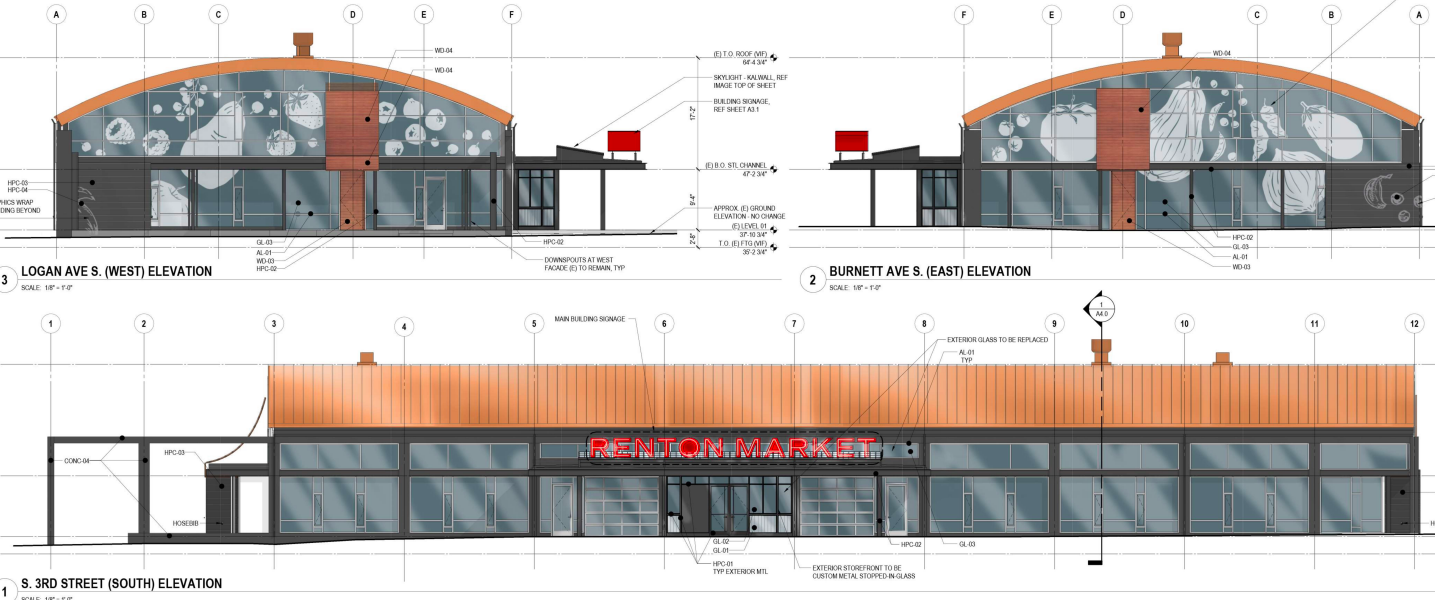
Current city drawing for Pavilion Market submitted as part of permitting process
The City of Renton is paying a consultant up to $49,000 to write a proposed lease agreement for the remodeled Renton Pavilion. As part of this work, the consultant is supposed to be asking the public what we want to see as the future of this building. The public should be weighing in now with our thoughts on the details of what we want to see.
One detail I’m not happy about is that even though both responses to Renton’s formal RFP process in 2019 retained substantial event space, the latest market concept no longer has event space other than a cooking classroom and possible banquet seating in one of it’s anchor restaurants.
For over 20 years the Pavilion has served exclusively as an event space, drawing large groups of people to downtown, sometimes hundreds at a time visiting for the first time. When the Spirit of Washington was operating both the dinner train and the Pavilion, Renton saw up to 200 events per year in this building, with some events bringing in 300 people or more. The Pavilion was so busy that the Renton Council had to move the “Movies in the Park” just to spread out the large gatherings we were attracting in our downtown. The Pavilion contributed to a renaissance in our downtown, helping inspire the name of the Renaissance Apartments next door to it. Then a frustrating deal between Burlington Northern Santa Fe Railroad and Washington State Department of Transportation ended our Dinner Train and sent Spirit of Washington packing.
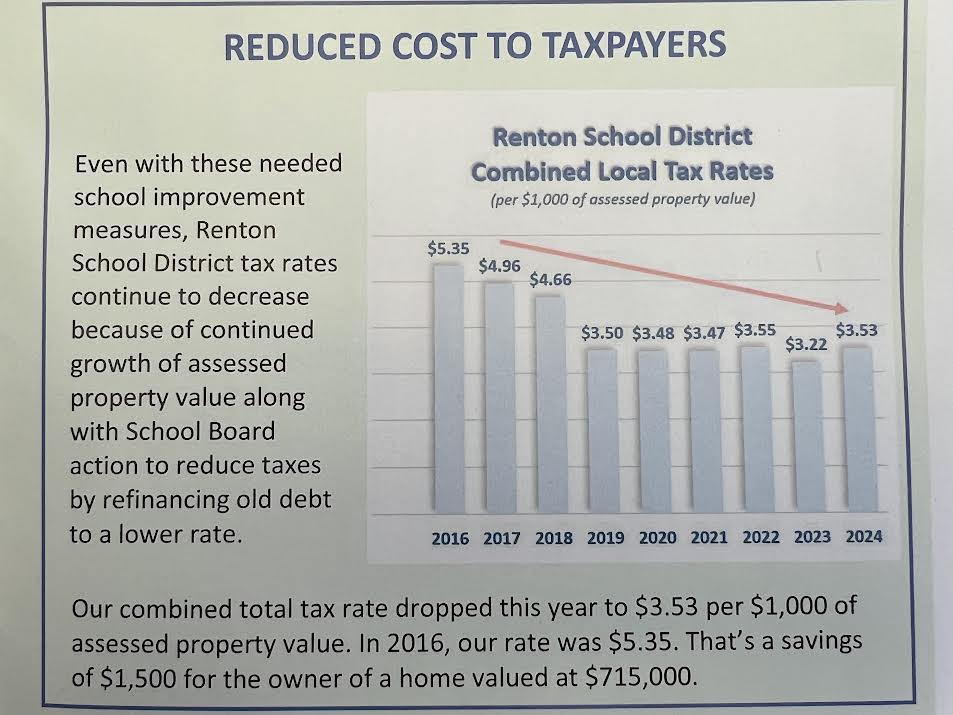
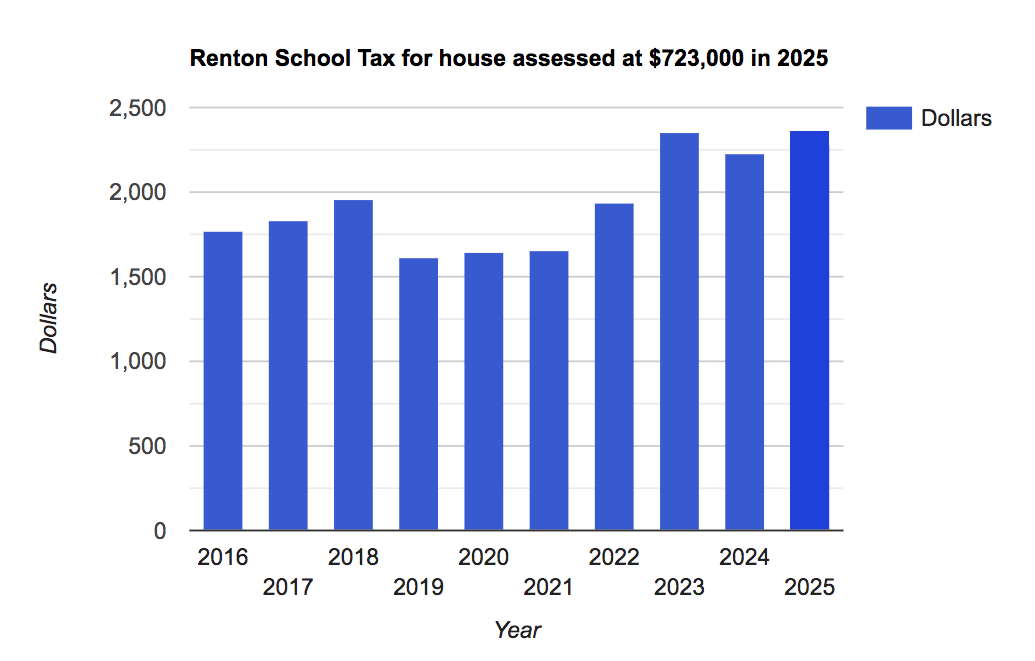
Renton School District sends out regular mailers telling us they are reducing our costs. They base their analysis on a non-existent (magic?) house that did not increase in value from 2016 to 2024. Can we really trust them to educate our children when they present data in such a misleading way?
In reality, the taxes for the school district are rising quickly. This is a typical Renton Highlands house (owned by my son) valued at $723,000 in 2025. This house appreciated at a normal rate with all the others, with no remodeling. The local school taxes went up significantly, not down $1500.
Contrary to the District’s published statements that typical taxes have gone down $1500 over ten years, Renton’s local school taxes have actually been going up fast, rising by many hundreds of dollars per year for a typical home during this time.
Renton voters approved a new Renton High School at a new location, with this concept drawing illustrating the school potentially at the former headquarters of Wizards of the Coast on Lind Ave. Some of the office buildings are repurposed in this rendering. This was estimated to cost $441 Million. The School Board is instead implementing a rejected (not voter-approved) concept of a new school at the current high school site, for a cost of $568 million plus rapidly escalating land acquisition and other costs.
Following the Uvalde Texas School Shooting in May 2022, Renton School District prepared a School Bond Proposition to pay for prudent safety and security upgrades, to protect our children. $182 million would be spent district-wide on entry point access controls, security systems, and video cameras, along with earthquake improvements and overdue heating and ventilating system replacements. The District also felt it was time to make a major upgrade to Renton High School, and they proposed relocating it as the cost-effective option that also preserved the historic Renton High buildings for other purposes. 64% of Renton voters ultimately approved this measure, including me and my extended family.
Everyone who’s enjoyed the Universal Studios Tour in Los Angeles can tell you about the Hollywood magic that can make you believe a facade is a whole building. The Courthouse in “Back to the Future” is a good example.
Our historic Renton High School will soon be another example of this type of illusion, with engineers and architects working to figure out how to support the front facade of the building while tearing down the building behind it.
The “Back to the Future” courthouse, seen from above
But voters did not ask for our century-old Renton High School building to be reduced to a Hollywood false front. Voters clearly wanted the building saved. The November 2022 ballot directed voters to the School District website for details about the ballot issue, which explicitly read “We will not take down the current Renton High School (we will continue to find uses for this building).”
The top floor of the Science building in Renton High was remodeled in 2024 at a cost of 11.5 million dollars, and is now scheduled to be torn down as part of Renton High School replacement
Renton School District just used taxpayer bond proceeds that we approved in 2019 to complete a $11,500,000 upgrade in the science building of Renton High School. The School Board is now making plans to tear this building down.
There are about 1,300 students at Renton High, attending for four years. So during the approximately four years this Science Center will have a chance to be used, it will have cost about $8,800 per student to make this upgrade (11.5 million/1300 students). Along with other pictures below, I’ve included a photo of the “before” condition of the science classrooms; they were remodeled in 2000 and certainly still look serviceable.
By state law, Renton has to complete a city-wide rezone by June 30th to include duplex, 4-plex, and 6-plex options in many single family zones. The closer the property is to transit and the city core, the greater the potential density.
As described in my previous post, Renton School District is actively pursuing property adjacent to Renton High School to relocate their baseball facility (at a possible cost of 100 million dollars). The targeted property owners describe the School District’s agents like bill collectors– phoning them at all hours, knocking on their doors, and mailing them urgent and frightening messages. The District hopes to complete their acquisitions soon, in April.
While some property owners have capitulated under the pressure and accepted a District offer, other property owners say they are being low-balled, and have vowed not to go down without a fight. These fighting-residents are seeking appraisals to counter what some describe as dismal or even predatory offers from the district.
The Renton School District is on a buying binge, going after 42 business properties and single-family homes to amass ten acres to move their baseball field. They’re apparently surprised by the high prices, and are starting to use eminent domain to take properties. With many multi-million dollar properties in the mix, one of them reaching 6 million dollars, the school district could potentially end up spending 60-80 million dollars on this property before they are through. Then they will have to pay to close several city streets, relocating all the utilities. They’ll also have substantial demolition costs, and environmental cleanup costs for some of the properties. And they will have archaeological preservation costs, as this former Black River riparian zone may have significant historical artifacts. All told, they could spend 80-90 million on site procurement and preparation before they even start work on the baseball field.
This means Renton High’s new baseball field could exceed the costs of our nation’s most over-the-top high school football stadiums, even before we install the first bleacher. That almost certainly makes it the nation’s most expensive high school baseball field.
In my blog entry of November 30, I provided documents describing King County’s anticipated purchase of the former Renton Red Lion Hotel. The documents show the County was choosing to purchase the damaged hotel instead of repairing it to save cost. Their future plans for the building and the site were not revealed.
That purchase was recently completed, and the questions have not been answered regarding their intended use for the property.
Renton’s former Red Lion Hotel remains boarded-up after being used as an emergency shelter during the pandemic
Former Mayor Denis Law received news that King County is preparing to buy the Red Lion Hotel, and he has written to two of our County Councilmembers to ask them to help improve inter-agency collaboration. King County’s plans appear to be intended to relieve the County of further ongoing costs, while failing to return a hotel in serviceable condition. Per King County documents: This property is being purchased to relieve the County of liabilities associated with the License Agreement. The property previously operated as a hotel at this location, is currently vacant, and there are no known plans for the property to be used at this time.
The news that the hotel will likely be purchased by King County with no specific plan to make the property productive motivated former-Mayor Law to speak out for Renton on this topic. Here’s his full letter to Council Members Upthegrove and Dunn.
As you are well aware, the homelessness crisis in this state continues to be one of the most frustrating issues with the public. Despite spending literally billions of dollars in tax dollars, the numbers continue to grow. There obviously are no easy solutions but one thing is certain: merely dedicating billions of taxpayer dollars has not made any progress to date.
I strongly feel that a poorly executed plan to decentralize Seattle’s homeless to suburban cities during the beginning of the COVID crisis, including taking over a hotel in Renton, proved to be a total failure that continues to cost taxpayers millions of dollars. This is only one of many such projects and we’re talking about millions of dollars for the Renton location alone.
As you know, the County, operating under a, “declaration of emergency,” took over the Renton Red Lion Hotel in April, 2020, to house up to 200 chronic homeless individuals with a goal to help stop the spread of COVID. This was done with no input from city leaders, which was legal due to the emergency declaration, but totally inappropriate and lacked in any sense of collaboration. To be fair, the COVID crisis was an emergency since everything was shutting down as the pandemic and fear spread like wildfire across the country. However, there was no effective plan of managing and serving this population that was relocated to the hotel and the consequence was considerable. Renton police and fire were overwhelmed with emergency calls for service at the hotel, from arson fires to assaults and other crimes. Local businesses were severIy impacted and in the end, upwards of $18 million dollars in damage was done to the hotel. The county’s contract agreement with hotel owners obligates you to return the hotel to its original condition, which has created another very costly challenge.
The homeless tenants were moved out of the facility within 16 to 18 months, around September of 2021. Fast forward to today, 26 months later, and the hotel remains boarded-up and surrounded by cyclone fencing. This is a major gateway to the city and has remained an eyesore for all this time. To make it worse, the County has continued to pay the owners of the hotel $330,700 per month in lease payments, more than $8.5 million since the buildings were vacated.
I must admit that the numbers I have may not be totally accurate, but they have not been disputed during conversations I have had with a couple county council members. The reason for my angst now, in addition to the hotel remaining an eyesore at the entrance to Renton, is a proposal before the county council to purchase the building. It’s my understanding that this is due to the huge amount of money required to repair the building, and there is no reasonable way the county can justify paying these repair costs and come away with nothing. The purchase price is $36,200,000 and to my knowledge, there has been no public discussion regarding this expenditure. This price is essentially for only the land since it’s likely the buildings would need to be demolished for new development. Here is some of the justification made to the county council for authorizing this purchase:
King County’s “Rationale for transaction:” Under the License Agreement the County is responsible for damages caused by the County’s use. While being used as a quarantine site during the COVID-19 pandemic, guest rooms, and common areas were extensively damaged. Damage ranges from broken furnishings such as mirrors and lighting, to soiled carpeting, to water damage due to demising walls and ceilings from over run toilets and bathtubs. There is also damage from an intentionally set fire in November of 2020. The estimated cost to restore the property to the condition contemplated by the License is $17,920,000. In addition, the County is paying $330,700 per month under the terms of the License. Acquisition of the property will relieve the County of the liabilities of the License.
In the end, taxpayers will pay upwards of $70 million dollars or more for this one initiative to address homelessness in King County. There’s no accounting on how many other similar scenarios exist, and not a surprise that billions of additional tax dollars continue to be budgeted by the state, King County and Seattle to address homelessness. There have been a number of initiatives created by these entities that have been disbanded due to a lack of funding or adequate outcomes. Again, there is no question that this is a very complex crisis, but there seems to be a need for better collaboration between government agencies as well as more public transparency on total costs and results.
I appreciate that you both have taken steps in the past to address the negative impact this effort has had on the Renton community and local businesses. It seems apparent at this point the county has few options remaining other than spending millions more to resolve the Red Lion issue. Finally, I feel it’s totally inaccurate and unfair for housing advocates to label cities as uncaring or unwilling to help vulnerable populations when they challenge the process of addressing homelessness.
I strongly encourage you to work with Renton’s elected officials on future plans for the Red Lion site.
Millions of dollars were allocated in Sound Transit 3 to study a link light rail connection between Renton, Tukwila, and West Seattle. The study must be prioritized. Photo credit: Sound Transit
As I’ve covered in previous blog entries, Renton taxpayers have paid between 1-2 billion dollars for Sound Transit, and have received very little benefit.
When Sound Transit 3 (ST3) was approved by voters, it included several million dollars for a planning study of a light rail connection to Renton. Renton must continue to push for this study to be completed, to ensure we are not left out of link light rail if a Sound Transit 4 is proposed in the future.
Many transit insiders believe there will be an ST4 proposed within a few years, as Sound Transit 3 funding isn’t covering all of the ST3 commitments, with one of the latest challenges being the quantity and cost of new trains. While the Sound Transit Board has a fiduciary duty to deliver as best they can with the funds they are allocated (making necessary compromises to design, operating frequency, implementation schedule, etc), the public could bring forward a new proposed ST4 bond issue to resolve these issues and enhance this service at any time. The last I heard, the buzz was that it may happen between 2024-2026.
We must have a Renton Link Light Rail connection in any future ballot proposals. I worked hard along with Renton’s Mayor and several council colleagues to get the Renton study into Sound Transit 3, and we then worked to jump-start the study by hiring a consultant to help us identify potential station locations and potential alignments. We now need for Sound Transit to take this good work, and finish the job.
“The planning studies would help to identify the range of alternatives, evaluate potential routes and station locations and terminals, inform local comprehensive planning, prepare for formal environmental review and engineering, and position the Sound Transit Board to evaluate options and establish priorities for implementation in future phases of high capacity transit investments in the region. The studies will include public outreach, preliminary environmental assessment, ridership forecasting, and conceptual engineering and cost estimating.
The studies include: HCT Study: Light Rail Extending from West Seattle to Burien, connecting to Renton via Tukwila This study would examine a light rail extension from West Seattle to Renton via Burien and Tukwila. The study would be completed in coordination with local transit partners to examine a variety of options for service provision and to maximize opportunities for regional integration.”
The Issaquah-Kirkland line is an example of a completed study. It includes 4 new stations and was funded with Sound Transit 3.
Part of the approved (and funded) plan for a Kirkland to Issaquah line
It’s way past time for Renton to get on the Sound Transit Link Light Rail long-term plan. Unfortunately there are Seattle-based transit interests that don’t think Renton deserves a light rail line and they still want our tax money. Renton officials must push back against these opinions. For example, prior to ST3, the popular Seattle Transit Blog published an article which said:
‘The “tell” of excess focus on new regional connections is the heavy emphasis on the east-west Burien/Renton corridor. To put it mildly, this is not a corridor where existing demand suggests a need for true high-capacity transit.’
Renton officials must be firm advocates for Renton when working with Sound Transit, so that Renton taxpayers do not spend many more billions of dollars while receiving very little benefit.
Part of the ST3 commitment to voters. Source: Sound Transit
Sound Transit’s 2023 Progress report does not include any discussion of these planning studies.
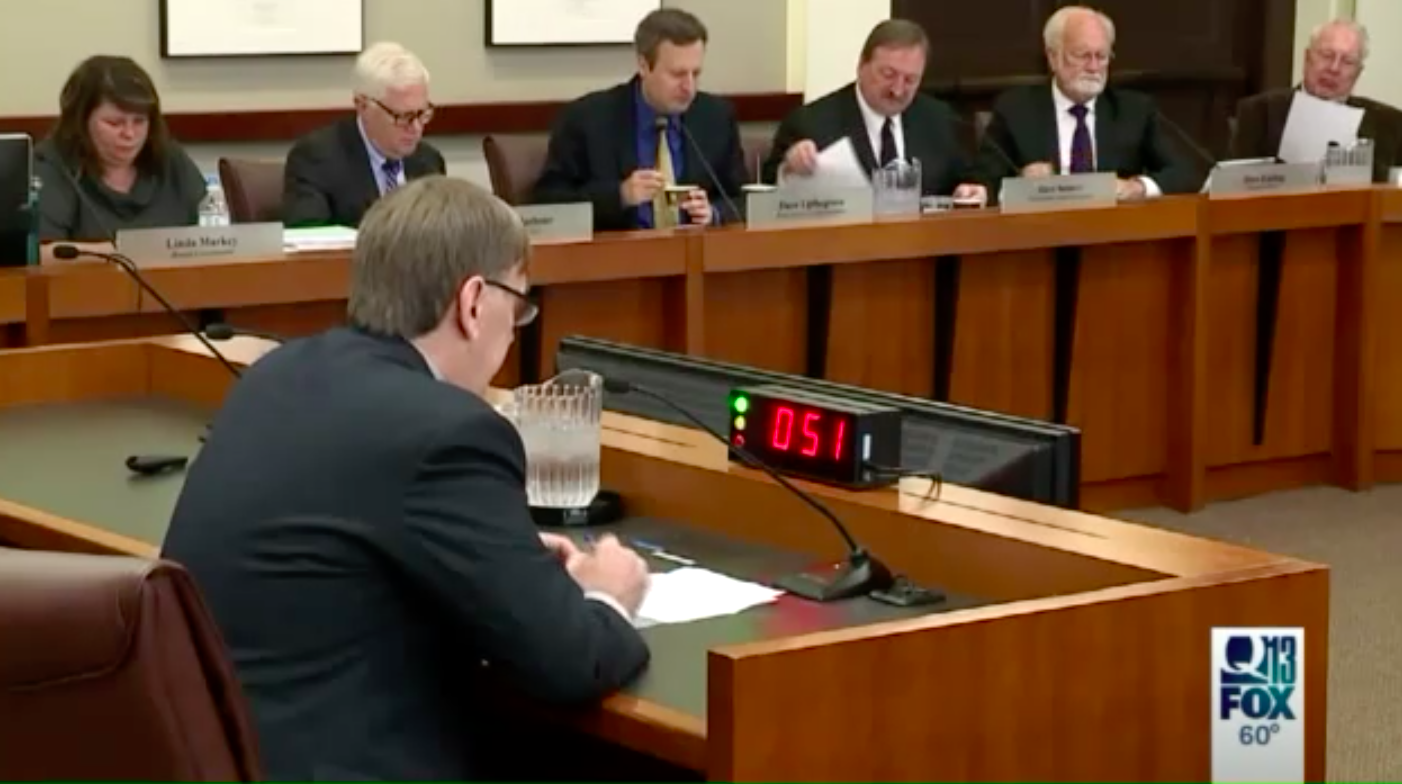
Randy Corman testifying to the Sound Transit Board in 2016. One of the board’s commitments was the study of a Renton-Tukwila light rail connection. The full story is here.
More Sound Transit 3 documents and reports can be found here.