A recent press release from the City discussed the impending purchase of the Stoneway Site for extension of Cedar River Park, but did not mention the environmental remediation challenges that will come with it.
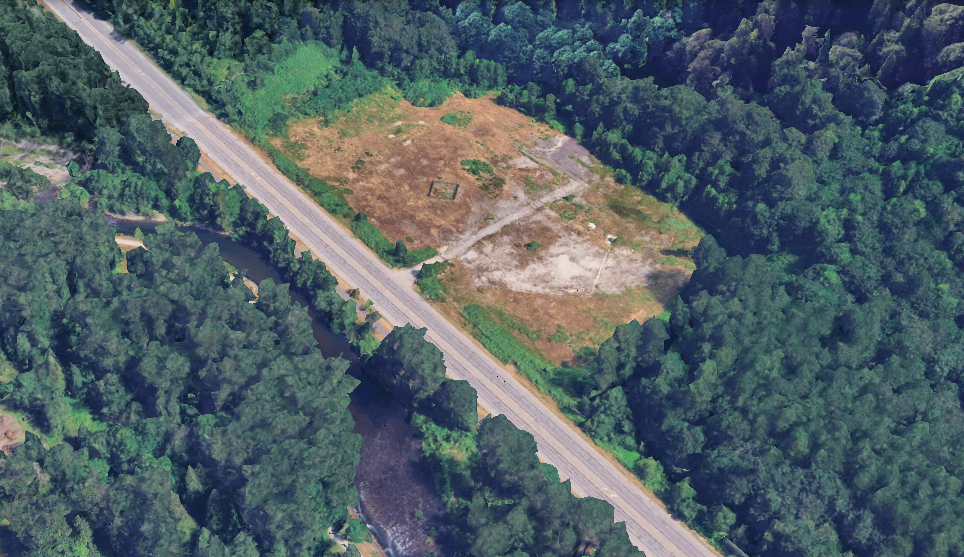
A graphic in a Department of Ecology letter shows locations of petroleum and formaldehyde contamination on the Stoneway site
I support the city purchasing this site as long as Renton gets it for a fair price and we get assistance from the Department of Ecology, State Fisheries, and others to help fully clean it up.
According to the Department of Ecology, there is still formaldehyde, petroleum residue and potentially other industrial waste on the site that is acceptably capped and monitored so long as none of the soil, concrete, and buildings are disturbed. Any digging on the site requires Department of Ecology approval and likely a new environmental remediation plan. The site is also subject to continuous monitoring for chemical movement, and carries liability for whoever owns it.
When I was young my Mom helped organize a drive to implement city-wide recycling programs in my home town of Livermore, California. Tom Lehrer’s musical number “Pollution” became an informal anthem for their effort, as my Mom and a small team of musicians and artists incorporated the song into a multi-media show about the value of reusing resources and protecting our environment. This song remains relevant today, and I listened to it occasionally during the many years of debate about the asphalt plant on our aquifer. Happily, this asphalt issue was resolved favorably last week.
Tom Lehrer’s songs frequently had a serious point to make, along with being catchy and entertaining. Many pollution sources have been successfully eliminated in our cities since this popular song was written in 1965, but there is always more work to do.
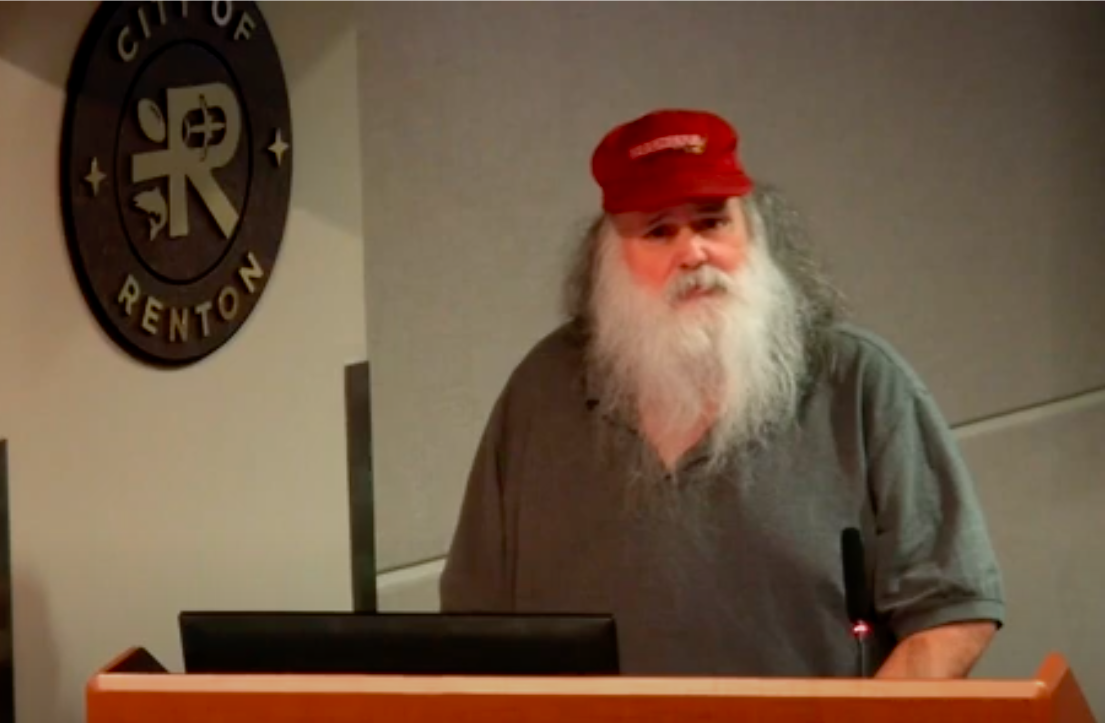
Bob Baker speaking to Renton City Council on March 3, 2025. His presentation can be found here.
In October 2017 a worried resident posted a social media warning for their community that a hot asphalt plant was proposed for Maple Valley Highway, just a couple hundred feet from the Cedar River. Bob Baker who lives nearby soon found himself joining a group of concerned citizens to stop the plant from being built at that location.
Mr. Baker is not an asphalt or soils expert by profession, but he is an avid reader and a quick study, and he soon began learning all he could about the potential impacts of the asphalt plant on the sensitive Cedar River Valley.
As he learned more through document searches and self-study, he began seeking out experts who specialize in the immediate and long-term effects of Asphalt Plants. He spoke with experts throughout the US, OSHA and even the UK to get the proper training on how these plants affect air, ground, water, human quality of life, fish and wildlife, plant life, and traffic. His ready-recall of these details is striking. Whether he’s telling you the specific carcinogenic contaminants in recycled asphalt or how much water is needed to extinguish an asphalt fire, he knows the names and numbers without looking at his notes.
Months before the news broke this morning that the Asphalt Plant was halted, “Save the Cedar River” leader Bob Baker was on record with a Churchill-like fortitude “We have every intention of stopping this project. We will take this to the very end. If it takes another five years, it takes another five years.” Similarly, County Councilmember Reagan Dunn made his position clear in an open letter to the King County Council, calling the plant a “Mistake of Monumental Proportions” which threatened the “Cedar River- the drinking water source for 1.4 million people in the region, and critical habitat for Chinook, Coho, Sockeye, and Kokanee salmon..”
Bob Baker’s “Save the Cedar River” organization and Councilmember Reagan Dunn worked to protect salmon spawning grounds and our drinking water aquifer
In contrast, Renton’s Mayor Armondo Pavone published a lengthy press release five months ago undermining Mr. Baker’s and Mr. Dunn’s strong positions, titled “Word on the Street.” This press release attempted to assure the public that the Asphalt Plant proposal was “relatively low” risk. It included two pages of arguments like “The contamination risk is further lessened by on-site requirements of the asphalt plant.” and “Any spills from those tanks would be confined to the containment areas to allow for cleanup.” The Mayor’s press release characterized the many environmental concerns broadly as “misinformation.”
The ridiculous “misinformation” label frustrated Mr. Baker so much that he confronted the Mayor and Council directly on the environmental issues at a Renton City Council Meeting this past March.
Now that Bob Baker, Reagan Dunn, and Lakeside Industries have succeeded in saving the Cedar River and its underlying aquifer from the risk of contamination by the asphalt plant, the Renton Mayor’s office is scrambling to articulate a new position.
Migrating salmon won’t need to pass an asphalt plant to reach the pristine upper spawning sites in the beautiful Cedar River Valley. And the aquifer that flows below the surface delivering Renton’s drinking water will be at less risk from contamination.
Lakeside Industries is withdrawing their permit requests for an Asphalt Plant on Highway 169, just upstream of Renton on the Cedar River. This is great news for so many: the surrounding residents; Renton and Maple Valley water customers who drink from the Cedar Valley Aquifer; Cedar River salmon and other wildlife; and Maple Valley Highway motorists who would have felt the traffic impacts.
Bob Baker, who has battled the proposed plant for 8 years, shared with me that the owners of Lakeside Industries didn’t wish to create so much controversy, and the owners have been seeking a solution that would satisfy community concerns.
I’ve written numerous articles about the long-term risks this plant could pose to drinking water systems in the Cedar River Valley, including Renton’s own municipal wells serving over 100,000 residents. These articles can be found here. By choosing to withdraw their Asphalt Plant permit application, the owners of Lakeside Industries are showing goodwill and stewardship toward all of these residents. I heartily thank them for it.
Here is the official press release:
King County Council Vice Chair Reagan Dunn and local community group ‘Save the Cedar River’ have struck an agreement with Lakeside Industries that would halt the building of a proposed asphalt plant along SR-169 and the Cedar River.
“Given the alternatives, this is a far better use of the property, and a big win for the community,” said Dunn, who represents this area on the King County Council. “Rather than rock crushers, truck traffic, noise, dust, and odors, this plan will provide benign warehouse space and avoid the impacts of an asphalt plant on the greater community.”
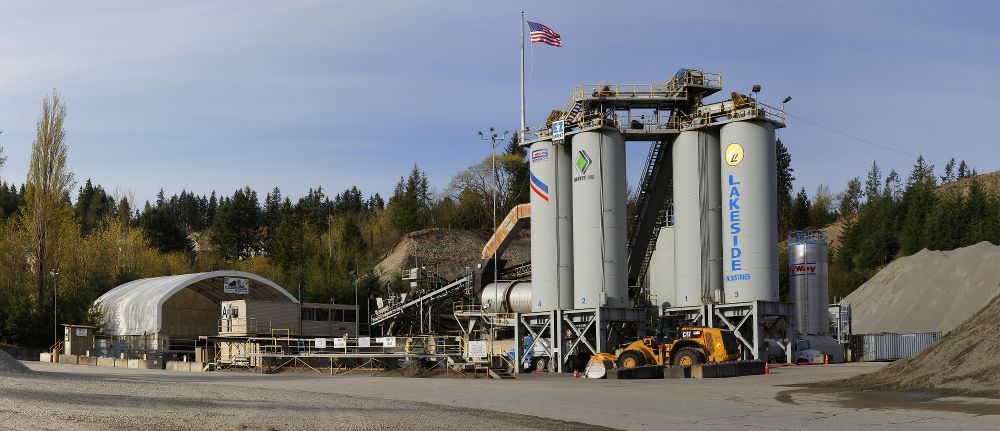
‘Save the Cedar River’ and other stakeholders have expressed concerns in the past about potential leaks to the nearby Cedar River and wetlands, noise and light pollution, truck traffic, and potential impacts on salmon from the plant. Typical asphalt plants require onsite crude, burners, storage silos, rock crushers, mixing drums, and machines for separating materials.
“This brings an eight-year-long, hotly contested battle to a great conclusion for all parties involved: there will be no asphalt plant, Lakeside Industries can finally utilize their property, and King County can put this chapter to rest,” said Bob Baker of Save the Cedar River. “I could not be prouder of the ‘Save the Cedar River’ organization and the long, hard hours that each member put in during this challenge. And to the citizens, HOA’s, businesses big and small, that supported us, thank you!”
‘Save the Cedar River’ was formed in response to a proposal to site the asphalt plant in 2017. After protests, environmental reviews, appeals, and a lawsuit, Lakeside Industries was issued a permit for the asphalt plant in April 2022. ‘Save the Cedar River’ sued in Superior Court but ultimately lost that legal battle in May 2024. This new deal puts all that in the past.
“We see this as a win-win for the community and Lakeside,” said Mike Lee, CEO of Lakeside Industries. “Lakeside is a third-generation, family-owned, local company. We want to be good neighbors in the communities in which we operate, and finding a creative solution balancing Lakeside’s needs, our obligations to our employees, and the concerns of the community, is a success that took all parties working together.”
Under the new agreement, Lakeside Industries would not move forward with construction of an asphalt plant under its approved permitting. Instead, they would reengage with King County to permit a warehouse as an alternative. ‘Save the Cedar River’ has agreed to support this alternative use and agreed not to oppose the permit application.
“I want to give credit to Mike Lee with Lakeside Industries for listening to the community and finding a solution that is a win-win for everyone,” continued Baker. “And a huge thank you to Reagan Dunn who stood by my side throughout this and for brokering this fantastic deal.”
This alternative use of the site would be a warehouse building for commercial use. The estimated trip traffic for a warehouse is substantially lower than what was estimated for the asphalt plant. The warehouse plan would protect all the critical areas as required by the County Code. However, the alternative use would still need to go through a new permit process by the King County Permitting Department.
Dunn and Baker will be available for interviews at the Lakeside site from 1:30 p.m. to 2:00 p.m. Dunn can also do interviews over phone or Zoom. 18825 Renton-Maple Vally Road, Renton, WA 98058.
Bob Baker, who has dedicated years to organizing the “save the Cedar River campaign,” became wistful when I asked him about Renton’s vanishing “amicus brief” that would have protected the Cedar River Valley. Hearing Bob report on the difference this would have made in the Court of Appeals trial is like listening to a die-hard Seahawks fan discuss the fateful decision to try a pass instead of giving the ball to Marshawn Lynch on the one yard line at the Super Bowl. Like Marshawn reports about his teammates at the Superbowl, the reaction of everyone close to the “Save the Cedar River effort” was “What the f….?
Mr. Baker had spent years raising the tens of thousands of dollars required for the Court of Appeals to hear the case, and Bob reports that at the trial two out of the three judges said that if Renton had submitted an amicus (friend-of-the-court) brief expressing municipal concerns about the plant, they would have found in favor of “Save the Cedar River.”
This blog post looks a little like a picture book, but is actually an important and easy-to-understand scientific description of where our drinking water comes from.
Renton’s newish Public Works Director, Martin Pastucha, is in over his head when it comes to understanding Renton’s aquifer. The aquifer was extensively studied in 1987, five years prior to my 28-year service on Renton Council, and then again in 2020 (when I was Council President pro-tem), in a 400-page study that built on the 1987 work.
Both of these studies confirm that much of our drinking water comes from many miles up the Cedar River Valley, and that this water can travel half a mile per day in an underground river.
Instead of accepting this reality, Mr. Pastucha has engaged in trying to convince our Mayor, our Council, and the public that it would be impossible for water in our aquifer to travel as far as three miles underground, and therefore asserts that the proposed asphalt plant could never affect our wells.
To help Mr. Pastucha understand our aquifer better, and for all those interested in where our water comes from, I’ve prepared a simple high-level overview using scientific sources.
A fun and easy lesson about where Renton’s water comes from:
Cedar River water is not drinkable in Renton
First, we need to know that the water in the Cedar River unfortunately contains street and agriculture runoff in Renton. It is not drinkable, and we work to keep it’s clay bed from being punctured so that it does not spill into the deep aquifer. For instance, we’ve ensured pilings for I-405 are not driven through the river bottom and into the aquifer. We work hard to keep it clean enough for wildlife, but not for human consumption.
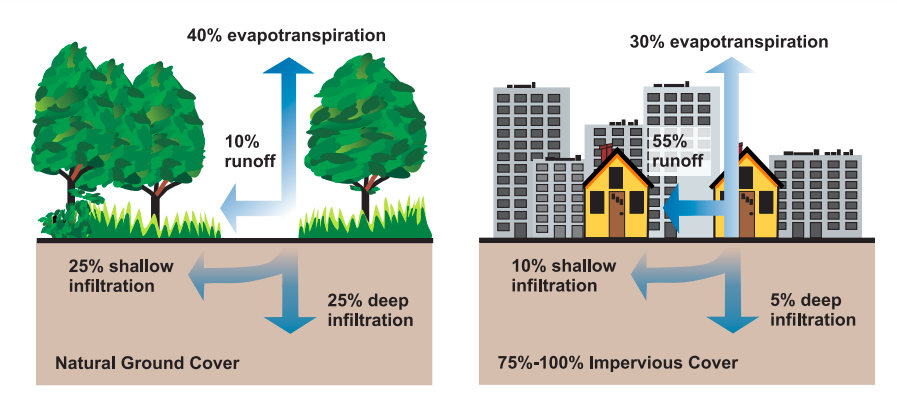
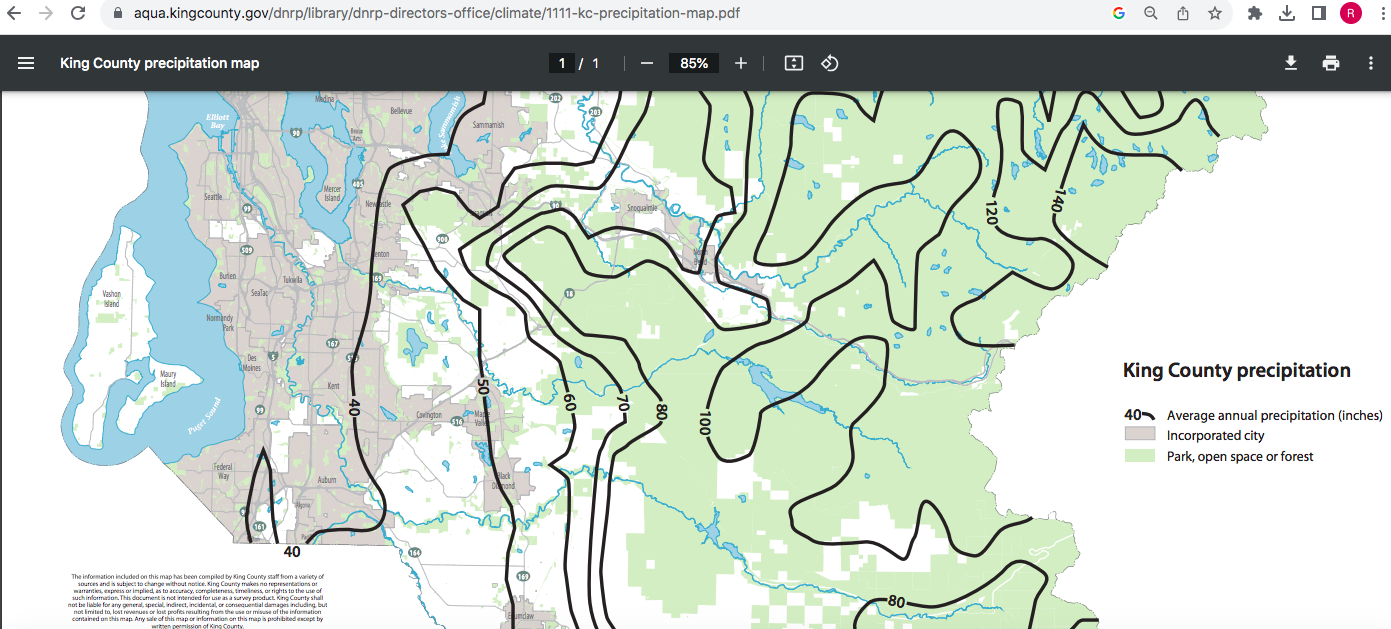
Renton’s drinking water comes from rain, which falls in our aquifer recharge areas and percolates into our underground aquifer. Renton gets about 40 inches of rain per year.
Bob Baker has been working to Save the Cedar River. His organization can be found here
Bob Baker, who manages the Save the Cedar River effort, gave testimony in last night’s Council Meeting. The meeting can be viewed here. Mr. Baker’s testimony begins at about one hour and 25 minutes into the meeting.
“Thank You for this opportunity to address the council and Mayor.
Eight years ago I joined a group of concerned citizens to stop a hot asphalt plant with RAP (recycled asphalt) from destroying the Cedar River, and ruining the Quality of life for thousands of citizens. The more I learned about the effects this facility would have on not only my community, but those from Maple Valley, through Renton and into Skyway I vowed to make this my lifes priority.
I sought Experts who specialize in the immediate and lasting effects of Ashalt Plants, especially RAP. The results were staggering. We talked to experts throughout the US, OSHA and even the UK to get the proper training on how These plants effect Air, Ground, Water, Human Quality of Life, Fish and Wildlife, Traffic, even plant life. We sought help from elected officials, including each of you. In fact I have a video of at least four of you giving a thumbs up to support this issue, including the use of city funds to stop the possibility of an Environmental Disaster.
But, after your re-election when we sought your assistance, you turned your back on us, even after you saw scientific evidence and a letter from your water district 90 asking the County to stop the plant due to the damage it will cause to their Aquafer. But why I am here is the fact that last Monday Councilman James Albertson made the comment that the scientific evidence was being considered “misinformation”. Now we may never know why Council has turned their backs on their own citizens an myself, but I take it personally that you would publicly label this evidence Misinformation.May I ask who has given you this misguided information? I have a list of my experts that I will share with you if needed. Please feel free to contact them.
The Council President seemed to be defending the placement of an asphalt plant in this sensitive natural area next to the Cedar River and over Renton’s sole-source aquifer
A reader wrote to me and said their friend wrote to City Council about the asphalt plant. Their friend got a lengthy response from the Council President, and they asked for my thoughts on this letter. I said it had some similarities to the message that the Public Works Director had put out a few days earlier, but no longer had the sections that I had easily debunked in this blog post. This letter offered a new set of arguments, probably also promulgated by Renton’s Public Works Director. These argument are equally wrong.
The note the reader sent from the Council President is shown in sections in red below, and my responses are in green. My responses are not copyrighted so, please feel free to send them back in response to his letter.
Council President: As part of the internal environmental review, the Public Works Department evaluated the potential contamination risk to the city’s drinking water sources by the proposed site activities and determined the risk should not cause concern for the following reasons:
The city’s Maplewood Wells do not pump from the shallow Cedar Valley Aquifer. The Maplewood Wellfield is drilled into the deep production aquifer (confined aquifer) that is encountered from approximately 135 to 345 feet below ground surface. The Maplewood Wells are located approximately 3.2 miles from the proposed Asphalt Plant .
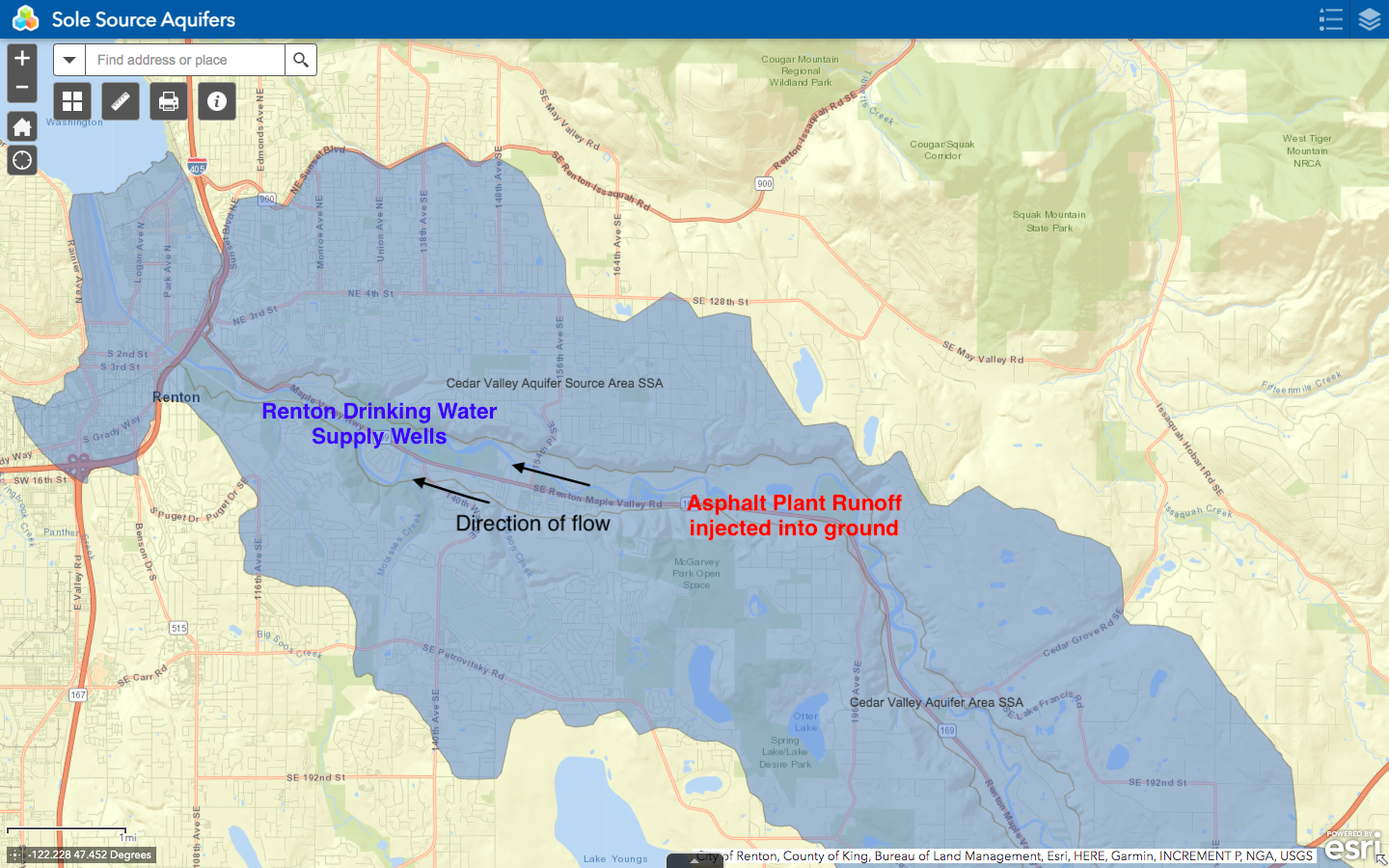
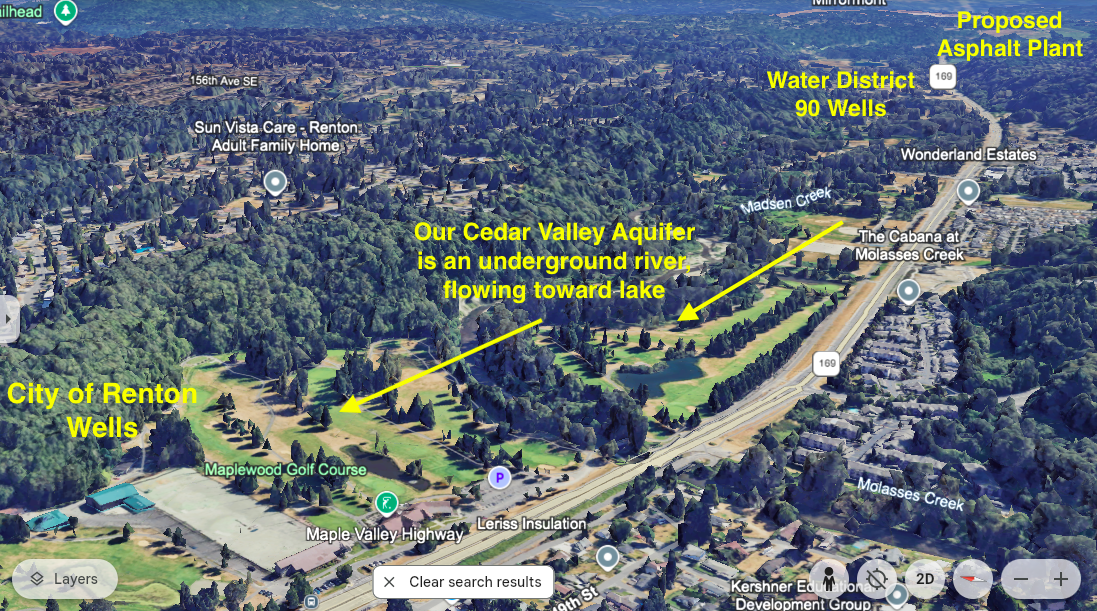
Randy’s response: Renton’s wellfield monitoring study makes it clear that the aquifer is an underground river that flows from Cedar Valley recharge areas (including near the Asphalt plant) to the Maplewood Golf Course wellfield area, and then to the areas near our downtown wells. Water can easily move underground, and the dissolved contaminants like benzene and heavy metals will not be completely filtered out.
We’re not pumping fossil water out of our aquifer. We’re pumping water that has accumulated in the aquifer recharge zone during the last decade or so. The water is not sealed off from the surface, or else the aquifer would be empty. Renton is pumping billions of gallons per year from the aquifer. We don’t need to intentionally introduce heavy metals and other contaminants from new and recycled asphalt into it. We should remain assertive about protecting our recharge zones with whatever means we have available.
“Where’s the Poison? The battle of wits has begun.” A memorable scene from “Princess Bride”
I found a city response about the asphalt plant online, but it has not yet been spread very broadly. I’m refraining from linking it at this time, because I’m not sure it deserves the high exposure it would get from my blog. (I think it should be rescinded.) But in case anyone has found it, here is my rebuttal.
In a recent memo on the Asphalt Plant, Renton’s Public Works Director, Martin Pastucha, addressed the existential risk of the Asphalt Plant poisoning Renton’s sole source aquifer, calling the risk “relatively low.” Relative to what? Is this the kind of confidence we should be basing the future of our city and the health of our children and grandchildren on?
But it’s worse than that. The Public Works Director based his vague non-assurance on a map of our “ten-year wellhead protection zone”, and relied on it being 1.75 miles away from the proposed asphalt plant. He implies, contrary to the data, that the water could never travel 9,200 feet through porous sand and gravel underground, even though Renton’s Maplewood Wells are downhill and sucking hundreds of millions of gallons of water per year– like giant drinking straws.
If Mr. Pastucha had ever bothered to read the report that formed the foundation of Renton’s “ten-year wellfield protection zone” he would have read this important statement:
“It is important to recognize that the aquifer limits shown in Figure 2-5 do not necessarily represent distinct boundaries that separate geologic materials containing groundwater. ” This is followed by the explanation that “the aquifer appears to extend several miles upgradiant of the bedrock narrows (near Renton’s wells)”
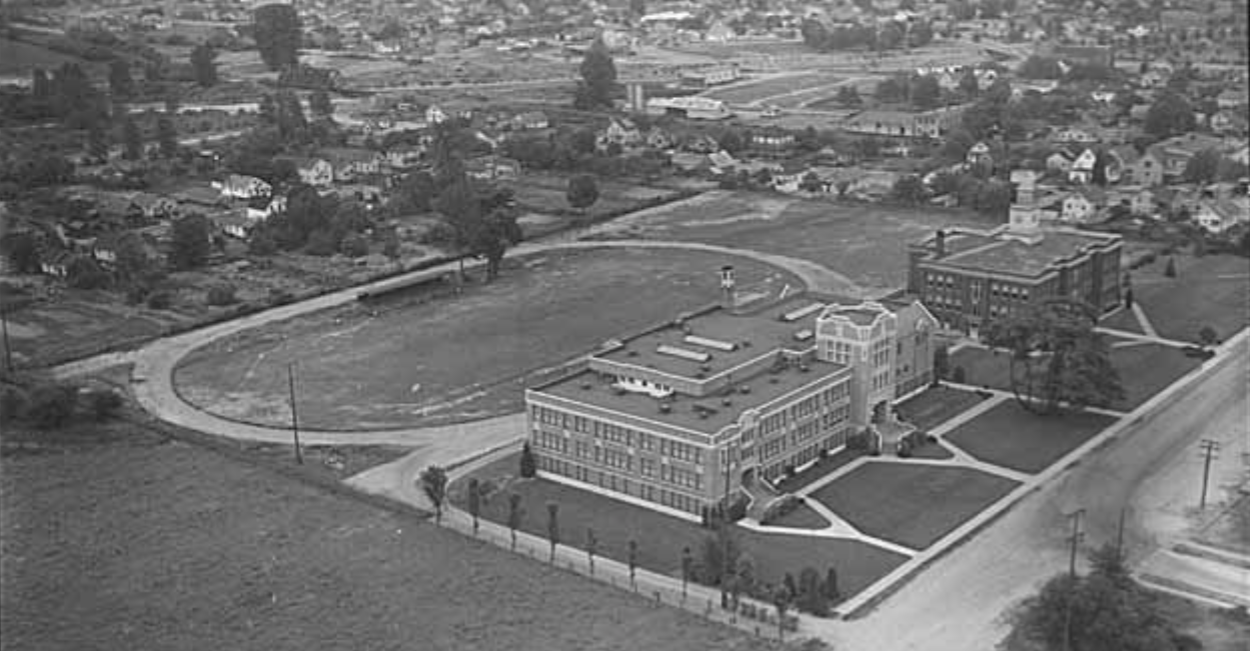
Renton High, 1938. Ten years later Renton Memorial Stadium was built on 17 acres nearby, to provide the high school with a football and track stadium. The School Board voted this week to use eminent domain to enlarge this school site into the neighborhood around it.
I’ve been writing about eminent domain on two topics, the Renton School District and the proposed Asphalt Plant. In this post I share some of my personal background being on both sides of eminent domain actions, and discuss a little about when I think it is an appropriate tool.
Being on the receiving end:
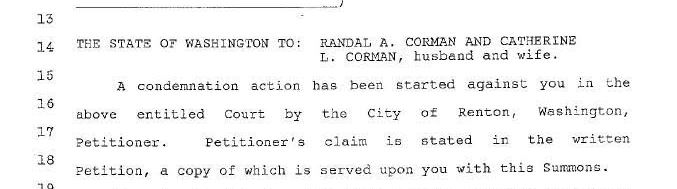
My wife Cathy and I were on the receiving end of a condemnation action in 1988. We challenged the “public necessity” in Superior Court and won, but that does not always happen. The experience led to my 28-year service on Renton City Council.
I have been impacted by an eminent domain action directed at me and my wife in the past. That experience helps me understand what it is like being the subject of an eminent domain taking. Our trial also helped set a judicial precedent on the definition of “necessity,” that, according to my attorney, was cited in many later cases.
At Monday’s council meeting, a Council member essentially characterized this data as misinformation, and said that an Administrative press release would be issued by the Mayor’s office with more details about why this scientific data was misinformation.
I’m looking forward to critiquing this issue paper, if it ever comes out. I have doubts about whether it will, because I don’t believe the City of Renton will be able to find an engineer who values their reputation and license and is willing to guarantee that Renton’s water will never incur pollution threats from the asphalt plant. The city may be able to find “story tellers,” willing to say the plant is going to always be safe, but the scientific reports will prevent conscientious engineers from doing it. Partially treated runoff being injected into our aquifer recharge zone is bad enough. But add in the additional risks, from landslide,fire, floods, earthquakes, and coal mining sinkholes, all familiar events in this area, and the asphalt plant is an obvious poor engineering fit on this aquifer recharge zone.
RCW 8.12.030. Every city and town …within the state of Washington, is hereby authorized … to condemn land or property… either within or without the limits of such city …for the purpose of protecting such supply of fresh water from pollution.
But on the other hand, I strongly recommend the City reconsider issuing such a press release. At the end of the day, residents need their Council to step up and purchase this site to protect our water supply. Every day the Mayor’s communication specialists spend writing a fictional story about why the plant is not a bad thing, it costs the city more money that could be spent on purchasing the site. Furthermore, by creating such a document, it will become a lobbying tool for the applicants of the asphalt plant, regardless of how much of a scientific farce it is.
Citizens to Save the Cedar River, an organization that has spent $300,000 opposing this plant, report that the plant would have already been stopped if Renton had provided an amicus brief (a friend-of-the court statement) opposing the plant. They say Renton would not do it, and I don’t know if this was the decision of the Mayor, or someone whispering into his ear. If the Administration now issues a press release which pretends their hands are tied, I hope this press release includes an explanation of why they passed on this very clear opportunity to protect our aquifer for future generations. Such an explanation will take a while as it requires some very creative storytelling.
And this time, please include the author of the press release. Residents and our City Council deserve to know specifically who is misleading them.
Renton’s Mayor Barbara Shinpoch (1980-1988), is pictured here with her predecessors Don Custor, Charles Delaurenti, and Avery Garrett. She was an inspiring regional leader and a visionary force in protecting Renton’s water supply from contamination. In this 1982 photo she is dedicating the new Coulon Beach Park, converting 1.5 miles of industrial lakefront to park use.
Renton Mayor Barbara Shinpoch was an inspiring leader in Renton and our region. In addition to many other enduring accomplishments, she left a legacy of protection of Renton’s water supply.
In 1984 Mayor Shinpoch and her City Council commissioned the first comprehensive scientific study of Renton’s aquifer, and then energetically implemented the many recommendations for protecting Renton’s precious drinking water. Mayor Shinpoch fearlessly confronted the State, the County, numerous filling stations, dry cleaners, Stoneway Concrete, Metro, and many others to ensure Renton’s success.
Her successor and friend, Earl Clymer, Mayor from 1988-1996, continued her hard work on Renton’s aquifer protection ordinance, with unanimous support of Renton’s dedicated City Councilmembers. (I was elected to Renton Council in 1993, and had the opportunity to join the team with the work already in progress.)
The study commissioned under Mayor Shinpoch in 1984 became our blueprint, and it contains guidance which remains relevant today. The study recognized that protecting our water was our highest calling. Recommendations included using tax money to buy business property and convert it to parks if it was upstream of our wells along our aquifer.
Mayor Shinpoch charted the course for clean water for our residents, and our council should retain the same vision today when it comes to the Lakeside Industries Asphalt Plant proposed upstream of our Maplewood Wells.
The US Environmental Protection Agency’s Hot Mix Asphalt Plant Emission Assessment Report provides the pounds-per-year of pollutants expected from typical asphalt plants.
In our toxic world, the only safe drinking water is that which evaporates from the ocean, condenses in a cloud, and drops as rain or snow in a clean, natural environment. This is what Seattle drinks, and it is what Renton residents deserve as well.
Treated industrial runoff will never be healthy drinking water. Industrial runoff is treated to a level that will minimize harm to wildlife as the water returns to the ocean. It’s not treated to a standard that makes it safe enough for human consumption. Only evaporation and condensation will make treated industrial runoff safe to drink again.
With their proposed new Asphalt plant, Lakeside Industries is planning to remove about 30-60% of the contaminants from their runoff using onsite treatment. They will then inject the remaining waste-water, still containing 40-70% of some of the worst pollutants, into Renton’s sole source aquifer. This is per poor instructions from the County, in a flawed approval process that has acknowledged the responsibility to protect salmon but not Renton’s residents.
Airborne contaminants from asphalt production will settle on equipment and pavement throughout Lakeside’s industrial site. Rainstorms will flush the poisons into a central catch basin, along with waste water from hosing down equipment and pavement. Contaminants will include toxins like benzene, arsenic, lead, and mercury, along with dangerous PAHs that can cause cancer and autoimmune diseases, including fatal blood diseases. Approximately half of the deadliest contaminates, those that are fully dissolved into the drinking water, will pass right through the “Enhanced basic” on-site filtration system–by design.
King County has required Lakeside to meet an “enhanced basic” standard in treating their runoff, which lets 30-60% of heavy metals pass right through. The partial-treatment comprises an oil separator, a sand vault, and a small retention pond. The 50% or so of dangerous contaminants that flow right through these simple systems will be infiltrated into our aquifer recharge zone.
There’s widespread misunderstanding about the capability of the on-site system to clean the water. The treated water is considered too dirty to dump in the Cedar River. Renton should not allow water deemed too dirty for the Cedar River to be intentionally pumped into our sole source aquifer.
Water District 90 is planning to take their wells offline due to contamination from the proposed asphalt plant, at a cost of $500,000 per year. Renton’s wells are just downstream and the cost to Renton would be $10,000,000 (ten million) per year. Renton Council could end the risk for both water districts by purchasing the proposed asphalt plant property for about $15 million, using state grant money.
Water District 90 has three wells in the Cedar Valley Aquifer, a short distance upstream of Renton’s wells. District engineers have determined that their wells are threatened by the proposed Lakeside Industries asphalt plant. In 2018, they determined the chemical poisoning risk would likely make their wells unusable within ten years. This was before it was established that the Asphalt plant would purposefully inject their runoff into the ground. If Water District 90 can’t replace the wells, they will begin paying Seattle $500,000 per year to supply the water to the equivalent of 6000 residents. (Water District 90 already buys 70% of their water from Seattle, and they are serving a total of 20,000 residents).
Water District 90 resolution opposed to asphalt plant due to poisoning of their wells
Renton’s wells serve 20 times as many people as Water District 90’s wells, so Renton customers would have to pay ten million dollars a year to Seattle to replace our poisoned water. Even worse, our wells are sized for our city’s future growth projections, capable of delivering water to 60 % more Renton population. And this water would also have to eventually be replaced by purchases from Seattle. Given past rationing during droughts, Seattle may not even have this excess capacity.