“Stoneway site” being purchased for park has history of contamination; carries use limitations

A picture of the Stoneway Site from the Tri-Park Master Plan

A recent press release from the City discussed the impending purchase of the Stoneway Site for extension of Cedar River Park, but did not mention the environmental remediation challenges that will come with it.


A graphic in a Department of Ecology letter shows locations of petroleum and formaldehyde contamination on the Stoneway site

I support the city purchasing this site as long as Renton gets it for a fair price and we get assistance from the Department of Ecology, State Fisheries, and others to help fully clean it up.

According to the Department of Ecology, there is still formaldehyde, petroleum residue and potentially other industrial waste on the site that is acceptably capped and monitored so long as none of the soil, concrete, and buildings are disturbed.  Any digging on the site requires Department of Ecology approval and likely a new environmental remediation plan.  The site is also subject to continuous monitoring for chemical movement, and carries liability for whoever owns it.

Continue reading →

“Johns Creek” shares blame with geese for frequent Coulon Beach swim closures

While currently open as of this writing, Coulon Beach swim area was closed during the Memorial Day weekend and the first above 80-degree day of the season.

Coulon Beach Park swim area was closed on this sunny Memorial Day weekend because of high bacterial counts.  It was one of only two beaches on Lake Washington closed for this reason.  Unfortunately this has become more common in recent years, with Coulon’s swim area sometimes closed for weeks at a time.

Renton’s Coulon Park swim beach was closed while most local beaches were open during this warm holiday weekend.

While it’s clear that ducks and geese are contributing to the problem, it’s less obvious to Park visitors that storm drains in western Renton Highlands, the Landing and even I-405 are also contributing to the problem by adding pollution to “Johns Creek” which empties next to Coulon’s swim beach.

Renton has been working for decades to improve the water quality in Johns Creek, and a Stormwater Management Action Plan (SMAP)  is in place to improve it.  Renton Stormwater utility fees, along with grants when they can be obtained, pay for this work.

Johns Creek is not the only creek that carries Renton’s surface water into Coulon Park; Kennydale Creek deposits Kennydale’s surface water about a mile to the north.  But in addition to emptying further away from the swim beach, Kennydale Creek flows mostly in a natural creek bed open to the sun and air, which helps reduce bacteria levels.  Johns Creek flows through many pipes and culverts, only in open air as it nears Coulon Park.

So to keep our swim beach open, businesses and residents in Renton Highlands, the Landing, Paccar, Southport and parts of North Renton should help keep our street gutters clean and spread the word that whatever flows into storm drains can flow right into the Coulon Beach Swim area.

The following photos and maps give more information about this little-known creek and the plans in place to improve it.

Continue reading →

Latest Shoreline Program controversy regarding dock widths pits Federal ADA access guidelines against State Ecology desires; State response undermines public legislative process

Developing the latest update to our Renton Shoreline Master Program has been a very involved, busy, controversial, and expensive project. The update– which we must complete in order to comply with state law– has cost over two-hundred thousand taxpayer dollars and thousands more in private-sector funds, and has taken over two years. During this time we have held numerous public meetings and hearing in such public forums as the Renton Planning Commission, the Renton City Council, and in our Renton Council Planning and Development Committee. We have also received countless letters from citizens and their attorneys, as well as phone calls, emails, and virtually all other forms of communication. ( For further background on this work, see my previous journal entries on this topic by clicking here.)

The result of all of these public meetings and hard work to date has been that Renton produced a 334-page ordinance , that you can see by clicking here

I was personally never fully satisfied by this ordinance, and joined my colleague Marcie Palmer in voting “No” on it after a lengthy, highly-attended public debate (which included testimony from a representative from the State Department of Ecology). I was particularity concerned about the ordinance provisions that mandated removal of river bulkheads, many of which protect our city’s downstream bridges and other critical infrastructure. This bulkhead removal is already putting our city at risk and costing Renton taxpayers dearly, as can be seen in journal entries and letters here.

While I voted “No” on this ordinance, the ordinance was nevertheless approved by Renton City Council on a 5-2 vote. And though I wasn’t thrilled about council moving ahead with this compromise, I accepted this result. In summary, the council majority was ready to “split-the-baby” on the remaining issues that our citizens and DOE could not agree on, and simply be done with this ordinance– a decision I can understand after two years of hard work. So while Marcie and I were ready to keep working the bulkhead issue, the rest of the council was ready to make some final compromises and move on. After ending up on the losing side of this vote, I thanked the council for affording us the time to debate the topic, and I reported on it in my journal here.

With the council capitulating to Department of Ecology (DOE) on so many areas including the bulkhead issue, this should have cleared the way for a DOE approval. Especially since DOE was with us on the floor of the council in the public meeting where we developed the final wording for our ordinance. Except now the DOE informs us they are not satisfied with the compromise that council approved on a 5-2 vote, and they have unilaterally decided that Renton needs to narrow our dock width standard.

The dock width standards are sensitive, because they pit clear safety and access issues against theoretical fish issues. Federal ADA access guidelines recommend a minimum of five feet and preferably more where people of limited mobility are trying to get into a boat or trying to turn around a wheel chair. On the other side of the issue, DOE officials say that predator fish like to hide in shadows under docks and ambush baby salmon, and that limiting the dock width to four feet helps reduce this threat. Renton’s ordinance had balanced these concerns by requiring that new and rebuilt docks be surfaced in light-transmitting metal or plastic screening instead of wood (so that 70 percent of the light penetrates the dock and prevents shadows). The limitation to a six-foot width along with increase in light transmission would give improved protection to baby salmon, meet the Army Corps of Engineers Standards, and meet guidelines associated with the Americans with Disabilities Act which state in part:

“Accessible boat slips must have clear pier space at least 60 inches wide and as long as the slip. Providing more than 60 inches wide clear space will improve safety for people with disabilities, especially on floating piers. This space is the minimum necessary for individuals with disabilities to have sufficient space adjacent to their boat slip to use a chair lift or transfer device for getting on or off their vessel and provide a turning space for changing directions. Every 10 feet of linear pier edge serving the accessible slips must have at least one continuous clear opening that is at least 60 inches wide. ”

While Renton Council reached it’s final SMP compromises in some highly public meetings, the State DOE testified to council last Monday that they subsequently held some private meetings of their own in which they decided that Renton’s standards for dock widths were not acceptable.

Specifically, they have decided that in the future all cities need to adopt standards limiting the dock with to four-feet in the first (near-shore) 30-feet of dock. But docks may reach their maximum length before they reach 30 feet long, since they can not got out further than the point where the water depth is ten feet. The only provision for a wider dock that would allow disabled access in the first thirty feet would be if the homeowner has state disabled status at the time of dock permitting. This has a couple problems: (1) it does not address the problem of the homeowner having extended family or friends that may boat with them, and need safe access, (2) it does not address the fact that it can take one to two years to get a dock permit, and cost tens of thousands to widen a dock, and it is therefore highly impractical to build it too narrow for ADA access and then widen it if the need arises.

Adding fuel to the controversy is the fact that two years ago the State DOE approved Redmond’s Shoreline Master Plan, which outright allowed six-foot dock widths. Many other cities on the lake are still working their SMPs, and are not as far along as us. If Renton agrees to a four-foot dock width limitation, and the council commits it to an ordinance, will we find by this time next year that we are one of the only jurisdiction that limits our docks to this potentially dangerous width?

The State DOE’s response to this question was that as a result of their (private) meetings, they intend to start demanding that all the cities limit their dock widths to four-feet within 30 feet of the shoreline. My view, which I expressed at the council meeting, was that if the State of Washington wants to limit all dock widths to four feet, then the State of Washington should follow a proper legislative process, including notice of new regulations, hearings, testimony before the legislature, public comment, public legislative debate, and a public vote by the state legislature. They should NOT try to limit all dock widths in the state to four feet by going to every city council and demanding it, especially when they have already approved a different standard for Redmond.

But what happened next put me on my soapbox about the legislative process and open public meetings. The State DOE implied that if Renton did not capitulate on their DOE dock-width desires, then the state DOE might just go back into Renton’s Ordinance (which again was the product two-years of public meetings and legislative action), and perhaps arbitrarily change other things they don’t like. This was a threat–pure-and-simple– to try to make Renton lawmakers fear that the private policy-making of one of our state agencies would trump our public meetings and our elected-representative role, and leave our citizens with no meaningful way to apply for a dock permit. In short, the DOE threat amounted to EXACTLY what the state legislature wanted to PREVENT when they wrote the Open Public Meeting Act:

“The people of this state do not yield their sovereignty to the agencies which serve them.
The people, in delegating authority, do not give their public servants the right to decide
what is good for the people to know and what is not good for them to know. The people
insist on remaining informed so that they may retain control over the instruments they
have created.” Washington State Legislature, 1971, Statement of Purpose in Open Public Meeting Act (42.30 RCW)

Near the end of our Monday discussion on this topic, I reiterated that if the State of Washington wishes to uniformly restrict dock widths, the State should use their own legislative process for making a new state-wide law, and give all cities a chance to weigh in at once, as well as give citizens an opportunity to contact their state legislators. In the meantime, the State DOE could do whatever they thought they had the power to do to limit dock widths in Renton, but they could not get me to agree that we should arbitrarily change our ordinance because of their DOE threat to impose other arbitrary (revenge-motivated) hardships on Renton if we didn’t.

If the state changes anything that we did not publicly discuss in our legislative hearings, I will contact the State Attorney General and ask for an investigation of State violation of Open Public Meetings Act. If the state DOE changes only the dock width, I will follow the issue to make sure that Renton has been treated fairly when compared to other jurisdictions, and if other cities are given permission for six-foot docks within thirty feet of shore, I will fully expect the DOE to give Renton the same consideration.

This topic will be back before Council Committee of the Whole tomorrow evening at 5:30.

Renton Shoreline Master Program sent to Department of Ecology on a five-to-two vote

After one and a half hours of debate last night, Renton City Council voted 5 to 2 to send the Shoreline Master Plan to the Department of Ecology for their review and approval.

While we spent some time discussing parks impacts and public access provisions, the main topic of debate was the way we manage existing bulkheads on the shoreline. The epicenter of the argument was the interpretation of section 173-26-231 (click here to read it) of the Washington Administrative Code, and whether it says that existing bulkheads need to be removed from the lake or river if they are still serviceable and not being proposed for alteration by the property owner. I argued that as written this section pertains only to shoreline “Modifications” not to shoreline pre-existing conditions. City staff and a Department of Ecology Official insisted that this section of the WAC also applied to existing bulkheads that are not being modified, and required that shoreline bulkheads be considered for possible removal whenever there is a change of use, or a significant expansion of an existing use, in the upland areas of a property.

This distinction was a big deal, because the required evaluation can be expensive for individual homeowners, the results of these studies can be unpredictable, and if the review says that the shoreline must be revised then the process to actually alter the shoreline can take years (federal and state permitting is complex). Furthermore, the bulkheads give peace-of-mind to property owners and their lenders as they protect primary structures and utilities from damage in storms.

The Council Committee of the Whole ultimately voted five-to-two to adopt a committee report recommending that the SMP be forwarded to the Department of Ecology for review and approval. (It is widely understood that once this DOE review is complete, the city would have a difficult time changing the words, which is why last night’s decision was so important.)

Marcie Palmer and I offered a “Committee of the Whole Minority Report” which had almost all the same language as the page-and-a-half long Majority Report, but included four additional provisions. (1) Tables should be clarified to be specific that they only apply within the shoreline buffer for each site, (2) Language should be changed so that existing shoreline stabilization that is still serviceable and is not being proposed to be revised by the property owner can be retained, (3) Typos in the document should be identified and fixed, (4) Council will evaluate providing credit against the Parks Mitigation Fee to projects that provide public access to the water.

At the council meeting a half hour later, the majority report was formally adopted in lieu of ours, which did not surprise me or Marcie given the 5-to-2 Committee of the Whole decision. (It’s the same people voting in Committee of the Whole and on Council). So, the majority report essentially only serves as a record of where our differences of opinion were. (Following the vote, Council President Don Persson asked city staff to try to scrub the remaining typos from the document before it is sent to Department of Ecology. Most of the typos had come about from negotiated changes to the document– we were on the seventh draft)

While I obviously wish the council had come over to Marcie’s and my point of view, I am highly appreciative of the entire council for the time they afforded for debate on this topic. Everyone was gracious, even while I (and to a smaller extent Marcie) kept the debate going a long time as we sparred over the complex technical issues involved. Our council works very well together, even when we hold such disparate opinions, and this makes it a sincere pleasure to serve.

The Renton Reporter covered last night’s events in this article today.

Shoreline Master Program moves to Committee of the Whole for final action

After more than an hour of unusually technical and highly passionate debate last night, Renton City Council voted four-to-three against the Planning and Development Committee Report recommending that the current version of the Shoreline Master Program (SMP) be approved immediately in it’s current form. Instead, the council ultimately decided via a six-to-one vote to move the SMP discussion to the Committee of the Whole (a committee which is composed of the whole council and chaired by Council President Don Persson.) In addition, we scheduled the issue for discussion and intended resolution at the September 27, 2010 Committee of the Whole Meeting, immediately prior to the regular council meeting (exact time to be announced next week).

Council members are intending to use the next two weeks to dig deeper into remaining issues brought up by the public at last night’s audience comment, as well as to collect written staff responses to concerns Marcie Palmer and I wanted formal closure on. Specifically, Marcie Palmer is asking the Parks Department for an assessment of how the proposed SMP language will affect maintenance and/or expansion of park facilities, and I have asked for an assessment by Public Works regarding whether proposed SMP provisions could increase risk to bridges and city center river-front property, and if so how can we mitigate this (see my previous blog entry).

Citizens who wish to participate in this process are advised that (per normal protocol) you will not have an opportunity to speak at the Committee of the Whole meeting on the 27th, but you can instead make comments to council at the normal audience comment periods near the start and end of next week’s council meeting (on September 20). You can also participate via email and letter. The Council President has requested that everyone please try to keep their inputs as crisp and to-the-point as possible, as council is working through copious written materials already in the records.

Renton Shoreline Management Program nearly done, but bulkhead restrictions may stymie redevelopment

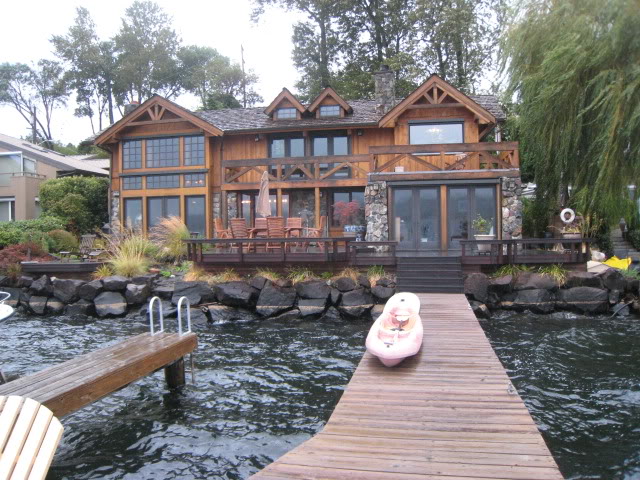
Photobucket The rock bulkhead on the shoreline of this Renton home provides crucial protection from wave-induced erosion caused by large boats and winter storms. I agree with property owners that existing bulkheads should be entitle to be used throughout their useful service lives even when upland changes are being made.

After months of hard work by Renton city staff and Renton’s shoreline property owners, the new Renton Shoreline Management Program is getting close to being ready for council approval. (Click here to see my previous articles on this topic). However, I have a remaining concern which relates to the proposed regulation of existing bulkheads. I’ll explain the issue in three parts:

First, my sincere appreciation:

I am grateful to all the affected parties for the collaborative work they have performed to get us to this point. Everyone–city staff, planning commissioners, state officials, shoreline owners, and elected officials–all have demonstrated a strong desire to maintain a healthy shoreline with good wildlife protection. Merging this shared desire with other legitimate interests in recreation, economic development, flood management, and private property rights has taken time and patience. Mayor Law and his senior staff have played an important role in providing the time and opportunity for these issues to get worked out.

Second, some background on riverfront zoning, and on existing bulkheads in general.

For at least two decades, many citizens have requested new ways to enjoy the the Cedar River through water-front dining, water-front cafes, and waterfront event space (for weddings, etc). Under Mayor Jesse Tanner, we rezoned property on the north bank of the Cedar River east of I-405 to accomodate such a vision. (Technically referred to as COR zoning, this allows a broad range of water-front and other types of high-end uses.) The Stoneway Concrete company even moved its concrete batch plant out of this zone to clear the way for this type of multi-use development. We hoped then and still intend to see a river-front “Carillon Point”-type development encompassing the old Stoneway site, the Rivierra Apartments site, and the site of other existing uses which all seem to “turn their back” on the River. The envisioned redevelopment could also include hotels, high-end office space, and condominiums, uses that would work synergistically with Cedar River Park and the Cedar River Trail. Office workers, hotel guests and residents could enjoy lunchtime walks in the park and on the trail, while trail and park users could stop into the new cafes for lunch, snacks, beverages, or simply to get out of a rainstorm. Everyone involved understands that such a development would be subject to a 50-foot building setback from the river. But fifty feet is close enough for the buildings to capture the river’s beauty and sounds, and visitors could dine outside closer to the river’s edge. The SMP should provide enough flexibility so that diners can see the water. Citizens of Renton could enjoy riverfront that is currently inaccessible to the public.
Photobucket
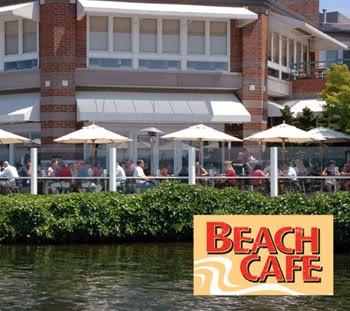
The owners of the Stoneway site and Riviera Apartments are positioned to create hotel, office and waterfront dining space, similar to the Carillon Point Beach Cafe shown above.

The old Stoneway industrial site is situated above typical winter flood waters, and the Stoneway shoreline is protected by a long-standing bulkhead that has proven reliable in the past. Similarly, most developed properties on Lake Washington have bulkheads of some type protecting their homes from the scouring effects of high waves during winter storms. Very few Renton lakeside properties have sufficient land to accommodate a gently-sloping beach. Most have an embankment, protected from sloughing by concrete or rock bulkheads. These bulkheads require substantial design and permitting efforts in addition to the costs of construction, and can cost more than one hundred thousand dollars on many home sites. Renton has installed many flood control measures and lakeside bulkheads on public property, such as the flood walls along the airport, and bulkheads near our restaurants in Coulon Park. And it’s not just Renton–last year our region created a new taxing district to pay for new levees and flood protections on the Green River, while the City of Seattle has been undergoing contortions trying to find funding for a new sea wall to protect its Puget Sound waterfront.

As a city official and a taxpayer, I’m appreciative of those riverfront and lakefront property owners who have used their private funds and negotiated the labyrinth of permitting agencies, hired the contractors, and installed storm protection for their property. When urban shorelines have inadequate flood and storm protection, we all end up paying for it one way or another. Left to nature, rivers will meander and scour– it’s what they do. They remove sediment on the high-velocity outside edge of river bends, undercut natural embankments, and carve wider and wider valleys. It’s a beautiful thing in an alpine meadow or at the Grand Canyon, but it is generally disastrous within an urban area like Renton.

Photobucket
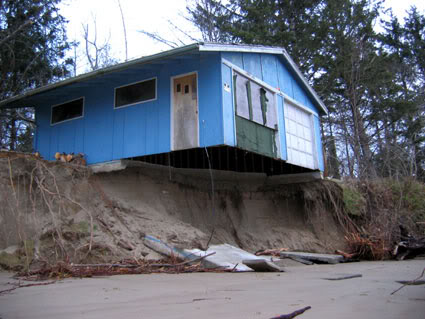
Washaway Beach, on the Washington coast, provides a dramatic demonstration of the destructive power of shoreline erosion.


Finally, here is my concern.

The problem with the current draft of Renton’s SMP is that, if adopted, it would require property owners to evaluate removal or reduction of their existing protective bulkheads if the owner adds 1000 square feet or more of new construction to his/her property, or proposes a change in use of the property, even if the owner plans no change to the bulkhead. Under the draft SMP’s current language, the property owner would be required to hire a geotechnical engineer who would opine whether the bulkhead is necessary to protect the property from imminent damage during only THE THREE YEARS following the engineer’s review, an unreasonably short time in view of the uncertainty regarding when the next big storm will hit. If, in the opinion of the engineer, the property would not be imperiled in the next three years without the bulkhead, then the bulkhead would have to come out or be modified at great expense to a different design–or else the homeowner would not be allowed to do the 1000 square-foot addition.

To make matters worse, even if the engineer concluded that the existing bulkhead was needed, there could be a series of time-consuming and expensive reviews and appeals of this decision by government agencies or other persons.

While it is laudable to want to restore the lake and river shorelines to the most natural state possible, the primary effect that this proposed policy governing existing bulkheads will have is to keep residential and business properties from being remodeled or redeveloped. Property owners will be very reluctant to take on a building expansion or replacement project if they are faced with the risk of having to modify their existing bulkheads, structures that often may have 50 or 100 years of useful service life left in them.

Furthermore, this proposed new requirement is throwing doubt and confusion at the owners of property along the Cedar River where the city has done massive legwork–and even negotiated removal of a concrete plant–to prepare for future cafes, restaurants, and hotels (“Carillon Point on the River”). The current SMP language raises the specter that the existing bulkheads on the Cedar River shoreline might be required to come out as a condition of site redevelopment. Anxiety stemming from that specter is likely to dampen redevelopment prospects for the old Stoneway site.

I think a much better approach would be for the SMP to read that when a bulkhead is ultimately replaced–which will happen when it’s reached the end of its serviceable life (such as when the concrete crumbles, the steel rusts through, the wood rots away, or the entire bulkhead is undercut by the river or lake)–AT THAT TIME the need for the bulkhead should be reviewed by an appropriate engineer and local and state agencies. That would be the point in time at which all interests logically converge. That is the time that the shoreline must be disturbed to remove or replace the bulkhead. And that is the time that the property owner is forced by nature (not the city) to pay for studies and reconstruction.

The text of the state SMP guidelines supports the view that the right time to review the need for existing bulkheads is when the bulkheads are being replaced. So I believe the Department of Ecology and other stakeholders would accept this change.

With such a change I feel we would be about ready to approve the SMP.

Photobucket
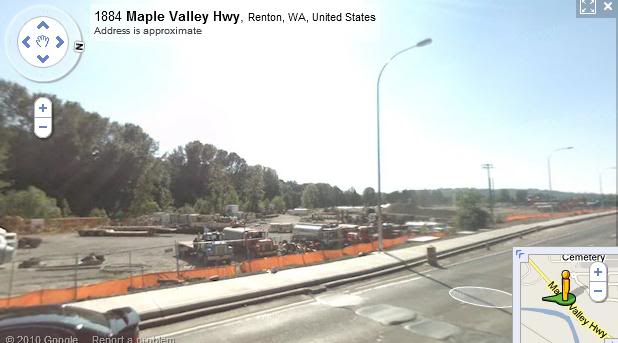
For reference, the river-front Stoneway Industrial site in it’s current condition.


Letter from Perkins Coie, representing Renton Shoreline Coalition

Debate over the Renton Shoreline Master Program is continuing. We had more testimony from three citizens (two attorneys representing river-front properties and and one lakeside property owner) at our Monday Council Meeting. Yesterday, the city staff released a “Frequently Asked Questions” issue paper to try to address some of the concerns (Covered in my previous post.) Today City Council received the following email and letter from the law firm of Perkins Coie, representing waterfront property owners who have formed into the “Renton Shoreline Coalition”.

___________________________________

Subject: Renton Shoreline Coalition Comments on Shoreline Master Program Updates

Dear Councilmember Briere,

Thank you for the opportunity to address the Committee on behalf of the Renton Shoreline Coalition. In the interest of time, I am emailing you a copy of a letter that addresses some important issues and asks specific questions that staff may wish to address.

I look forward to the meeting on the 24th.

Sandy Mackie | Perkins Coie LLP
sent via his secretary, Karen Rentz
1201 Third Avenue, Suite 4800
Seattle, WA 98101-3099
PHONE: 206.359.8653
FAX: 206.359.9653

CLICK HERE to see the eight page letter that accompanied the email.

Renton Shoreline Master Program Frequently Asked Questions

The city planning department released this “Frequently Asked Questions” yesterday to try to resolve some confusion/concerns regarding the Shoreline Master Program. 
____________________________

City of Renton Shoreline Master Program

Common Concerns FAQ


Why is the City updating its Shoreline Master Program (SMP) in the first place?

The City’s existing Shoreline Master Program has been in place since the 1970s when the state legislature passed the Shoreline Management Act.  A few years ago, the state adopted new shoreline guidelines and mandated that all cities and counties update their Shoreline Master Programs.  The City was required to adopt an updated SMP by December 1, 2009.  However, due to interest and concern by the public, the City has delayed adoption to allow for additional public input and City Council deliberation.


Continue reading →

Council President Don Persson identifies concerns with Shoreline Master Plan; City Staff respond

I received an interesting email regarding the Shoreline Master Plan yesterday. Council President Don Persson expressed some concerns regarding the Renton’s proposed Shoreline Master Plan. The staff examined Don’s concerns, and provided an initial response back. I’m not sure if this will settle all the issues or not, but the interchange will probably be of interest to many people.
_____________________________

Councilmembers,

In Julia’s absence, I’m forwarding the following response Erika Conkling wrote in response to concerns expressed by Council President Persson as a courtesy to the rest of the Council. Please let Erika, Chip, or I know if you have additional questions or concerns.

Have a great holiday weekend!
________________________________________________

From: Don Persson
Sent: Wednesday, May 26, 2010 7:51 AM
To: Julia Medzegian
Subject: SMP/ Planning and Development Committee

My concerns on the SMP are:

1.) We are not the most restrictive of any city

2.) The non-conforming use issue, do not want people who have built their homes using and following all the legal codes in place, to now all of a sudden become a legal non-conforming use. In the Highlands we were able to work around this problem.

3.) If a house burns down or needs to be replaced it should be able to be rebuilt on the same foot print as it currently has.

4.) Bulkheads should be able to be repaired and replaced

5.) Same with docks

6.) Rewards for taking out bulkheads, if they do not damage adjoining properties

Continue reading →

The Muckleshoot Indian Tribe wants additional protections in Renton’s Shoreline Master Plan


Coulon Park over-water trail; the Muckleshoot Tribe has sent a letter saying they would like Renton to reduce these

In the audience comment section of tonight’s council meeting we heard from several speakers with property on Lake Washington. The three speakers, and an attorney representing others, all spoke to their concerns that the Shoreline Master Plan is too restrictive. This was similar to inputs we received at earlier council meetings, as I described here.

On the other side of this issue, we heard today from the Muckleshoot Indian Tribe, which feels our Shoreline Master Plan allows docks which are too large, does not do enough to restore the shoreline and vegetation around the lake, and comes up short in other areas.

You can read their letter by clicking here . This letter is an important one, because old treaties and recent case law give the Muckleshoot Tribe a co-trustee role when managing our fish and waterways.

The controversy is really brewing on this topic. The Muckleshoot Letter arrived the same day that we received a hand-delivered letter from David Halinen Law Offices, who is representing AnMarCo, the owner of the old Stoneway Concrete and Gravel site on Cedar River (Next to the Henry Moses Pool). Mr. Halinen expressed concern that the Shoreline Master Plan could force his client to remove the concrete Cedar River bulkhead on this site, opening the door to river erosion and loss of some –or even most– of the old Stoneway property.

Mr. Halinen also attached a copy of a five-page listing of concerns from a group called the “Renton Shoreline Coalition,” dated May 11. This list captured many of the concerns we had heard in chambers from citizens attending our council meetings.

In many areas of this plan, I feel a little like a referee. The city of Renton is trying to find some common ground between the interests of State Department of Ecology and the Muckleshoots on the one hand, versus Renton property owners on the other. And note that property owners are not all private; property owners include all of us, the Renton public, as we own Coulon Park, Kennydale Beach Park, the Airport, and much property along the Cedar River.

Photobucket
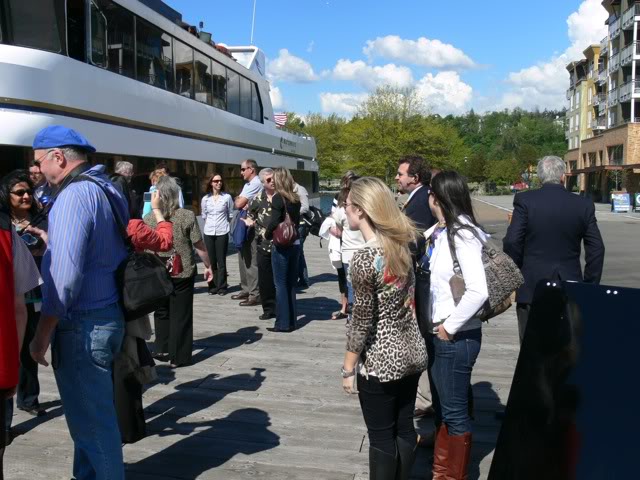
A privately-owned, publicly accessible waterfront trail graces the entire frontage of Southport, from Coulon Park to the Boeing factory. Here, Renton residents are queued for a Waterways Cruise, which departs from Southport’s dock.

While normally we referee, I found myself feeling disagreement with both the Muckleshoot Tribe and the Renton Shoreline Coalition on one point this evening. The Muckleshoot Tribe says in their letter that we need to work to reduce our over-water trails (like we have at Coulon Park). But these trails are used by tens of thousands of residents each year to get their best views and enjoyment of the lake. Trail users include members of the community who often don’t have access to boats or private docks, and yet deserve access to Lake Washington. Some visitors also have mobility issues, making our ADA accessible water walks extremely valuable for ensuring all members of society can enjoy the lake. Meanwhile, the Renton Shoreline Coalition has taken issue with the Shoreline Master Plan giving priority to lakefront development projects which create more public access (like Southport did). In their issue paper they state “the shoreline Guidelines in WAC 173-26-221(4) do not require that new private shoreline development provide physical and/or visual public access for the general public.” So, on this point it feels like both the Muckleshoots and the Renton Shoreline Coalition are unreasonably lowering the importance of public access. And I disagree with both their positions on this. And while they have property rights (in the case of private property owners) and treaties (in the case of the Muckleshoots) dating back to the nineteenth century on their side, we in the general public have something dating back to the Magna Carta on our side– the Public Trust Doctrine.

In short, the Public Trust Doctrine comes from ancient English law, and dictates that certain resources (including waterways) belong to all the people. Every state in our nation recognizes the Public Trust Doctrine, and courts across the county have been increasing public access under it’s provisions. I’ll discuss it in greater detail in another blog. But in the meantime, suffice it to say that I understand the right of the inhabitants of our region to have good access to Lake Washington is of greater importance and is more-strongly rooted in older laws than any private property rights bestowed by our state, or any treaties between the federal government and the Muckleshoot Tribe.

Keep checking back for more blogs about the Shoreline Master Plan.

Renton’s draft Shoreline Master Program continues to generate comments and controversy

A couple months ago I wrote about the complex and controversial process of developing a significant update to Renton’s Shoreline Master Program.

As this plan makes it’s way through Planning Commission, Planning and Development Committee, and eventually the Renton City Council (which has received one briefing so far), it seems that the controversy has not abated… at least, not if I judge by the correspondence and comments I have been receiving.

Far and away the most correspondence has come from lakefront property owners concerned about possible losses of use and value to their property, non-conformance of currently conforming docks and bulkheads, increased set-back requirements, and other issues.

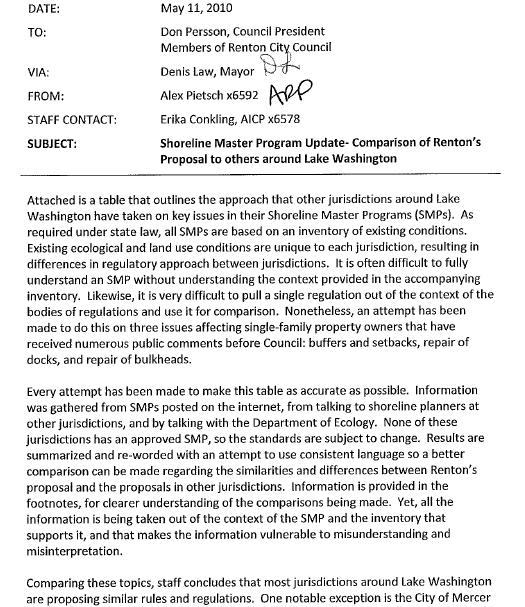
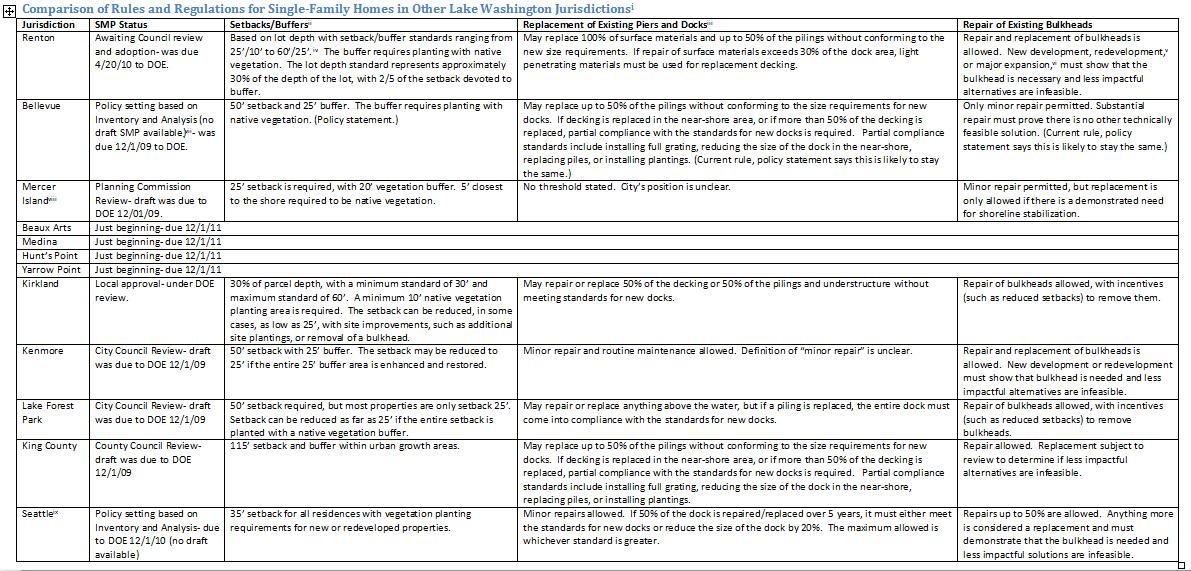
At the council briefing on this topic a couple weeks ago, I had asked for further clarification about how Renton’s proposed rules compare to nearby cities. I made the comment at that meeting that it would seem to me that our approach should be compared to Mercer Island’s, since we are sitting on opposite sides of a common channel. Note: After writing this, I received a comment that the Mercer Island plan was rejected by the State Department of Ecology. (see comments below)

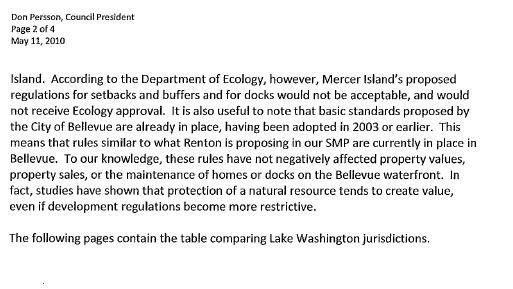
The council received the following memo two days ago on this topic from our staff. Click on each image to enlarge it… and then you may have to click it again to read it in your browser.


Memo page 1

Memo page 2


Comparison Table


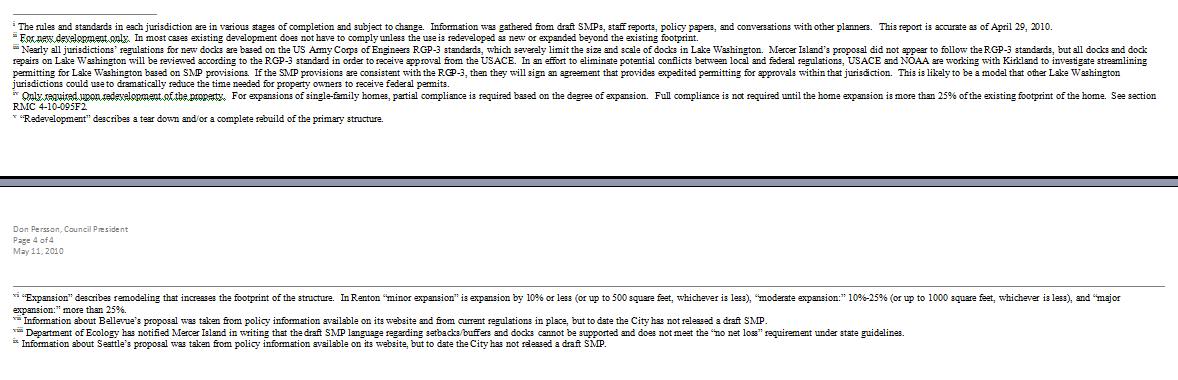
Comparison Table Notes


For those of you interested in this subject, you can find city documents and meeting schedules here.

I look forward to further discussion on this topic. Meanwhile, our Renton City Council Planning and Development Committee is working hard to process your comments and inputs.