
 Written by
 On Monday I posted that Renton Mayor Pavone cast a controversial tie-breaking vote regarding the Tobin Street vacation; state law says that the votes of four council members are necessary to pass a vacation ordinance, and only three council members gave their support to proceed to the next step of the process.
The “For A Better Renton” organization has formally notified the city that they are challenging the legitimacy of the tie-breaking vote. They’ve sent a letter to the Renton City Attorney, Renton elected officials, and staff.
They posted the letter on their Facebook page. I’ve included a screenshot of their letter below. (For background on this issue please see my Monday night blog post here.)
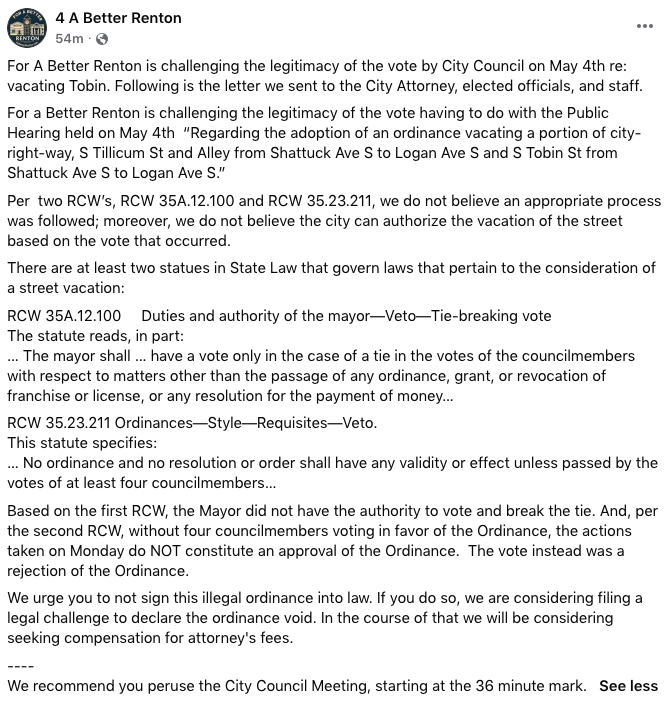

The city better hope it doesn’t get approved in the final reading: The legal argument here appears credible under Washington law, though it is probably not an automatic slam dunk. RCW 35A.12.100 plainly says a mayor in a code city cannot cast a tie breaking vote on the passage of an ordinance, and RCW 35.23.211 requires at least four councilmember votes for an ordinance to pass. If this vote was the actual adoption of the ordinance, the challengers likely have a strong argument that the ordinance was not legally approved. The city’s best defense is that this may have only been a procedural first-reading vote rather than final passage. Washington cities handle first readings differently, and there does not appear to be overwhelming appellate case law directly on this exact fact pattern. Courts would likely look closely at the exact motion language, council rules, and whether later votes cured the issue. If the mayor’s vote was essential to final approval, the challenge has real teeth. If the vote only advanced the ordinance to a later reading, the city probably has the stronger position.
This is a good assessment Anonymous. The City may try to argue they were just “accepting the vacation petition,” and the formal ordinance has not come up yet. But accepting the formal petition has the action of beginning preparation of an ordinance.
At the hearing it was clear to the public that only three out of seven members of the legislative branch (councilmembers) have chosen to approve such an ordinance. If any of them changes their vote because of dialogue outside of a public meeting, it will raise serious “Open Public Meetings Act” and appearance of fairness concerns. Privately twisting arms to whip up four votes might work in Congress, but its not allowed in Washington cities because of the Open Public Meetings Act.
They should have discussed this at the hearing on Monday, in front of the public. When a Council Majority did not favor unconditionally giving up the city property to the School District, they needed to discuss it further and either reach a compromise or refuse the vacation petition for lack of council support. If they weren’t sure what to do, they could have moved to table it. Voting to accept the petition with the support of only three councilmembers leaves everyone suspicious about what will happen next.
Is the OPMA so sweeping that it prevents individual councilmember-to-councilmember discussions of issues before their body? My understanding is that it precludes a QUORUM of members from getting together privately to discuss official matters governed by the OPMA. I don’t think the OPMA prevents in-person ex parte interaction between two individual Councilmembers, or with the Mayor and/or School Superintendent, to privately discuss this matter following the Rotary meeting or church services. The OPMA is not an absolute gag order against one-on-one ex parte meetings, it does prohibit a secret “quorum” from meeting in person or online to discuss official business concealed from the public.
Great question Ron. Thanks for asking.
While normally two Councilmembers would be free to talk with each other, in this case it would likely result in an illegal serial meeting. This is because they have already voted, and they know where they all stand (meeting number one), so any two members getting together to change one key vote (meeting number two) would constitute “action” by the Council. They are not allowed to agree on “action” outside of a public meeting. Renton pays the Municipal Services Research Center to help guide them on issues like this, and I’ve included a screenshot below from this article here on the topic.
Thanks again for this important question.
isn’t that what happened with the public art and the flock cameras?
Council Perez flipper her vote on the flock cameras. After being a champion for police through and through. Now shes claiming public distrust.
Council Rivera flipped her vote on the art and admitted on the pulpit she spoke to the Council President about it before the meeting.
Councilmembers are allowed to speak to one another outside of public meetings, as long as their meetings don’t constitute action by a quorum, either as a group or meeting serially. So there is gray area in a situation where after a Council vote, there is a private one-on-one meeting to get a councilmember to change their vote before another vote on the same topic. I can’t say one way or the other that this is a violation, but I can say it looks bad. I always told my council colleagues that if they wanted to change my mind after I publicly voted on a Council issue, they needed to do it in a public meeting so that the public could see why I was changing my mind.
While I’m not a lawyer, I probably know more about this topic than many people because I was on the winning side of a lawsuit on this very topic. Clawson VS Corman et al went to Superior Court and then the Court of Appeals (we won in both courts). Even though I was always careful to adhere to OPMA in my dealings with other Councilmembers, we were still (unsuccessfully) sued for allegedly violating this very act. We won the lawsuit, in part because I had worked (as Council President) to limit off-dias conversations on topics that were coming before Council.
If I was Council President now, I would be encouraging Councilmembers to refrain from private meetings about South Tobin Street, especially meetings that could look like arm-twisting or polling of the Council. Any such conversations can and should be done in public. Whether these meetings violate OPMA or not, they would sow distrust by the public.
From page 17 of the Appeals Court Ruling:
“Under the OPMA, an individual member of a governing body is subject to a $100 civil penalty only if he or she attends a meeting knowing that the meeting violated the OPMA. RCW 42.30.120(1); Wood, 107 Wn. App. at 566. Here, the Councilmembers periodically received training and materials from the City Attorney, the City Clerk, and the Municipal Research Service Center regarding compliance with the OPMA. CP 49-50, 53-54, 57-58, 61-62. A key theme recurring throughout that material is the mandate to refrain from meeting as a quorum, outside of a duly noticed open public meeting. ld. Clawson incorrectly implies that the Councilmembers’ knowledge of the OPMA establishes the fourth element of an OPMA claim. To the contrary, the Councilmembers’ training made them even more aware of their obligation to refrain from prohibited meetings – precisely as the Brief of Appellant at evidence here indicates they did.”
Here is the 27-page appeals court ruling on the Clawson Vs Corman et al case, which has some language on this issue.
Under RCW 35A.12.100, the mayor can break a 3-3 tie on a preliminary motion like the motion on Monday, but cannot break a tie on adoption of the actual vacation ordinance when that ordinance returns. Because passage requires a majority of votes, a 3-3 split that holds through ordinance adoption would result in the ordinance/vacation failing.
This is another reason we need to pay attention to whats happening in our city. They need to know we are watching and will hold them accountable. Thank you to Randy and Anonymous for all the information posted here.
The council doesn’t seem to understand Roberts Rules of Order and that brings up more questions.
Some of them haven’t figured out how to make a motion. Kinda of sad.
The City Attorney seemed to be caught off-guard by this tie vote, when she was asked by Councilmember Van about whether State law allowed the Mayor to vote to break a tie.
The city attorney not being a good parliamentarian, has been a problem for Renton for decades. Even when it’s different people.
It’s concerning that the mayor believes he can ramrod something through with the public watching. What is going on behind the scenes that we can’t see? Very shady…
Yes, residents should ask themselves why the Mayor seems so determined to close this street. Past Mayors typically worked hard to keep streets open, and even build more of them.
The current plan only has the support of three Councilmembers, and I suspect this support would rapidly go away if the Mayor came out as neutral on this street vacation. The idea of tabling the street vacation request until after South Second Street becomes two-way is so compelling, it’s hard to see any reason to be opposed to it.
I pay way too much in taxes. I don’t see how the mayor can justify spending MY TAX MONEY writing an ordinance that he does not have the votes to pass. City lawyers cost a lot of money. Money doesn’t grow on trees. Mr. mayor should pay for the lawyers himself if he wants them to write laws that the Council doesn’t support.
You wouldn’t want the mayor (or anyone) to know the outcome of a vote beforehand. That would likely be a violation of the Open Public Meeting Act.
If the RSD’s street vacation matter ultimately is not granted, this will not cause irreparable harm to Renton High School or to the RSD. There are many options available to modify their project. However, if the street vacation ultimately proceeds, future Renton residents and future Renton elected officials could face irreparable harm. Mobility is the lifeblood of a prosperous, vibrant community with a high standard of living. The proposed permanent closure (vacation) of South Tobin Street does not serve the public interest now, or in the future.
In the Council’s recent vote to proceed with vacating Tobin Street, the Renton City Council fell short of its due diligence obligation to residents. They had choices, including modifying the street vacation request to accommodate public need. It doesn’t help matters that last year’s School Board elections, none of the three open seats (all held by incumbents) were uncontested. Even Washington’s 11th LD Republicans (there is supposedly a Republican party in Renton!), whine and complain about the RSD yet refused to field ANY school board candidates last year.