 Written by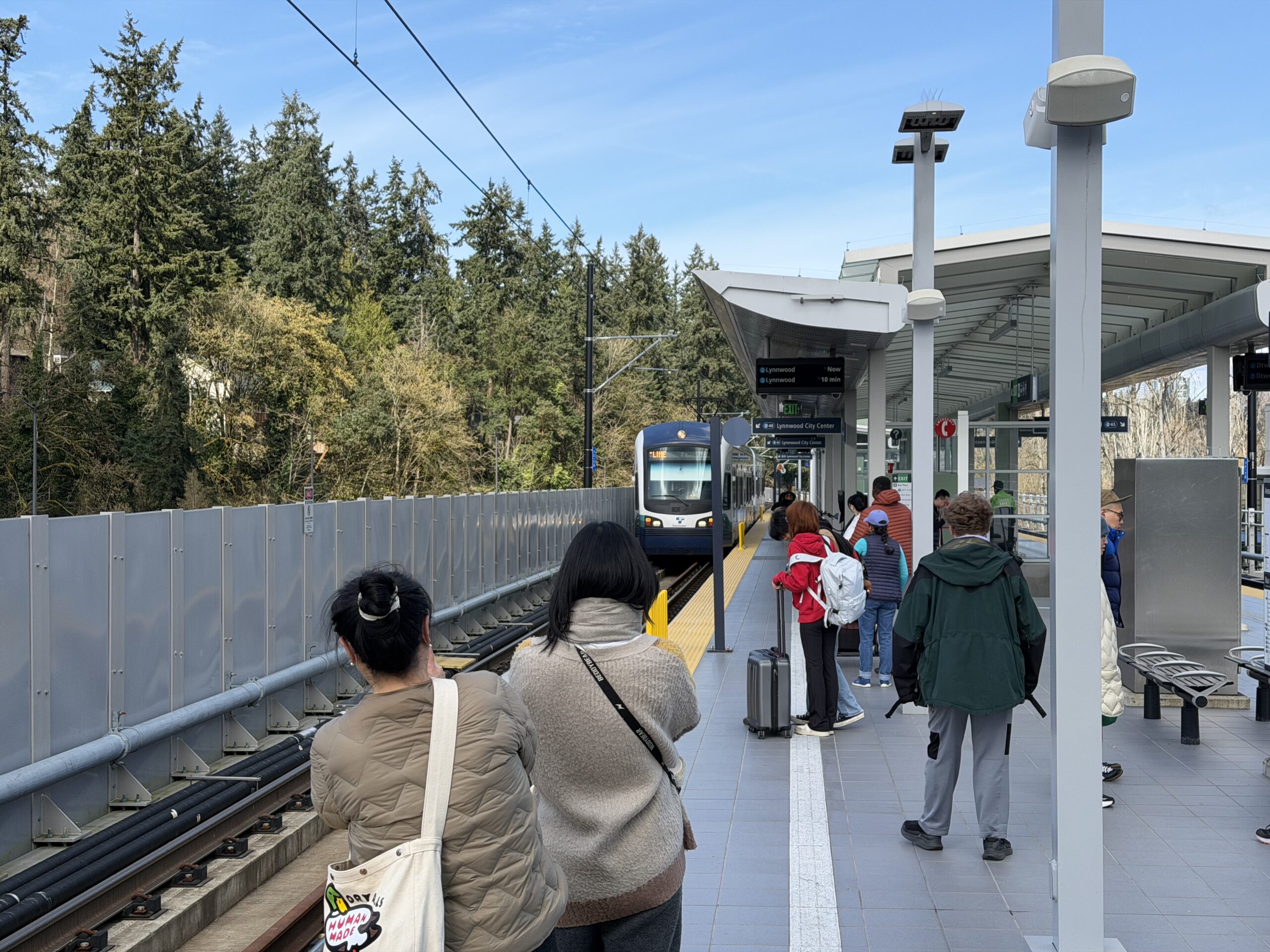
Passengers at the South Bellevue light rail station await the arrival of the train that will take them to Seattle. (Renton is still waiting for a station.)
The Renton Reporter informs us that in Mayor Pavone’s “State of the City” address he said the city missed an opportunity by denying light rail to preserve the small town feel. That decision continues to shape some of the challenges we’re working to overcome today.”
This untrue statement by the Mayor works against Renton’s urgent need to obtain equitable transit service. And the statement is grossly unfair to the four Mayors that preceded Mayor Pavone who all toiled through complicated, difficult regional politics to try to get Renton light rail access.
Mayors Clymer, Tanner, Keolker-Wheeler, and Law all labored to get light rail service to Renton. Mayor Clymer led Renton through our first Growth Management Plan in 1994, in which Renton worked to be recognized regionally as an “Urban Center.” This designation, which required upzoning of downtown and South Renton, was accomplished primarily to make Renton eligible for regional high capacity transit, which was just coming into existence with Sound Move in 1995.
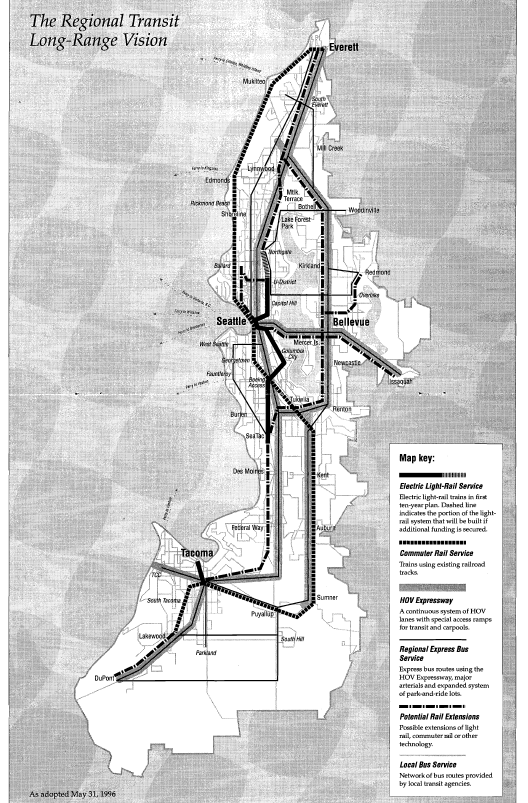
Renton has been working for 30 years to get high capacity transit along the I-405 Corridor, as shown in this 1996 Sound Transit Long-Range Vision. This vision shows Regional Express Bus Service (BRT) on I-405, along with a “potential rail extension” along the corridor.
Mayor Tanner worked to recover funding and commitments from Sound Transit after the agency backed out of their ST1 campaign promise to spend $100 million improving regional bus service in Renton with HOV direct access connections to I-405. Mayor Tanner, an accomplished engineer and former FAA executive who had spent his life promoting safe public transportation, would have been delighted if Sound Transit had offered to install the light rail system per the 1996 long-range vision.
Mayors Keolker-Wheeler and Law both advocated vociferously for Renton light rail through Sound Transit 2 and Sound Transit 3 planning efforts. But ultimately the fact that Renton is in Sound Transit’s Eastside Planning District and our Eastside Board Members were from Bellevue, Redmond, and Issaquah was too big a hurdle; all three of these cities received light rail while Renton did not. Both Mayors sought Renton representation on the Sound Transit Board, and both were turned down until after ST3 had passed. In a series of past blog posts I’ve given the details of these frustrating battles to bring light rail service to Renton.
These four Mayors were backed by incredible staff leadership, including Chief Administrative Officer Jay Covington and Public Works Director Gregg Zimmerman, who both advocated for high capacity transit for Renton for thirty years. The Renton Mayors were also supported by about twenty-five councilmembers during these years who would have all liked to see Renton get light rail service. Many of us on Council worked countless hours on regional bodies in east King County, south King County, and in Seattle in an effort to get us light rail.
If Mayor Pavone has knowledge of any of these previous Renton public officials working to deny light rail to Renton, he should be forthcoming with the names of those involved.
When I retired in 2021, Renton was supposed to receive BRT Stride Service starting in 2024, with a parking garage at the Rainier/Grady station and a large park-and-ride lot at the Seahawks station; and Sound Transit was supposed to be spending $5 million to develop concepts and layouts for a potential future light rail line from Renton to Burien along the I-405 corridor. But since I retired, the BRT service was pushed out to 2028, the parking facilities have been delayed until 2036, and the Renton light rail study has been seemingly ignored. A year ago, many Renton Highlands residents were celebrating that new King County Council legislation would provide improved access to light rail via more frequent Metro 111 service once the Seattle-Bellevue rail link was activated. But Metro has recently delayed this improvement, and Renton officials have not even acknowledged it yet, let alone tried to speed it along.
Mayor Pavone cannot blame these delays on past Mayors or Councils.
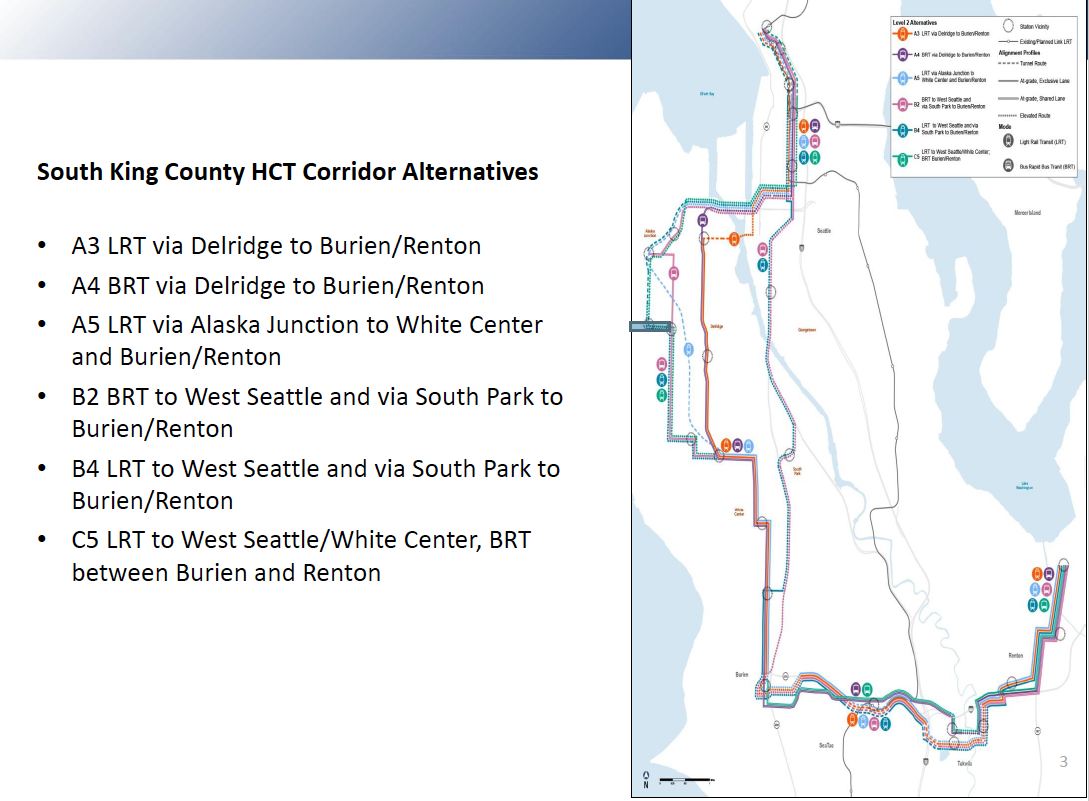
2015 Sound Transit Corridor Studies, in advance of finalizing the Sound Transit 3 package, included two Renton light rail options that aligned with the 1996 long-range vision. Renton officials strongly advocated for funding one of these in ST3, but only got a commitment that Sound Transit would spend $5 million developing the layouts for a Burien to Renton light rail line (along with providing Stride Bus Rapid Transit service on I-405). Current Renton officials need to hold Sound Transit to their commitment to finalize the Renton light rail concept.
Excerpt with context from April 6, 2026 Renton Reporter:
“Pavone said they have to plan with the future in mind, which involves making tough decisions. He cited the land acquisition for the expansion of Coulon Park in the 1960s and moving the car dealers out of downtown as good decisions the city has made. However, he said the city missed an opportunity by denying light rail “to preserve the small-town feel.” “That decision continues to shape some of the challenges we’re working to overcome today,” Pavone said. “The decisions we make now will define our future. It’s up to us whether we impact it positively or negatively.”
Recent Comments