
 Written by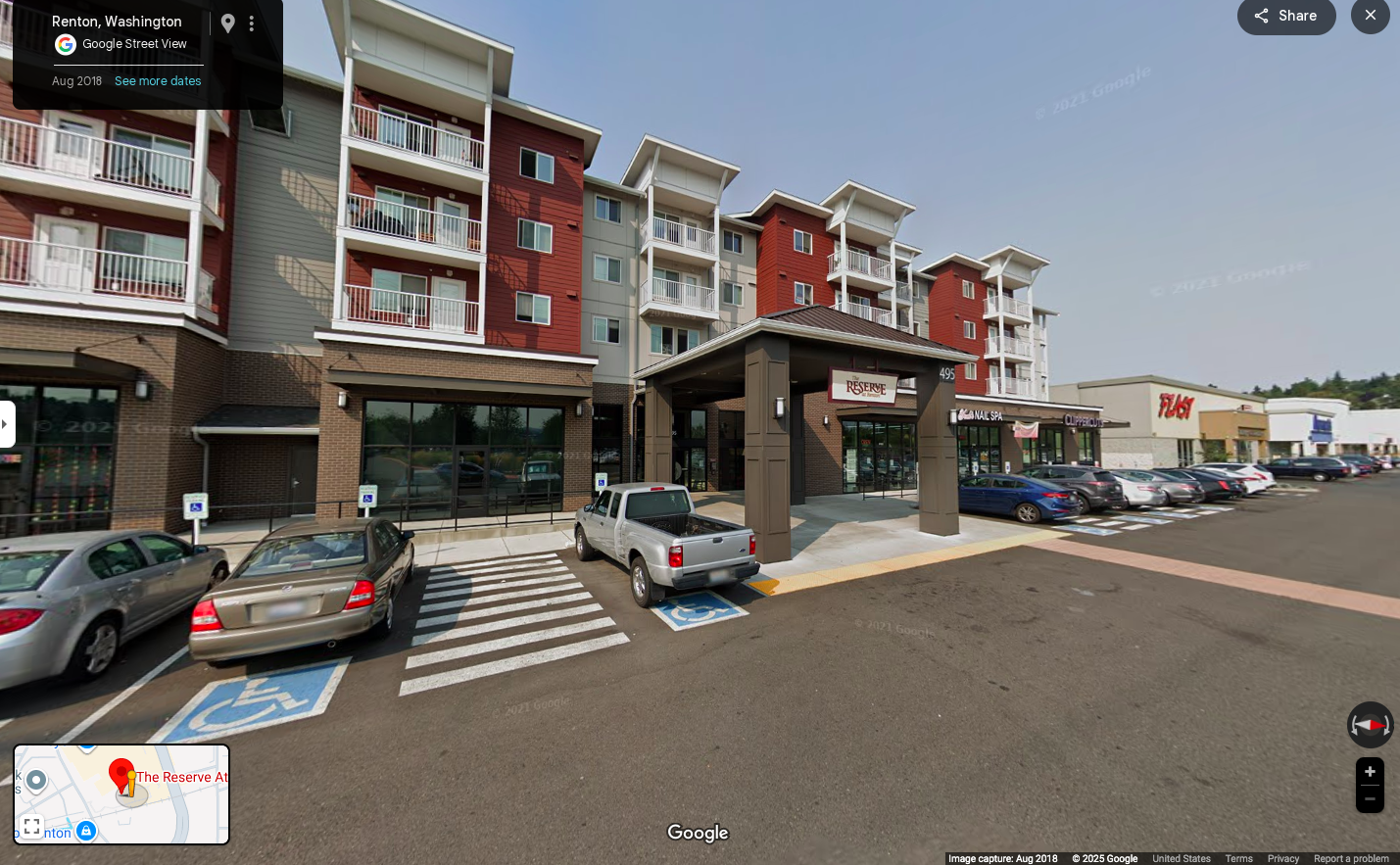
The Reserve at Renton income-restricted senior living apartments and the Feast Buffet banquet restaurant sit side-by-side in the Rainier Avenue Fred Meyer Shopping Center. The Reserve also has two businesses located on its ground floor. Tight parking and new parking permit requirements at the Reserve have resulted in senior residents and store customers having their cars towed, seemingly unfairly in many cases; some have allegedly been towed from ADA spots even when displaying state ADA credentials. (Google Map photo for location reference but does not include current signage- see photos below story for signage)
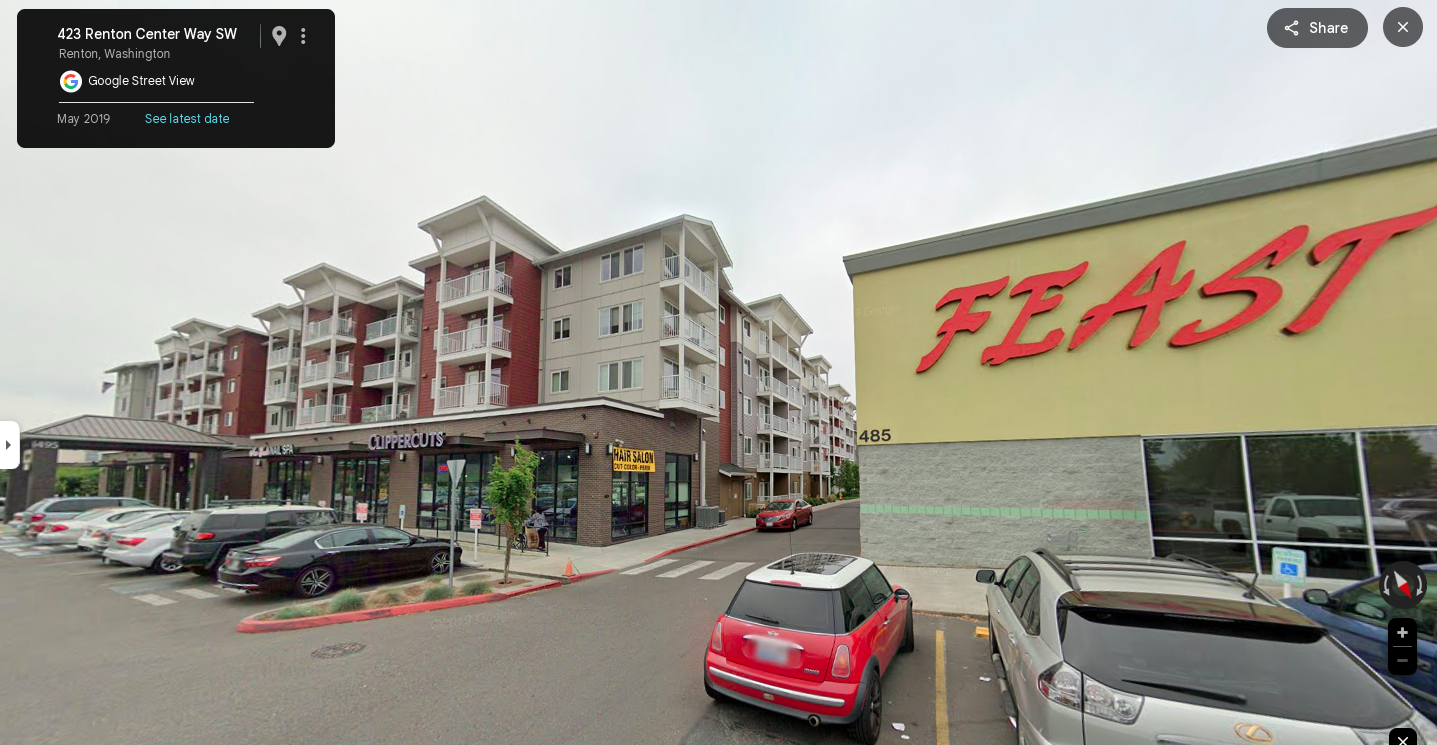
Reserve at Renton and Feast Buffet are side-by-side
At last night’s council meeting, five speakers from the audience expressed heartfelt disappointment and frustration about confusing parking permit requirements and recent overzealous towing at the Reserve at Renton Senior Living apartments.
The Reserve at Renton opened in 2015 at a site that had previously been in use for school bus parking, and was once the home of the Renton Food Circus (seven restaurants in one dining complex.) The Reserve also includes two ground floor stores, and is located adjacent to the Feast Buffet banquet restaurant, in Renton’s Fred Meyer Shopping Center on Rainier Avenue.
When the Reserve at Renton opened, there appears to have been an assumption that the large retail lot would ensure adequate parking for everyone. Urban planners at the time were beginning to embrace the idea of getting greater density and parking efficiency through shared parking; the logic being that living units require the most parking in the evening, while retail requires the most parking during the day– so fewer spots are required when they are shared.
But retired residents don’t necessarily leave their homes during the day, and banquet halls can get very crowded, so parking shortages arose. In response, the Reserve at Renton posted permit-only parking signs and issued limited parking permits. Any resident or store customer vehicle not displaying the permits could get swiftly towed, apparently even residents or customers parking in ADA spots. The residents of these apartments have limited income, and many speak English as a second language. Several residents reported very challenging efforts to reclaim their cars in Kent, and towing bills ranging from $500-$900. Some reported missing medical appointments from the disruption.
I hope they can get these parking challenges resolved soon, and I think some of the residents deserve refunds.
The situation also serves as a stark reminder that there is a limit to how much Renton can reduce parking and still maintain peace in our city. It is not reasonable to assume every senior resident can safely walk to and from transit stops, and take 2-3 hour bus trips to get to their medical appointments; they need adequate parking, and so do their caregivers.
Here is a youtube video of last night’s public comment. The testimony about this topic begins at 25:09.
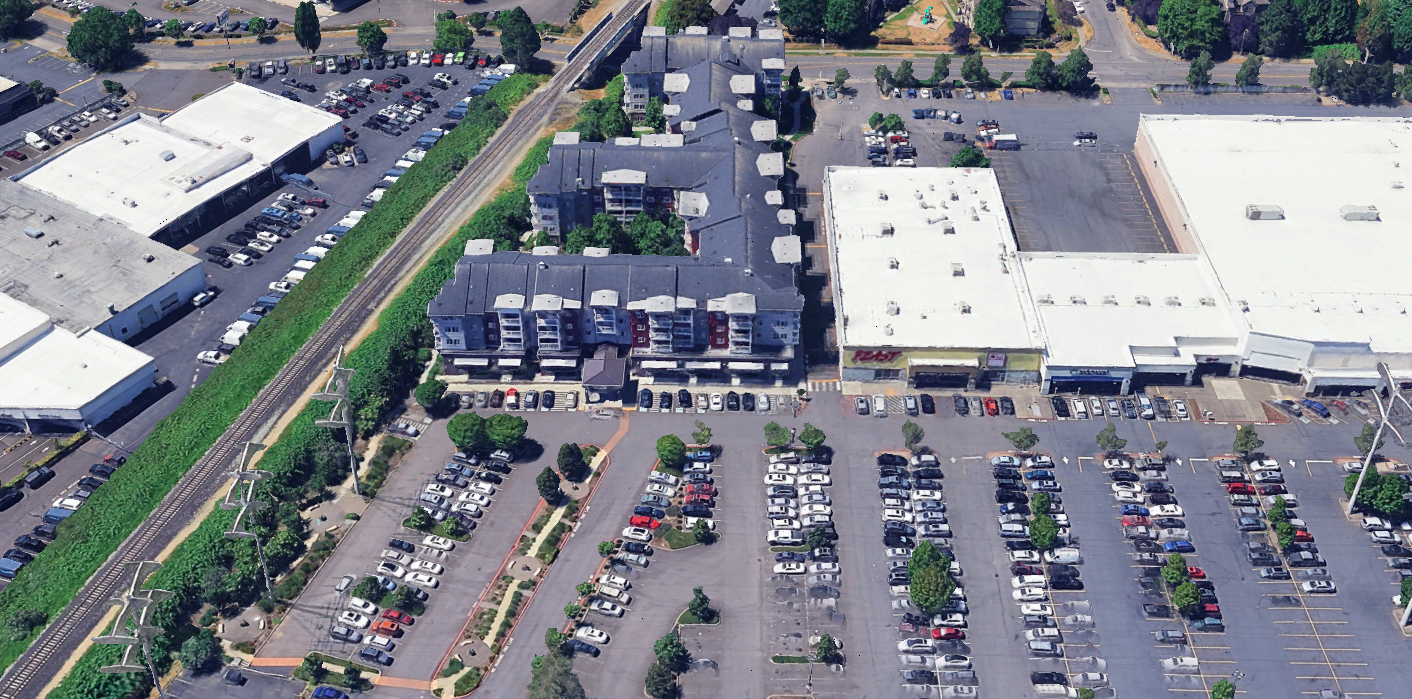
A Google Earth view of the Reserve next to the Feast Buffet and Fred Meyer Shopping Center.
Additional photos of the site, which include the recently added signage, can be seen by clicking below:
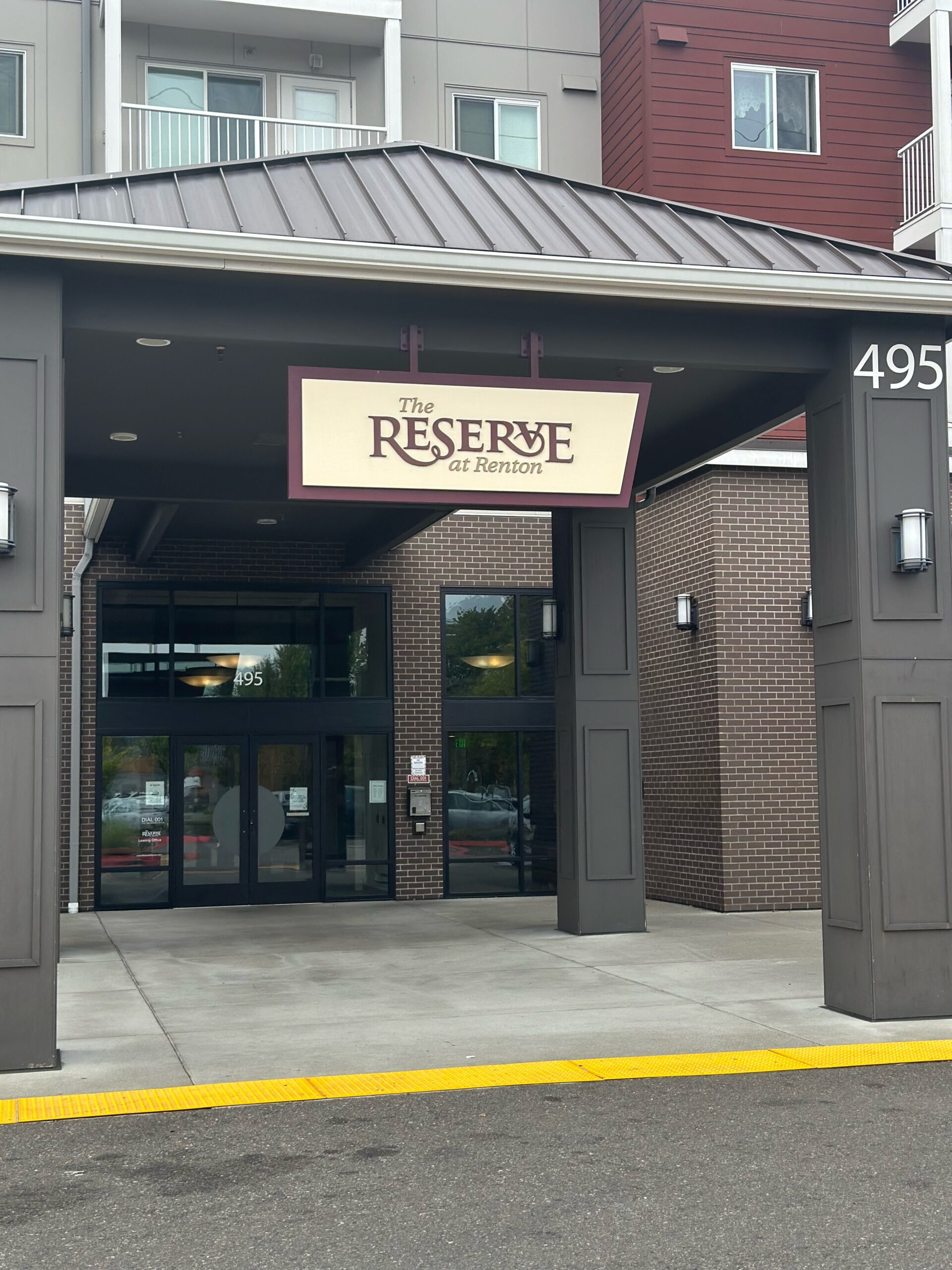
Photo credit: Sheryl Friesz
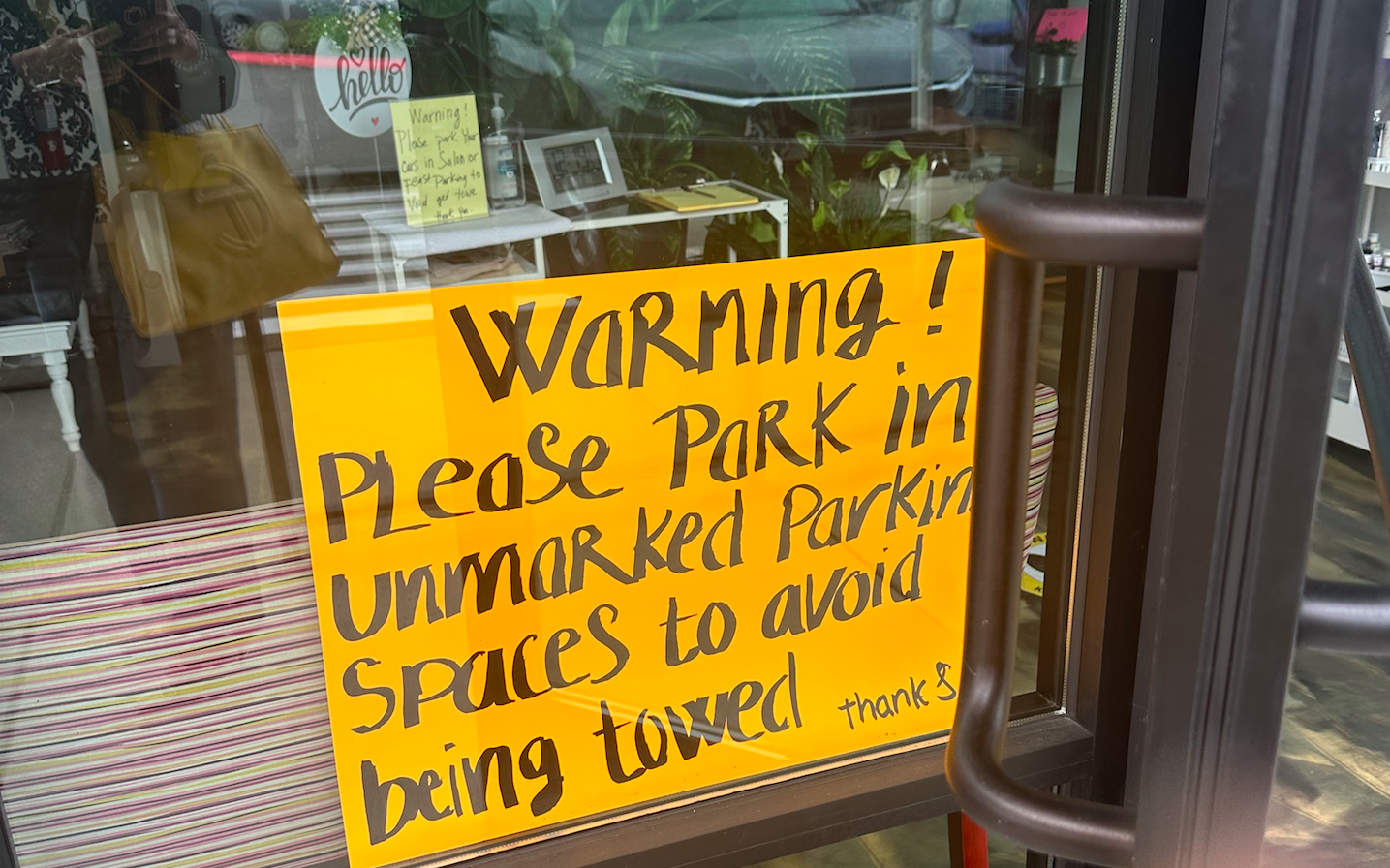
Photo credit: Sheryl Friesz
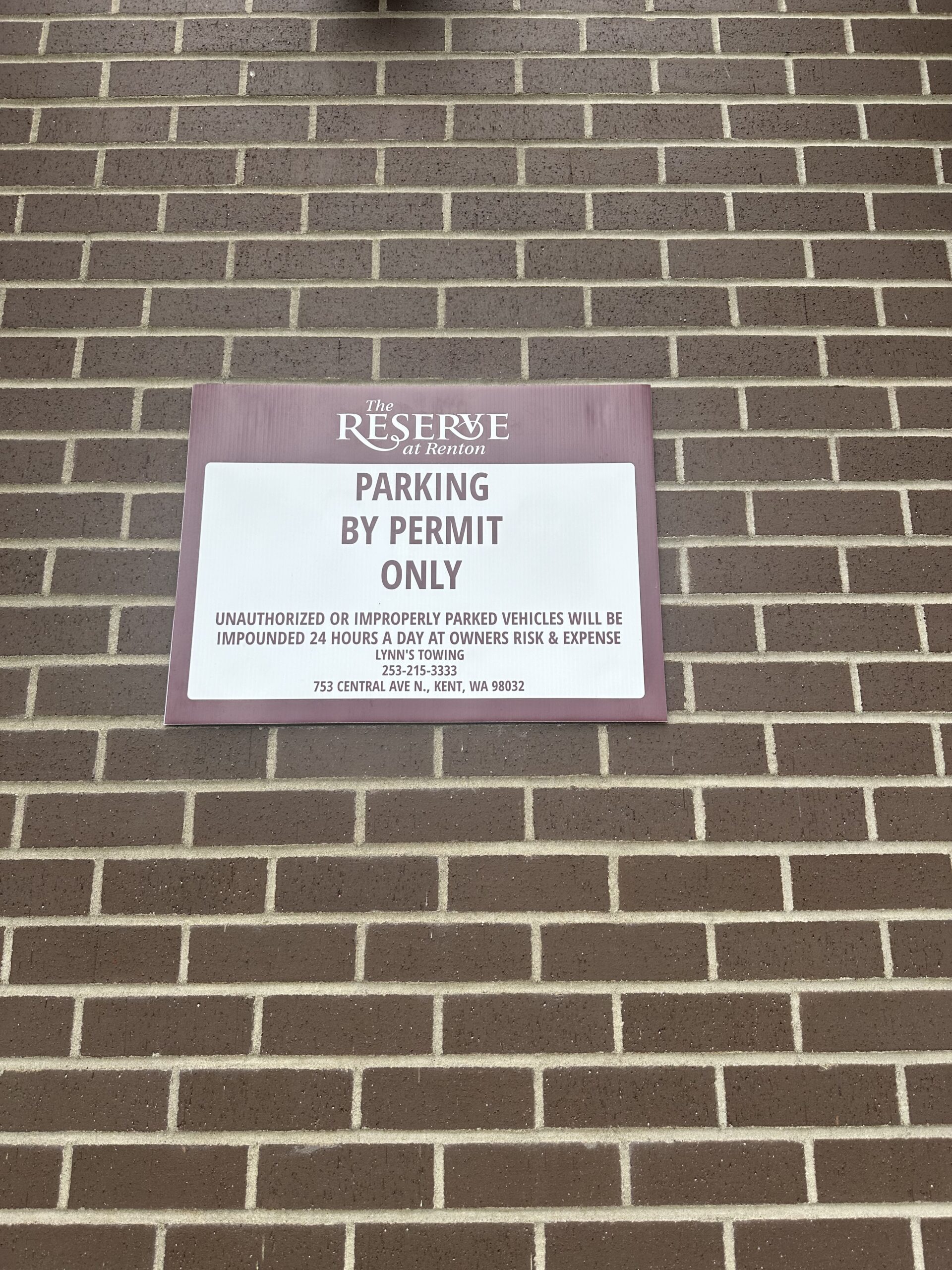
Photo credit: Sheryl Friesz
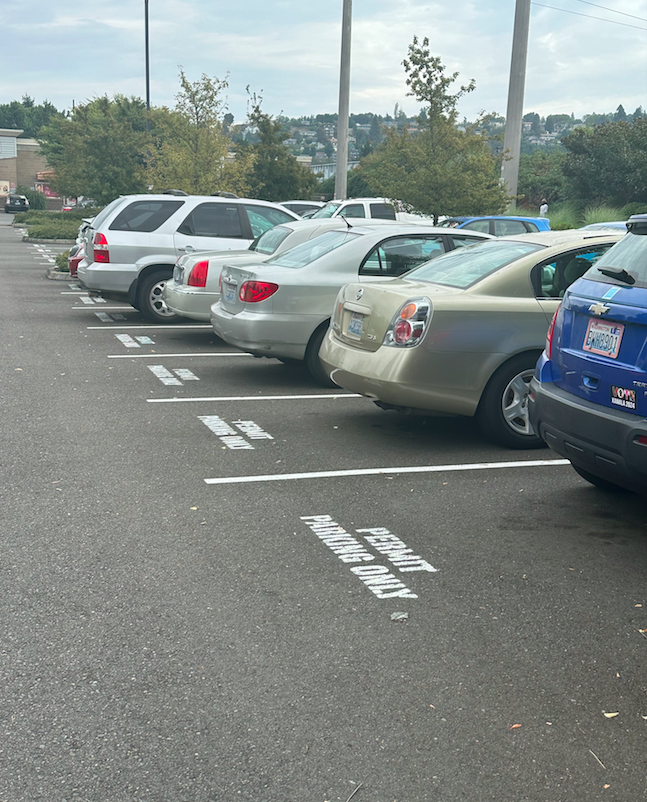
Photo credit: Sheryl Friesz
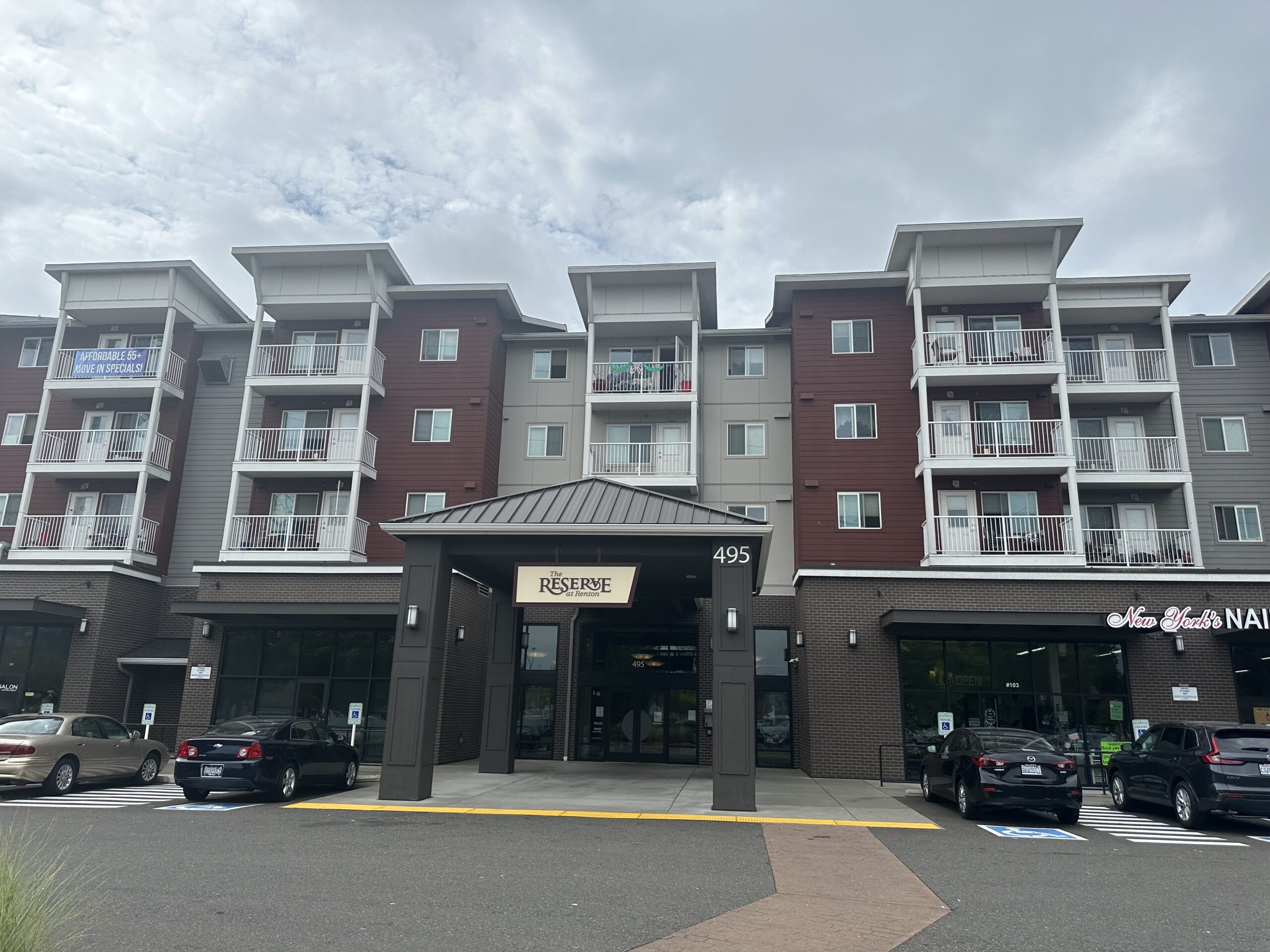
Photo Credit: Sheryl Friesz

It breaks my heart to see the seniors in our city becoming victims. Doesn’t it seem troubling that as soon as a vehicle is parked and the customer walks into the business (sometimes less than 5/10 minutes the tow truck is there? There is also the question of mismanagement of the Reserve in general, going from no garbage pickup, no hot water,etc.
Yes I felt so bad for those residents and the Reserve’s impacted shop owners and customers. They all seem like such kind and trusting people, and such easy targets to be taken advantage of by someone charging them up to 900 dollars in outrageous towing fees. Like you SharonB my heart breaks for the sweet senior residents as they struggle to recover their cars. My heart also breaks for a society that has fallen so low that this is considered an okay way to treat an elderly citizen who is striving to live independently. Towing a car with a state Disabled Parking placard out of an ADA spot at a Senior Living home should really give a person pause. I truly appreciate these residents, and the caring people that helped advocate for them at the council meeting.
If the parking is this much of a problem, the apartment staff could put advisory notes on the cars informing the drivers that they need new parking credentials. The apartment staff should then help everyone figure out how to meet the parking requirements, and make it easy for their residents to continue living independently. If there is truly not enough parking for all the residents and their onsite shops, the apartments should lease some nearby parking, and the City should be advised to increase their senior living parking standards in the future.
I’d be curious if the towing company is licensed to do business in Renton.
This is an important question Anonymous. Thanks for asking. Renton joined a statewide licensing system about six years ago that makes business licenses easier to apply for across multiple cities, and they may have done this through this system. I’ll see what I can find out. (If any readers know the answer, please leave it as a comment.)
This reminds me of a blog post I wrote 18 years ago, after a woman moving into an apartment had to pay $900 to retrieve her vehicle and rental trailer three hours after it was towed.
At that time, as a result of this case, we added limits to how much a tow company can charge motorists for cars towed away from public property. But under state law we could not limit how much towing companies could charge to tow and store from private property.
Here is a link to my blog entry about towing in 2007.
If someone is unable to read the clearly written notices and warnings about parking in incorrect spots, do we really want them driving? If they have an ADA plaque card or our elderly, you should have enough wits about you to follow basic instructions if you want to keep driving and putting all of us at risk.
While I’m not a resident of the Reserve and I don’t know all the details, it sounds as though the parking permit system was not well vetted as it was rolled out, and it left questions that still have not been answered.
For instance, people report being towed from ADA spots even with valid ADA permits. A sign reading “Permit Parking only” near an ADA spot does not necessarily make it clear that the motorist needs an additional credential beyond the ADA placard to park in the spot. This is the kind of questions that could have been answered with warnings, as opposed to going straight to towing.
Similarly, suppose you live in an apartment you have always parked in the same place per your approved lease, and one day you come home and it says “permit parking only.” You might go speak with your landlord about whether you need a permit, but some people might assume their “permit” is their approved lease. Especially if English is a second language. I would assert that the management should have begun by putting flyers on the residents’ cars, in multiple languages ideally, explaining why and how they needed to apply for permits. Anything short of this might make the management ethically culpable for the $900 towing fee.
Good point.
If you can’t read a sign, you shouldn’t be driving because some signs are really important.
Like “Chidden crossing ahead”
I’m surprised the Reserve used Lynn’s Towing in Kent instead of a more Renton-based tow company. Gene Meyer’s Towing (including their impound yard) is one block away from the Reserve apartments on Rainier Avenue. While neither Gene’s nor Lynn’s would necessarily brag about their Yelp reviews, Gene Meyers 2.7 is better than Lynn’s 2.2. And towing a car 2000 feet should cost less than towing it five miles. It would have been far more convenient for the Reserve’s residents to recover their cars, which the apartment managers should have considered in my opinion.
Thank you for allowing space for this conversation.
I want to again emphasize that the residents of the Reserve at Renton are the onsite management office’s direct customers. The entire purpose of the community is to serve them, support them, and advocate for their well-being. Based on my own personal communication with the leasing office, the team onsite has maintained a consistent message: their first priority has always been the residents everyone continues to reference in public comment. They are not ignoring, dismissing, or minimizing resident needs. In fact, they are actively working to protect resident stability, safety, access, and parking structure in a way that many of the city hall discussions have not fully acknowledged.
One of the most harmful outcomes in situations like this is allowing rumors to grow unchecked. When testimony is repeated publicly without fact checks, it can easily overshadow documented reality. During my call with the leasing office, they clarified that only one incident involving a tow from an ADA-marked space had occurred. They confirmed they had saved proof, documentation of the violation, and evidence supporting the action. This same incident was addressed publicly by the manager on a previously posted Google Review response. Their account of that situation was entirely consistent with what was shared with me directly. That consistency matters. It indicates transparency, accountability, and a willingness to answer difficult concerns in public spaces when given the chance.
What is missing from the broader narrative is simple verification. Many speakers have made claims implying widespread towing from ADA spaces, intentional targeting of seniors, or questionable business arrangements. Those claims, when repeated often enough, begin to sound factual, even when they are not grounded in documented incidents. The city should hold a stronger responsibility in high-impact community disputes to distinguish verified facts from assumptions before discussions reach months of emotional escalation and financial speculation. The unfortunate truth is that a situation should never have been allowed to grow legs in the public forum when the city physically came out, walked the property, and saw for themselves the extensive signage, the marked enforcement boundaries, and the operational challenges of shared retail parking. When city officials or representatives personally confirm context on-site, it is fair for the public to expect that verified perspective to carry weight in council dialogue. That perspective should have informed the tone and direction of the public narrative early on.
When the city visited this community in person at the Renton Rainier retail complex, they would have seen roughly 30 posted signs related to towing and permit-only enforcement, far exceeding the minimum posting requirement under the Revised Code of Washington. They would have observed that permits were distributed to businesses on the ground floor, which those businesses independently allocated to their employees, rather than the leasing office dictating that use. They also would have seen that the management company has the legal right to contract with any towing provider they choose. None of this context removes the human impact of towing on fixed-income residents, but it absolutely reframes intent. Enforcement is a product of a permit-only parking system, not malicious targeting of seniors.
Permit enforcement at this scale may feel unfamiliar to residents because few properties clearly label every private, reserved, or prospective parking space individually. In all my time interacting with multifamily communities, I do not know of another place that designates so many spaces with individual reservation markings. That, in itself, suggests the intensity of the parking challenge, not impropriety. A property does not mark hundreds of spaces out of convenience, but rather necessity when shared retail parking fails to match living community needs. This deserves empathy, solutions, and clarity, but not a villain narrative.
With all of this being said, the frustration expressed by residents is real. The financial impact of $500 to $900 towing bills, vehicle retrieval in Kent, language barriers, and loss of transportation for medical care deserves civic collaboration, policy refinement, and better holistic planning. These resident hardships should absolutely be reviewed. But humility is also required in public discourse. Allowing council dialogue to frame management as neglectful when they are literally the residents’ service provider is counterproductive and discourages participation from all voices.
The real oversight here is not parking policy execution by the property, but rather a civic communication breakdown that allowed public belief to drift away from proven, in-person observations. When a situation is investigated on-site by municipal representatives, there is a shared responsibility to communicate those findings publicly, guide the narrative toward verified information, and prevent rumor from replacing reality. Instead, weeks of council dialogue continued to reinforce only part of the story, while facts gathered on the ground were left out of the spoken room.
I hope moving forward that the city:
1. Ensures both resident voices and management context share equal representation.
2. Distinguishes verified incidents from rumor in public dispute conversations.
3. Looks at long-term parking needs holistically for senior living communities, caregivers, and retail partners.
4. Acknowledges the operational effort already being made onsite to protect residents, even when it is unpopular or misunderstood.
5. Collaborates on solutions that decrease hardship without discrediting resident-focused property management.
The best way to restore peace is through balanced dialogue, factual checks, and partnering residents with the staff that serves them, rather than placing them on opposing teams in a civic forum.
Thank you for the opportunity to speak and encourage full perspective going forward.
Thanks “Anonymous”
https://www.gorenton.com/chamber-members/find-a-member/member-details?member=reserve-at-renton&refererUrl=https://www.gorenton.com/chamber-members/find-a-member/
Thank you for your very thorough and detailed comment. You make some strong points, and your comments add depth to the dialogue about the challenging parking issue which has been so impactful to some of the residents of the Reserve.
I agree that once residents began providing emotional testimony to the City Council, the city leaders should have began doing some more public and transparent problem solving. Instead of simply saying “thank you…next” to the comments, I would have liked to see many more questions asked about the specifics of each event. I’ve recently expressed concerns about both the speaker’s time constraints, and the lack of council questions/interaction, and I think that both of these shortcomings have made this issue unnecessarily become more hostile and less productive than it should have.
My impression watching the meetings is that the City appears to be treating this as if it’s entirely a private property dispute. But it’s not really just a private concern; the city was involved in the design and permitting of this project, and therefore should acknowledge any shortcomings in the design that elevate to this level.
The city should be especially engaged right now, because ironically the state legislature (which has very little zoning experience) has just recently superseded all city and county authority on parking for low-income senior housing. The legislature decided a few months ago that there should be no requirements to build any parking at all for low-income or senior housing. Renton elected officials could be using data from the Reserve dispute to inform the Legislature about the financial and accessibility impacts that limited parking puts on seniors, so that we don’t see hundreds more projects where seniors on limited income have their grocery and rent money taken from them by towing companies.
Here is the new 2025 law, “called the parking reform and modernization act,”
(RCW 35A.21.445)
Minimum parking requirements….
(3) A code city may not require any minimum parking requirements for:
(a) Residences under 1,200 square feet;
(b) Commercial spaces under 3,000 square feet;
(c) Affordable housing;
(d) Senior housing;
….
I have attended and followed every City Hall meeting regarding The Reserve at Renton since the very beginning. As a resident, it has been extremely disheartening to watch false narratives expand without being corrected.
Parking has been one of the biggest concerns for residents for years. We finally have someone who is present, consistent, and willing to enforce parking fairly. Most residents are relieved. A very small number have instead chosen to spread untrue claims and recruit friends or customers to post false reviews filled with gross fabrications stated as facts.
I personally went into the management office to show documented proof of the first communication provided to residents regarding parking. I watched staff verify the records directly. In addition, if any resident needs policies explained in another language, the office has a translation list available for residents to choose from, and staff will translate for them upon request. This demonstrates accessibility, not avoidance or secrecy.
I also know for a fact that parking rules were explained directly to each household when they picked up their parking permit. We have guest visitor parking, and residents are always informed of the options available. The idea that people were not informed is simply false.
There is one resident, in particular, who has openly had conflict with every manager who has ever worked in this building and behaves as if they run the community. Their personal disputes are not representative of the experience shared by the rest of us.
The on-site business responsible for pushing much of the misinformation is the nail and head spa. Staff and residents have been harassed due to defamatory claims that were completely fabricated and never supported by any evidence.
The treatment Heather and her husband have received has been disgusting and unacceptable. Heather has continued to serve residents professionally, verifying permits without bias. Her husband is one of the kindest people, someone who cares deeply about everyone around him and shows compassion to every resident he meets.
This community should not be defined by a dishonest minority. I urge the city to recognize the documented proof, correct misinformation when it appears, and encourage more residents to share their positive experiences or flag harmful reviews that cross into bullying and retaliation.
I respectfully ask the city to acknowledge the facts publicly and support the fair, consistent enforcement residents have long requested and deserve but have not heard back.
3
I want to share my perspective as someone who cares deeply about the residents here. Towing incidents can be really stressful, especially for seniors on fixed incomes who rely on their cars for things like medical appointments, groceries, and caring for family members. It’s important to remember the real impact these situations have on people’s lives.
At the same time, the permit-only parking system isn’t about targeting seniors. With shared retail parking, caregiver needs, and reserved residential spaces, rules are enforced out of necessity, not malice.
Some of the claims about widespread towing from ADA spaces or unfair treatment should be looked at carefully and verified. Repeating unverified information can make it harder to focus on real solutions.
If you look at the comments, most come from the same small group of business owners and roughly five residents who didn’t read the posted signs or feel they are exempt from the rules just because they’ve lived here a long time. Living here for many years doesn’t give anyone a free pass to ignore posted policies.
There’s also plenty of parking for residents and visitors. There’s a whole row of spaces for guests, salon clients, and caregivers, plus six clearly marked salon-reserved spots right in front of their businesses.
Many residents are relieved that parking rules are now enforced fairly and consistently. The management team has also provided accessible support, including translation in multiple languages, to make sure everyone understands the rules.
Going forward, the best results will come from residents, management, retail partners, and the city working together. Towing issues should be reviewed, but solutions need to be based on facts, include everyone’s perspective, and help protect seniors’ independence without adding unnecessary financial stress.
Thank you for taking the time to read this. Approaching this with empathy and fairness will help our community move forward together.
Thank you “Concerned Family Member” for sharing your point of view on this towing. There certainly appear to be multiple perspectives on this.
There is one aspect that the Reserve and the City of Renton must quickly clear up. At the Council Meeting two days ago there was a woman named Melody S. who said she has a disabled parking permit and cannot use the disabled parking space in front of the nail salon without fear of getting towed. She said she worked for the state for 35 years, and she’s confident that it is actually illegal to tow her. She asked the Mayor what he thought, and he also thought she should be able to legally park in a disabled spot without being towed. It’s a question I also raised here, since state guidance seems to say that anyone with a disabled credential can park in a disabled spot. Still, Melody S. made it clear that she feared getting towed from a disabled spot by the Reserve management.
This is a problem for the Reserve Management that they need to fix right now. A disabled visitor should not be frightened away from using a disabled parking spot. Even if the Reserve now claims they are not actively towing from disabled spots, they need to clear up this misunderstanding before a disabled visitor gets hurt trying to transit across the whole parking lot afraid to park in an ADA spot.
Below is a picture of Melody S. giving her testimony, which can be viewed on youtube here.
I have personally heard the nail salon instruct visitors not to park in ADA spaces without a parking permit, even when a valid placard is displayed. They tried to enforce this when my uncle came to visit. This did not come from the office or management.
The ADA spaces are not marked as permit-only parking like other areas. Management has publicly confirmed the only vehicle ever towed from an ADA space did not have a placard displayed.
There is also a Google Reviews post stating the nail salon asked someone to leave a negative review about the community. The salon is spreading misinformation and trying to shift blame to a team that has not acted improperly, while recruiting residents and contacting former employees to build support for false accusations. This has created unnecessary conflict and misdirected frustration.
I know residents are being approached because this happened to me directly. Salon staff have spoken to me and others while walking home, presenting themselves as an authority on parking rules when they are not.
To better understand any valid concerns, can you confirm whether Randy has gone to the office or been in contact with anyone from the office regarding this matter?
What I have seen is the Reserve “Parking by Permit Only” sign hung on the bricks behind/above the state standard blue ADA signs. And I’ve seen the cars parked in the ADA spots displaying both the ADA placard and the Reserve placard. And I’ve seen testimony at city council meetings in which speakers have reported that one or more cars have been towed from the ADA spots for not having the “Reserve” permit. And I’ve read online reviews on google saying this. And I’ve seen at least one person at City Council who testified that they have an ADA permit but are afraid to park in these spaces, and is therefore parking far away.
IF this is all just a big misunderstanding, and the Reserve Management is not trying to assert that users of the ADA spots need a “Reserve” parking credential, they could clear this up easily. I would recommend they remove the “Reserve Parking by Permit Only” sign from the bricks above/behind the ADA spots and instead substitute a sign indicating that the ADA spots are open to anyone with a valid state ADA credential. As an additional step, they could also respond to the specific negative google reviews by clarifying that they won’t tow anyone with a valid ADA permit, regardless of whether they have a “Reserve” permit, and perhaps even offer to reimburse anyone that was towed for this. That would go a long way toward clearing up this misunderstanding.