
 Written by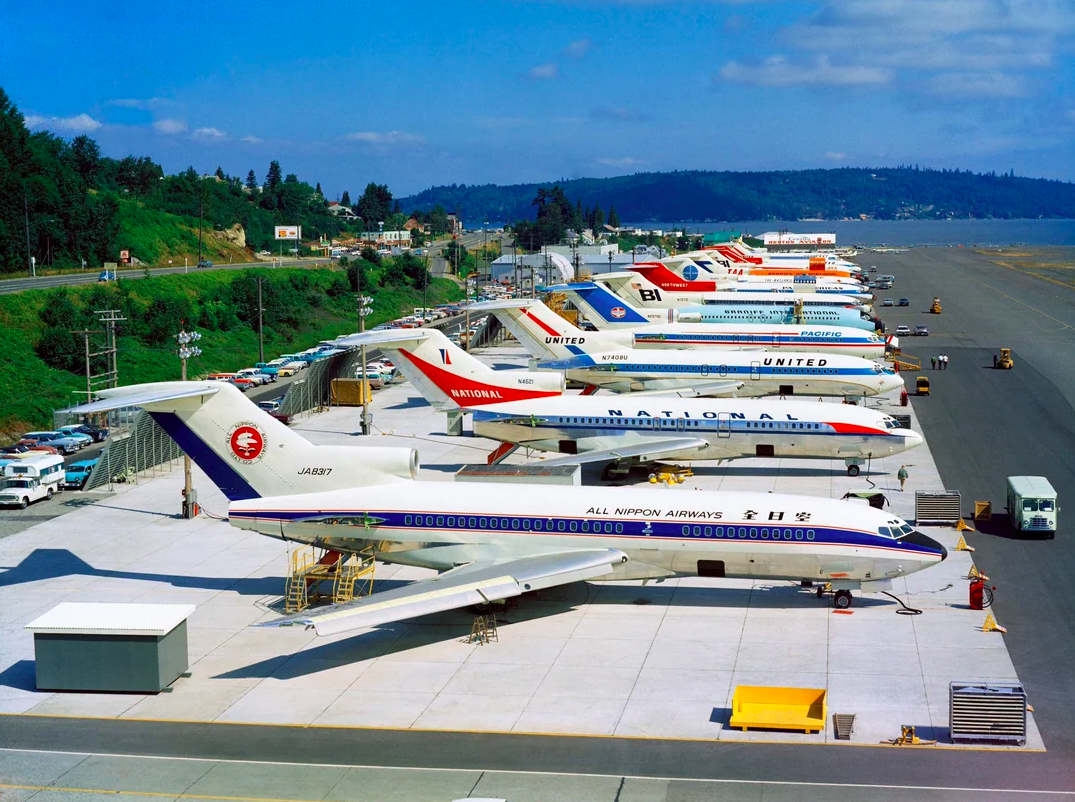
Renton airport in summer 1966. The Boeing Everett factory opened the following year.
This colorful picture of Boeing’s 727 flight line in the summer of 1966 has been shared at least a couple times on Reddit. The original poster three years ago also provided information on how long each of these individual airplanes performed in service. Several of them were flying until at least 2005, and one flying until 2014.
When I joined Boeing in summer of 1984 the company was still making 727 airplanes, but the last one was delivered to Federal Express a few months after I started work. Most customers looking for single-aisle airliners switched to ordering 757-200 airplanes (certified December 1982) and 737-300 airplanes (certified November 1984).
This photo serves as another reminder of Renton’s proud history in aircraft production. Renton is the birthplace of commercial jet aviation, and Boeing has played a major role in our city’s success for over 80 years. Renton should strive to keep Boeing building airplanes here for decades to come.
I’ve written more about Boeing’s significant contributions to Renton’s economy in a previous blog entry here.
The detailed information for these airplanes is below the break.
727-81, s/n 18952/306. First flew 19 August 1966. Delivered to All Nippon Airways 30 August 1966 and registered JA8317. Later registered D-AHLN and N110NE with other owners. Scrapped in Grayson, TX by 1998.
727-35, s/n 19166/303. First flew 12 August 1966. Delivered to National Airlines 31 August 1966 and registered N4621. Later registered N150FN, OO-DHP, and TG-DHP. Scrapped in Guatamala 1999.
727-22C, s/n 19096/305. First flew 19 August 1966. Delivered to UAL 14 September 1966 and registered N7408U. Went to Wien Air Alaska 30 March 1981 and registered N497WC. To UPS 14 September 1982. Modified with Rolls Royce Tay engines June 1993. Scrapped at Roswell, NM 2007.
727-193, s/n 19305/300. First flew 28 July 1966. Delivered to Pacific Airlines 5 August 1966 and registered N2979G. Later registered PP-CJH and OB-R-1256. Scrapped in Lima, Peru 1995.
727-27C, s/n 19111/297. First flew 1 July 1966. Delivered to Braniff 14 August 1966 and registered N7272. Went to Transrasil 28 November 1975 and registered PT-TYS. Crashed 12 April 1980 22 km NNE Florianópolis-Hercilio Luz International Airport, Brazil. The aircraft struck a hill while on approach. There were 55 fatalities and 3 survivors.
Likely 727-51C, s/n 19206/294. First flew 5 August 1966. Delivered to Northwest 24 August 1966 and registered N495US. Later registered N413EX and D2-FFB. Scrapped Luanda, Angola 2006.
727-21C, s/n 19135/301. First flew 1 August 1966. Delivered to Pan Am 2 September 1966 and registered N340PA. Later registered J2-KAD, N47142, and N724PL. Last served with UPS beginning 1 May 1985 and registered N934UP. Modified with Rolls Royce Tay engines August 1985. Scrapped at Roswell, NM 2007.
727-26, s/n 19254/298. First flew 24 July 1966. Delivered to TAA 9 August 1966 and registered VH-TJD. Layer registered N8043B, N10XY, N682G, VP-BAB, M-FAHD, and 2-MMTT. Stored at Kemble Airport, UK 2018 and eventually parted out. Fuselage now at Brislington, UK for use as an office.
727-27C, s/n 19112/299. First flew 29 July 1966. Delivered to Braniff 26 August 1966 and registered N7273. Layer registered PT-TYT and N725EV. Scrapped at Marana, AZ 1998.
727-77, s/n 19253/296. First flew 20 July 1966. Delivered to Ansett International 9 August 1966 and registered VH-RMR. Layer registered N110AC, N111EK, VR-CKL, N340DR, N440DR, N448DR, and N720DC. Severely damaged at Palm Beach International Airport, FL by Hurricane Wilma 2005 and never flew again.
727-22C, s/n 19095/302. First flew 9 August 1966. Delivered to UAL 6 September 1966 and registered N7047U. To Emery Air Freight 8 March 1981 and registered N425EX. Written off 3 May 1991 at Bradley International Airport, CT. The number 3 engine suffered an uncontained failure on takeoff. The takeoff was aborted and the aircraft was consumed by fire. The 3 crew escaped unharmed.
727-191, s/n 19391/309. First flew 25 August 1966. Delivered to Frontier 8 September 1966 and registered N7270F. Later registered N297BN, N502RA, and N502MG. Scrapped at Oscoda, MI 2014.

The beautiful livery shows that it’s best to be the one selling shovels during a gold rush. ANA and United are the only ones left I think. I have to admit that getting the ANA 727 with just a few hours across on it across the Pacific would have been daunting even with three engines. Our modern era of ETOPS/EO weirds me out on two engines so I try not to think about it. I know the actuaries are right… but still.
Thanks for the comment Ben. I guess it was like the gold rush! My wife and I also had fun discussing some of these airlines of the past.
I enjoyed working on certification of extended twin-engine operating (ETOPS). I worked this on 757s, 737s, and assisted with 767s. Thanks to the incredible turbine engine reliability and the ETOPS upgrades we made to add additional redundancy to key systems, these airplane missions really are incredibly safe.
The 727s engines were many times more reliable than the earlier 707 engines, and they set the stage for switching from a three-person to two-person crews. In the 707 days the flight-engineer had a full time job of just keeping all three (or four in the case of 747) engines running on any given flight, but after an initial learning curve in the 1960’s, the industry learned to make jet engines that can now each go 375,000 hours or more (43 years of service) without an inflight shut-down. Since the airplane can safely complete a flight with just one engine, the odds are 1/ (375,000 X 375,000) x 8 hours = 1 in 17 billion of losing both engines on an 8-hour ETOPS mission. Commercial jet engines have amazing reliability, largely because they have so few moving parts and they typically maintain very steady speeds. They of course are also engineered very well.
The industry has only vary rarely seen multi-engine failure in modern jets, like US Airways Flight 1549 landing on the Hudson; these have sometimes been related to a common issue that affected both engines at lower altitudes like bird strikes or heavy precipitation, that typically would not occur at a high altitude ETOPS cruise phase of flight. Human errors, like miscommunication or ground-servicing mistakes are another risk category (like when Canada Air 143 had to glide to a landing after running out of fuel), and they can impact any flight whether it’s ETOPS or a quick 30-minute hop. Many of us in the industry focussed a lot of energy on minimizing these risks.
FAA requires that airliners be designed to have a lower than one-in-a-billion chance of a failure serious enough to force a landing outside of an approved airport. And we also design aircraft to be safely ditched on water, including life rafts, life jackets, beacons, floating cushions, and other safety measures, that form an additional layer of safety (that we hope is never needed) on top of everything else.
I should remind anyone reading this comment that flying on a commercial jet is about 50 times safer than driving, and creates about the same amount of carbon as driving a car with two people in it, so I recommend it as the best option to everyone when they can afford it. I discussed the high level of safety on commercial airplanes, and the little-known safety reason why the FAA allows lap children, in a blog entry here.
Thanks for all your work to bring safe travel to so many people.
If I remember correctly, the most dangerous part of a commercial flight is the drive to the airport.
I love the seeing the old ANA logo and the Devinci-like air screw as a reference to their start as a helicopter operator. Their IATA code is still NH for Nippon Helicopter.
What I love most about this photo is zooming in to see the corner store on Lk Washington Blvd. Kennydale was a great place to grow up. We walked all the way down Lk Wa Blvd to downtown to go to the movies. Kids don’t try that now…..
Renton was flourishing commercially at this time, with a six-year-old Sears and JC Penneys building in an open-air mall a half mile south of the Airport on Rainier Avenue. (Two decades later, the new Southcenter Mall would steal these businesses away, and Fred Meyer rebuilt the site and replaced them.)
Across the street from Sears was the first Valley Medical Center, an asterisk shaped building that was later leveled to build K-Mart, and then remodeled into the current McLendon’s Hardware.