Dont forget!… Curvee Award ceremony is tonight!


Tonight from 7-9 at the IKEA Performing Arts Center we will be announcing the winners of Renton’s 2010 Film Frenzy, and we’ll be showing the winning films.

In past years this event has proven to be a lot of fun. It’s a great way to celebrate our local film makers and our community.

Several of us on council will be present to enjoy the show and help present awards. All citizens are invited to attend.

You can find more information in this article in the Renton Reporter.

Amira’s Belly Dance Spectacular! Cathy and Anastasia to perform tonight!


Photo by Gabe Tompkins
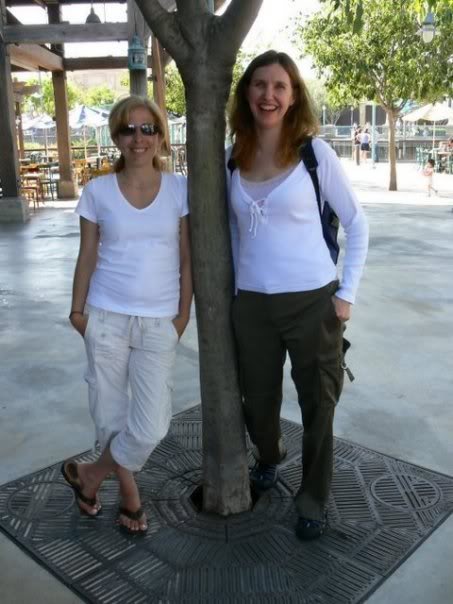
My wife Cathy (left) and daughter-in-law Anastasia (second from right) have learned to belly dance through classes offered by our Parks and Recreation Department. (My daughter Katie has also learned to belly dance through these classes, but is not participating this quarter because of her work schedule.) Their instructor, Amira (second from left) is a very experienced teacher and performer. The fourth performer pictured is their classmate Emily (right).

Tonight Cathy and Anastasia will be performing along with other belly dance troupes (including professional dancers) at Carco Theater. (The show is at 6:00 PM. Tickets are $10.00, and there were about 100 seats left at last count. Proceeds from the ticket sales benefit “Friends of the Children- King County”, a student mentoring program )

The photo above is from a previous performance.

Renton Reporter covers new store openings at the Landing; merchants like family-friendly environment

Celeste Gracey of the Renton Reporter included some interesting interviews in her story yesterday about the six new businesses coming to the Landing.

I strongly agree with the viewpoint offered by Donna Jones and Dr. Evie Lawson, who are opening “Eyes on the Landing.” They are confident that the Landing’s family-friendly feel and easy access will make it a perfect location for their stylish optometry. You can find more of their sentiments, and interviews with others, in the Renton Reporter story.

Read the Renton Reporter story here


(Above photo owned, hosted, and linked from rentonreporter.com) Dr. Evie Lawson (left) and Donna Jones will be opening Eyes on the Landing next month. I’m particularly enthusiastic about this store opening, as Donna Jones is family (my daughter’s mother-in-law.)

Here is one of my earlier journal entries about “Eyes on the Landing.”

SMP public access provisions remain controversial; Public Trust Doctrine vs. US Constitution

Public Access Provisions remain an element of controversy in Renton’s proposed SMP. This is not surprising, as the issue essentially pits the US Constitution (which states “…nor shall property be taken for public use, without just compensation”), against the Public Trust Doctrine, the ancient premise the public ownership of our waterways transcends lawmaking altogether (e.g. no law can take the oceans and certain other waterways away from the public.)

Throughout our county there have been countless legal battles regarding waterway access, that usually come down to balancing the US Constitution and The Public Trust Doctrine. And every law produced by congress, the state, the county, or a city, is subordinate to these two supreme codes. Since the Constitution and the Public Trust Doctrine are both nearly unchangeable and open to broad interpretation, the judicial branch currently has more power to affect laws regarding water access (through case-law decisions) then any legislative body in existence. And courts have been doing so.

Still, the City of Renton has been tasked by the state with developing broad, constitutionally acceptable public access rules for waterfront property in Renton. The State Administrative Code specifically says “Local governments should plan for an integrated shoreline area public access system that identifies specific public needs and opportunities to provide public access. … The planning process shall also comply with all relevant constitutional and other legal limitations that protect private property rights.” So as part of the SMP process, we are attempting to construct our public access laws knowing full well that we are not the final authority, and that we could end up in court like so many other jurisdictions have if we don’t balance the interests just right. (Wish us luck!)

So how do we do it? I can only speak for myself on this topic. Here are some of my most candid thoughts.

Boaters should feel free to travel on our lake, and float down our river, with no interference or admonishment by property owners. If two kids in a rubber raft need to stop in the mud at the edge of the Cedar River to re-inflate their boat, I believe they have that right under the Public Trust Doctrine, even if the upland property owner would prefer they not stop there. Likewise, if a fisherwoman in hip waders wanders in the shallows next to your riverfront property, you should let them fish– they have a supreme right to be in the river.
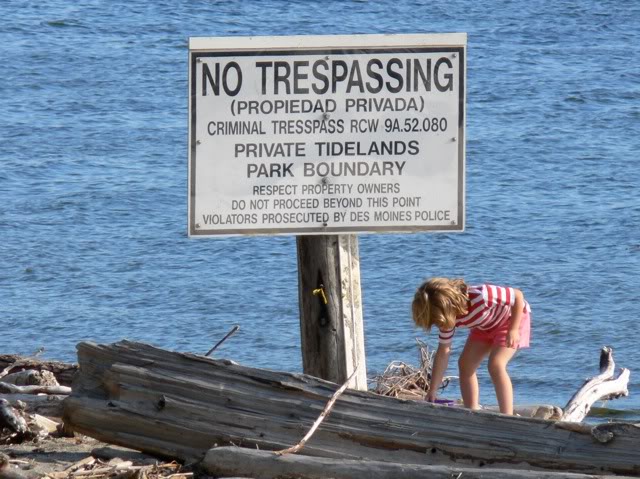

Children on the tide lands getting yelled at by territorial homeowners or their agents is too common in our area. I took this picture after witnessing such an altercation last summer at the edge of Salt Water State Beach. New state shoreline rules, and court decisions in other states favoring the Public Trust Doctrine, suggest that public access to Washington’s waterways will be increasing. This is particularly true of our tide lands, which many people feel are part of the ocean– the argument is that the state never owned the ocean, so it therefore had no right to sell part of it.

If our city bordered Puget Sound, I would be aggressive with public access there as well. If a photographer is looking at tide pools at a public access point on Puget Sound, and they spot an unusual star fish 20 feet away in a tide pool in the tide flats below a private residence, I believe they have a right under the Public Trust Doctrine to scramble to the stafish for a closer look. (Be aware there are waterfront property owners who would disagree with me, and some of them are stubborn; so be prepared to get in a confrontation if you try this. Some will argue that their great-great-grandfather purchased the tide-flat from the state years ago. But a growing body of case law says that the state never owned the sand and tide pools between the low and high tides, and hence could not sell this resource to a private homeowner. This issue has not been resolved in our state.)

Bottom line, I’m progressive on water access. Don’t get between me and a tidepool in THE PUBLIC’S tide-flats, and we won’t get into any arguments. And don’t try to stop me from floating past your property on the PUBLIC’S river, and we will be just fine.

However, once you get above the high water mark of the body of water, public access rights become murkier or non-existent. The sandy areas of saltwater beaches are widely in dispute on this point, because of the presence of annual extreme high and low tides which make the limits of the ocean disputable. Courts have had an easier time finding a bright line for property ownership on freshwater lakefront, when the water line is relatively constant. River boundaries are not as easy to define as lakes, but perhaps easier than salt-water beaches. In all these cases, land which is never underwater is generally assumed to be eligible for private ownership.

This is where the constitution comes in. As a councilman, I have been officially sworn to uphold the US Constitution (along with the laws of the state.) And the fifth amendment of the US Constitution makes it clear that private property can not be taken by the public without “just compensation”. What constitutes “just compensation” is clearly open to debate, but it is often a cash payment. It can be something else of value.

Our proposed SMP asks property owners in some cases to dedicate an easement for a trail across the dry portions of their property (above the high water line), and to physically construct the trail as part of their development. In some circumstances this is required outright, and in others it is a condition of being able to develop a larger project closer to the water.

While I love waterfront trails myself, this could raise the question of whether “permission to build” is in itself “just compensation” for the trail dedication. Evidence in favor– developers often dedicate roads and utilities to the city when they build, as part of the development agreement. Evidence against– these roads and utilities are almost always connected to the development project, and are necessary for access and operation of the building; a waterfront trail for the public is somewhat different. Evidence in favor– we require developers to either build park amenities or contribute to a parks fund when they build. Evidence against–a public waterfront trail may be above and beyond the typical burden placed on a developer, and I do not know if we have offered to waive the parks fee as part of the SMP.

In summary, balancing the public access rights with the private property rights is a complicated and often controversial process. We will discuss this topic as part of our final council deliberations on the SMP tomorrow night.

Click here for more complete text from some of the referenced documents

Email with my questions about SMP regarding flood risk and parks impact

For those of you following the final work on the Shoreline Master Program, here is a copy of an email I sent to city hall on Friday summarizing my questions about flood risk and possible parks impacts. (Marcie Palmer raised the parks question on Monday night, so she may be asking her own questions about this).

I believe the staff is also following up on questions raised by the public at last Monday’s council meeting.

_________________________________________
To: Renton Council President Don Persson

Dear Don-

At our last council meeting I raised some questions regarding the SMP that staff offered to look into for me. I appreciate their willingness to follow up on them. I am sending this email to give more specifics about my questions, and a couple examples, in order to hopefully save as much time as possible.

I am interested in hearing from Public Works regarding the risk of increased sedimentation occurring in the Cedar River bed downtown as a result of SMP provisions regarding shoreline stabilization. In particular, I would like confidence that we are not increasing the risk of significant river channel migration (either over time or dramatically during a flood) immediately upstream of our downtown commercial zone, with the resulting dislodged deposits reducing under-bridge flow capacities at Bronson, Wells, Williams and Logan bridges. Since flood water was lapping at the bottoms of several of our bridges in a storm less than two years ago, I am concerned we do not have any capacity left under these bridges. It’s of course a balance– ecological concerns dictate that we have the most natural Cedar River possible, while safety concerns dictate that we keep the river in a strongly defined and stable channel where it travels through the the urban area.

Note that per a suggestion given at the council meeting, I checked on the City of Kent’s SMP as an example of an approved document for a river-front city. When I read through this 203-page document, I could not find any section that required property owners with developed sites to remove existing serviceable bulkheads, whether on the Green River or on a lake. The main discussion of shoreline stabilization on the Green River is focused on the Federal Army Corps of Engineers recommendations to enhance the levees by increasing their width. This would be done as a multi-jurisdiction (federal-state-county-city project), using public funds. There seemed to be nothing in the Kent SMP requiring that existing serviceable bulkheads be removed for work being done in the upland areas of waterfront property (away from the shoreline.) If possible, I would like staff to comment on whether I understand this correctly.

On the issue Marcie brought up about the impact the SMP might have on our waterfront parks, I have similar questions as Marcie.

For example, if we wanted to add over 1000 square feet of additional parking lot, pathways, or sports courts at any of our parks we would consult the table on page 192 of the SMP (under section F-1 –partial compliance for non-single family development), and find we have a “Moderate Alteration”. The table says we would need to (among other things) replace any solid decking on all our piers and docks with light-penetrating surfacing materials. Such a change at Coulon Park could cost millions of dollars, and would require many additional permits for over-water work. (We could also face this same issue at Kennydale Beach Park.) Furthermore, we might find that adding the new light-penetrating surface to the docks is not sensible without simultaneously updating the support structure of the docks (i.e. we don’t want to put a new surface over a support system that only has 10 or 15 years of life left.) This could further complicate our ability to install a simple parking or other improvement.

As a second example, if we were trying to update the restrooms at Kennydale Park, they would likely need a 25% expansion due to ADA rules. The same table in the SMP would identify this as a “Major Alteration” and require that we replace the dock surfaces with light-transmitting materials AND evaluate removal of the shoreline stabilization. ( It probably would be feasible from an engineering standpoint to remove the bulkhead at Kennydale Beach Park, and it may be a good idea sometime in the future, but it does not make sense to me that we would have to require it upon a restroom reconstruction.) This could likely make a restroom upgrade cost-prohibitive and impede gradual improvement of our parks facilities.

I would like to see our Community Services Department analyze this concern so that council knows what the impacts will be if we approve the SMP as written.

Thanks!

Randy Corman
Renton City Council

I wish to understand how bulkhead rules would affect gravel buildup under bridges

Now that the SMP is finally moving back to the full council, I want to explore whether the latest proposed bulkhead rules could impact the risk of floods in Renton. In particular, I am worried about sand going downstream and plugging up the space under our bridges. Obtaining dredging permits from Department of Ecology and Fisheries is becoming extremely difficult, expensive, time consuming and unreliable.

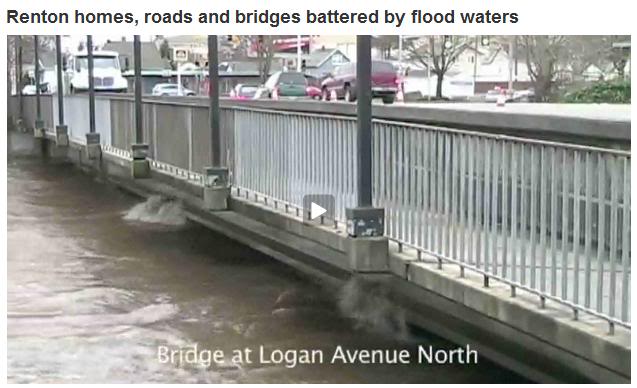
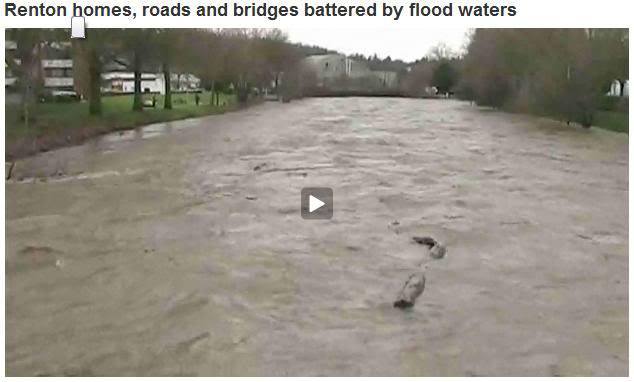
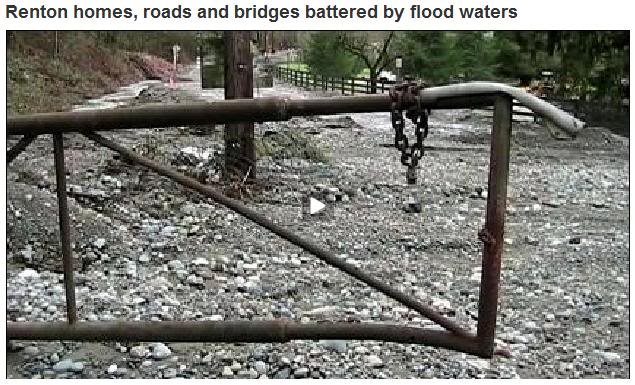
The following three images are still shots from a Renton Reporter video which documented the Cedar River impacts in Renton from the January 2009 flood. Click here to see the Renton Reporter video and article about the 2009 flood.

Photobucket
In January 2009, flood waters came within inches of reaching capacity below several Renton bridges. If there had been another foot of sand at the bottom of the channel, there would not have been enough room for flood waters to go under. Water would have likely backed up behind the bridges (turning the bridges into dams) until the water completely submerged them or cut a new channel through a nearby neighborhood. If this had happened, damage to bridges and property could have reached the tens of millions of dollars.

Photobucket
(above)From Renton Reporter video, showing high water in Cedar River through Renton

Photobucket
From Renton Reporter video, sand washouts upstream in the Cedar River

Photobucket
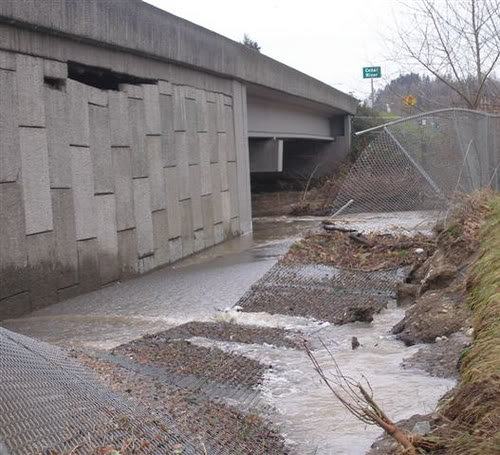
(Above) Maple Valley Highway and one of the DOT bulkheads was damaged by the Cedar River. Replacement of this bulkhead structure and related repairs to the supported highway were estimated at approximately four million dollars.

Photobucket
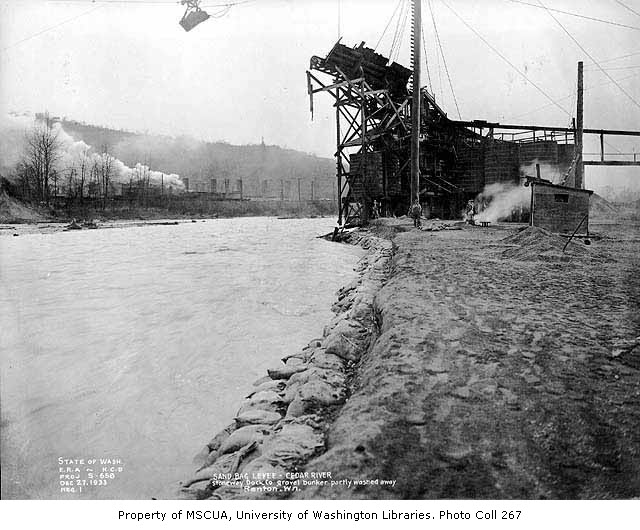
Above, the Stoneway site, with a sandbag levee in 1933.

Photobucket
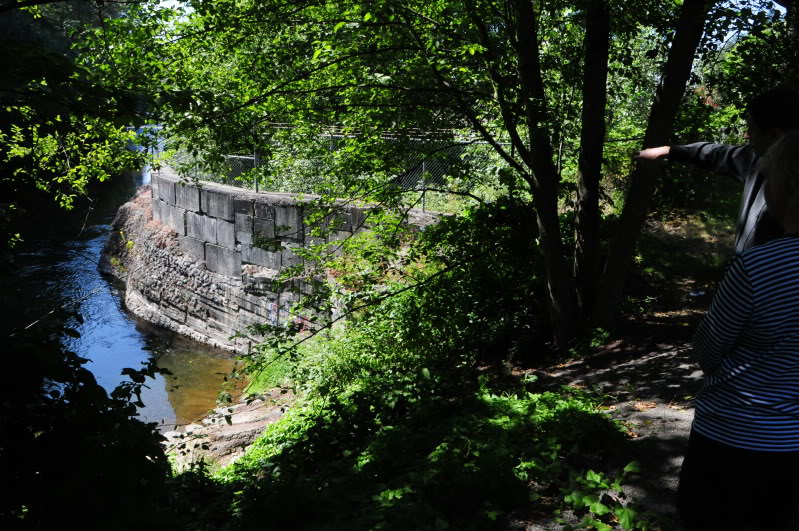
Above, the upstream end of the current Stoneway bulkhead, which has never been damaged by river flooding. This 1200 foot long bulkhead likely helps prevent sand from washing downstream, under Renton’s library and bridges. The owners of the Stoneway site feel that our SMP may cause them to remove this bulkhead.

Geotechnical Engineer itemizes concerns about rules for existing bulkheads in Renton’s draft SMP

The issue of how Renton’s updated Shoreline Master Program addresses existing bulkheads on Renton’s waterways has really heated up in the last two weeks. This is different than in the case of NEW bulkheads, where we seem to have largely achieved agreement among property owners (at least the vocal ones), DOE officials, and city officials. (For background on this issue, see my previous blog entry HERE.)

Yesterday we received an email from an expert in geotechnical engineering. In his email he itemizes significant concerns regarding the way we are addressing existing bulkheads.

I feel the concerns have enough merit that we should at least discuss them as a full council. I’m hoping to do this on Monday night. And because this issue could have impacts of tens of millions of dollars on both public and private property, I may wish to refer this topic into Committee of the Whole for a couple of weeks. I’ll explore this on the floor of the council on Monday night, and see if I can get support.

I have my own related concerns about ever-growing deposits of sand and silt under out downtown bridges, and the way these deposits put our downtown properties at risk during storms. Getting dredging permits becomes more difficult each year, and yet we are embarking on rule-making which will increase the potential for these deposits to build up. If I get a chance later today, I will try to describe this concern in more detail.

You can read the email from the Geotechnical expert below. I have also attached his resume for those who wish to know more about him.

Read the email, draft letter, and resume by clicking here

Time to go through your closets; Renton Clothes Bank struggling to meet the need

Susan Bressler, a Renton Reporter columnist and tireless community volunteer, is reminding us that the Renton Clothes Bank needs extra citizen support during this time of prolonged recession. While the need is greater than ever, the Renton Clothes Bank has lost some of it’s traditional financial backing from other financially-pinched agencies and organizations.

Susan has worked hard over the years to keep clothing flowing into the Clothing Bank. I often see her moving multiple 30-gallon bags of clothes from St Mathews Church out to her car so she can drive them to the Bank for distribution to kids and adults who need them. In addition to clean wearable clothing donations, cash is also extremely appreciated to keep the lights on and to purchase new underclothing and items for babies.

Susan wrote an informative and touching article on this topic for this week’s Renton Reporter. In her article, she tells of a boy who attended school with his shoes repaired by duct tape, and a little girl who had to wear her father’s boxer shorts when she ran out of underwear. With your past assistance, The Renton Clothes Bank has worked hard to prevent such situations– and with your continuing commitment, they can keep making a difference in our community.

Click here to read Susan Bressler’s article in the Renton Reporter.

One of our most vulnerable citizens needs our help

Please spread the word!

Concerned citizens are holding a special concert for the benefit of, and in honor of, a little girl from our community who had to undergo a liver transplant earlier this year. Little Annie Rowan was mere days away from losing her life when Children’s Hospital performed a miracle transplant on her. While she now has a promising chance of long-term survival, she is still on nine medications and she faces a lifetime of medical treatment.

You can help Annie and her family with past and future medical costs by attending the special “Rock ‘N’ Opera” concert at Benaroya Hall on September 30, 2010 at 7PM in the Nordstrom Recital Hall. You can buy tickets and learn more about this concert by clicking here.

If you can’t make the concert but you want to learn more, donate, or help in other ways click here to go to Annie’s page.

Here is a very touching video that gives a glimpse of Annie’s frightening, then hopeful journey during 2010.


For more information about how you can help Annie, please call Kress Franzen at the website or phone number below:

Kress Franzen
Public Relations Committee chair for COTAforAnnieR.com
425.341.3332

(Thanks to my council colleague Marcie Palmer for bringing this event to my attention)

Interesting old photo of Stoneway property prior to the permanent bulkhead

Photobucket

Sandbag levee protecting Stoneway property in Renton, in 1933. Click here to go the the University of Washington archive source for this photograph.

After my previous blog entry I searched online for a photo of the Stoneway Cedar River bulkhead, a concrete structure that I have seen many times during rafting trips. I never found a photo of the current bulkhead, but I found this photo from 1933, before the bulkhead was built. The sandbags in this photo illustrate why the “Stoneway Docks” Company felt they needed a permanent bulkhead.

As a reminder, the dam which provides some flood protection on Cedar River (and forms the Chester Morse reservoir) was built in 1900, 33 years before this photo was taken.

I think this photo is looking west along the Stoneway site, with the NARCO brick company immediately across the river (current home of the offleash dog park), and Renton Hill in the background– I’ll ask astute readers to please tell me if I’m mistaken on the angle of the photo.

Cities having “fire sales” to get cash for assets– billions of dollars in public property for sale

The Wall Street Journal reports that:

“Cities and states across the nation are selling and leasing everything from airports to zoos—a fire sale that could help plug budget holes now but worsen their financial woes over the long run.

California is looking to shed state office buildings. Milwaukee has proposed selling its water supply; in Chicago and New Haven, Conn., it’s parking meters. In Louisiana and Georgia, airports are up for grabs.”

You can read the full article by clicking here .

It’s an interesting article. I would be reluctant to put city assets up for sale for the reasons stated in the article. My experience is that most times we have privatized a city function, such as turning over the management of the downtown parking garage to Diamond Parking, we have drawn some complaints from citizens. I can’t imagine negotiating a long-term lease with a private company which lets them make profits from street parking.

What do you think? Are there any city assets you readers suggest we sell?

“Eyes on the Landing” will keep your vision sharp, and keep you looking sharp

Photobucket
Friend and in-law Donna Jones (left), pictured here with my wife Cathy, is partnering with Dr. Evie Lawson of Bellevue to open a stylish and convenient optometry and eye glass supply down at the Landing.

A fashionable optometry is coming to the Landing. This one is very special to me, because one of the partners in the business is my dear friend and in-law Donna Jones. Donna, who is the mother of my son-in-law, has many years of experience managing a successful and fashionable optometry in Bellevue. In the new “Eyes on the Landing” Donna will be partnering with New England College of Optometry graduate Dr. Evie Lawson. Ms. Lawson is an avid sportswoman, and has years of experience as a practicing optometrist. Whatever your lifestyle and fashion preferences, Evie and Donna will be sure to give you friendly personal service and the sharpest vision you can get. They will also offer eye glass accessories and related items and advice. Their new store will be across the street from “The Rock”, on the opposite side of the parking garage entrance from the Balanced Athlete. Their address is 822 North 10th Place, Suite A, Renton.

The business is locally owned, and both owners have strong ties to the community. Donna is married to 1979 Renton High graduate Bob Jones, and she and Bob are raising their children in the East Renton area near Cedar River. Dr. Evie Lawson makes her home with her husband and son in Bellevue.

They can work with most insurance companies. Look for them to open in a few weeks. Click here to visit the website for “Eyes on the Landing”