Hi, I'm Randy Corman, Renton City Councilmember. I am the most senior member of the council, currently in my 25th year (I have been elected seven times). I pay for this website with my own funds. Please recognize that all views expressed in my journal entries are my own, and not the official position of Renton City Council, other councilmembers, nor the city of Renton. Thanks for reading.
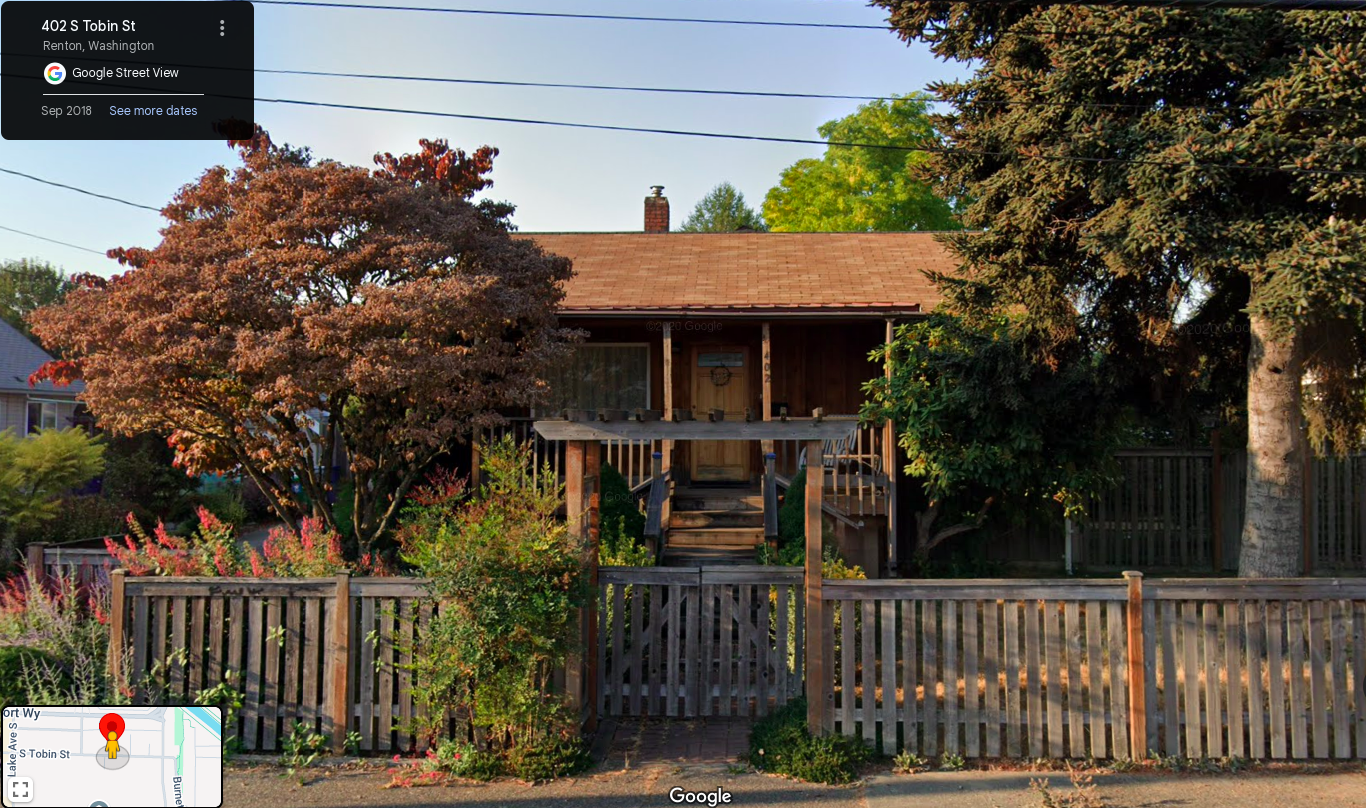
Google Street view of 402 S. Tobin Street, the subject of tonight’s School Board meeting and public hearing
As part of their plan to expand the Renton High School site all the way north to Airport Way and east to Logan Avenue, Renton School District has been working to acquire thirty-two homes and eight businesses.
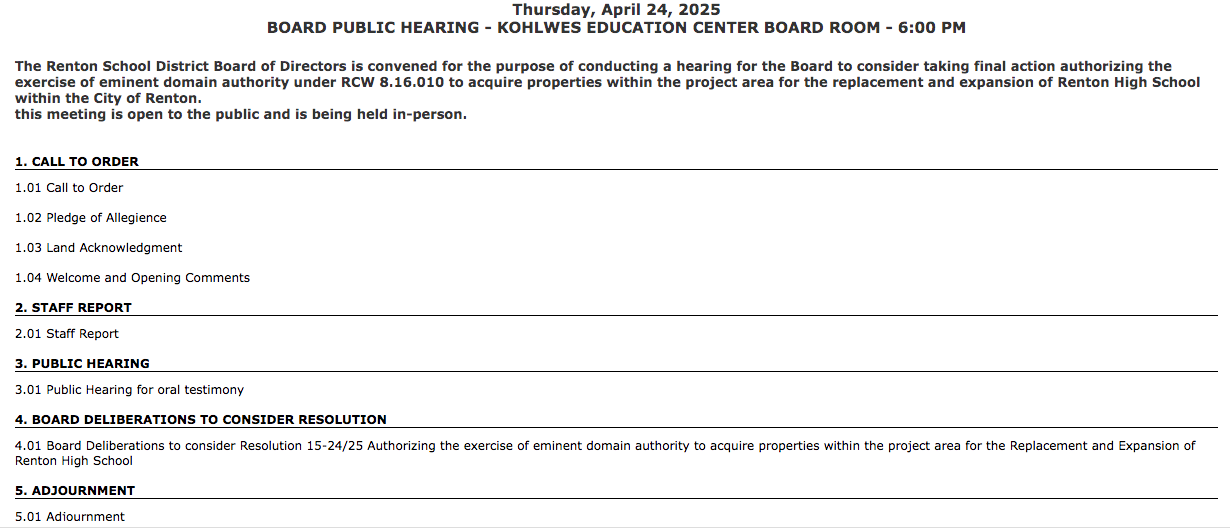
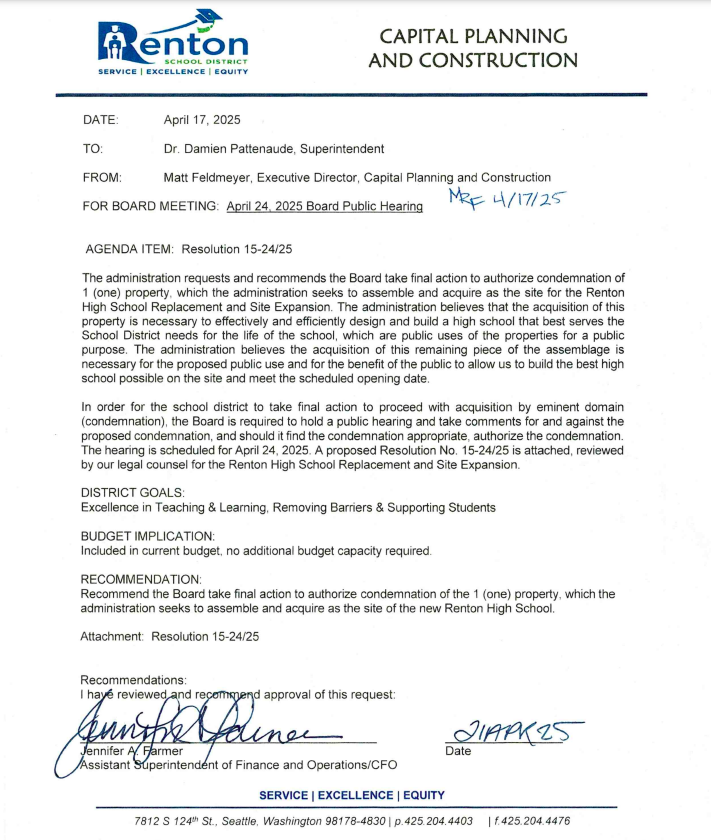
The School District’s negotiators have been using the threat of eminent domain to encourage owners to sell, but they can’t actually proceed with eminent domain on a property until the final authority is specifically given by the School Board.
At a meeting tonight, the School District’s property acquisition team will be seeking this final authority to forcibly take another pretty and historic home at 402 S Tobin Street. This home is currently treasured by its owner as a personal residence full of precious memories, and it sits on a triple-size lot in an area that allows six homes per lot (maybe 18 total) under the new “missing middle” legislation, so “just compensation” will be incredibly hard to determine if the eminent domain action is approved. This home would be flattened to make room for a relocated baseball field, one that may be the most costly high school baseball field in our nation’s history.
The meeting starts at 6:00 tonight at the School District Headquarters at 300 SW 7th Street. There will be time for audience comment before the School Board takes action on the eminent domain authority being requested by the School Superintendent in this resolution.
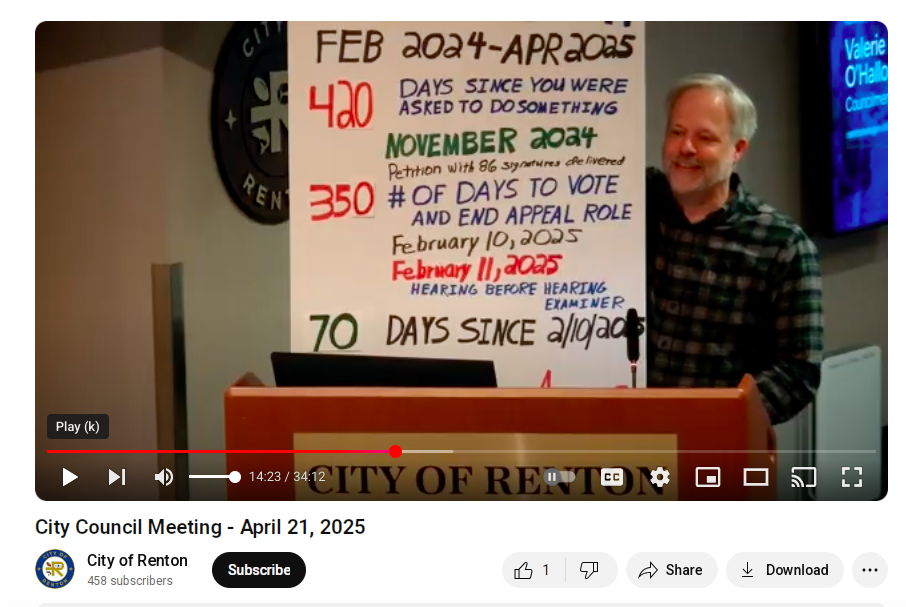
North Renton resident Matt Hanbey showed a poster at last night’s meeting displaying a timeline related to Council activities on the Logan Six project. In the previous Council Meeting the poster and much of Mr. Hanbey’s presentation was mysteriously left out of the video feed.
An apparent censoring of a poster exhibit at last week’s audience comment further illustrated the heightened tension that is preventing residents and council members from freely communicating at council meetings.
In a blog post on March 25th I described how our city leaders should find their way back to the type of council meeting communication we had with residents in past decades. Prior to the pandemic, audience comment was an interactive and solution-oriented portion of each council meeting, in which council members routinely asked questions of presenters, shared their own perspectives on issues raised, engaged in cooperative problem solving, and often referred resident’s concerns to the Administration or a Council Committee for review. But lately it seems the “communication” consists entirely of residents giving three-minute monologues, with no response other than a possible “thank you… Next”
Two weeks after my post, a member of the public brought a poster board exhibit to the audience comment that had a timeline on it, and for some unknown reason the video recording system did not capture any images of it. Instead of the usual protocol of recording an image of the speaker, the cameras moved from focussing on the speaker to showing the council for the entire three minutes. This left those of us watching the meeting online very confused about what was on the poster that seemed to be so controversial that it was being censored.
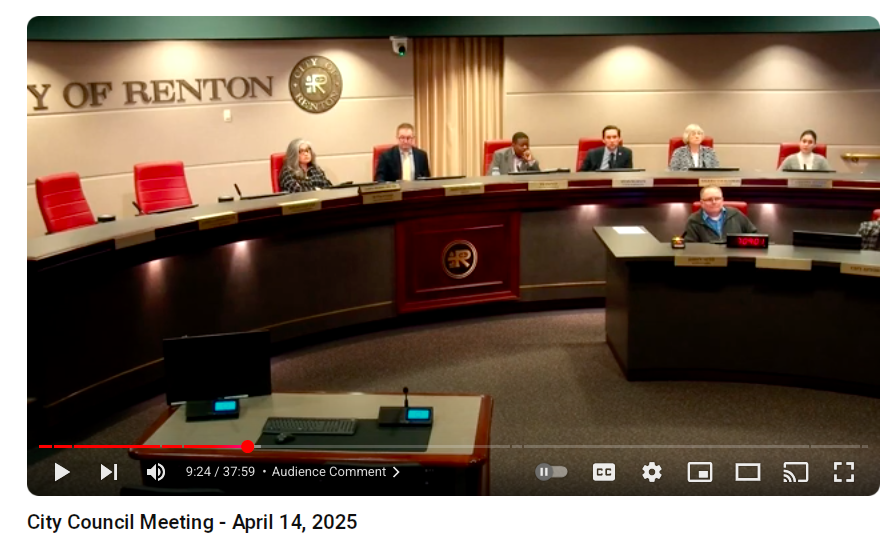
This is the view that remote viewers had of Mr. Hanbey’s presentation at the April 14 meeting. The poster Mr. Hanbey held (which was written, shown to Council, and is therefore probably a public record) was never shared with the remote viewers of the meeting. As a public record, it was even at risk of not being properly retained, except a quick-thinking staff member managed to take a photo of it.
This was a huge departure from past decades, in which residents were welcome and even encouraged to bring written exhibits to audience comment, usually in the form of paper that could be displayed for everyone in the chambers using a special projector next to the audience comment podium. Residents would use the projector to show such things as maps, lists, photos, calendars, timelines, event posters, and any other exhibit that improved communication between the resident and the Renton Council. In the pre-digital age we could see the data projected on a screen (from paper or view foils), and in later years we could see it on our monitors on the council dais. Residents would certainly challenge us back then like they do now. Concerns and complaints have always been a common reason for residents to attend a council meeting. But that did not stop Council from encouraging residents to show written documents with their testimony.
With this display option no longer readily apparent , Matt Hanbey brought a poster-board chart instead, and it then seemed to be censored on the video feed.
Thankfully, Mr. Hanbey contacted Chief Administrative Officer (CAO) Ed VanValey after he realized he and his exhibit were not shown on the meeting video feed, and CAO VanValey agreed to remedy the mistake at the next council meeting. That subsequent meeting occurred last night, and as CAO VanValey said, the timeline poster and Mr. Hanbey’s testimony were broadcast. Hence, the confusion has apparently been corrected, but not before at least two speakers mentioned it in last night’s meeting.
Whoever censored this audience comment has apparently been retrained, but the underlying tension that sowed the censorship should still be addressed. Elected Officials must remember that (as the Declaration of Independence says) “governments derive their just powers from the consent of the governed,” and that the residents that make their way to City Hall to speak with them are collectively their bosses. Council should engage with the public, the way any of us would engage with our employer, when issues are brought up or questions are raised.
Renton’s residents usually hold the answers to Renton’s problems, and it is Council’s job to gather these solutions and help implement them. Interacting during audience comment, including looking at the data the residents bring forth, is an important part of this assignment.
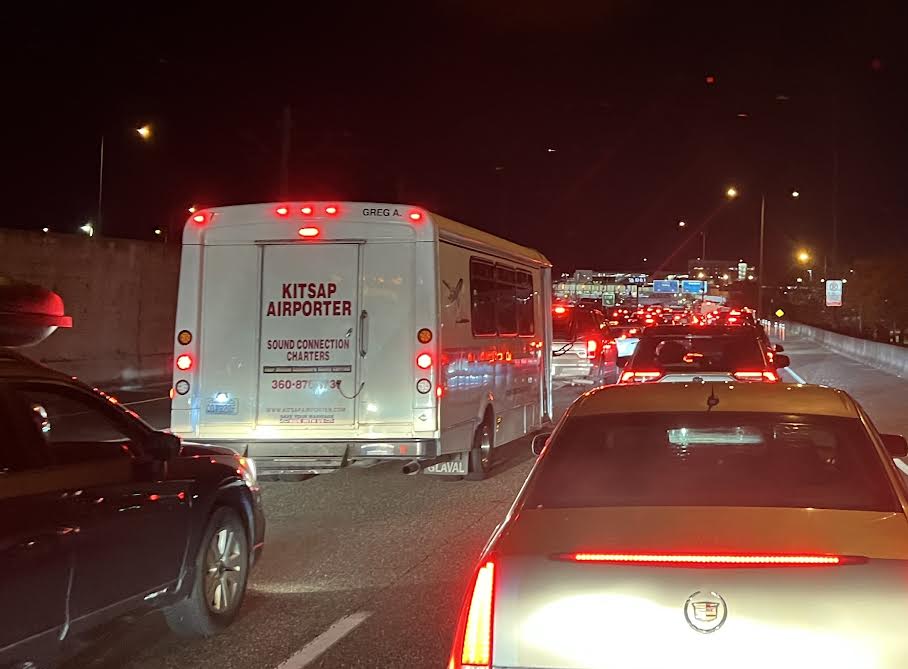
The view as my wife and I crawl for 25 minutes in a typical SeaTac airport arrival traffic jam last week
I’m excited about an arriving visitor this week, but I’m already dreading the traffic jam I know I’ll encounter at SeaTac Airport when we pick her up. While Port of Seattle leaders will give the excuse that these jams can’t be helped because of the large number of travelers, the reality is the Port created this problem with the poor traffic planning of the cell phone lot.
The 1960 SeaTac airport approach was brilliantly engineered for high volumes: three dedicated express lanes approaching the airport, growing into four — two departure lanes and two arrival lanes. Each of these roads double from two to four lanes at the terminal with the addition of curbside pick-up/drop-off lanes. The elegant design could smoothly handle today’s volume of travelers, if Port officials had not implemented the “rideshare weave” that requires 25% of the drivers to cut across four lanes of the other 75% of drivers in the last critical quarter mile of the approach.
As Rideshare became more prevalent –now estimated at about 25% of airport passengers– Sea-Tac and other airports across the nation set up waiting areas for drivers who are picking up. When drivers are notified their passengers are in the pick-up spot, they swiftly proceed to the designated location, and wisk their passenger to their destination.
Except at SeaTac Airport. Here at SeaTac, designers located the cell phone lot such that every rideshare driver must merge onto the right lane of the final stretch of the airport expressway, and then during the next quarter mile move four lanes to the left, before exiting into a typically backed-up lane into the parking garage. This flawed configuration has been snarling evening traffic into SeaTac for years, and can seriously impact all passengers arriving or departing from SeaTac airport by cars, busses, and courtesy vans (whether or not they are rideshare passengers).
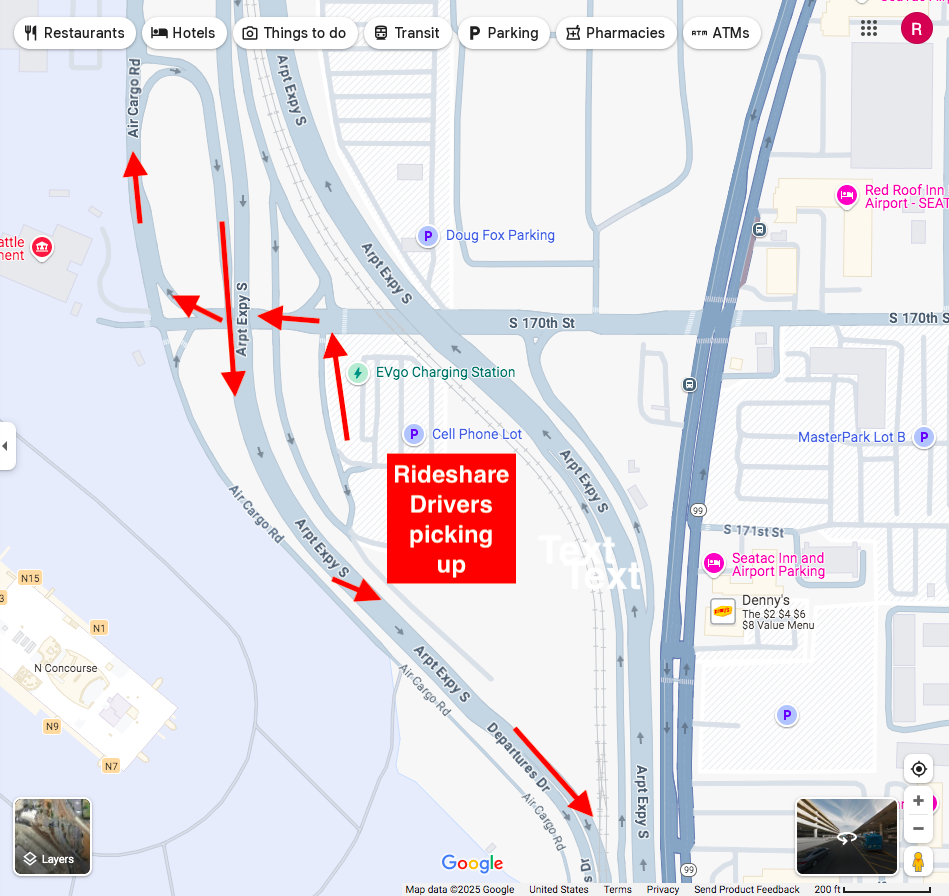
Rideshare drivers picking up passengers, and other cell phone lot users, follow this path when informed that their passengers are ready. It requires a merge followed by three quick lane changes across the airport expressway. All arriving airport traffic is slowed by these lane changes.
As rideshare drivers negotiate the multitude of lane changes, often hugging the right lane as long as possible before aggressively moving left, the entire airport access road comes to a standstill– not because of volume (as the Port states) but because the Port officials implemented the dangerous weave in the traffic design about ten years ago.
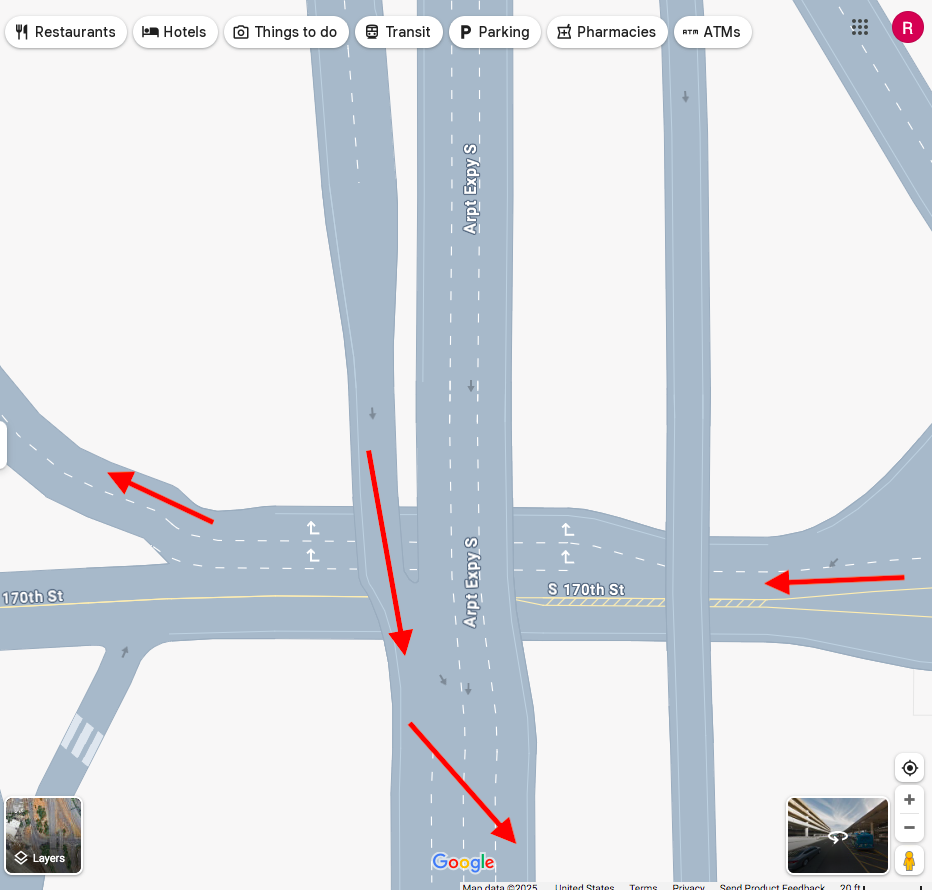
Details of the weave across four lanes right before arrival-departure split
This nightly traffic jam can easily add 20-30 minutes or more to a pickup or drop-off time, stressing travel schedules and making it harder to coordinate driver and passenger connections. When an arriving motorist finally gets past the weave, the traffic into the arrivals or departure curbs usually flow reasonably well, except where it gets blocked by idling drivers whose passengers have not arrived, and refuse to go around again because they can’t tolerate the traffic jam a second time. The weave-related traffic jams trigger additional scofflaw activity near the airport entrance, where scores of drivers pull over onto the shoulder next to “no-parking” signs in an ad-hoc cell phone lot, preferring to risk a ticket over the traffic weave from the designated cell-phone lot.
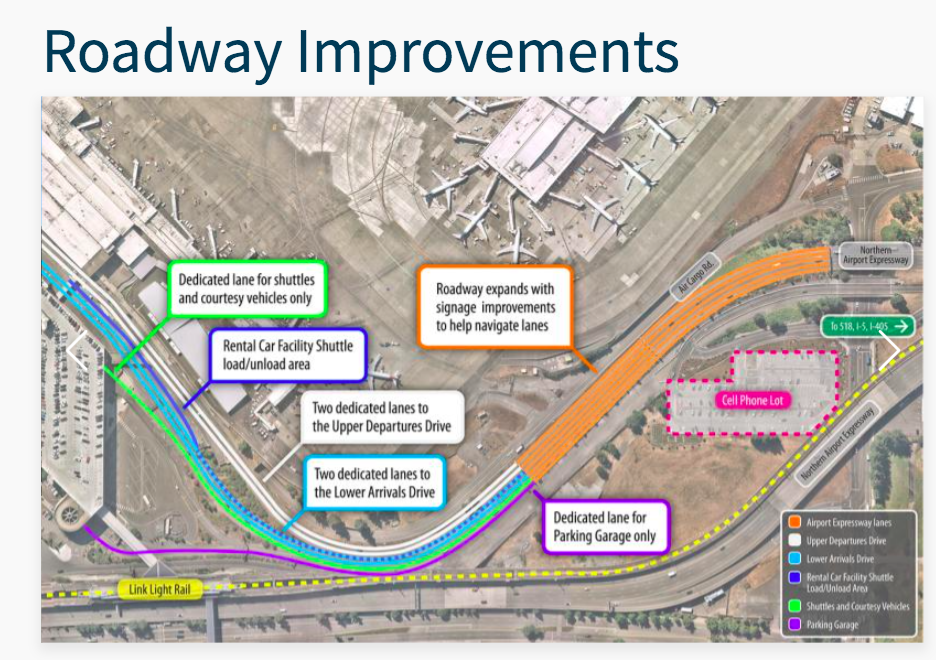
The airport clearly needs to find a way to NOT have to move all the rideshare drivers from the right side to the left side. But instead of resolving this weave years ago (with perhaps a direct road connection from the cell phone lot to the parking garage), the Port spent $13.5 million improving circulation into and around the cell phone lot in 2022. And next the port will spend $79.3 million widening the airport expressway, and making the backed-up single lane into the parking garage longer. All this new additional pavement will provide more space for jammed up cars to queue, but won’t address the weave problem at the root of the backup.
New pavement will be added with roadway improvements in 2026 for $79.3 million, but the Cell Phone lot users will still have to weave across all lanes of arriving airport traffic
Together, we taxpayers are currently putting about five billion dollars into Sea-Tac Airport expansion, so it would be nice if we could get to the airport reliably. As I sit stewing in these jam-ups, I blame the Seattle Port Commissioners more than anyone else for the traffic mess. They have ultimate responsibility to make our airport usable, and the buck stops at their office. Most of them promise higher energy efficiency and lower carbon in their campaign literature, and thousands of idling cars and people going nowhere doesn’t cut it. The Commissioners could have solved this by now, and instead they are banking on a 2026 fix that probably won’t work.
Departing passengers fret about missing their flights, while drivers picking up loved ones wonder how long they will be waiting in the cold, in this typical evening traffic jam at Sea-Tac Airport. Evening brings the worst jams because aircraft arrivals –and ride share pickups– are typically at their highest.
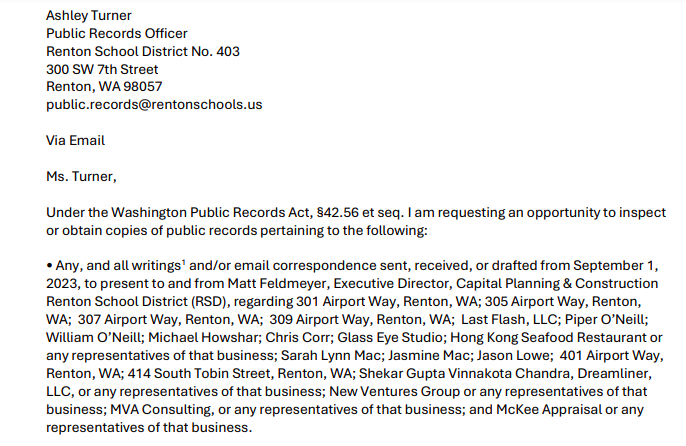
The formal request was officially submitted by Piper O’Neill, partner in the world-class Chihuly-style “GlassEye” Studios that was making arrangements to locate to Airport Way in Renton before Renton School District initiated an eminent domain action to take their building.
Under our State’s open public meetings and public records acts, virtually all correspondence sent or received by local elected officials regarding official agency business are considered public records. The same is true for most other agency records. This request seeks relevant correspondence generally dating back to September 1, 2023.
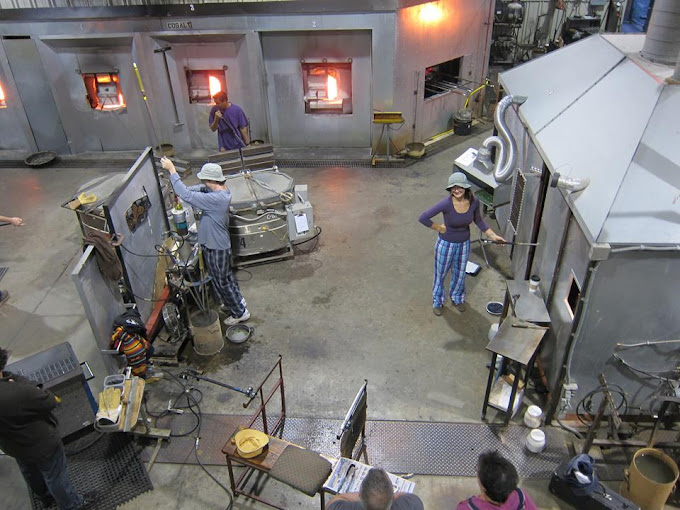
Glass Eye Studios was preparing to introduce Renton to Chihuly Style Glass creation in a new Renton Studio.A current Glass Eye facility where art is created for shipment all over the world, and students learn the art of glass blowing
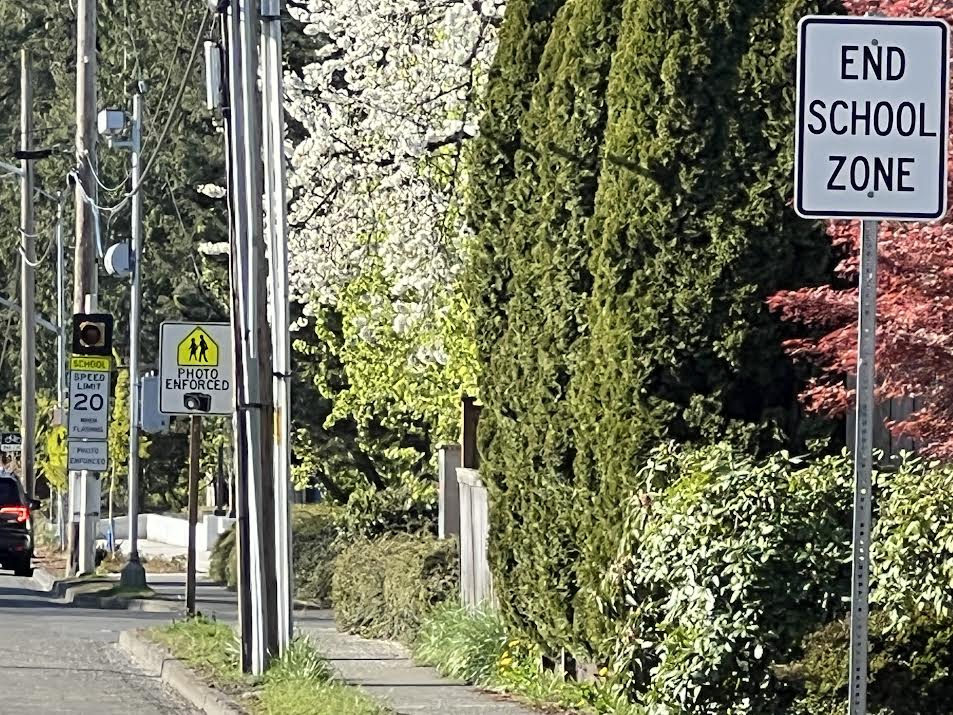
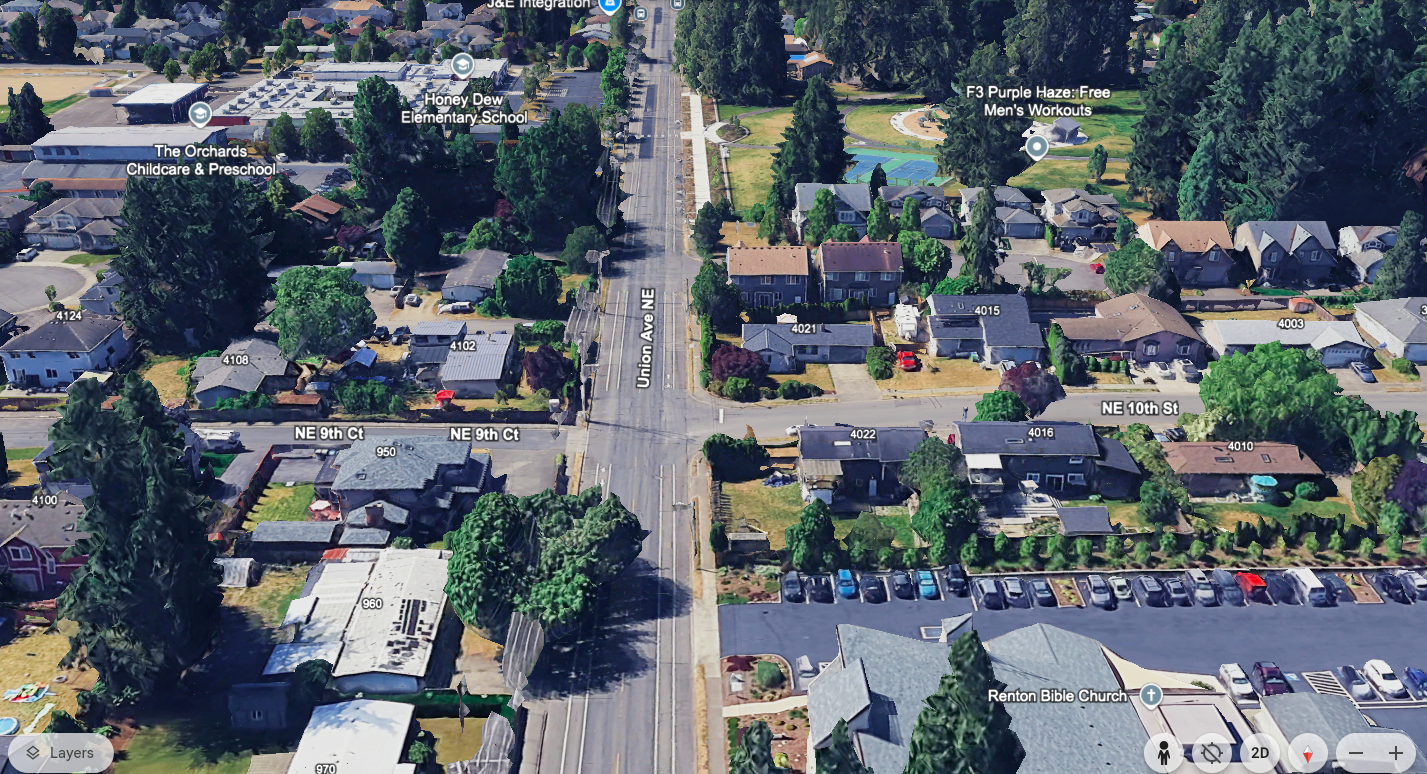
It seems nonsensical to have an “End School Zone” sign followed so closely by a photo-enforced school zone camera, as shown in this image from southbound Union Ave NE.
When I was on City Council I used to let Public Works know when I saw confusing signage, and I’m not going to stop doing it now. The arrangement on southbound Union Ave NE that puts an “End School Zone” sign right before a school zone with a speed camera seems like a definite mixed-message.
Any motorist trying to accelerate to the posted speed limit of 30 MPH in this gap will have to immediately hit the brakes to avoid a ticket. And they’ll make these speed changes passing through the intersection with NE 10th Street, where their variable speed will be confusing for drivers turning onto Union.
Every sign diverts drivers eyes and attention from the road for a second or two, which is enough time to travel 20 or 30 feet at the posted speed limit. Diverting drivers’ attention from the road, and making it confusing, is especially undesirable in areas around schools.
In short, it seems like it would be a good idea to merge the two school zones.
This confusing signage could be a result of an Arizona contractor, American Traffic Solutions. They install and operate Renton’s speed and red-light cameras, in exchange for a cut of the revenue from traffic fines. Even if they are the ones that engineered this, the City of Renton should take a look at it, and see if the configuration really makes sense.
The “End School Zone” sign is posted right before the intersection with NE 10th Street. Half a block further south the school zone camera tickets drivers for not observing the Honey Dew school zone.
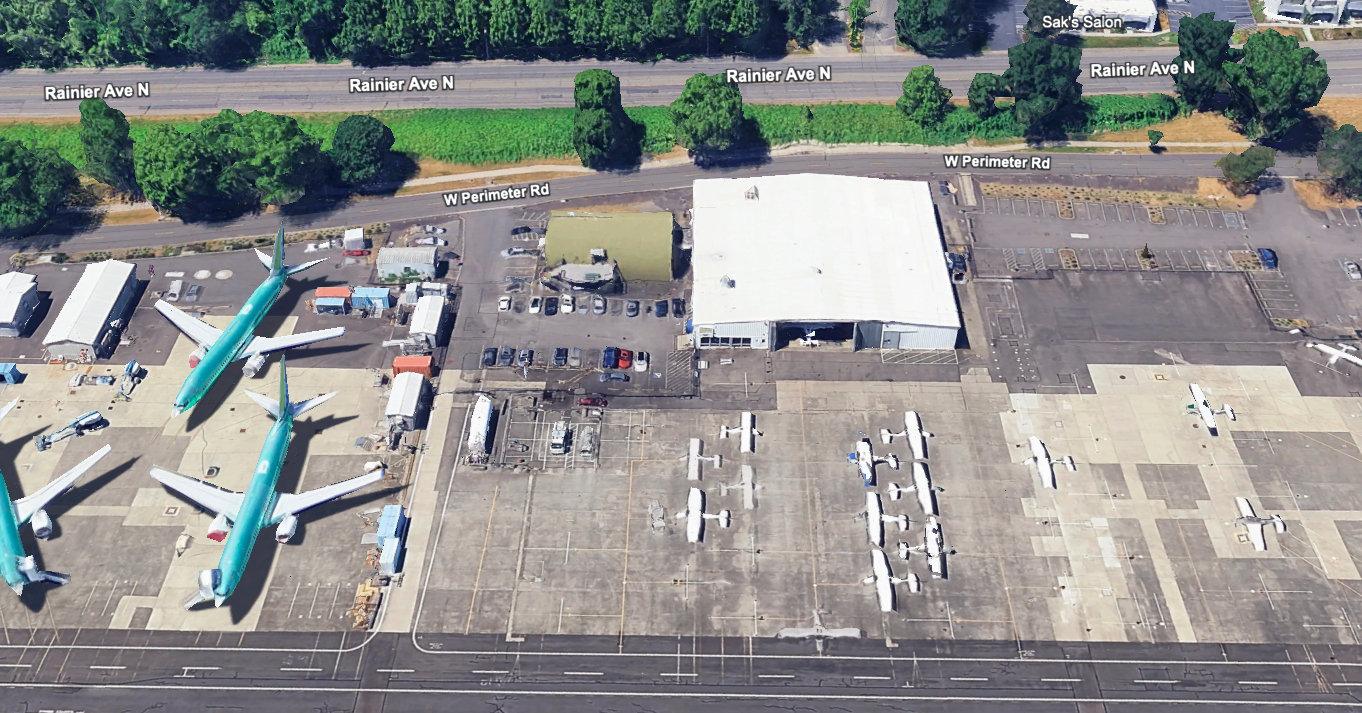
The flight school occupied the large white building in the center, and the fuel farm is located between the Boeing airplanes and the propeller airplanes.
April 21 update: Vesper Aviation raised a concern at tonight’s Council Meeting regarding the informal process used to award this lease, but the lease was nevertheless approved by Council. See my April 21 comment on this post for details.
Rainier Flight Services was one of only two public fuel suppliers on our airport. Installing fire-safe and environmentally-safe aircraft refueling tanks is not trivial, so this reduced the fueling options and hurt aircraft operators.
Renton’s Airport Management is now suggesting a solution to the near-term refueling issue, in the form of a new lease to BosAir, the parent company of Ace Aviation.
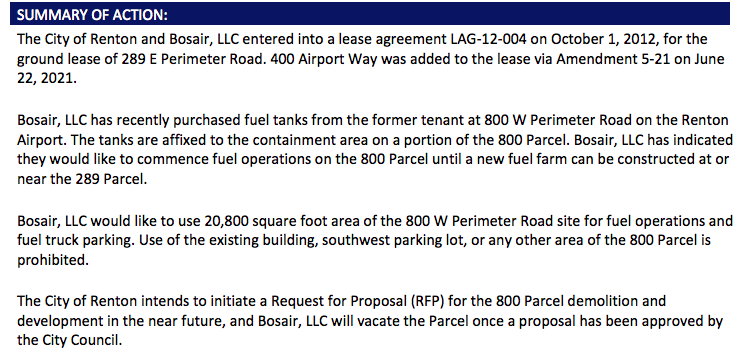
According to a Council Agenda Packet that will be considered tonight, Bosair has purchased the refueling equipment from Rainier Flight Services. Since it may take months or years for the refueling tanks to be relocated, Airport Management is proposing that the land under the tanks be leased to Bosair on a month-to-month basis. In other words, Bosair, or Ace Aviation, will take over the fuel supply business formerly owned and managed by Rainier Flight Services.
While this may be an appropriate solution, the Renton Airport Advisory Committee (RAAC) should have been consulted and the decision made more publically. Since the Airport Director used to work for Ace Aviation, utilizing the RAAC could help alleviate “appearance of fairness” concerns.
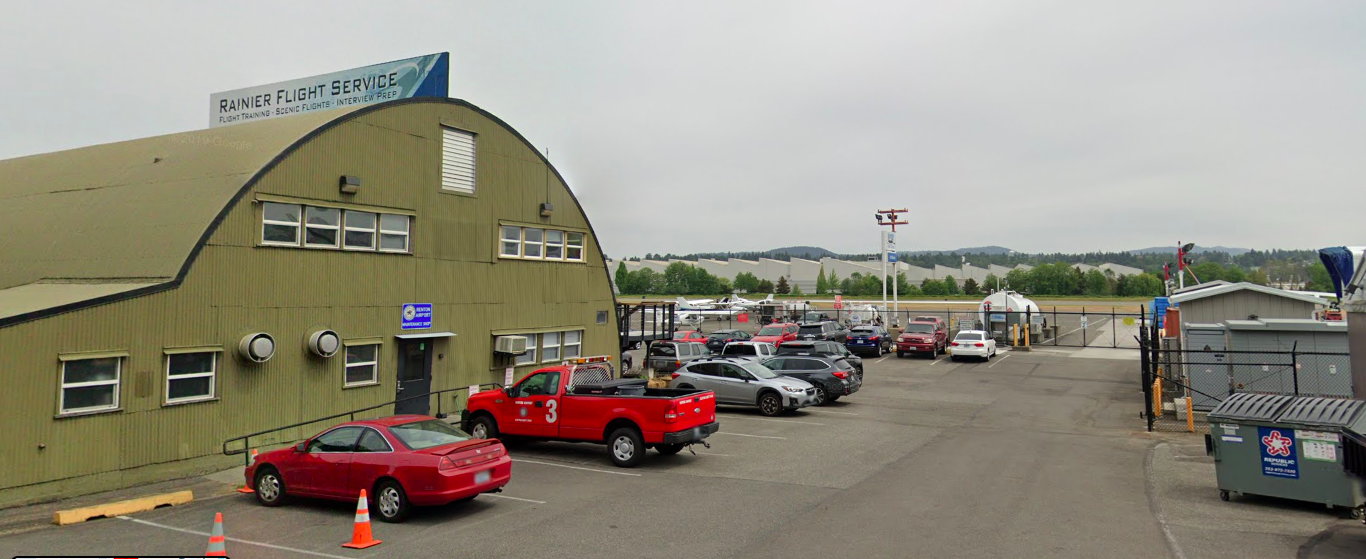
The former Rainier Flight Services fuel farm can be seen behind the fence in this photo
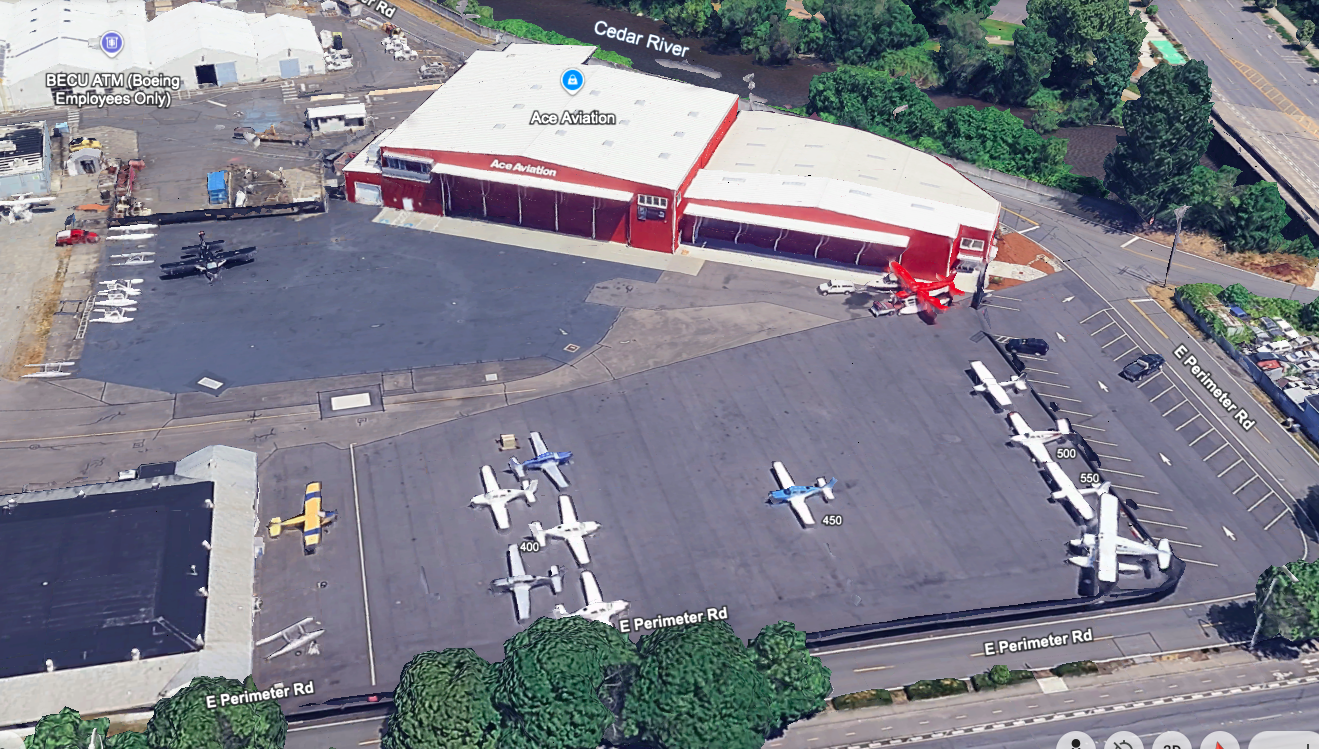
Renton Public Works now proposes that the parent company of Ace Aviation, which also owns the above facility at the SE corner of the airport, take over the lease for the fuel farm on the west side of the airportThe now outdated Rainier Flight Services website showed they provided full-service and self-service fueling optionsScreenshot from today’s agenda packet
Here’s a variation of an old riddle: What time is it when the hour hand points to both 9 and 10:30?
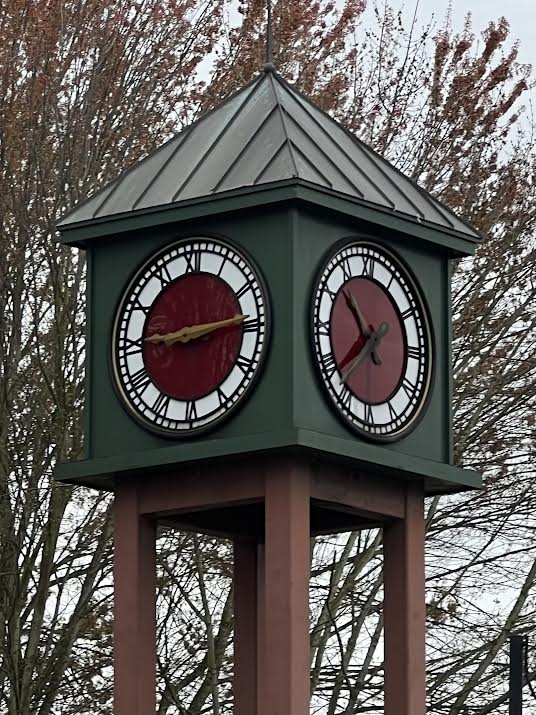
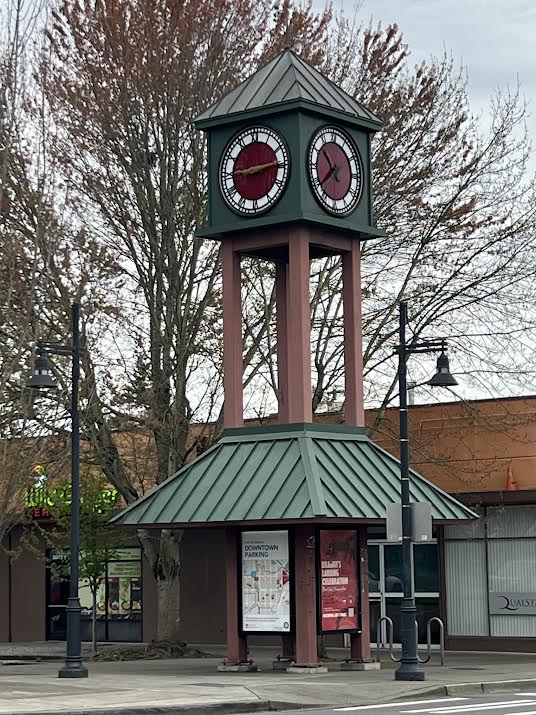
None of the four faces of the clock had the correct time yesterday
Answer: Time to get your clock fixed!
Renton’s downtown landmark 4-sided clock, which sits on a tower on it’s own cozy “Clock Tower Plaza,” does not appear to have functioned correctly for years. It appears to have run properly shortly after it was last moved in 2021, but sometime in the years since it quit keeping proper time.
And unlike most stopped clocks that are correct twice per day, the tower clock is never correct because all four of its faces are showing different times.
As Renton works to revitalize the downtown, it’s important to keep up with the basic maintenance. And setting the tower clock, and repairing it as necessary, is one of these tasks.
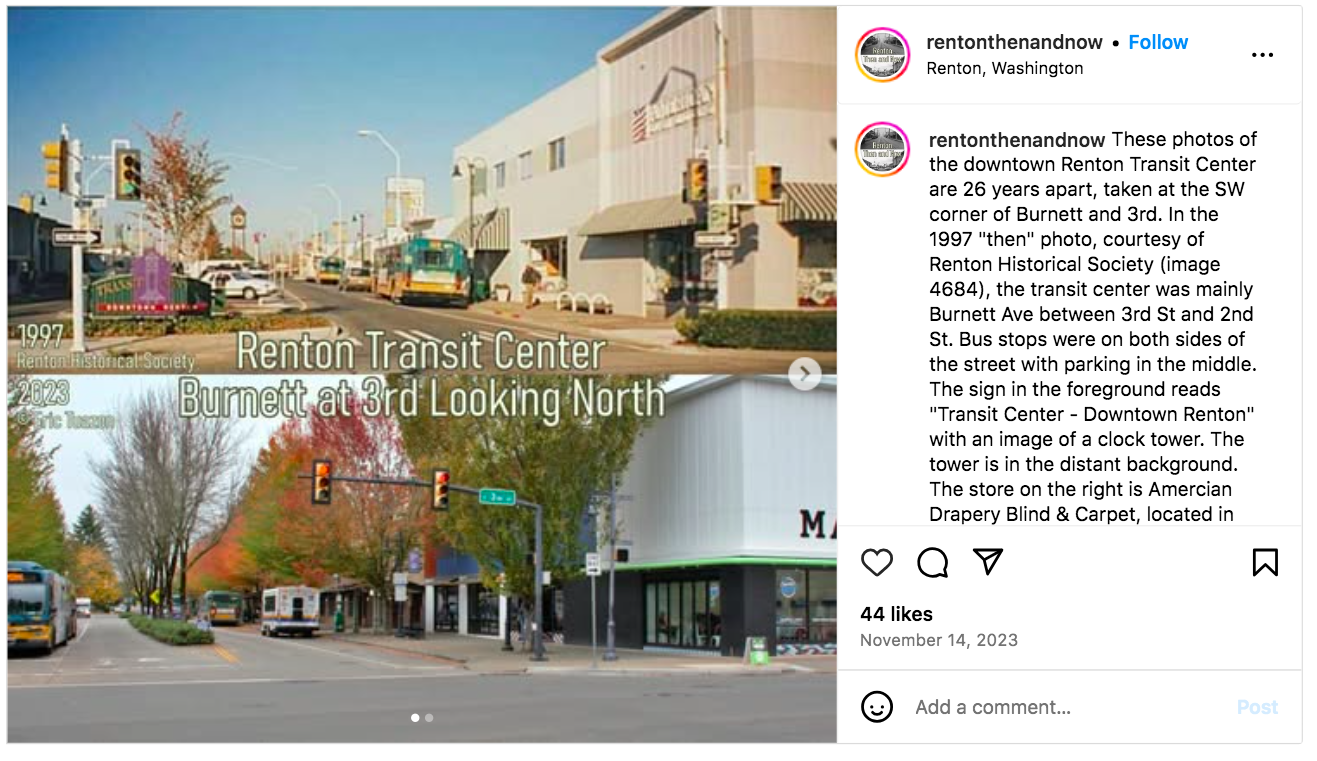
While there is not a lot of information about this clock online, I remember it joining our downtown landscape as part of the Metro Interim Transit Hub in 1997. Metro Transit had just been part of King County for a few years, and they were creating a hub and spoke system that would increase transit service between “transit hubs” in urban centers in King County. Renton did not have a transit hub, so we agreed with Metro on a temporary hub on Burnett between South 2nd and South 3rd streets, with a permanent hub coming later. Since Metro was paying for infrastructure in other cities, they agreed to pay for bus shelters, signage, and (if memory serves) I think this clock in Renton. The clock was placed at the corner of South 2nd and Burnett, with a sign alluding to it an South 3rd and Burnett.
In the following years we completed a purchase of the former Mazda dealership at this location for about half a million dollars, and ultimately built the transit center with Metro’s help (for about $3 million), the parking garage (for about $8 million), renovated the Mazda showroom into the Pavillion (for about $2 million), and built/landscaped the Piazza park (for about $1-$2 million). I think we moved the clock to its new location on South 3rd and Burnett when we built the parking garage. The dollar amounts I’m quoting are approximate, from memory; they should be fairly accurate. Prices were obviously lower in 1997.
The clock was moved temporarily again in 2020-2021 to allow reconstruction and improvements in South Third Street.
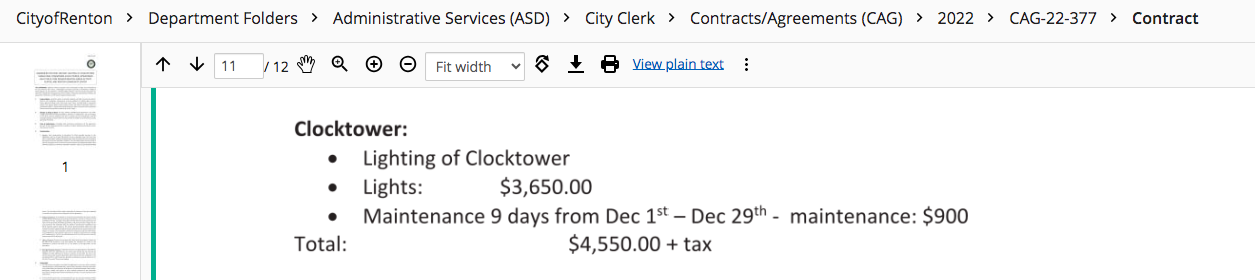
After the clock was moved back to its current home, it kept time for a while. In 2022, Renton spent $4500 on holiday lights just on this clock tower, recognizing its significance as a landmark.
Downtown merchants and visitors deserve to have the clock fixed. Friends have told me they’ve reported the broken clock in the past, but I plan to add my personal report to “Renton Responds” to see if we can get the clock accurate again. Hopefully the time has come to fix the clock.
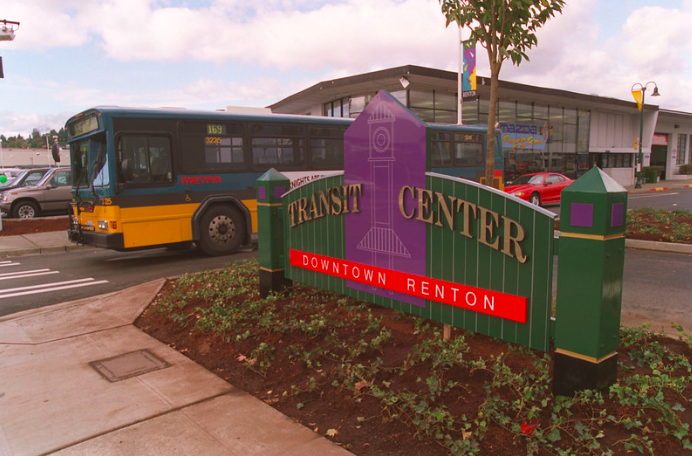
Moving the clock back into its present position on South 3rd Street and Burnett in 2021.In 1996, this sign at Burnett and South 3rd marked the entrance to the Burnett Ave Interim Transit Hub. A stylized version of the clock tower can be seen in purple in the center of the sign. The Mazda dealership can be seen behind the Metro bus. The prominent Mazda showroom was built in the early 1960s, and we tore it down to create the Piazza. Behind it on the far right one can see the east end of the older showroom, which was built in the 1940s with old-growth wood bowstring roof trusses; we kept that building and remodeled it into the Pavilion Event Center. (King County photo)The top photo from 1997 in this post from “Rentonthenandnow” Instagram shows the clock tower in the distance at it’s South Second and Burnett location.
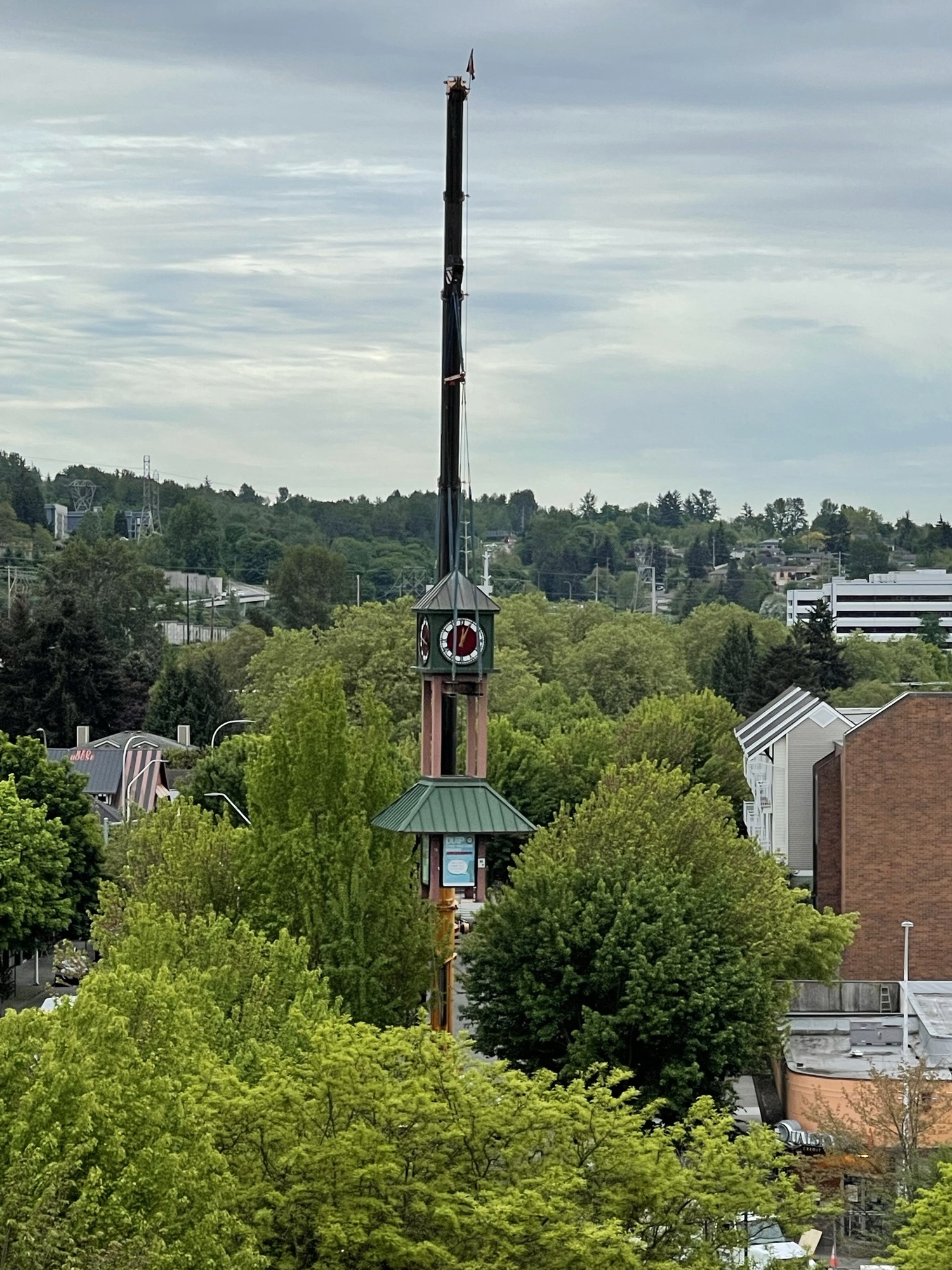
Renton’s clock tower as it appears today, at South 3rd and Burnett.Holiday lighting of the clocktower cost $4,550 in 2022
“There was once a Countryman who possessed the most wonderful Goose you can imagine, for every day when he visited the nest, the Goose had laid a beautiful, glittering, golden egg.
The Countryman took the eggs to market and soon began to get rich. But it was not long before he grew impatient with the Goose because she gave him only a single golden egg a day. He was not getting rich fast enough.
Then one day, after he had finished counting his money, the idea came to him that he could get all the golden eggs at once by killing the Goose and cutting it open. But when the deed was done, not a single golden egg did he find, and his precious Goose was dead.
Those who have plenty want more and so lose all they have”
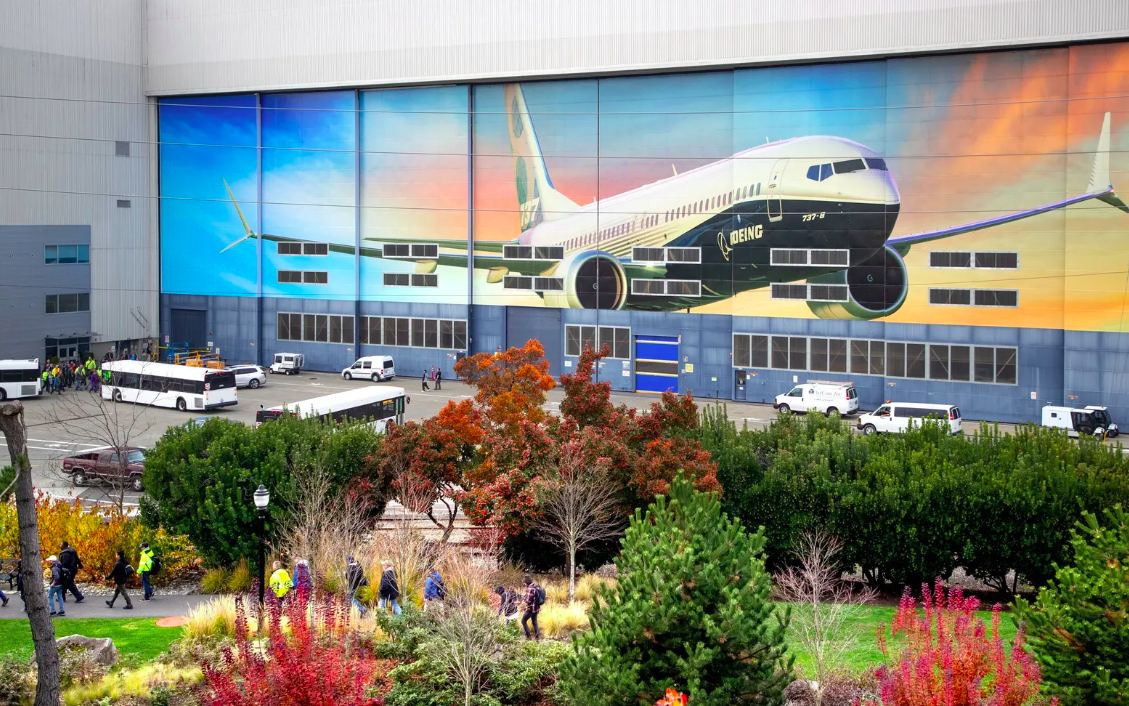
For decades Renton’s prosperity has been supercharged by the Boeing Company, which provides thousands of living-wage, union-represented, machinist and engineering jobs to Renton residents and their families. Boeing also employs pilots, scientists, supply-chain specialists, logistics professionals, managers, administrators, and many others. And they typically give their employees benefits that include health care, vacation, sick leave, parental leave, life insurance, and 401K packages.
This money comes to Renton from global sources– everywhere in the world where 737’s are sold. The Boeing Renton factory can assemble three billion dollars worth of product per month. This outside revenue coming into Renton fuels economic activity throughout our region, as Boeing keeps local suppliers in business, and the money they distribute in payroll flows from aerospace workers to homebuilders, retailers, restaurants, service providers, and local and state governments. Boeing’s international revenue allows Puget Sound’s other successful large companies to flourish, like Starbucks, Costco and Amazon, as well as countless small Renton businesses like Common Ground Coffee and Cupcakes, Boon-Boona, and The Sub Shop.
But after the MAX crashes and the Alaska door plug blowout, Boeing’s worldwide prominence and reputation have taken a severe beating. The story has now been extensively covered by everyone… New York Times, BBC, Seattle Times, 60-Minutes, Congress, even Boeing themselves. Boeing’s 1999 merger with McDonnel Douglas sparked an identity crisis in their executive ranks in which a new focus on “shareholder value” overtook their historic culture of innovation, achievement, and excellence. Now Boeing and the FAA are working to fix things. Among their various efforts, Boeing keeps trying new CEOs, working to find one that can help them regain the safety-culture that propelled them to technical and economic prominence. Most of their engineers and machinists never lost this culture, so it’s more a matter of elevating it back into the top ranks. It is something Boeing can do, and needs to do, with a current backlog of 6,200 airplanes, and as our nation’s only builder of air transport jets for the future.
Boeing’s reputation had sunk so low that even before a door plug blew off a 737, Seattle’s progressive newspaper “the Stranger” was already seriously suggesting that the Boeing factories should be sold to Amazon.com to serve as warehouses. While I’ve heard this notion suggested before, I was surprised to read it in such a progressive newspaper. Only about ten percent of Amazon’s jobs are union, while the majority of Boeing Renton’s factory and engineering jobs are union. And while the average machinist will soon be earning six-figures and have full benefit packages under their newest 2024 contract, Amazon warehouse workers frequently make close to minimum wage, and are only eligible for benefit packages if working full-time in some jobs. Replacing career union machinist and engineering jobs with Amazon warehouse work is hardly progressive.
But “the Stranger” is not alone in suggesting Boeing has a limited life span left in Renton. Business journals like Leeham News predict Boeing may leave Renton in 2033, just eight years from now. If this happens, the future of the Boeing property should be of serious concern to all residents of Renton. Back in the 1990s, when a rumor broke that Boeing was considering consolidating in Everett, Renton’s Mayor Tanner spearheaded a plan to put overlay zoning on the Boeing property to turn it into a biotech research office center if Boeing moved out. Southport office towers were part of this plan. But pandemic-era work-from-home changed the landscape for office projects, and it’s doubtful this plan would work.
The most likely outcome would be the one predicted in “The Stranger,” a combined Amazon/Fed Ex facility that utilized the airport and the massive Boeing production hangars. These companies would likely be high-bidders for the property. And they would get political support from King County Port Commissioners and King County Council Members who need to free up space at Seatac and Boeing Field– moving air freight to Renton would help them immensely.
But Renton’s environment would suffer dramatically from this change. Instead of having two brand-new empty 737 takeoffs per day, we could have day and night air cargo operations using older airplanes. Much of downtown Renton would find itself in a noise zone, with windows rattled regularly by older jets and turboprop aircraft. In short order, FAA would be leaning on Renton, again, to extend the runway right into the newly rebuilt Renton High School. We would succeed in bringing the noisiest operations of Boeing Field and Seatac into the heart of Renton’s historic downtown. There is nothing desirable about this scenario.
“The Stranger” alternatively suggests that the Boeing Renton property could be used for low-income housing, which is certainly a possibility. I don’t think that non-profits or governmental organizations would outbid Amazon for the property, but perhaps they might. While this could help the regional housing shortages, Renton Council and residents must be aware that even market-rate housing is a net drain on Renton’s resources, costing more to provide services to than the users of the housing pay in taxes. In contrast, Boeing is a net producer of tax revenue, giving more to the city than they use in services. Replacing Boeing with housing would directly negatively impact the City of Renton’s budget by millions, and possibly tens of millions, of dollars per year. Along with losing thousands of living-wage jobs, this would deliver a one-two punch to Renton’s finances, and the impact would have to be made up with higher taxes on everyone in Renton.
The scenario for this property that works out best for Renton is for Boeing to rediscover its quality and safety culture, and to continue to build jets in Renton. And this includes the new small-medium airplane that eventually replaces the 737s and 757s that were always built in this factory.
Yes, Boeing has space in Everett where they could consolidate, and they’ve also shown a tendency to move work to South Carolina which has lower labor costs. But Boeing has historically thrived in Renton, running the most efficient airplane factory on the planet. And as their current home, Renton ought to be working to retain them here. If Boeing announced they were holding a contest to locate the production line for a 737 replacement, every city in America would be competing to win the factory. And Renton is the incumbent… the one to beat. Renton should be working NOW, doing everything reasonably possible, to remain the preferred site for Boeing’s small-medium (single-aisle) airplane manufacturing.
Unfortunately, that has not been happening lately.
Taxes:
In 2016, during a time of budget challenges in Renton, the City of Renton implemented a B&O tax for the first time. With a three billion dollar monthly revenue stream from 737 sales, Boeing was understandably concerned that they would pay the lion’s share of the proposed tax. Mayor Law reached an agreement with Boeing that Boeing would not fight the tax if Boeing’s share was capped at five million dollars per year, and the tax was imposed with Boeing’s acquiescence. In 2022, the City of Renton approximately tripled Boeing’s B&O taxes, escalating their rate over three years from the pre-agreed capped five million per year to 12 million per year plus a small fraction of their annual revenues. Renton already has one of the highest property taxes in the area, with schools getting the biggest share.
A four year step-up in Boeing’s Renton B&O taxes was implemented in 2022, and has now approximately tripled this tax (approximate because it is now based partly on confidential revenue data).
And Renton’s 2025 total property tax levy rate (including schools, county, city, hospital, library, and others) is $10.02 per thousand in assessed valuation. This is about 10% higher than Everett’s and Seattle’s rates of about $9.00, and 30 % higher than Bellevue’s rate of $7.30.
Currently the State Legislature is developing a suite of new B&O, payroll, and property taxes they may levy on Boeing and other large employers which would be additive to Renton’s new tax increases.
Airport Facilities:
Renton Airport and Boeing traditionally have worked together to keep as much property available for general aviation as possible, while supporting Boeing production as necessary to meet world-wide demand for airliners. Over the years Boeing has vacated leased airplane parking aprons and facilities they’re not currently using, but by mutual understanding, Renton Airport puts these properties in limited-term leases in case Boeing needs them again for airplane production. But new airport management, and a new focus on having tenants pay to completely rebuild airport-owned buildings, will require new 40-year leases with non-Boeing tenants. This will limit the options for Boeing in the future. Furthermore, an increased focus on Business jets at Renton airport increases the likelihood that the total number of Boeing new airplane take-offs, combined with business jet take-offs and landings, will reach the threshold that requires a longer runway.
In the past decade Boeing has also seen significant rent increases for their airport leased space, and new “through-the-fence-fees” for use of the airport; these charges would be okay if they went into diligent airport maintenance, but lately airport maintenance has been lacking as pavement and markings wear out and leased buildings get ignored.
Other infrastructure:
Boeing has special high pressure water lines serviced by the Seattle Water System. If these lines are broken, factory production stops (at a cost of millions of dollars per hour). Renton recently approved a controversial housing project that sits so close to these lines that it puts them in jeopardy in spite of Boeing’s warnings.
Sound Transit was unwilling to include either a Link Light rail station or Bus Rapid Transit station near Renton Boeing in previous phases, and Renton needs to keep pressing them for service in the future. PSE has modernized much of the Eastside electrical infrastructure in Bellevue and Redmond, running transmission lines through Renton to do so, but Renton’s grid near Boeing and the Landing still has less reliable equipment. Renton should be pushing them for continuous upgrades.
In summary:
Renton’s goose that lays golden eggs may be going through a moulting season, but that’s no reason to kill it. Renton’s Economic Development Department, Airport Management, and Renton Council should be actively working to ensure Boeing’s next single-aisle airplane gets built here.
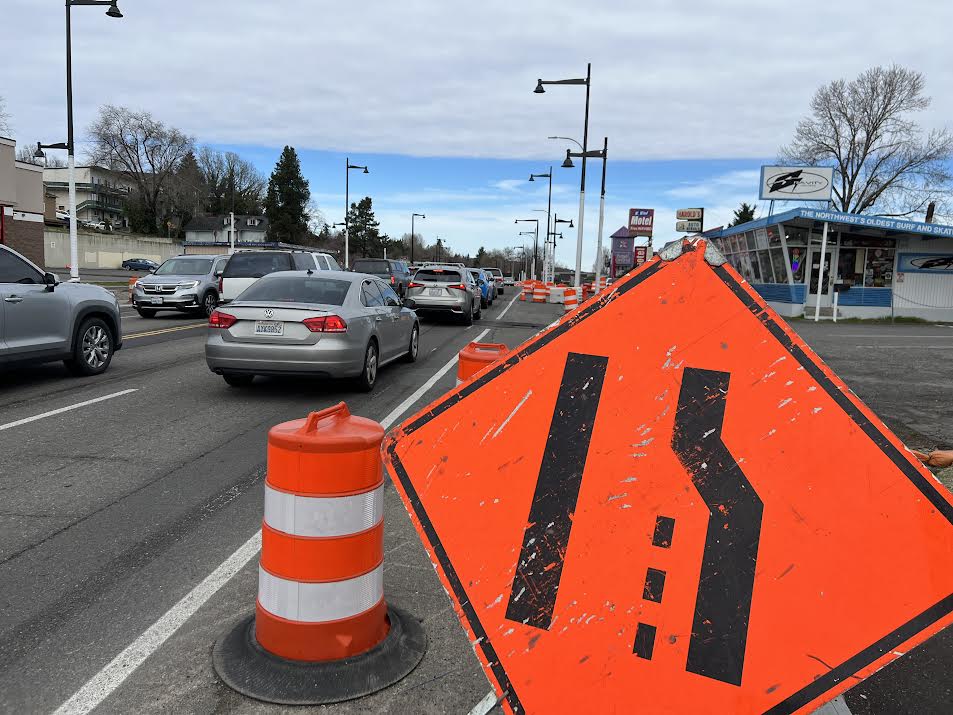
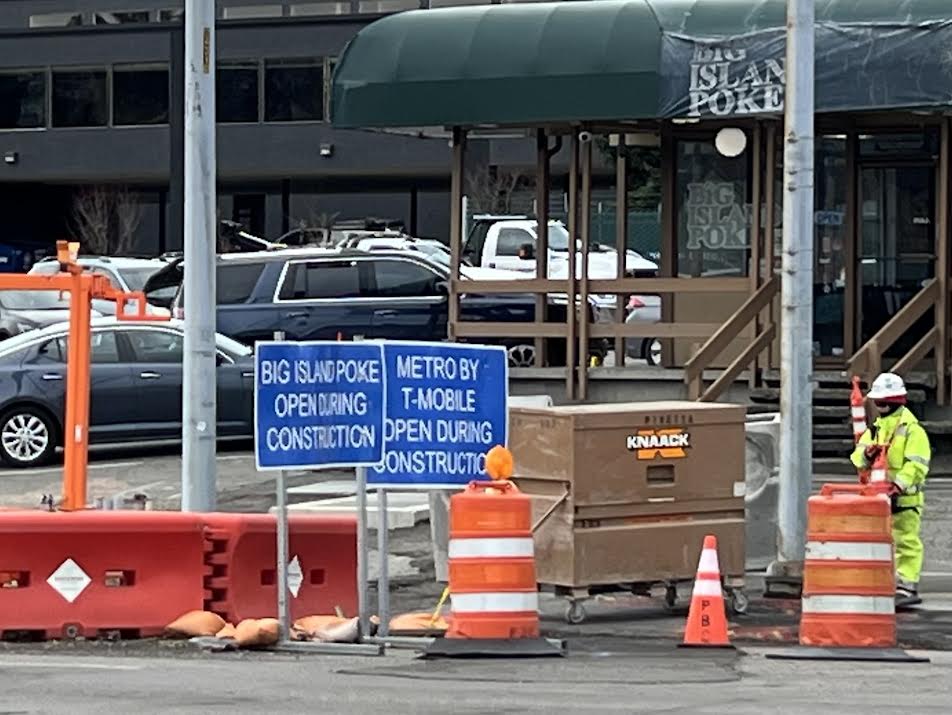
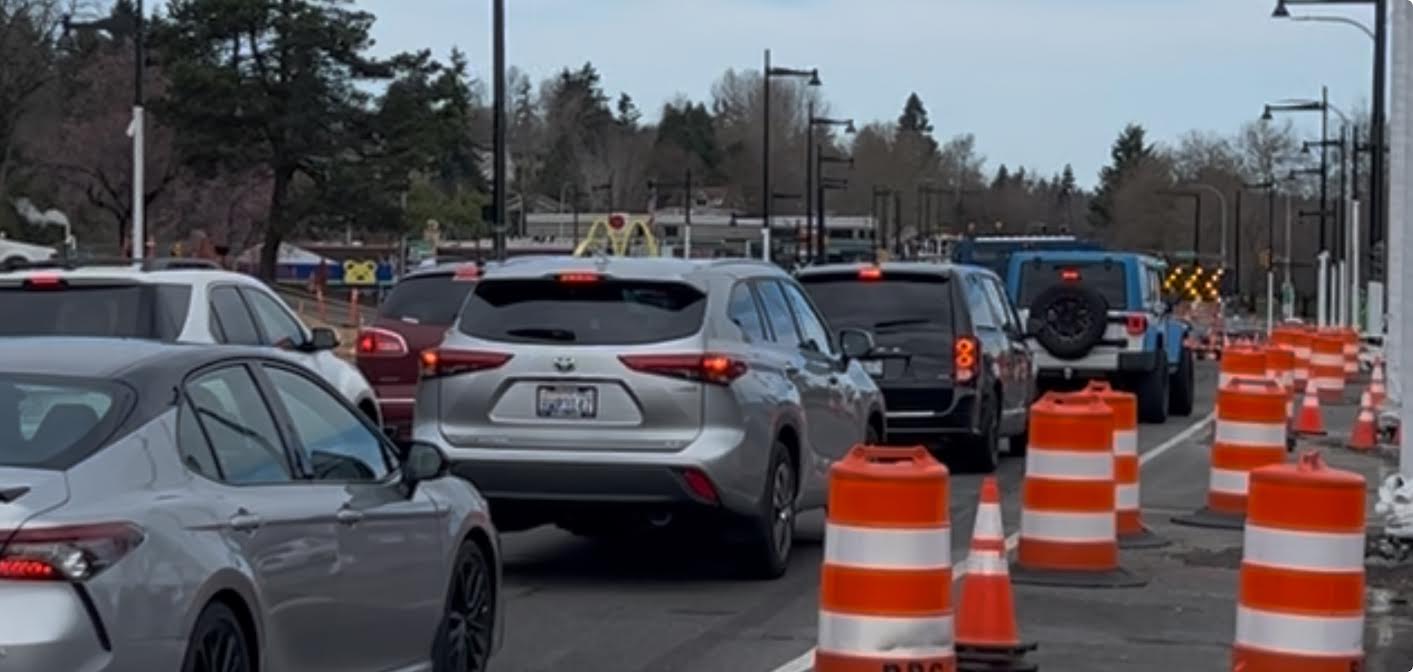
Even on the off-peak hour of 10:30 AM, traffic on Rainier Ave is grid-locked through multiple stoplights by a lane reduction near Airport Way.
The Rainier Avenue Phase 4 improvement project was originally scheduled to be completed this week, but after multiple delays it’s now expected to continue until at least October.
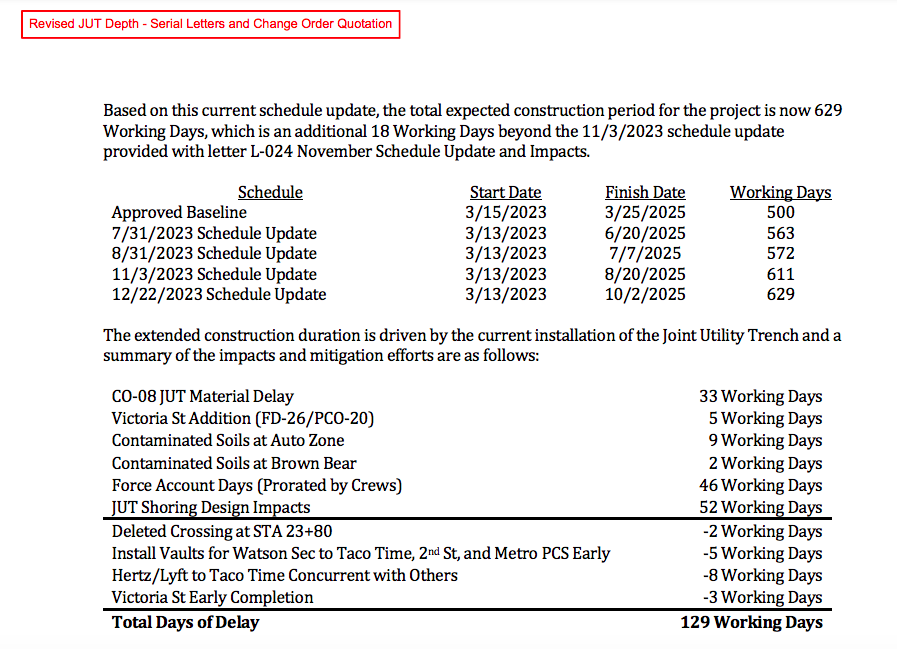
The last major delay was approved by City Council last summer, when the Council authorized a change order that added about four million dollars and 129 extra work days to the contract. Utility franchises will pay the $4,000,000 in additional charges, but Renton’s motorists and businesses are paying for the delays through their lost time, idling, frustration, and lost business revenues.
This latest delay was specifically caused by installation issues with a Joint Use Trench (JUT) that will be used for utility routing by PSE, Lumen, and Comcast. Because of unexpected conflicts with other in-ground utilities, the JUT has had to be installed at a depth of ten feet underground instead of the planned 5 1/2 feet. The extra 4 1/2 feet of depth significantly increases the cost of the worker protection shoring in the trench, requiring excavator placing of heavy steel frames instead of the hand-placed steel sheets. The extra depth also put the trench deeper into the water table, requiring pumping and loose sand management. Making matters worse, some of the extra soil being removed has some minor petroleum contamination (probably from old service station activities), and the soil has to be taken to a special site.
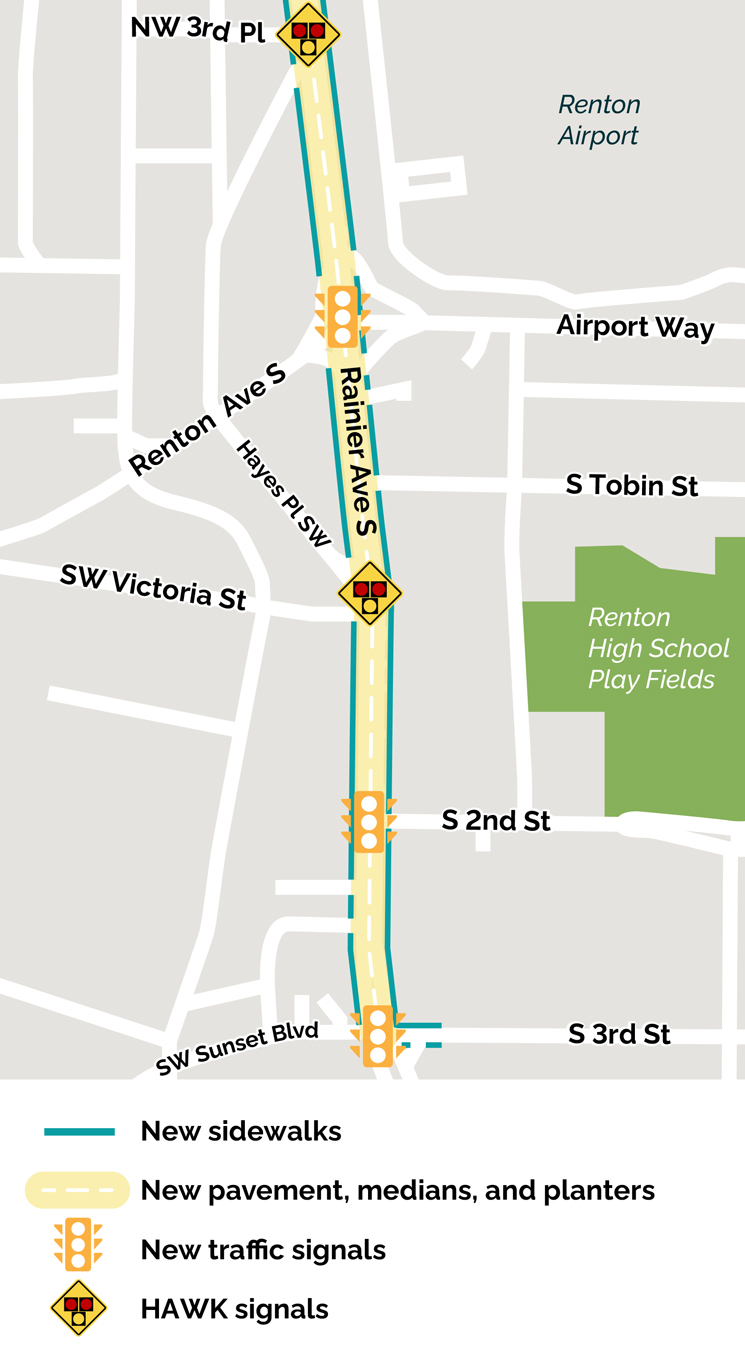
The 31-month construction project will update the street, sidewalks, signals, planting areas, and utilities
While I understand that utilities can cause delays, I think there could have been more effort placed on minimizing the number of days with lane closures.
In past years Renton Council passionately debated every proposed lane closure; Council used to typically restrict lane closures to hours, not weeks or months, and Council tracked them. When asked about a planned lane closure, or how long a prior lane closure had lasted, former Public Works Director Gregg Zimmerman always had the answer. Mr. Zimmerman usually knew immediately because he had been personally overseeing the work site. In the previous (southern) phases of Rainier Ave improvement under Gregg Zimmerman’s management, he famously committed to keeping five lanes of Rainier Ave continuously open. And Council helped Mr. Zimmerman hold the contractor to it. As quoted in the Renton Patch in 2012 ” Renton Public Works Administrator Gregg Zimmerman’s promise to keep at least five lanes of traffic open throughout construction drew heavy applause and whistles from a crowd of more than three dozen attendees”
Minimizing lane closures should be a requirement in all future road projects. Even if it makes the job more laborious to keep moving cones and steel plates in and out of position when a lane closure is needed (as opposed to leaving the lane perpetually closed), the extra labor can easily pay off. Rainier Ave typically carries about 40,000 cars per day. Many motorists are reporting delays of ten minutes from these lane closures, and google maps confirms this. If every car suffered ten minutes of delay, that would represent 6,666 hours of lost car/driver productivity per day. Assuming $50 per hour for a car and driver (the Uber hourly rate), this amounts to $333,000 per day. (The real losses are people being late for work or school, paying extra for daycare, taking time from family, etc, but these are harder to put a price on.) Whether the delay actually costs $333,000 per day, or half of this, the point is still the same. It’s worth investing $5000-$10,000 per day moving cones, signs, and steel plates to keep the lanes open when work is not being performed in them.
A Facebook user recently asked about this project on a group page, and the question attracted over 70 passionate responses. Here is just a small sample:
“QUESTION???? at RAINIER and RENTON AVE Would anyone care to share why it’s taking so long for the Road / infrastructure project to move forward? It’s been several years and not a single person was working. It’s an absolute inconvenience to all, and taxpayers should know.”
“I have empathy towards construction workers and don’t blame them specifically. Lots of hands at play here. But as someone who travels this intersection at least 4 times a day, it’s absolutely an inconvenience. Is it convenient to have to wait up to 10 minutes to get through a light? Not an exaggeration, has happened multiple times and not only when the power was out. I’m pretty patient and do like city improvements but this project should have been planned better or the city should somehow help navigate the delays.”
“The entire project is an embarrassment to take this long. It would be interesting to know why it has been taking years upon years.”
“Very sporadic as to when they will be working and when they aren’t. Majority of the time not.”
“It shouldn’t be left like it is for the time being. I drive a lifted truck and it feels like I’m out off of exit 38 going through the mountains on Rainier. It’s sick”
“It’s inexcusable and not professional nor is the city functioning in the best interest of it citizens. You don’t just leave it a mess for years. They could at minimum reconfigure the traffic and the ridiculous lane closure if they’re going to do nothing for another six months.”
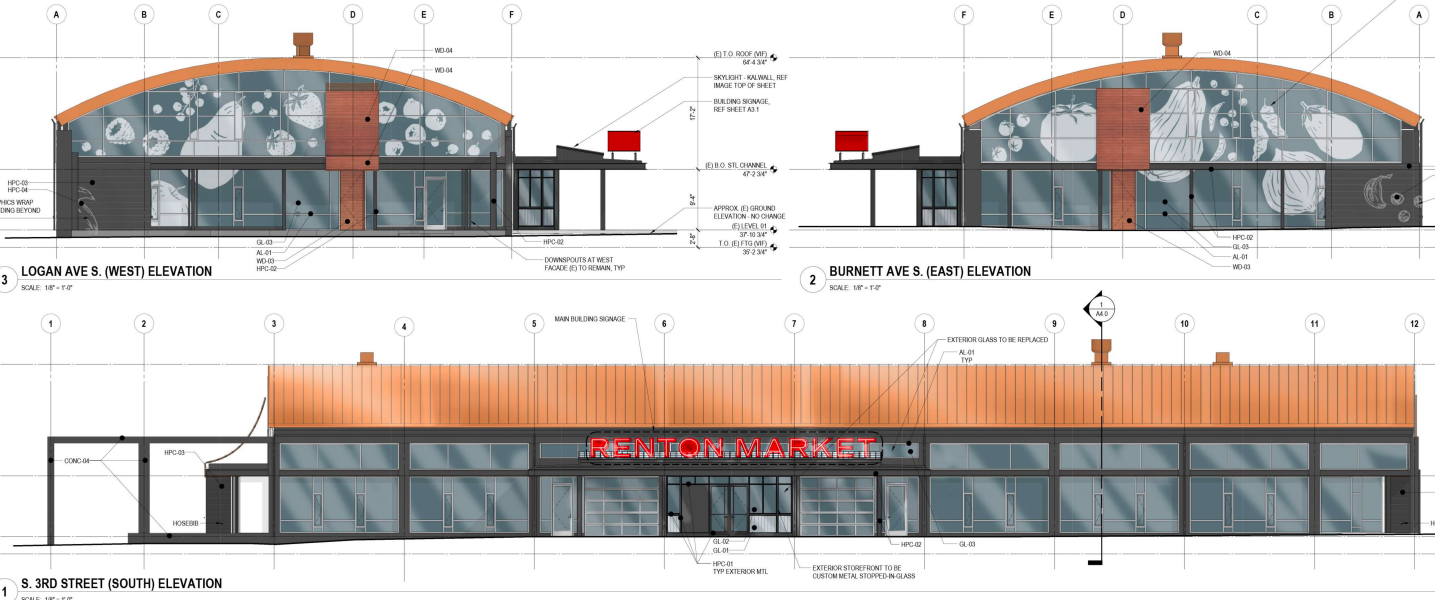
Current city drawing for Pavilion Market submitted as part of permitting process
The City of Renton is paying a consultant up to $49,000 to write a proposed lease agreement for the remodeled Renton Pavilion. As part of this work, the consultant is supposed to be asking the public what we want to see as the future of this building. The public should be weighing in now with our thoughts on the details of what we want to see.
One detail I’m not happy about is that even though both responses to Renton’s formal RFP process in 2019 retained substantial event space, the latest market concept no longer has event space other than a cooking classroom and possible banquet seating in one of it’s anchor restaurants.
For over 20 years the Pavilion has served exclusively as an event space, drawing large groups of people to downtown, sometimes hundreds at a time visiting for the first time. When the Spirit of Washington was operating both the dinner train and the Pavilion, Renton saw up to 200 events per year in this building, with some events bringing in 300 people or more. The Pavilion was so busy that the Renton Council had to move the “Movies in the Park” just to spread out the large gatherings we were attracting in our downtown. The Pavilion contributed to a renaissance in our downtown, helping inspire the name of the Renaissance Apartments next door to it. Then a frustrating deal between Burlington Northern Santa Fe Railroad and Washington State Department of Transportation ended our Dinner Train and sent Spirit of Washington packing.
North Renton residents issue press release about their Logan Six appeal. This appeal was announced on Monday night after North Renton neighbors tried one final time to get assistance from Renton City Council. This is the statement in its entirety:
PRESS RELEASE
NO Logan 6!
Contact: Sheryl Friesz, Matt Hanbey
FOR IMMEDIATE RELEASE
RENTON ‘AHEAD OF THE CURVE’!? MORE LIKE ‘BETWEEN A ROCK AND A HARD PLACE!!’
Renton Neighbors Raise Funds, Hire Lawyer to Appeal Proposed Logan 6 Development.
Renton, WA (March 25, 2025) – Renton Neighbors, fed up with city, the mayor, and the city council are taking their issues to court:
“We’re fed up. We’ve tried to work with the city and our elected officials for more than eighteen months, including our city council members and mayor, but they played ostrich and dug their heads in the sand. So, we’re taking our issues to Superior Court.” “The message we’re sending— and have been sending– to the City, the Mayor, and the City Council is: we will not tolerate the inaction, lack of engagement, and disregard for process on developments, like Logan 6, that impacts all of Renton.”
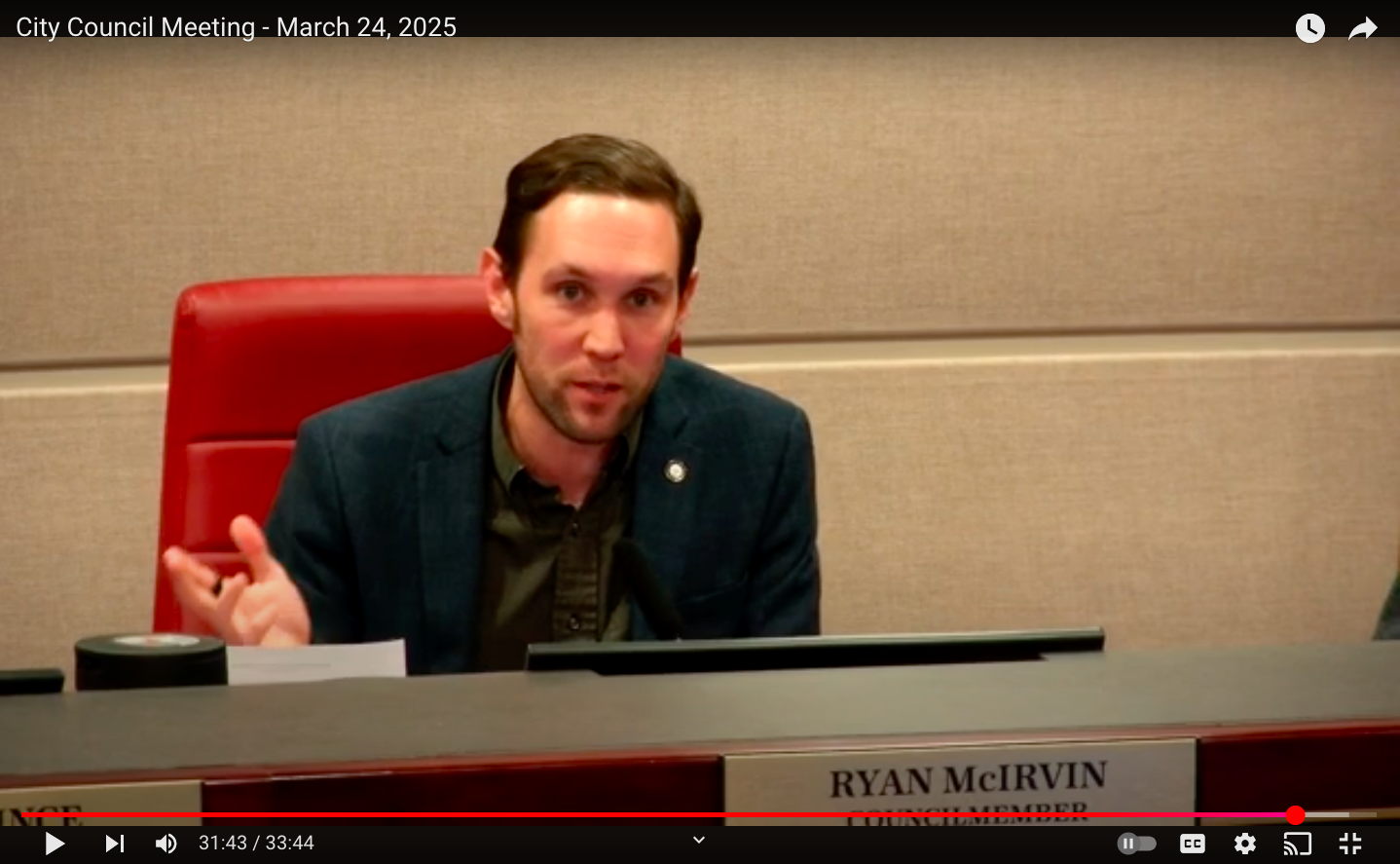
“I know you’ve had the opportunity to meet with everyone, but I just want… I don’t want there to be the appearance that we’re not listening….that I haven’t heard. I just I don’t know that this format lends itself to being the best one for discussion. But if there’s a discussion that needs to be had, I’m happy to have it when that time is right.” (Council Member McIrvin, at 3/24/25 meeting)
Council observers have recently seen Renton residents complaining about not being heard at Council Meetings, and Council refusing to act, or even discuss acting, on issues that are brought before them by the public.
Individual Renton Council Members have no authority individually. But when a quorum of them agree on an issue, they have more authority than the Mayor. They are like the city’s “Board of Directors,” while the Mayor is CEO.
But the only way Council can use their authority, or even talk about using it, is in an open public meeting. So we taxpayers fund a comfortable council chambers, and staff it with a Clerk, Chief Administrator Officer, City Attorney, department heads, and a recording crew so that Council Meetings can be productive and effective.
We also provide an opportunity for Renton residents to interact with their council at these meetings, as Public Agencies are encouraged to do by state law.
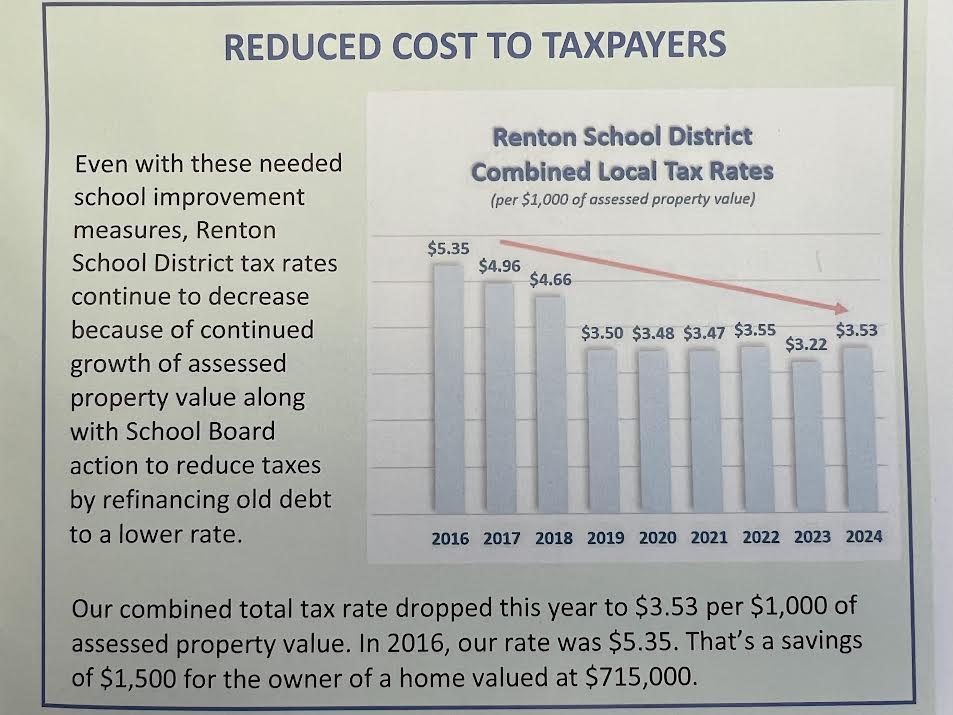
Renton School District sends out regular mailers telling us they are reducing our costs. They base their analysis on a non-existent (magic?) house that did not increase in value from 2016 to 2024. Can we really trust them to educate our children when they present data in such a misleading way?
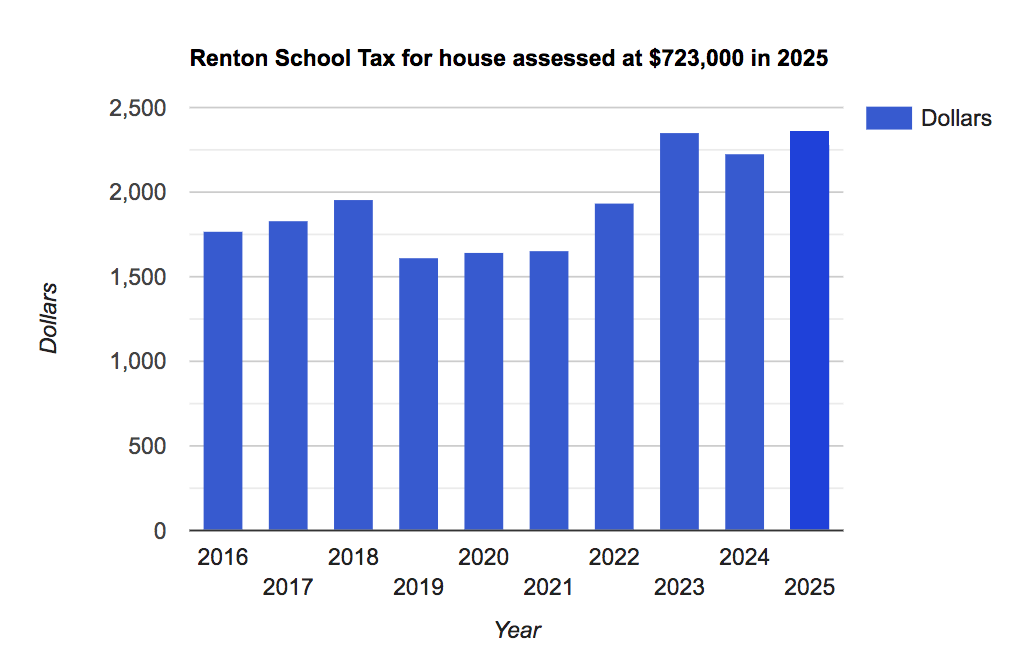
In reality, the taxes for the school district are rising quickly. This is a typical Renton Highlands house (owned by my son) valued at $723,000 in 2025. This house appreciated at a normal rate with all the others, with no remodeling. The local school taxes went up significantly, not down $1500.
Contrary to the District’s published statements that typical taxes have gone down $1500 over ten years, Renton’s local school taxes have actually been going up fast, rising by many hundreds of dollars per year for a typical home during this time.
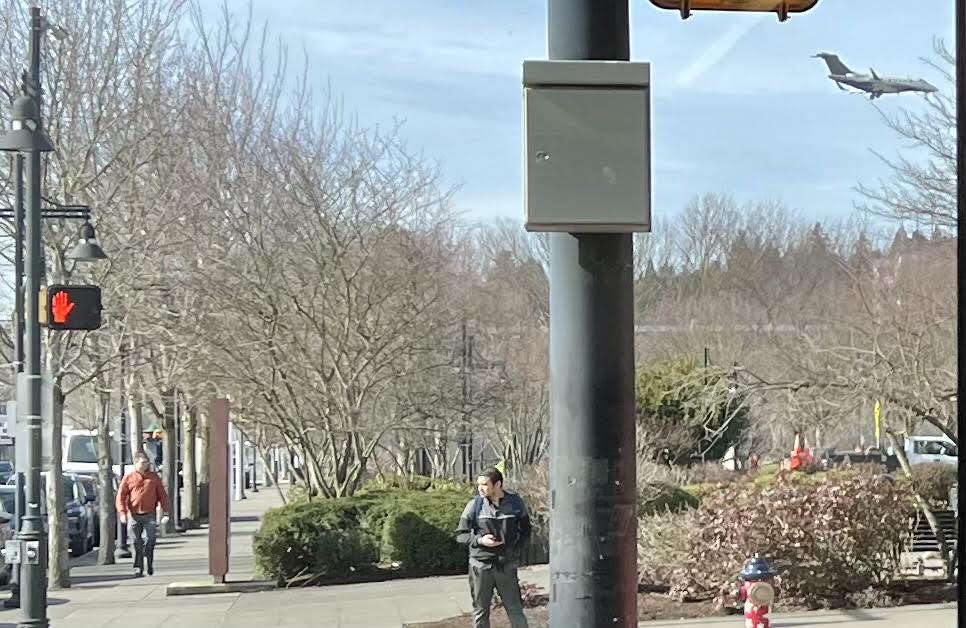
A business jet lands over Renton’s Piazza in downtown Renton. I shot this photo with my iPhone a week ago while dining in Rain City Market.
Don’t be surprised to hear more nighttime business jets in Renton through October. Boeing Field has completely closed their smaller runway for the next seven months, and their large runway will be closed every night starting at 8:15-9:15 PM and continuing until 3:30-5:15 AM.
While business jets based at Boeing Field would be expected to schedule their operations for the runway’s daytime (open) hours, Renton will likely pick up nighttime traffic from jets based elsewhere that are flying to our area and trying to work around the closures. Particularly jet taxi services will likely find Renton to be the most convenient nighttime alternative to Boeing Field.
Private jet traffic will likely pick up even more this summer, particularly with the FIFA Club World Cup soccer activities.
The impact from private jets in Renton is already being felt. I’ve heard from a Mercer Island resident who has noticed an overnight increase in Renton jet traffic. Jet traffic from Renton often goes directly over Island Crest Way, near the center of Mercer Island.
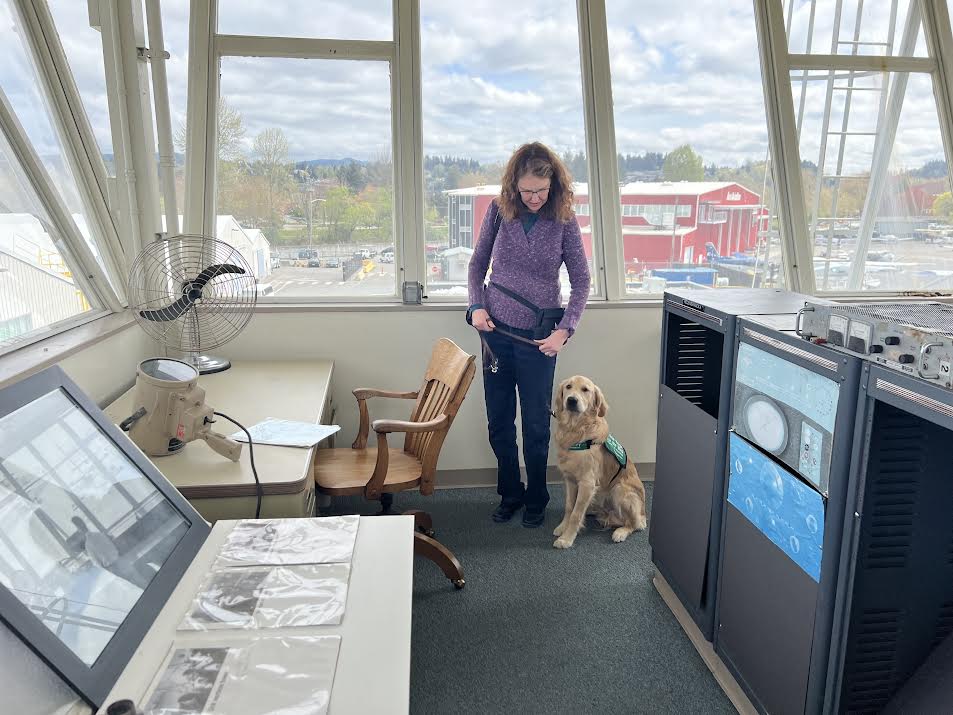
Scheduled for Demolition: A few years ago I would have been confident that all or part of Renton’s WWII air traffic control cab would be saved from the wrecking ball by Renton historians. But now that the City has severed ties with the Historical Society and emptied the Renton Historical Museum, it’s not clear who is watching out for Renton’s history.
A few months ago the City of Renton ended a 54-year relationship with the Renton Historical Society, kicking their priceless collection of artifacts and photographs out of the Renton Historical Museum. The Renton Historical Museum now sits empty and closed to the public, while the Renton Historical Society is actively searching for a new permanent location for their large collection, to replace the historic fire station they they helped run and maintain for 54 years. The Historical Society was taken by surprise by this move, and the city’s reasoning for the separation has not been clear.
Now while the Historical Society is distracted with this chore, the City of Renton has chosen this time to move forward on tearing down Renton’s 80-year-old historic air traffic control tower.