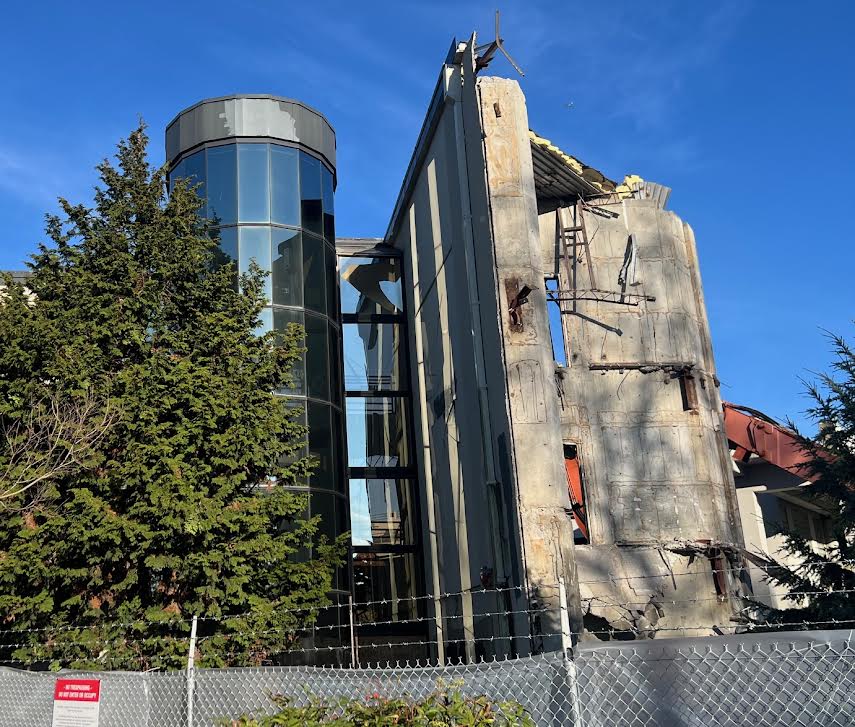
Two years after Renton evicted a thriving aircraft parts manufacturing business, the buildings sit empty

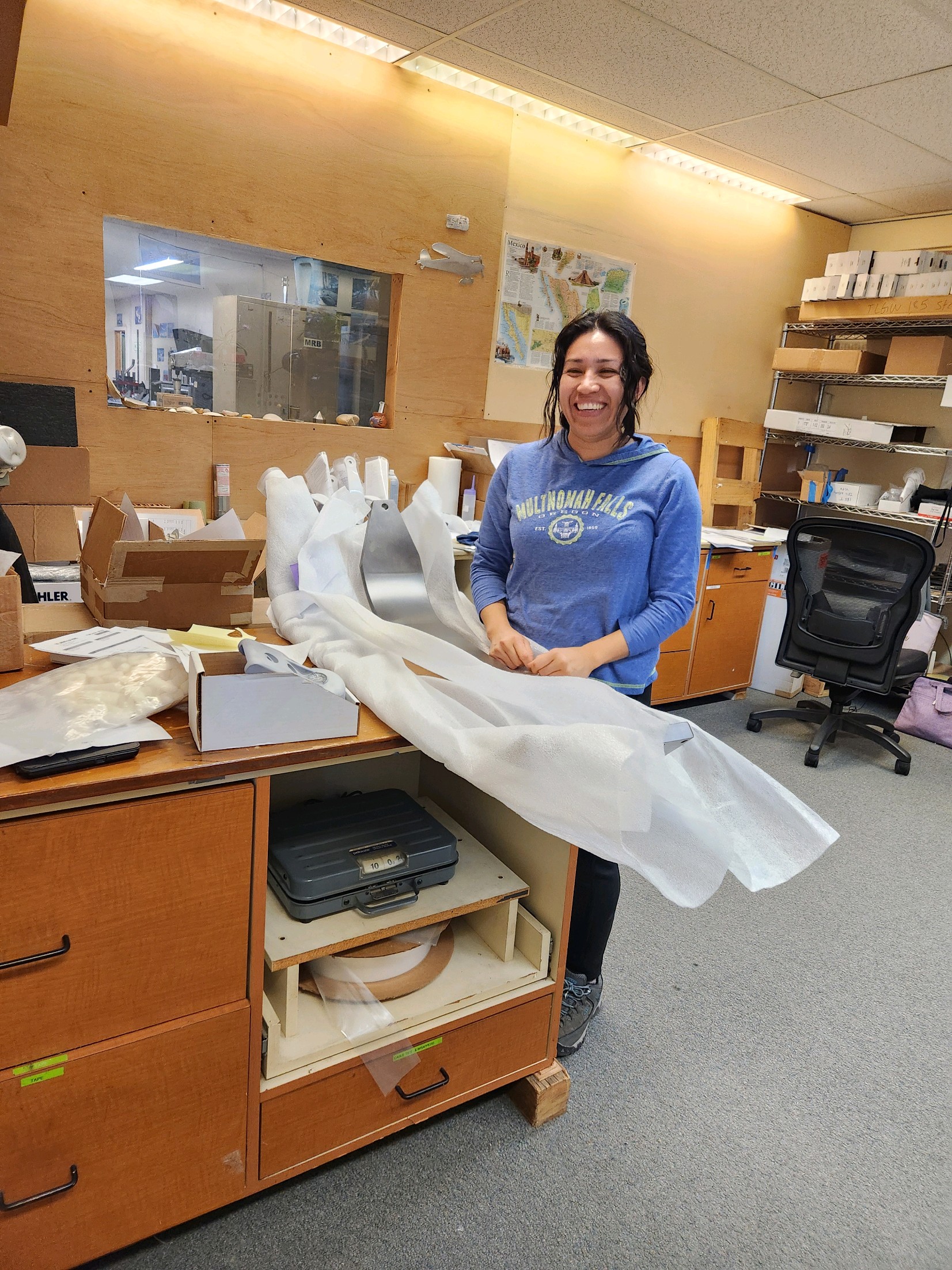
In this 2024 photo, Sofia Farret prepares high-tech Renton-made titanium landing gear for shipment, at ” the Landing Gear Works” at Renton airport. This facility is now abandoned.

The Renton City Council should thoroughly review how Renton manages our city facilities to return the best value to our residents and businesses.  Lately, it feels like our city facilities are being treated as if they are disposable.  With replacement buildings now costing in the tens of millions of dollars, our city facilities should be utilized to their fullest and managed with respect.

It’s been two years since the City of Renton evicted the popular “Landing Gear Works” from their leased manufacturing building and hangar at Renton Airport.  The decades-old landing gear manufacturing company specializes in small-airplane components,  and their operation provided desirable economic diversity to our airport.  The eviction eliminated dozens of living wage jobs, sacrificed city B&O and sales tax revenue on a multi-million dollar business, and left aircraft owners queuing for support for their aircraft products while the Landing Gear Works hurriedly relocated their operations to other cities.

Two years after this eviction began, nothing has been done with the city’s now-empty buildings.

The eviction process began when a roof replacement was needed on the manufacturing building that was partially leased by the Landing Gear Works.  The City (which owned the building)  would neither pay for the repair themselves nor grant the tenant reasonable lease terms to accomplish the repair.   The dispute became exacerbated when the city realized they had made a multi-month billing error, and then demanded tens of thousands of dollars in surprise back-rent from the Landing Gear Works at the same time as they were refusing to address the roof.

While a negotiated settlement could have quickly resolved these issues, the Renton City Council (which has responsibility and authority for leases) never publicly discussed a possible resolution, either among themselves or with the tenants.  The Council remained silent during a series of Council meetings as the tenants made repeated heartfelt pleas for a negotiated settlement.
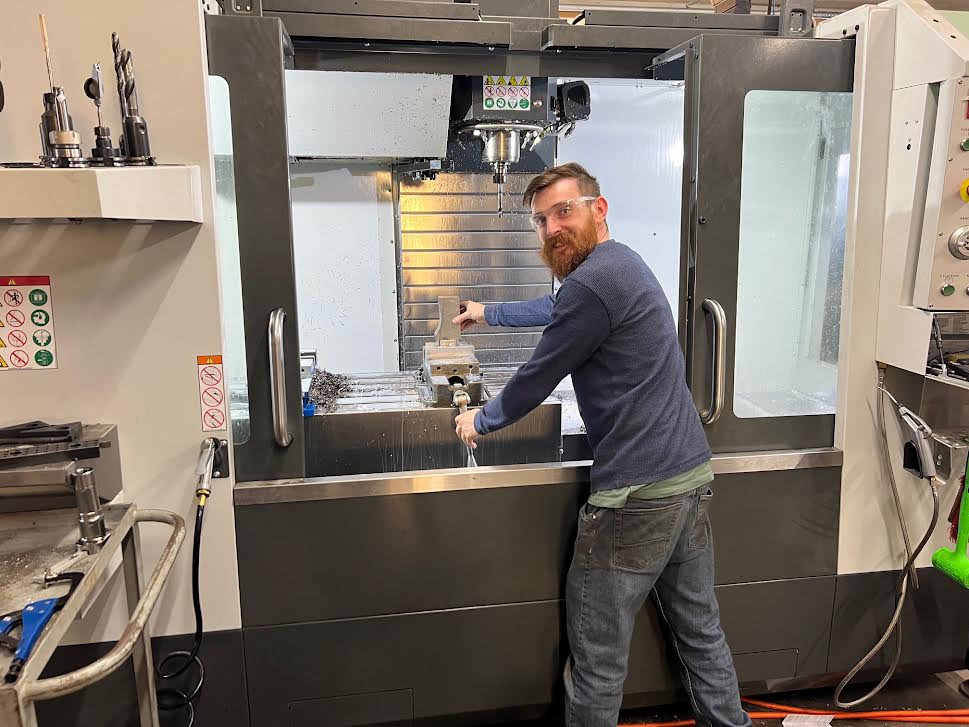
Derek Anderson, a third-generation Renton business owner and machinist is preparing parts for milling at the Landing Gear Works at Renton Airport in 2024. This building is now vacant.

When it ultimately became apparent that the Council would not intervene, the airport manager pressed the tenants to work around-the-clock to meet a strict move-out deadline; the tenants used floodlights and worked into the nights, to clear the buildings– as if it was one of the City’s biggest emergencies.

But following the midnight move out, the city has let the buildings sit vacant and abandoned in the year-and-a-half since.  The message apparently was “Hurry up and get out, so that we can leave TWO MORE City of Renton buildings vacant.”
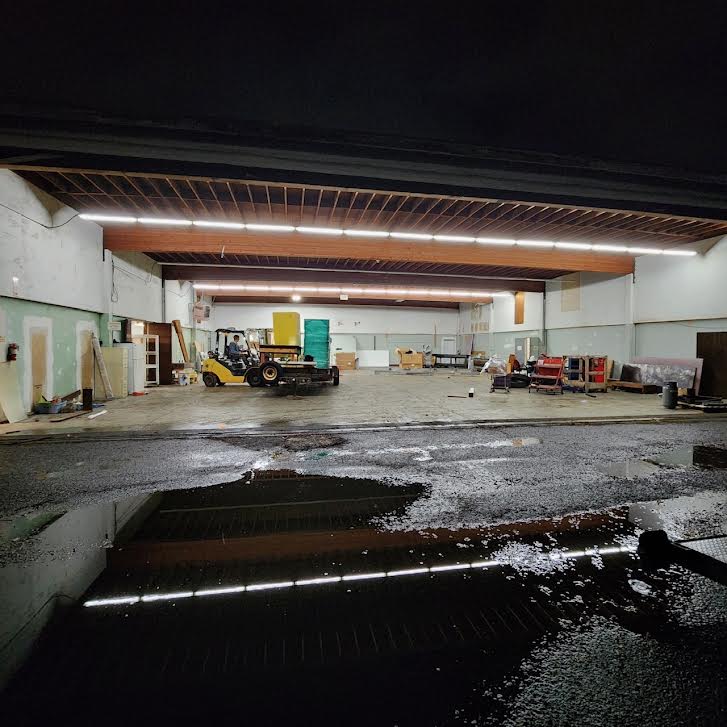
The Landing Gear Works worked night and day in November 2024 to vacate this large hanger and a manufacturing building under intense pressure from Renton. After their forced move out, the buildings have sat vacant and neglected for the past year and a half.

While a new roof might have cost six months of lease revenues, it would have kept years of lease payments and taxes flowing into the city and preserved an important Renton business.

Eventually the manufacturing building (and maybe the hangar) will be demolished and replaced, but there is still a long process to do so, and it could have hosted a viable, revenue/tax-generating business in the years leading up to its replacement.  We certainly don’t want private property owners leaving abandoned buildings all over our city, and there is absolutely no reason the City should be modeling this bad behavior.

The Landing Gear Works buildings have joined a long list of city buildings that have been temporarily vacated or completely abandoned by Renton in recent years, including:

The Former Chamber of Commerce Building (left vacant, now demolished)

The Renton Historical Museum (Historical Society kicked out, now sitting empty with unclear future)

Rainier Flight Services flight school building at Renton airport (school kicked out, building sitting empty)

The Pavilion Event Center (empty for over a year, now getting a taxpayer-funded $10 million conversion into a privately-managed market)

Carco Theater (flooded by Cedar River in December, activities cancelled as flood-damage is  remediated)

200 Mill Avenue- former City Hall (recently flooded by broken 16-inch water main, repair costs and future currently unknown)

The Landing Gear Works hangar and nearby manufacturing building (thriving business kicked out, now left vacant)

This protracted, wasteful vacancy of the Landing Gear Works buildings was 100 percent predictable.   In a blog post two years ago I identified many errors in the Mayor’s official statement regarding Renton’s airport management at that time. Many topics were errantly discussed in that memo, leaving me seriously concerned about Renton’s airport leadership. For example, the Mayor asserted that business jet operations would cease each day when the tower closed, and I corrected that (per FAA policy) jet operations would continue 24 hours per day  which they have.    The Mayor’s equally erroneous comments concerning the Landing Gear Works in that memo are shown in italics below, with my corrections underlined and linked to source data.  (This exchange is excerpted from the April 2024 blog post):

5. Is there a business leaving the Renton Municipal Airport?

The City of Renton is moving through the legal process of eviction of a tenant for a long-standing non-payment of rent. The occupied buildings in question were originally scheduled for demolition in 2015. The buildings occupied by the Landing Gear Works, the old tower building and hangars, have never been scheduled for demolition. 

The occupation of these buildings were at a deeply discounted rate, with an understanding that any repairs needed would be at the expense of the tenant. This statement is false. Landing Gear Works hangers are priced like all other Renton airport hangars.  The old tower building was leased for the highest rate the Airport could get after it had been vacant for months.Airport management had responsibility for maintenance of common areas and the tower of the office building through most years of the tenancy.

The natural end of the lease was slated for July 2024, we have moved forward with a lease termination date of March 31, 2024 in light of nonpayment. This more accurately would say “in light of an ongoing rent dispute that began when we improperly billed the tenant, then ignored his concerns while we played musical chairs with our airport managers, and finally denied him and his employees their First Amendment rights to communicate with their elected officials.”

It is the responsibility of the city to maintain safe, functional and market-rate buildings for future tenants. It IS the city’s responsibility, and the city has unreasonably tried to get out of it by arguing that the building is going to be replaced in the future.  It’s also the city’s responsibility to ensure that private buildings are safe, and they are failing in many places.

One of the core pillars of our city administration is to communicate regularly and clearly with plain facts and direct language.  The Council, not the Administration, is responsible for leases under state law.  The council members have never publicly discussed this lease issue with each other, or communicated in any way with the tenants.  An attempt to reach out was made by one council member, and was apparently shut down by the city attorney.  This complete lack of council involvement and communication is shockingly different than council behavior and actions in the past. There were many steps where a collaborative discussion between the tenant and  the airport manager or council members would have quickly and peacefully resolved this dispute.

(Reminder: The full Mayor’s statement and my responses can be found here.)
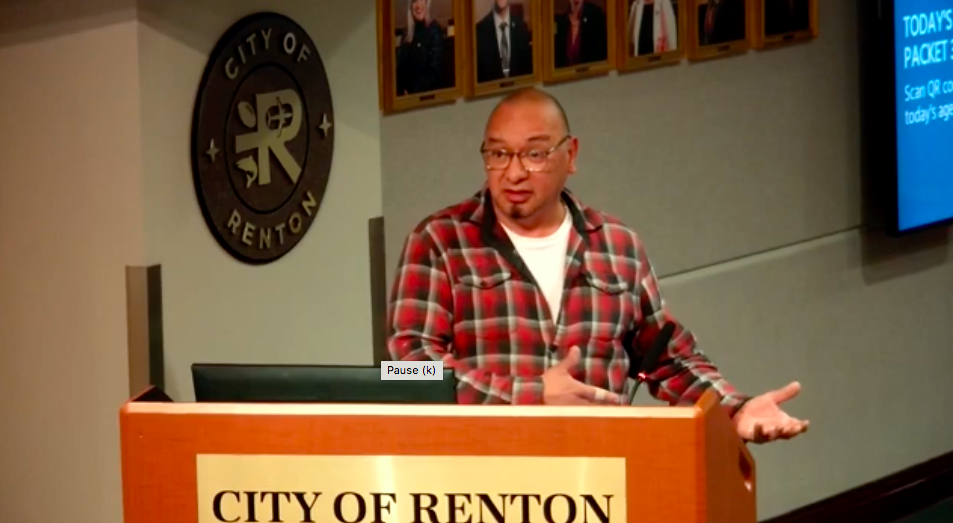
Employees of the Landing Gear Works made numerous requests to City Council to help them reach agreement on their lease

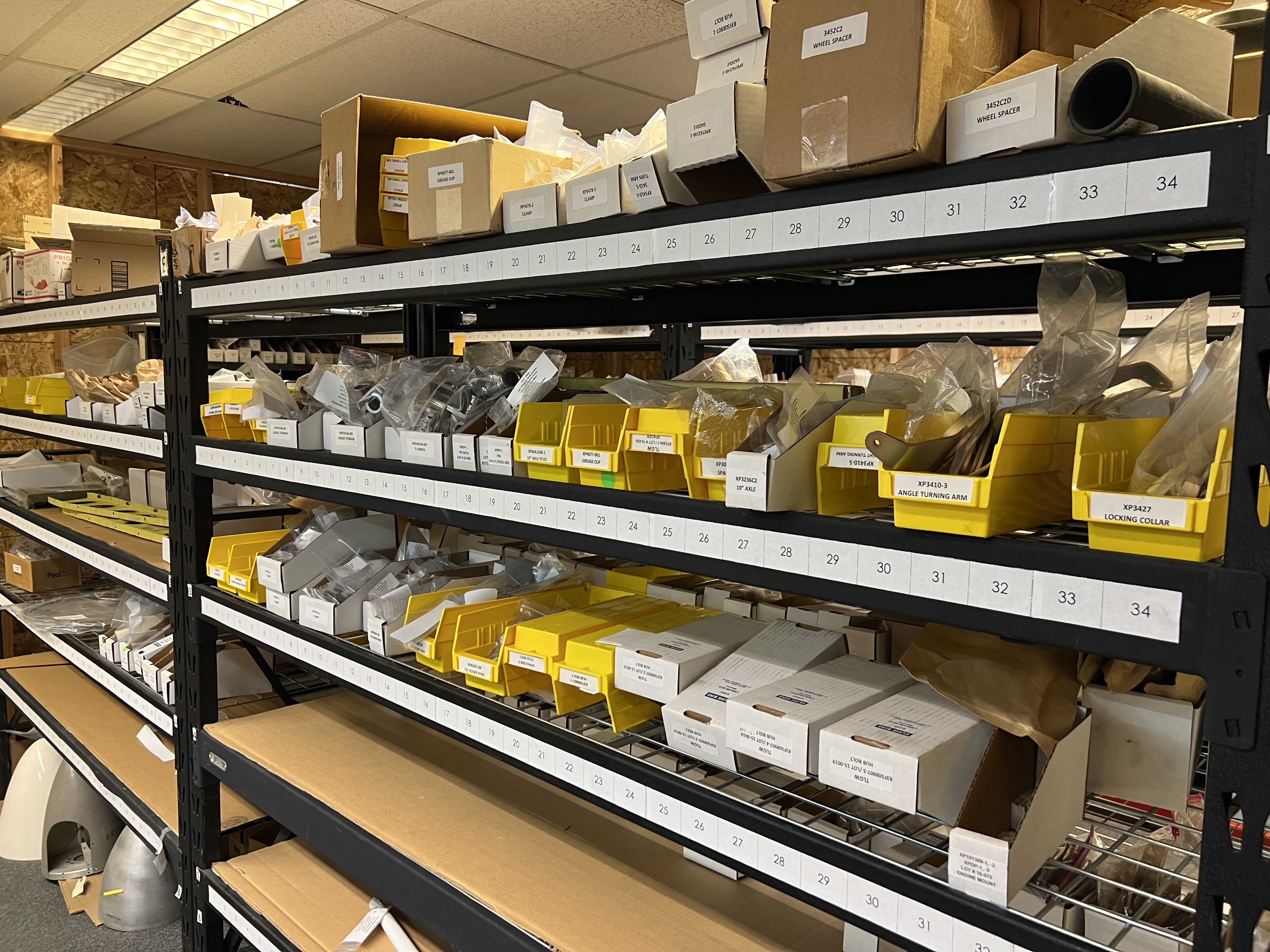
FAA-approved spare parts for aircraft landing gear, many of them fabricated in Renton, were stocked, sold and delivered from this facility in Renton. Renton collected associated B&O and sales taxes. This spares business has been moved, and the facility is now abandoned and empty.


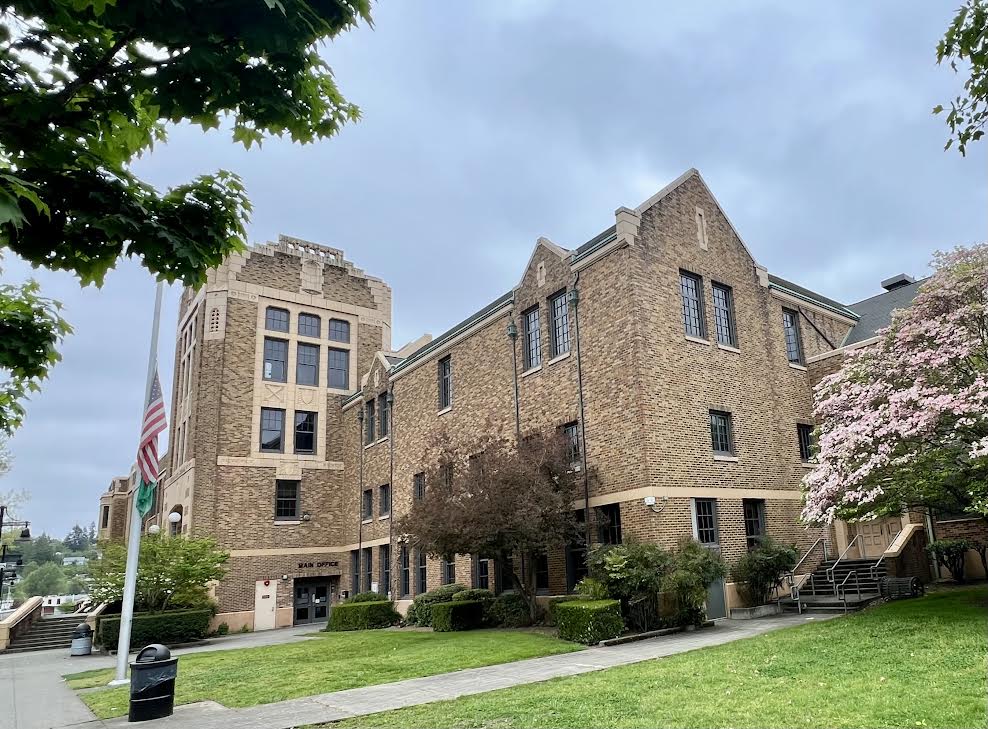
Shiney titanium Renton-made landing gear adorn this Cessna 180. The city-owned historic building in the background needed new roofing, and the city was unwilling to discuss a plan to replace it.  The building now sits empty.


“The greenest building is the one that is already built”

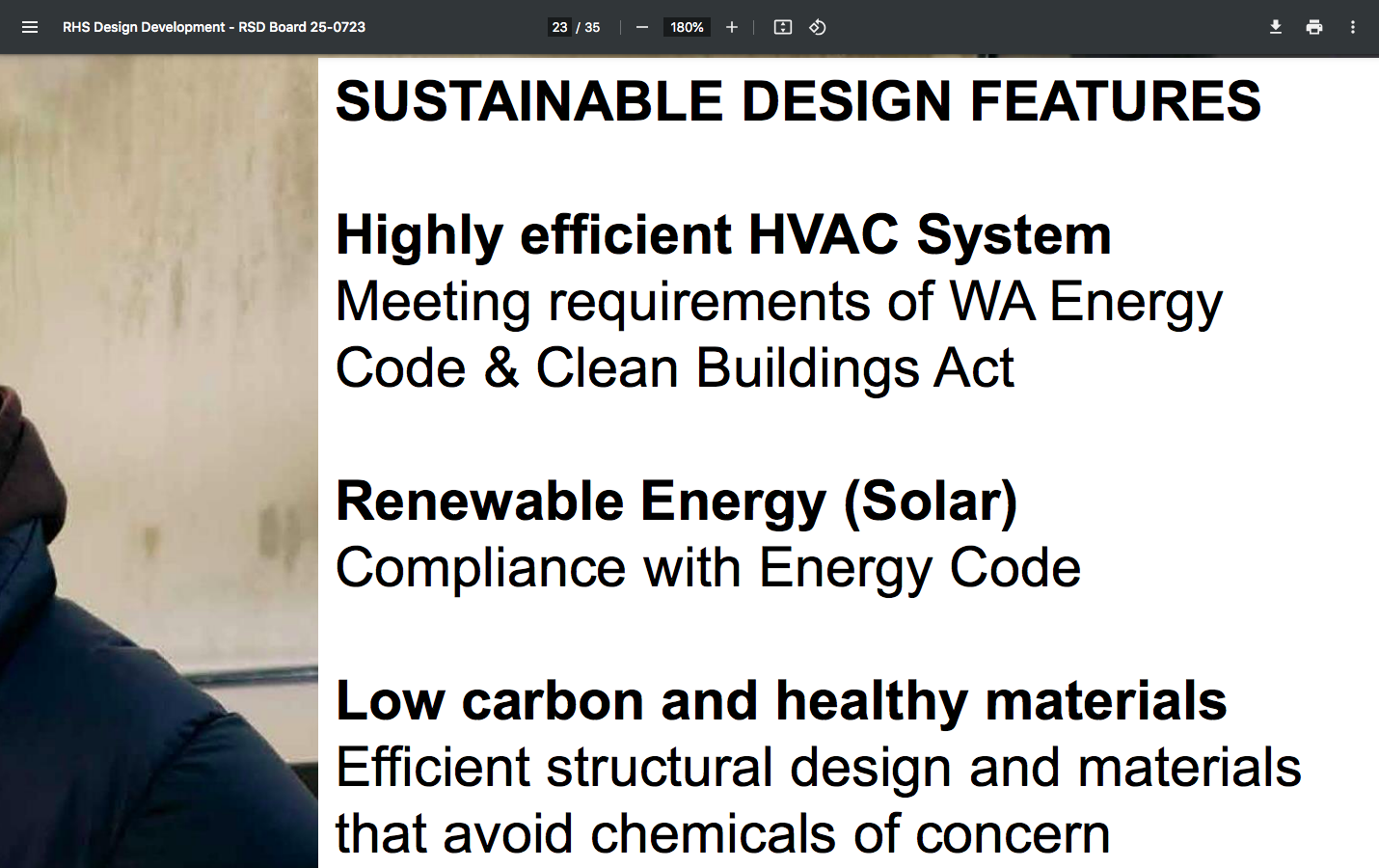
When Renton High School is torn down and replaced in the next four years, it won’t be a win for the environment.  Yes, its replacement will have a “highly-efficient HVAC ” system and meet the “requirements of Washington Energy Code and Clean Building Act.”  But constructing an all-new school instead of updating/expanding the existing one has a nearly insurmountable environmental cost.  Millions of pounds of materials will be crushed and trucked to landfills, while millions of pounds of new materials will need to be mined, manufactured, and transported to replace them.  It may take 80 years before an improved HVAC system overcomes this environmental impact, if it ever does.

In 2007 Carl Elefante, former president of the American Institute of Architects, summarized the new-vs-remodel dilema by pointing out that  “the greenest building is the one that is already built.”

This link includes an excellent interview with Mr. Elefante, where he elaborates on this point.  The argument that we should preserve buildings when possible extends far beyond Renton High School.  We should be practicing it everywhere.

The Renton High replacement also involves tearing down 40 homes and businesses, which along with causing misery through unwanted takings and displacements, will also have to be replaced.  And the new high school project will cut down hundreds of trees, more than the Renton code would typically allow for a site of this size.  No amount of insulation in the new school will overcome the environmental cost of these impacts.

I voted along with the majority for the bond issue to build a new Renton High School,  because I believed the district’s voter materials that said that the existing high school would be preserved and repurposed.  The district’s voter information also made no mention of taking and destroying 40 homes and businesses.

Our Renton students deserve the very best high schools we can give them, but no one should be arguing that this particular plan for Renton High was the most environmentally friendly one.


One of 32 houses being torn down for the new school. There are also eight businesses being bulldozed.
Some of the trees being removed for the new baseball fields at the school
This page from the “New Renton High” presentation on the School District’s website implies that the new high school will be a win for the environment. (It won’t be)


Airport office remodel goes 50% over budget

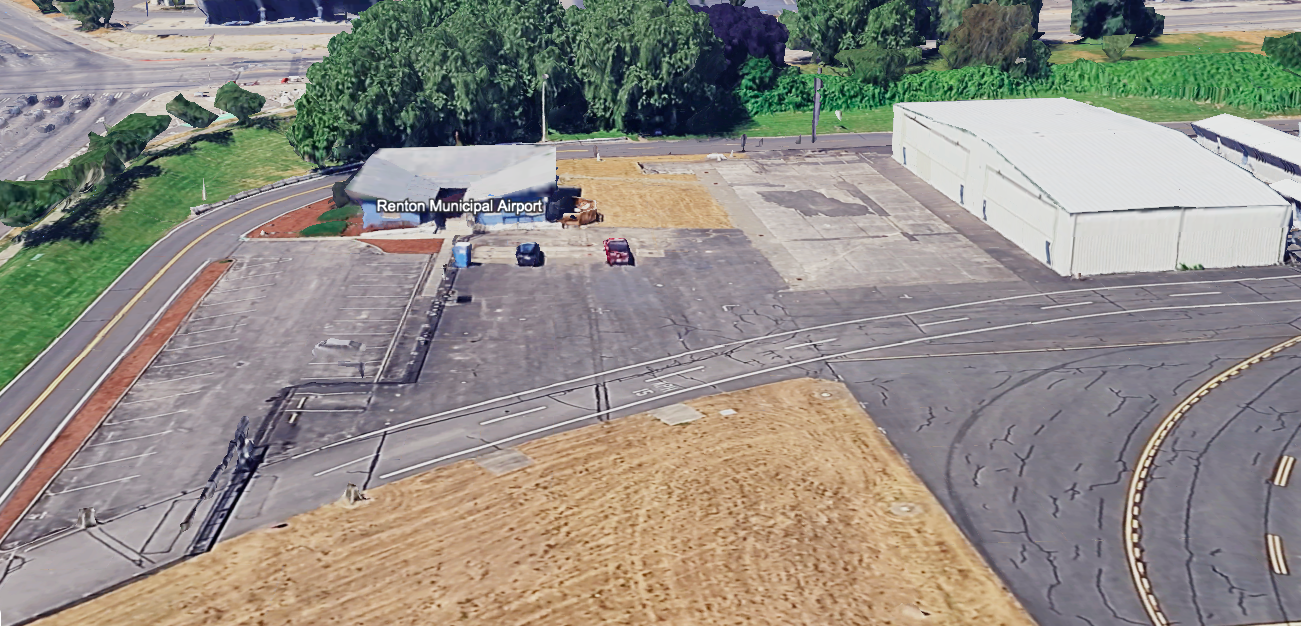
The City of Renton has recently done a million-dollar interior remodel of the small blue building at the southwest corner of the airport, to serve as an airport management office.
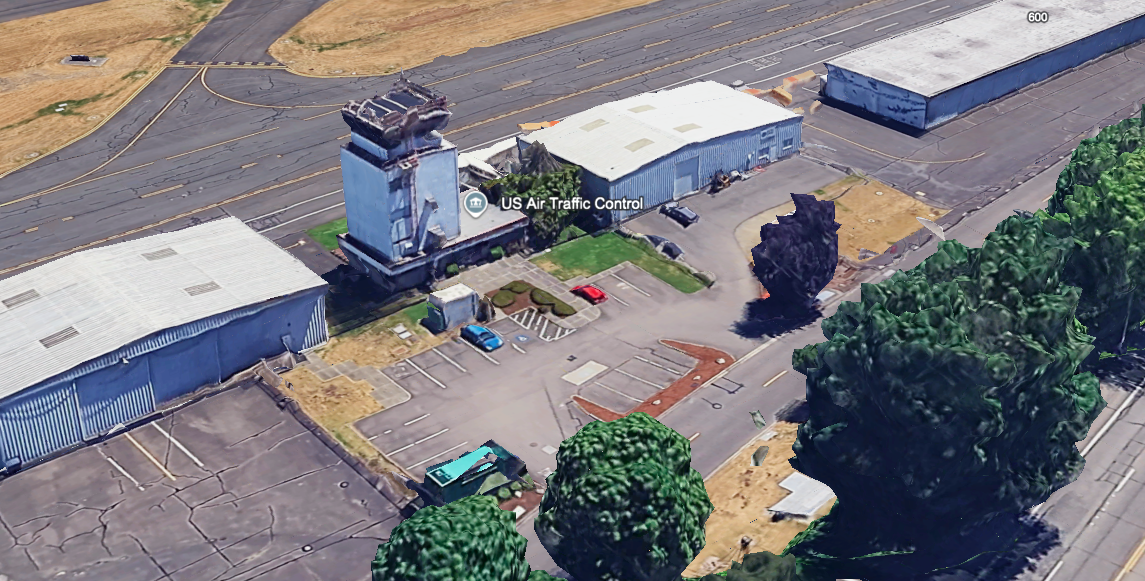
The airport management office had previously been located in the one-story building at the bottom of the control tower

Author’s note: I’ve recently written two blog entries recommending that the City of Renton investigate the way it bids and manages Public Works contracts due to recent severe overruns.  This is a story about a third public works project that experienced a 50% overrun in the same timeframe (i.e. three over-budget projects all required significant additional funding within a two week period. )  While one overrun might be an unfortunate anomaly, twice indicates a trend, and three times feels like it could be a new normal.

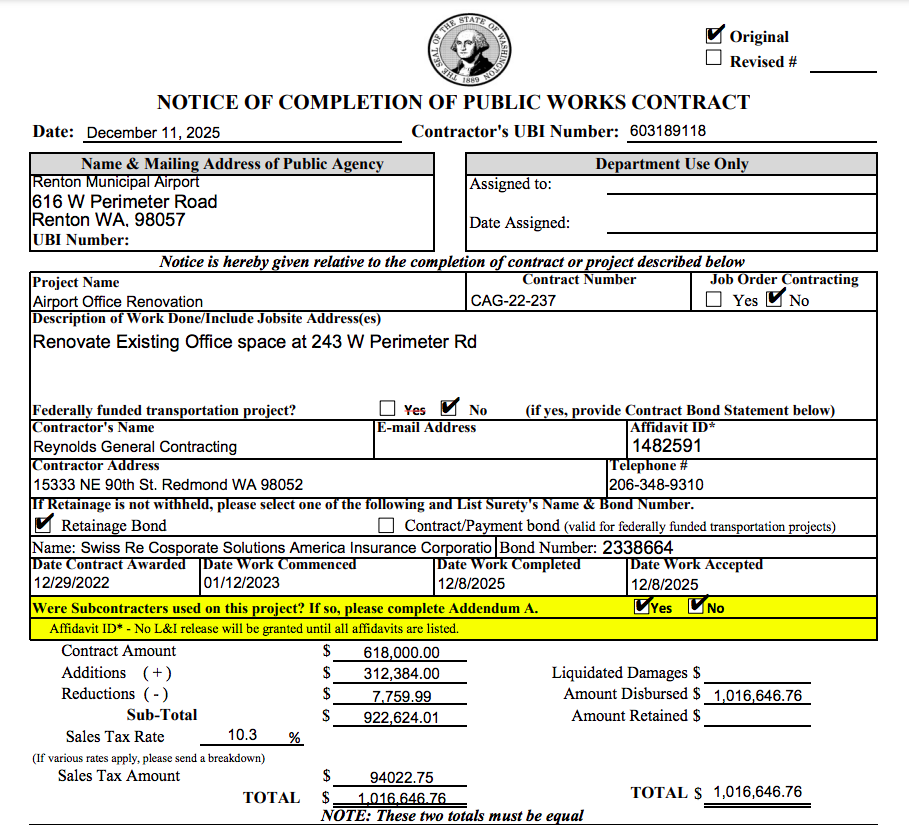
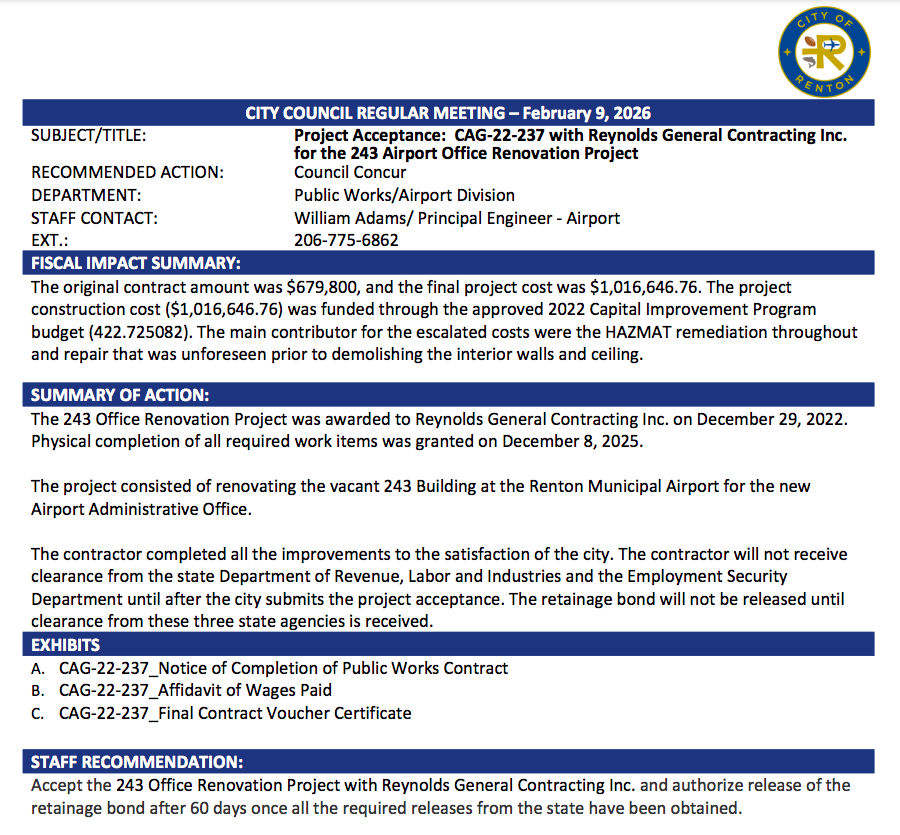
On February 9 the Renton City Council was asked to approve final expenditures for an office remodel project at Renton airport that exceeded the budget by over 50%.  The project provided refurbished office space for an increase in the number of staff managing the Renton airport.

According to city documents, “the main contributor for the escalated costs was HAZMAT remediation throughout and repair that was unforeseen prior to demolishing the interior walls and ceiling.”

While safely dealing with hazardous materials like asbestos and lead are important, some of these materials could have been expected in a 1950’s era commercial building.  And it seems like some preliminary investigation could have revealed their presence in advance.  In future budgeting and bidding processes, it would make sense to explore for these materials and budget in advance for these contingencies.

With regard to the unforeseen repairs, contractors will tell you repairs are inevitable when remodeling an older building.  Most Public Works contracts carry a 10% contingency to cover for unexpected repairs or other work, and that is typically sufficient.  It’s hard to imagine that reframing or redecking a portion of a small one-story building should exceed the 10% contingency for this project.

The original contract amount was $679,000.  The final amount was $1,016,647.  This amounts to a 50% overrun.

When overruns climb this high, it can become impossible to determine whether the city truly got the best deal during the bidding process.  We’ll never know if the second or third place bidder might have been less expensive overall… there is no way to know.

The previous two blogs discussing recent Public Works cost overruns where for the Williams/Wells which needed $1,000,000 additional funding on February 9 and went over budget by 43%, and Rainier Avenue Project with required $370,000 additional funding on January 27th and was over budget by 29%.

Overrunning the budget on projects can happen even with solid planning.  But  it seems like there is room for improvement in estimating Public Works projects, and the City Council should consider an after-action review to find these opportunities.


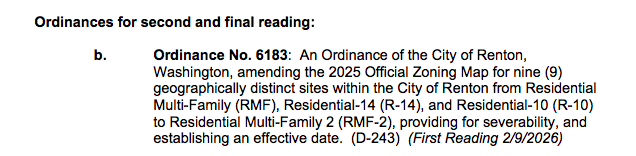
Council upzones multifamily properties at nine sites from 10-20 units to 40 units per acre

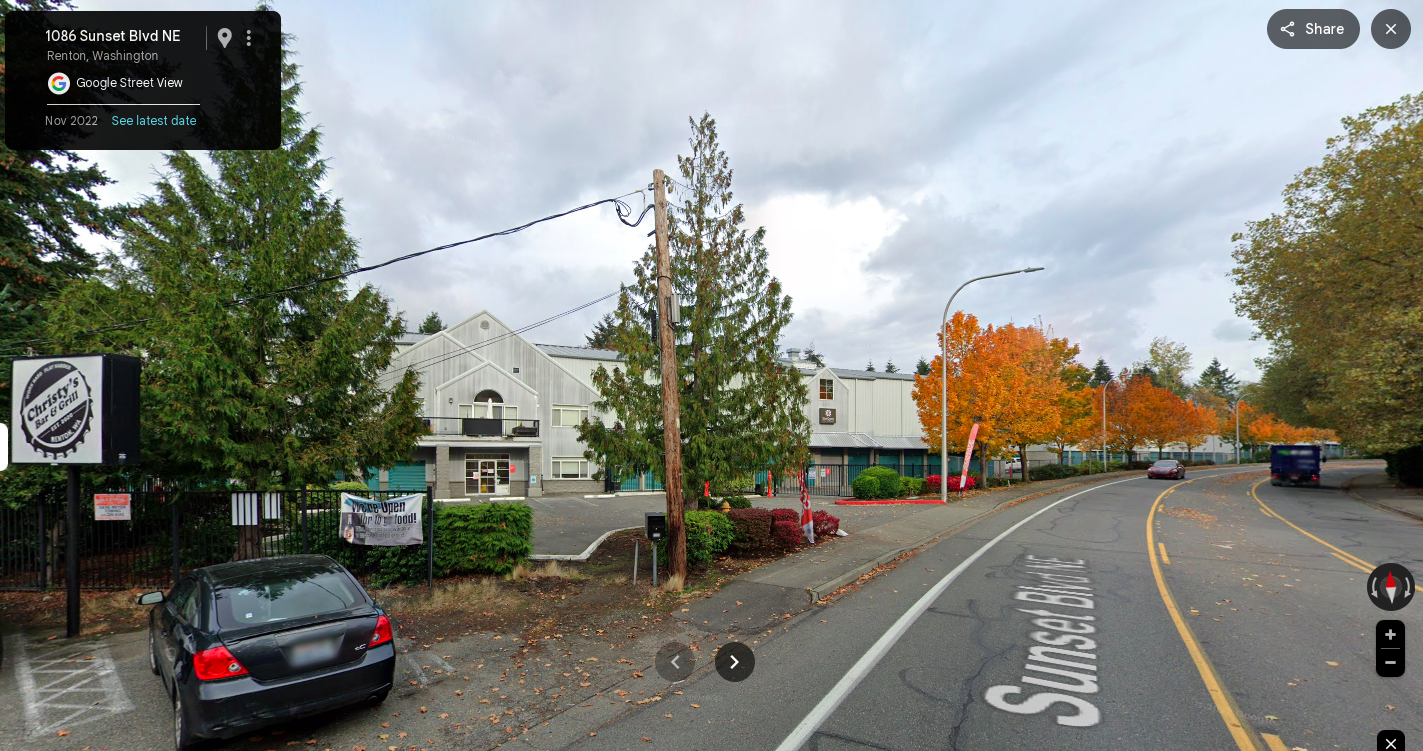
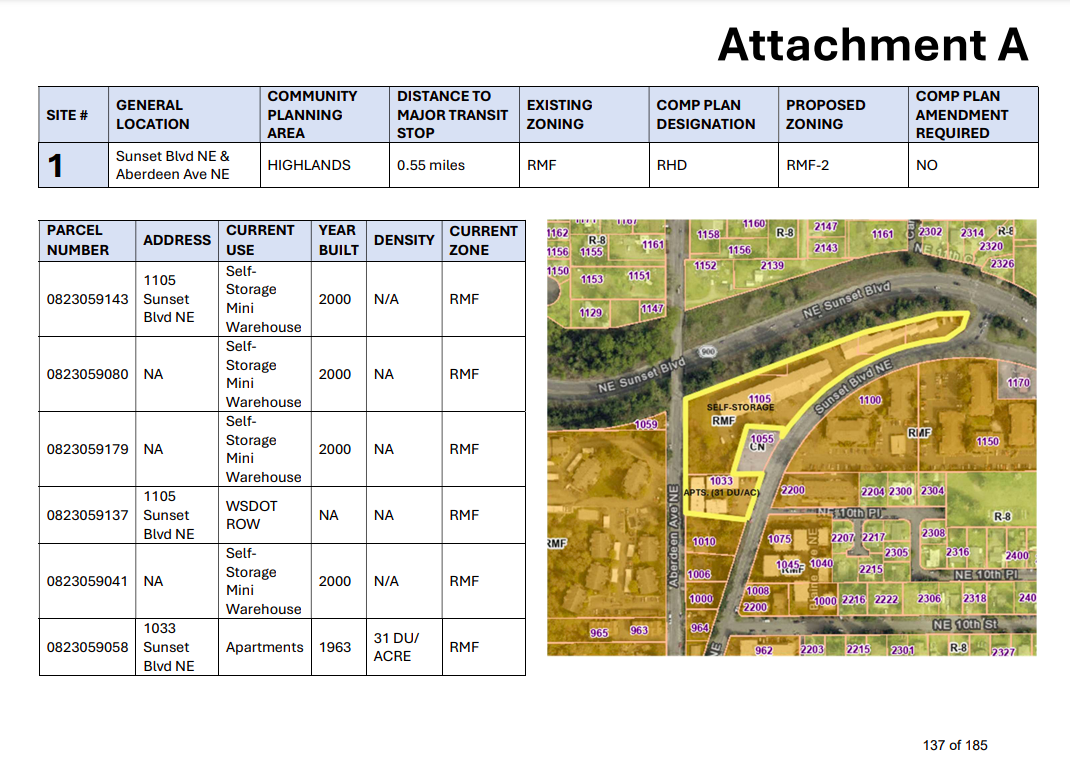
The Self Storage next to Christy’s Bar and Grill on Sunset was rezoned for 40 apartment units per acre as part of Site 1 of the rezone. (Christy’s zoning did not change.)
On February 23rd, Renton City Council changed the zoning on nine sites in Renton to 40 units per acre.  Most of these sites were previously zoned for 10, 14 or 20 units per acre.  Since they are largely already developed, its expected that they will be slow to redevelop.

However residents should be aware that they can now be legally developed at 40 units per acre. And since they are within a mile of a transit stop, the parking requirement may be as little as one car per unit, or even less.

I’ve included the details for Sites 2-9 below the cut, as well as the ordinance that was approved.


See the information for sites 2-9 by clicking below:

Continue reading →

Williams/Wells 67th change order and fees will cost Renton another million dollars

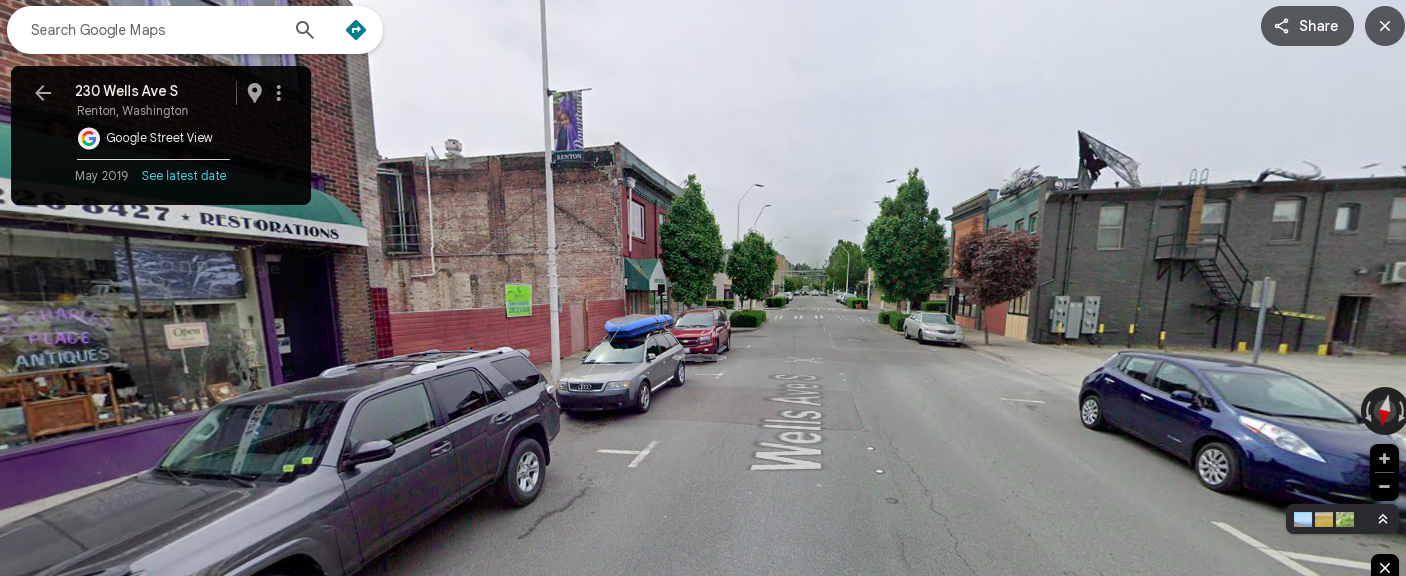
Wells Ave in 2018, with both travel lanes heading northbound (Photo from Google Maps)
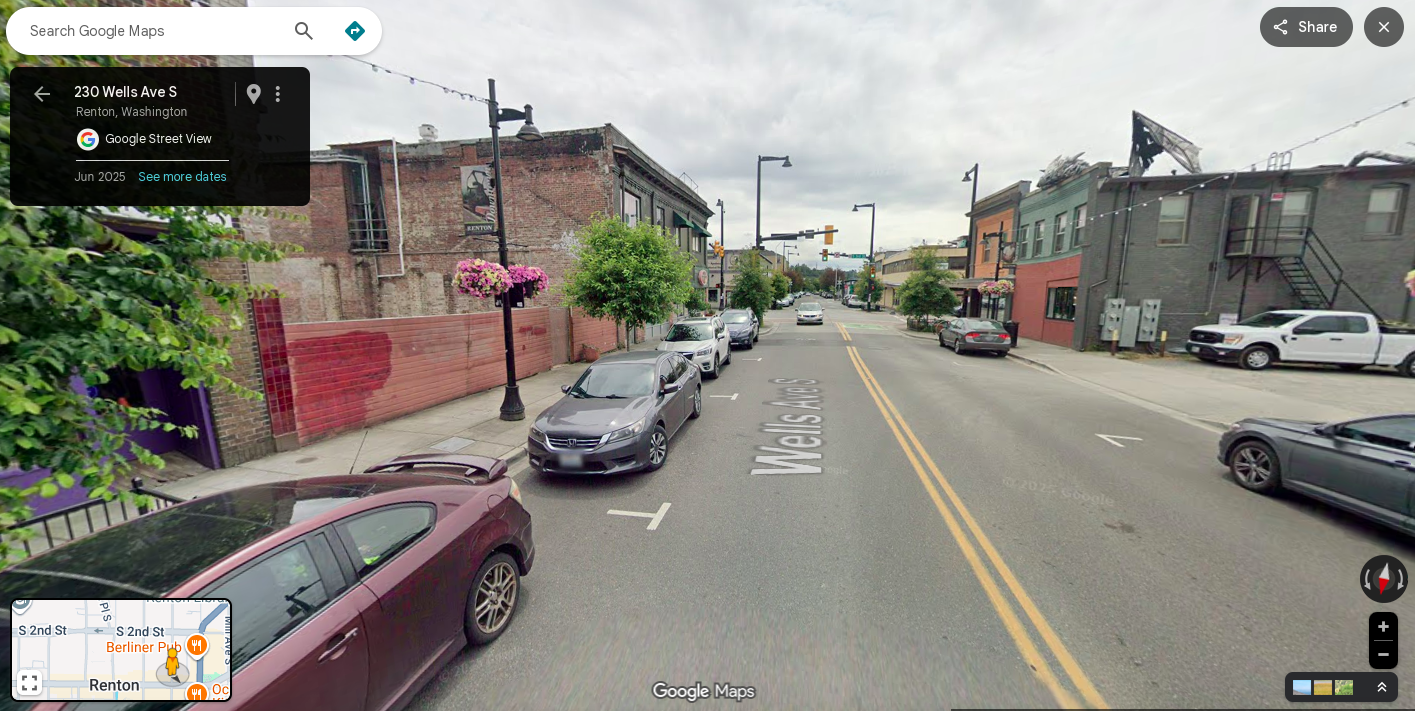
Wells Ave as it appears in Google Maps today, with two-way traffic

The Williams/Wells two-way street conversion was completed over a three year span from 2019 to 2022.  The work included intersection improvements and new utilities and sidewalks on sections of Williams and Wells,  as well as sections of South Second and South Third Streets. The project suffered several long delays, primarily from an evolving work statement and pandemic-era material and labor shortages. Our long-time Public Works Director retired in February 2020, and the project leadership went to Martin Pastucha, Renton’s current Public Works Director.

As the project overran the schedule, the costs ballooned.  The contractors began submitting dozens of change orders to cover the changing project requirements, and cover their expenses that came from delays they felt were outside their control.

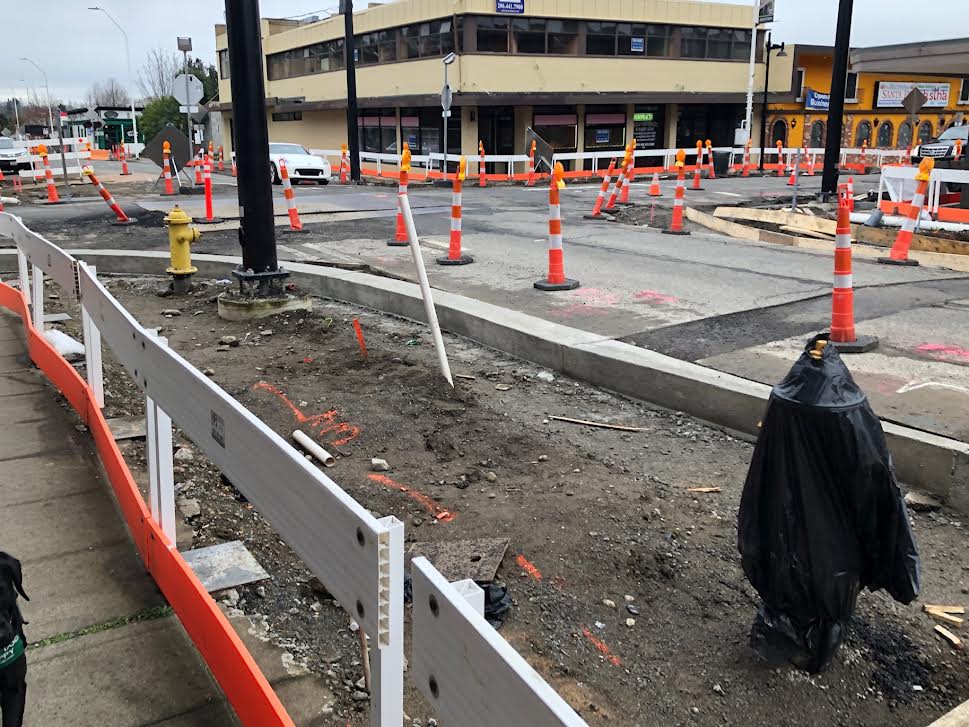
This 2021 photo shows the worksite at the intersection of Wells and South Third Street during the Williams/Wells street conversion.  Impacted businesses begged the City to get the project done as quickly as possible. (Personal photo)

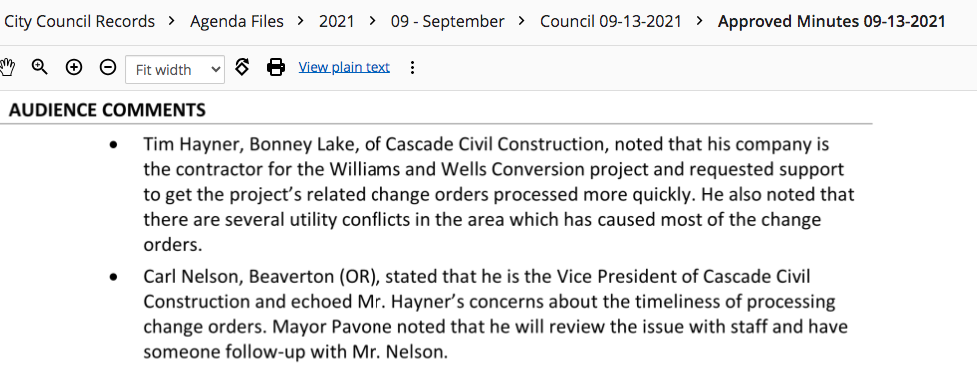
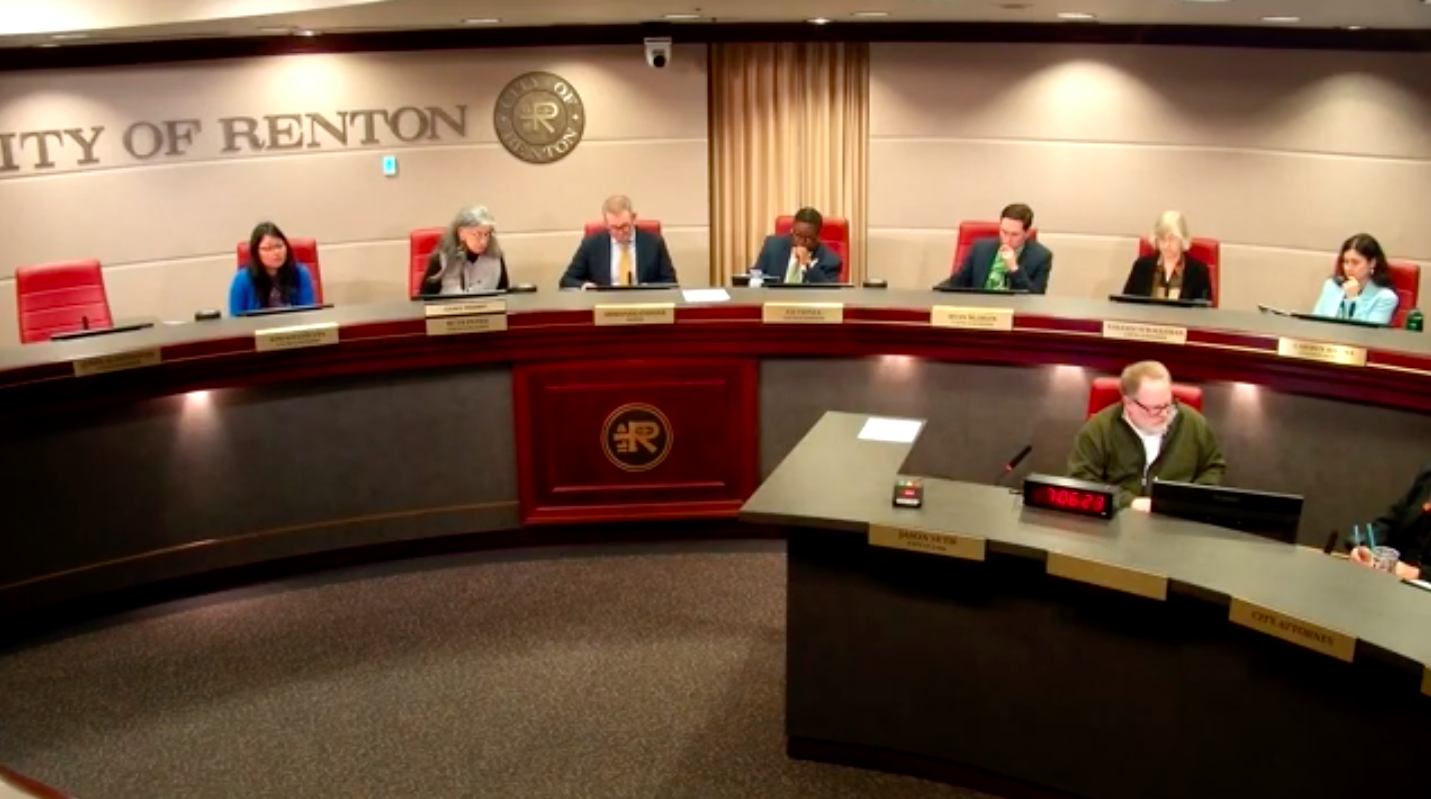
In late 2021, two representatives from the prime contractor, Cascade Civil Construction, attended (via Zoom) a Renton City Council Meeting to let the Council know that they did not feel that change orders were being approved quickly enough.

In 28 years on Council, this was a first for me; I didn’t remember ever having seen a contractor attend a Council Meeting to complain about slow approval of change orders.  After the meeting I was informed by staff that the issue was a misunderstanding, and would soon be handled. (I was only on Council for three more months before my final term came to a close.)
The Renton Council Minutes from September 9, 2021.

The change orders continued piling up into 2022.  While the initial agreed contract amount was $7,733,422, sixty-six total change orders increased it to $10,424,543, a 35% increase.

But it was not over even after the construction dust cleared.  Cascade Civil Construction and the City of Renton fell into a dispute over an additional half-million to one-million in costs, and both sides began paying attorneys.  Renton employed Perkins Coie in addition to paying City attorney staff.  Both sides finally hashed out the final Change Order number 67 at a settlement conference, which will bring the contract to a close.

At the February 9 Council Meeting (three weeks ago), the Council approved this $602,390 change order, along with approving $304, 826 recently paid on the contract.  There are also other fees associated with the settlement, including attorneys fees and recording fees, which added up to accrued 2025/2026 costs of 1.25 million dollars.  By my calculations, the amount going to Cascade Civil Construction will bring their total up to $11,026,923, or 43 percent over the original contract amount.

The Council passed a motion at the February 9 Council Meeting to add an extra $1,000,000 to the Williams/Wells conversion project fund.

In another recent blog post I described how 56 change orders on the Rainier Avenue Project took it 29% over budget, and recommended Renton perform an after-action review to find ways to reduce these change orders on future projects. The Williams/Wells project could be included in this review.

Below the cut I’ve posted the agenda bill and settlement documents that the Council approved for Williams/Wells at the February 9 meeting.

Continue reading →

Public safety concerns continue at derelict Park Avenue building

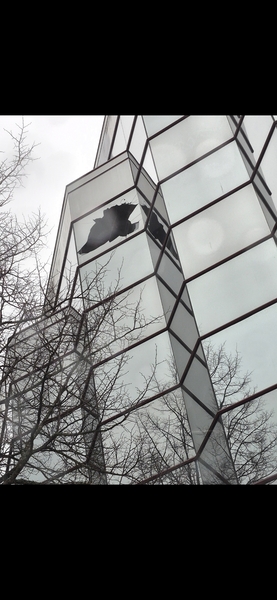
Even while the owners of Renton’s Garden Plaza have been demolishing the three-story 500 Park Avenue building and unveiling plans for it’s replacement, the seven-story building on the site continues to be a danger.

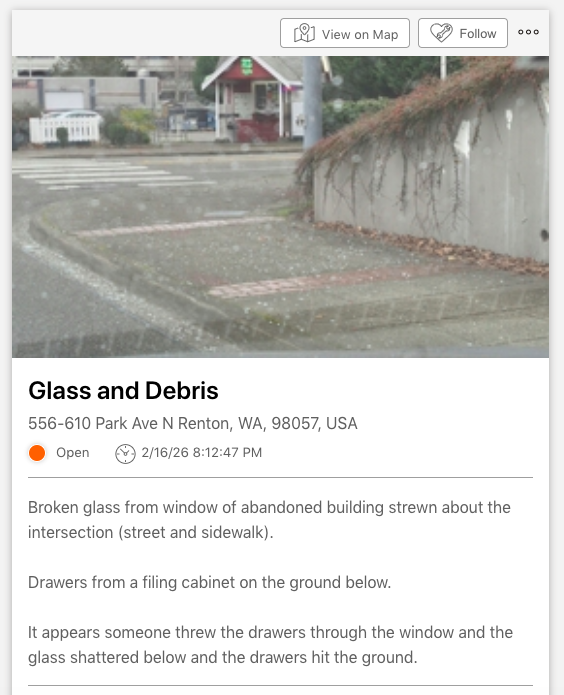
The City has told the public that this property has been secured, and that there are workers in this building preparing it for demolition. The City has said they are monitoring progress daily.  But a “Renton Responds” complaint filed last week leaves doubt.

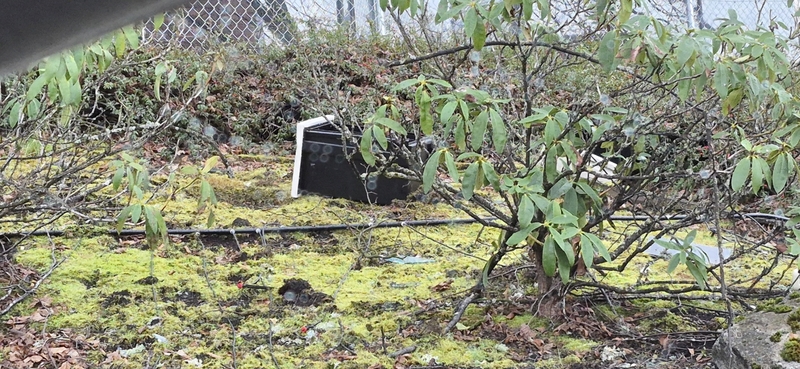
Unless the workers are throwing drawers through plate glass windows on Park Ave (probably not), there appears to be a continuing presence of intruders who are putting motorists and pedestrians in danger with thrown objects.  Unauthorized occupants also continue to put the city in danger of fire, since the seven-story building lacks its required fire protection systems.  And they put themselves (and potentially their emergency rescuers) in danger, as open elevator shafts and other hazards on the site put anyone at risk who has not had site briefings and is not wearing OSHA-specified protective equipment.
I’ve seen Renton residents threatened with $100 per day fines for such minor transgressions as not cutting their lawn for a few weeks or not painting over someone else’s graffiti on their fence for a few days.  For these small (non-safety) code compliance actions to be taken seriously in the future, the city must demonstrate they won’t continue to show favoritism to an out-of-town property owner who lets broken windows rain down on our public streets and sidewalks.


ION Renton proposes apartments at Park Ave demo site, but their cost projections seem optimistic

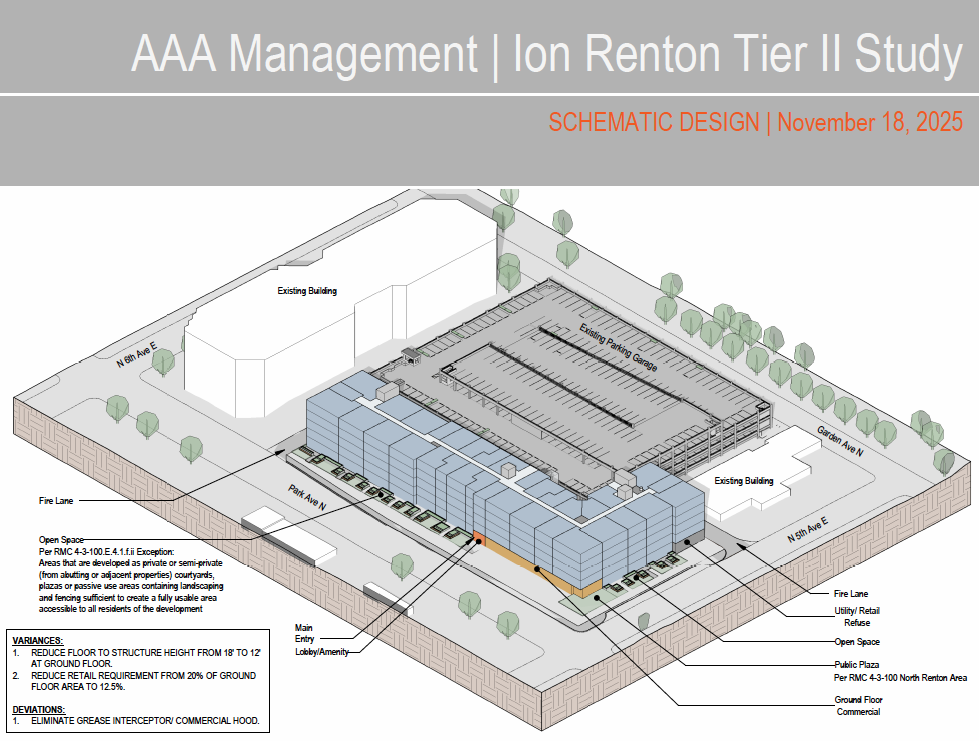
Conceptual plan for phase 1 reconstruction at 500 Park Avenue North, From ION Renton’s Pre-Application Package

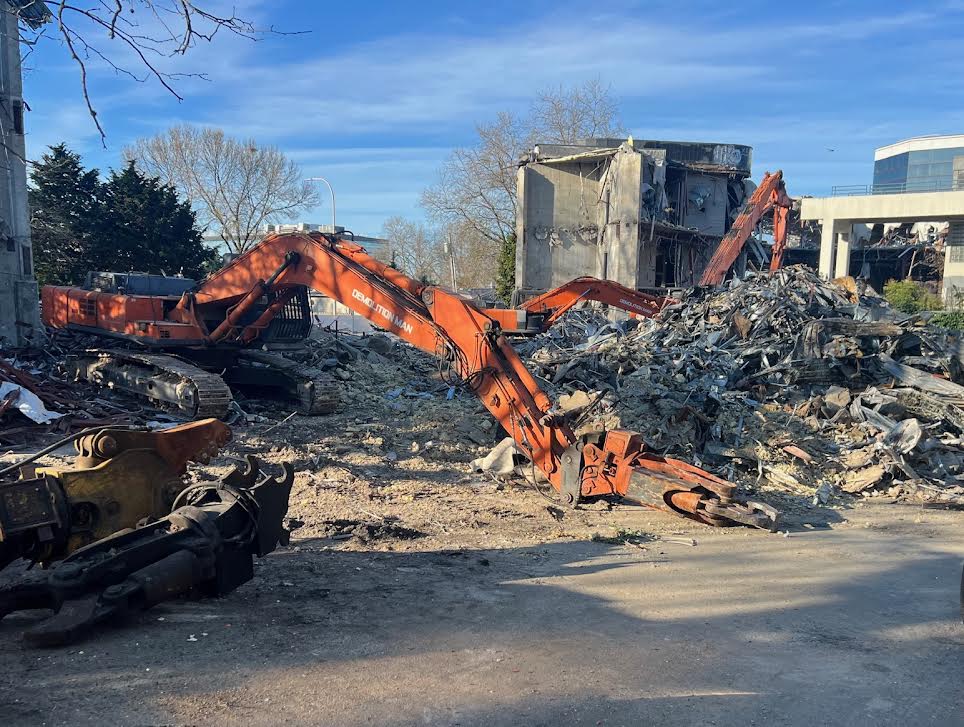
After more than two years of amassing fines and complaint letters, ION Renton presented Renton officials with a peace offering this past holiday season.  In November they  let the City know they were serious about getting started with the demolition of the smaller of the two abandoned buildings, and they offered preliminary concepts for a first phase of redevelopment of the site.  Residents and nearby businesses have been glad to see the three-story derelict 500 Park Avenue building finally coming down.

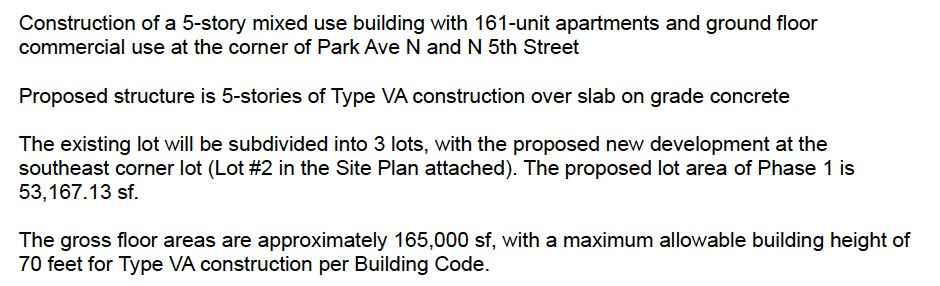
ION Renton has provided the City with a preliminary proposal for phase 1 construction at the Park Avenue site where a derelict office building has been removed. Type VA construction is wood frame with 1-hour fire resistance. (From ION Renton project narrative)

ION Renton’s proposed replacement is still preliminary, and has not been widely advertised. I only learned these details from reviewing public records regarding potential upcoming Renton projects.  ION Renton’s proposal was prepared for a pre-application meeting, which is a fact-finding introductory meeting where a developer gets advanced input from the city.   It would not be fair to be overly judgemental at this early stage, but helpful input is valuable.

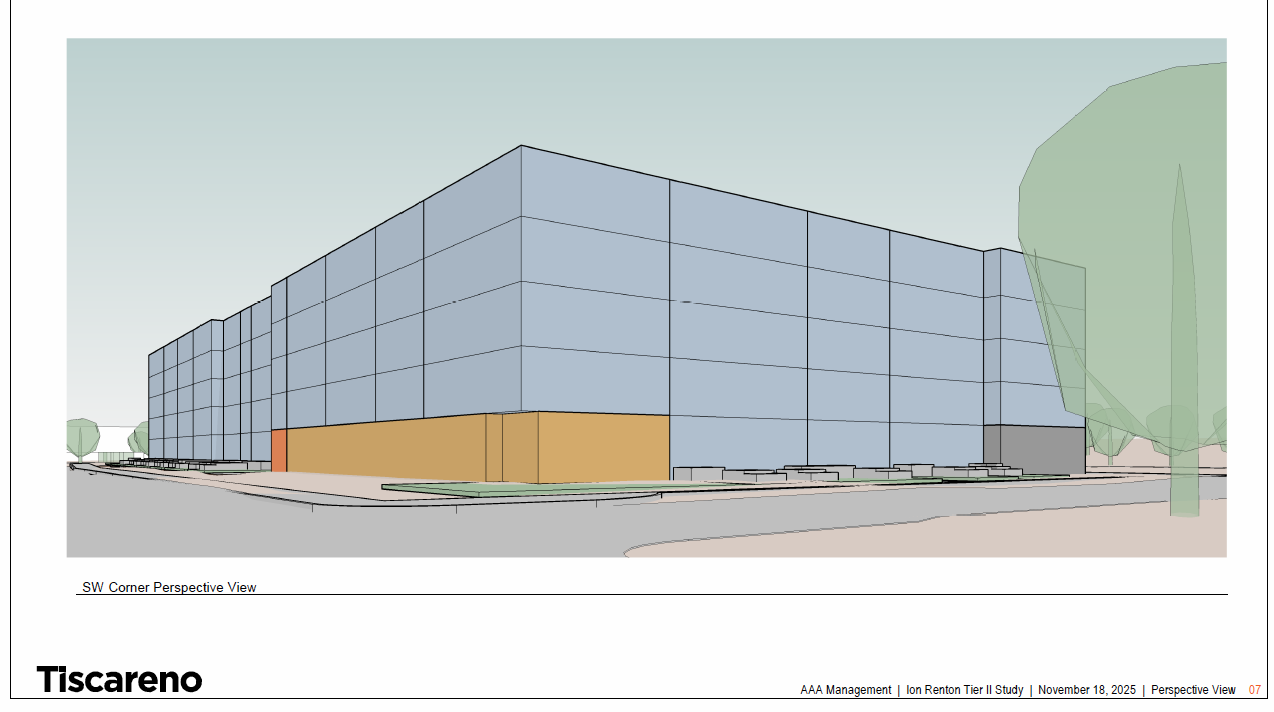
A conceptual view from North 5th and Park Ave North.  The orange is commercial storefronts, and the blue-gray is apartments. (From ION Renton’s pre-ap package)

From my experience, I think their mixed-use (mostly apartment) proposal fits the existing zoning and could possibly work at this location, but I am concerned that ION Renton has significantly underestimated the costs of construction. I also have some design suggestions and want them to keep more trees.

ION Renton is proposing a 165,000 square foot project with an estimated construction cost of  $30.6 million, which works out to be about $185 per square foot.  Apartment construction can easily cost $300-$500 per square foot in our area, potentially double the estimate they submitted.  Looked at another way, they hope to build 161 apartment units ranging from 1-3 bedrooms for about $190,000 per unit (based on $30.6 million  construction, plus about $4 million for the land, minus about $4 million to be spent on retail space instead of apartments) . Building apartments for $190,000 each would be an amazing achievement, and it doesn’t seem possible these days.  For comparison, Renton Housing Authority’s 2021 Sunset Oak project created 60 units for $26.6 million, a per-apartment cost of  $443,000.   ION Renton will currently need to pay mitigation to Renton for Transportation, Parks, Fire, and Schools, and utilities which could add up to $20,000 per unit just in fees.

Cost estimates from ION Renton project narrative

And the construction costs could go much higher depending on the environmental cleanup effort that would be required.  The Department of Ecology had determined this previously-polluted site had been sufficiently cleaned up to support office use by their 1970s-1980s standards.  But Ecology’s residential pollution standards are more rigorous than office standards, and their 2026 standards are more strenuous than they were four decades ago.

Renton’s staff review at the pre-application conference addressed this with a broad brush by simply noting the project was “pending environmental review.”  My experience says any significant soil cleanup could add millions in costs and years of flowtime to the project.

Hopefully ION Renton is just coming in optimistically about these low costs while preparing for potentially more realistic costs.  Who doesn’t like an optimist, right?

Aside from my concerns about costs, their proposal to build multifamily housing seems like a reasonable use, with a few comments/suggestions of my own: demolish the 7-story building before they construct any new apartments to avoid dropping glass and concrete on the work site;  add details to the final proposal that create nice street frontages and sidewalk connections (which is required by the zoning); save more of the trees, and find a location on the broader site to replant the trees they are removing.

In conclusion, I’m glad ION Renton is finally getting some of the demolition completed, and kudos to them for bringing a proposal forward for more needed housing.  While ION Renton should have kept the office buildings in operational condition until the company was prepared to demolish and rebuild, I wish them success in achieving their vision for mixed use on their site.  It will still be a long process for them to achieve approval and a viable financial plan, so they must remain focussed on completing the demolition of the seven-story building and making their property safe and presentable until building permits are issued.


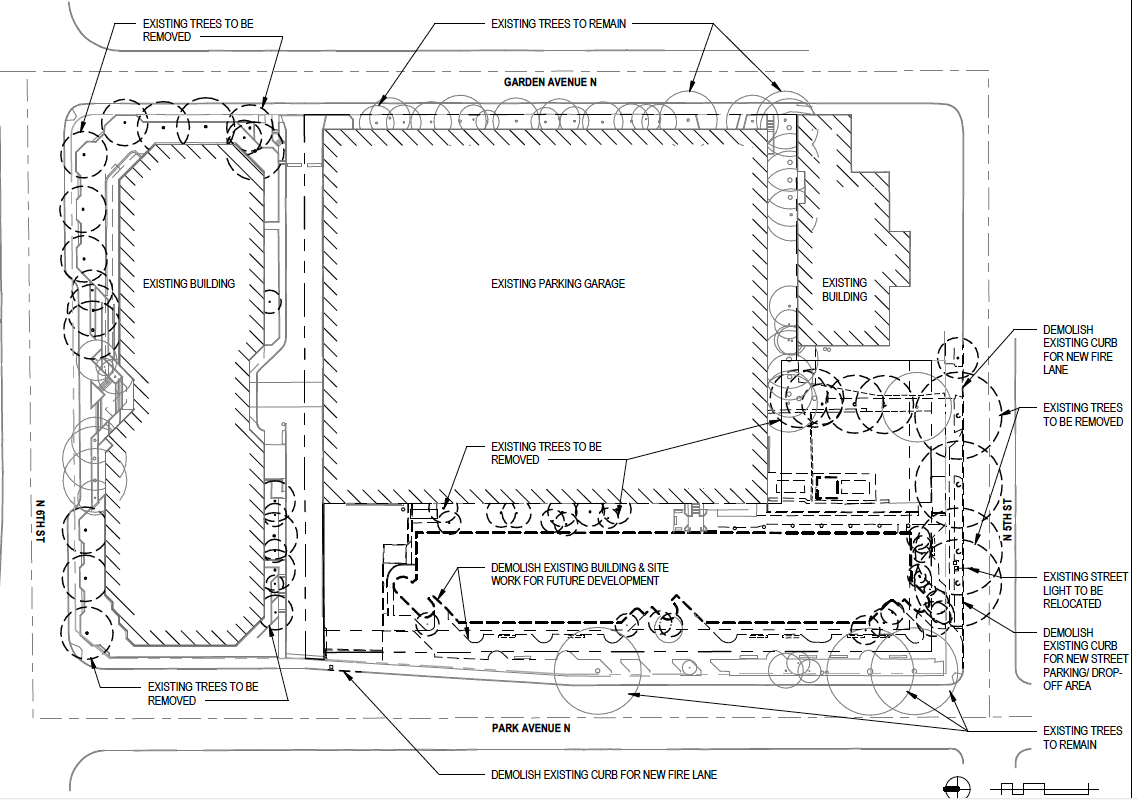
Site plan showing trees to be removed and trees to be saved, from ION Renton’s pre-ap package


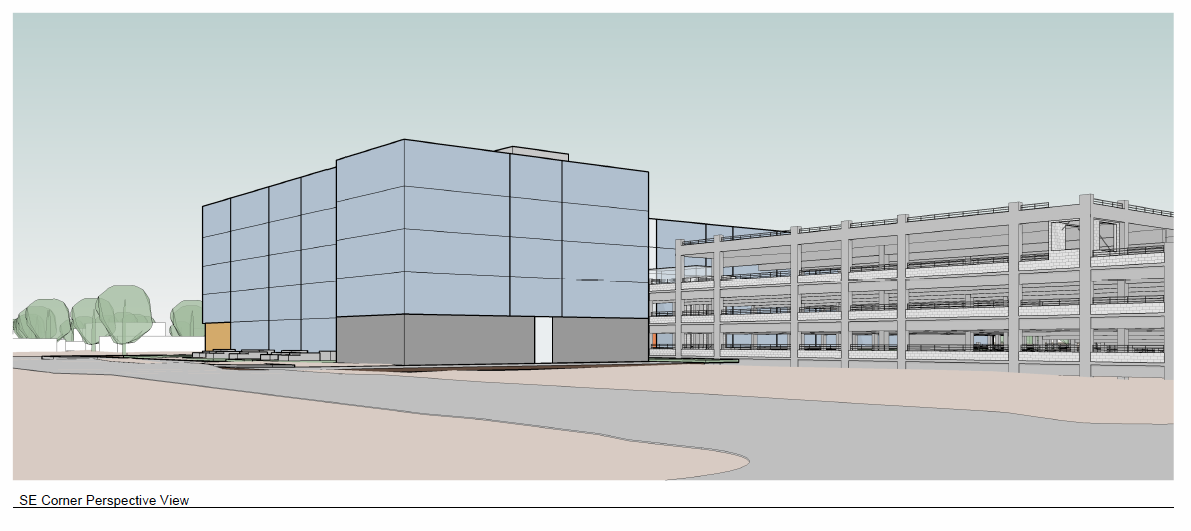
The conceptual view from North 5th, showing the building’s connection to the existing parking garage. From ION Renton’s pre-ap package.
The remnants of 500 Park Avenue North (a building I used to have an office in). This building would be replaced by the mixed use apartment/retail project.
These trees between the demolished office building and Park Avenue North would be removed by this proposal
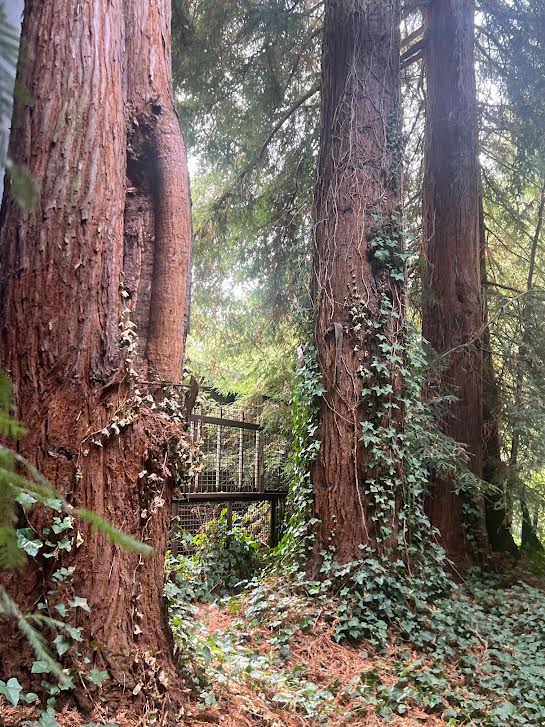
Saved: these large redwood trees between the garage and the adjacent Metalcraft Fabricators would be protected under the ION Renton proposal.  (Trees near the Garden Avenue side of the garage would stay, and trees near Park and North 5th street would be removed.)

Before and after Renton’s Piazza Park

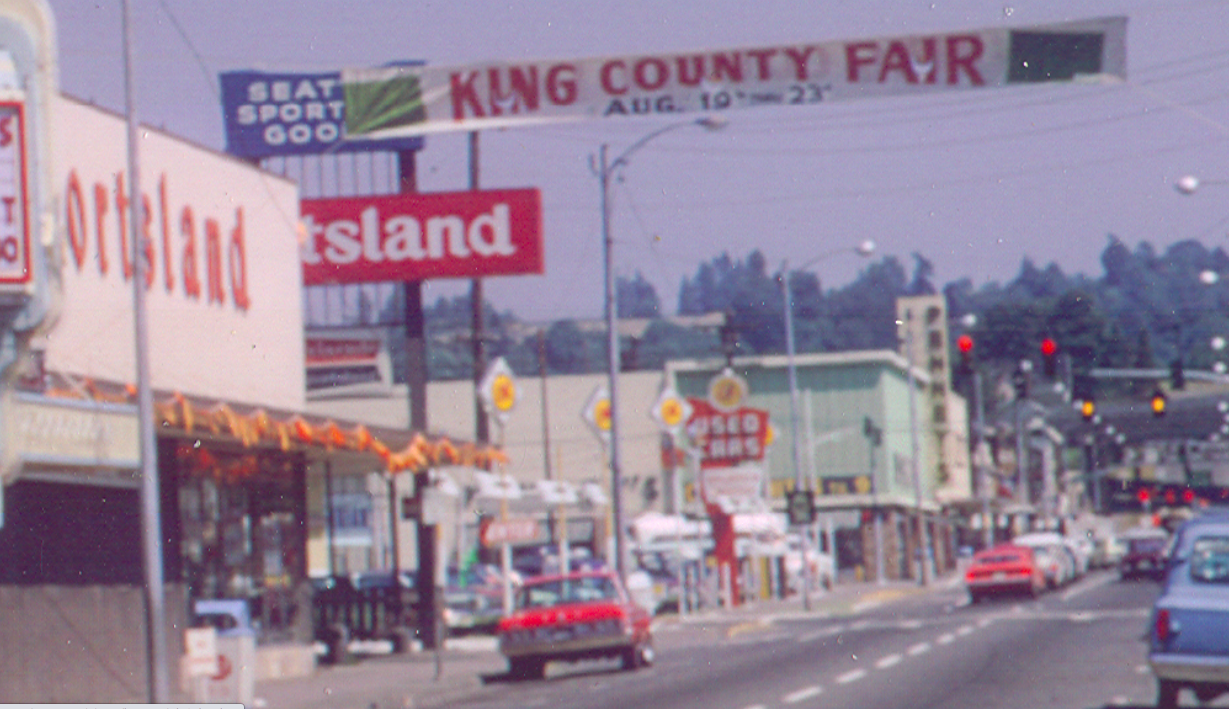
This was the 1970s view on Renton’s South Third Street, about three decades before we purchased the car dealership and and the Sporting Goods store (on the left) for park use. (Photo credit Renton Historical Society)


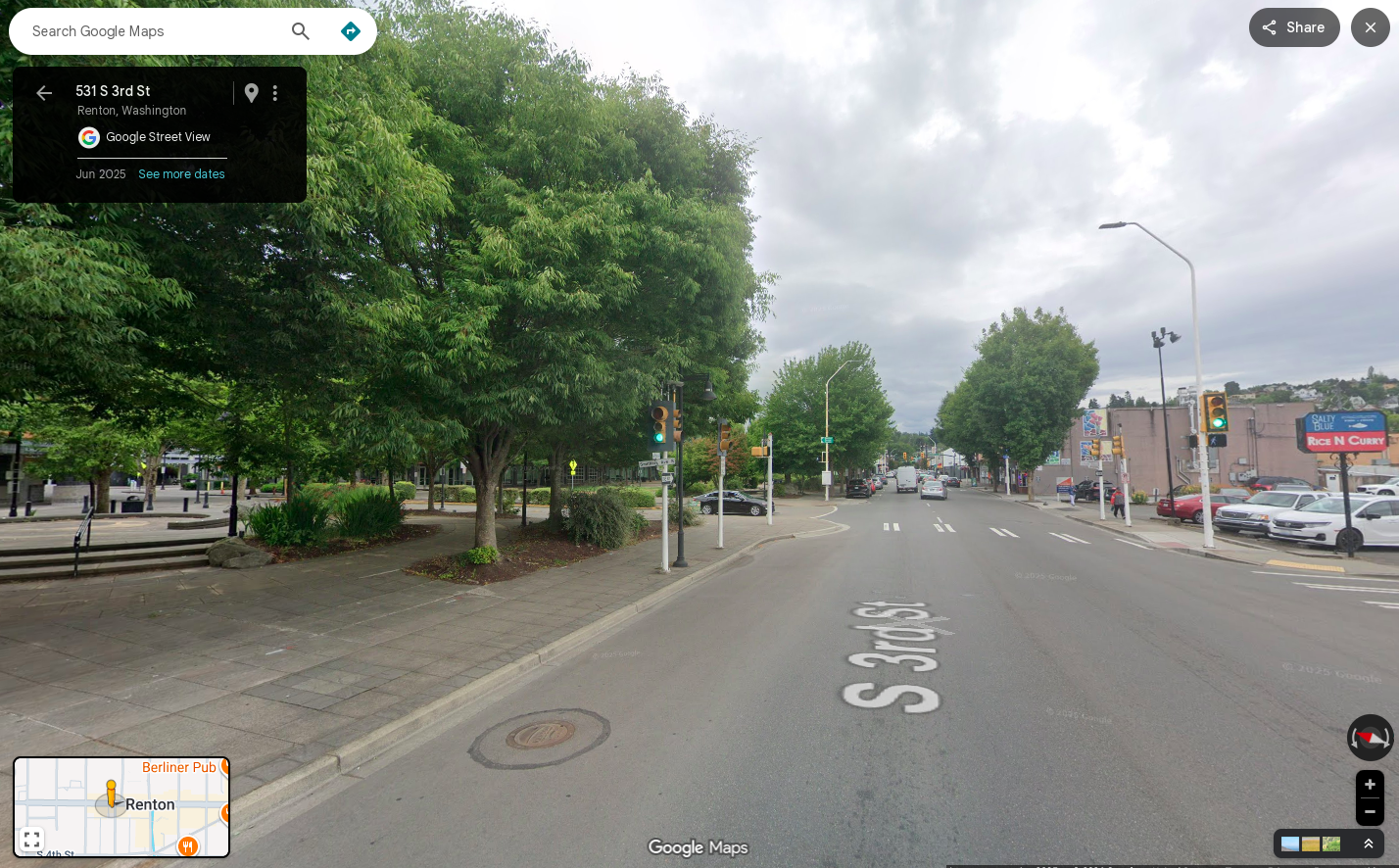
This is the same location 55 years later, about two decades after we purchased and planted the Piazza and Gateway Park. (Photo credit Google Maps)

In my second term on Renton City Council I helped tip the scales in a 4-3 vote to purchase a car dealership in downtown Renton, and build the Piazza Park and Pavilion Event Center.  All seven councilmembers and the Mayor were soon on board, creating the beautiful garden-style Piazza Park Renton has been enjoying for the past 25 years.  We tore out the dealership parking lot, and added pretty stained-concrete patios, lawns, trees, shrubs and benches. We incorporated two impressive water features into the new park: a formal cascading fountain and a 40-foot babbling stream.  We eventually acquired the aging sporting goods store as well, giving us space for Gateway Park and food trucks, and room for another future building which several of us thought might be a public arts and crafts studio and market.

On May 14, 1997 the Seattle Times published an article titled  “Is Jet City Finally Taking Off? — Projects Bringing New Look To Blue-Collar Hub”

“Renton, the little city with industrial shoulders on Lake Washington’s southern shore, suddenly is on the verge of coolness.”….“To help, the city is building a 1 1/2-acre plaza in the heart of town scheduled for completion next spring. The Piazza Project, at Burnett Avenue South and South Third Street, will anchor downtown businesses and provide a focal point with benches and trees, a fountain and amphitheater.  In addition, the city will redevelop a 15,000-square-foot building on the site for possible use as a public market or festival and banquet hall.”

We also remodeled the dealership showroom into the Pavilion Event Center with the help of Mithun Architects, the award-winning firm that designed REI’s flagship store in Seattle.  The design highlighted the historic old-growth wooden bow-string roof trusses, that gave the room unobstructed space, and we surrounded the 12,000-square-foot open space on three sides with unobstructed glass. New glass “garage-style doors” could be opened by rolling them up in the summer, creating indoor-outdoor pedestrian flow.  Mithun helped us tear out the cement-slab floor, and excavate a two-foot deep crawl space in the building that allowed us to distribute conditioned air throughout the building and run electrical and plumbing, without visually impacting the open space. We topped the crawlspace with carpeted “plenum floor panels” that distributed air throughout, and could be lifted for easy maintenance of the system below. The event center brought tens of thousands of visitors per year to our downtown, many of them for the first time.

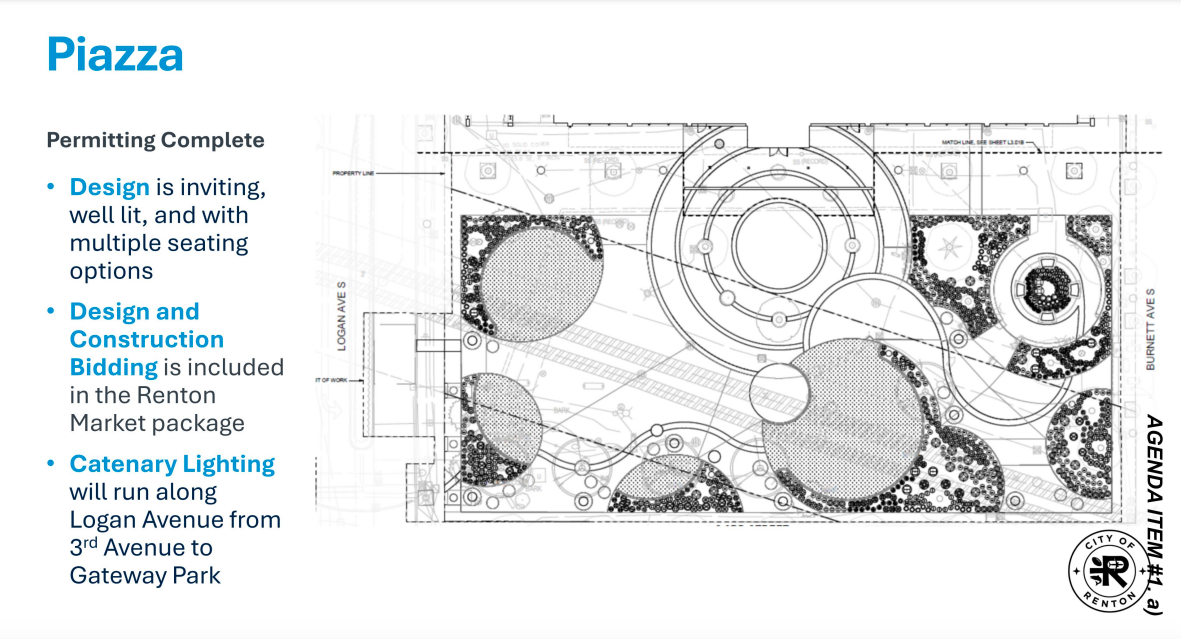
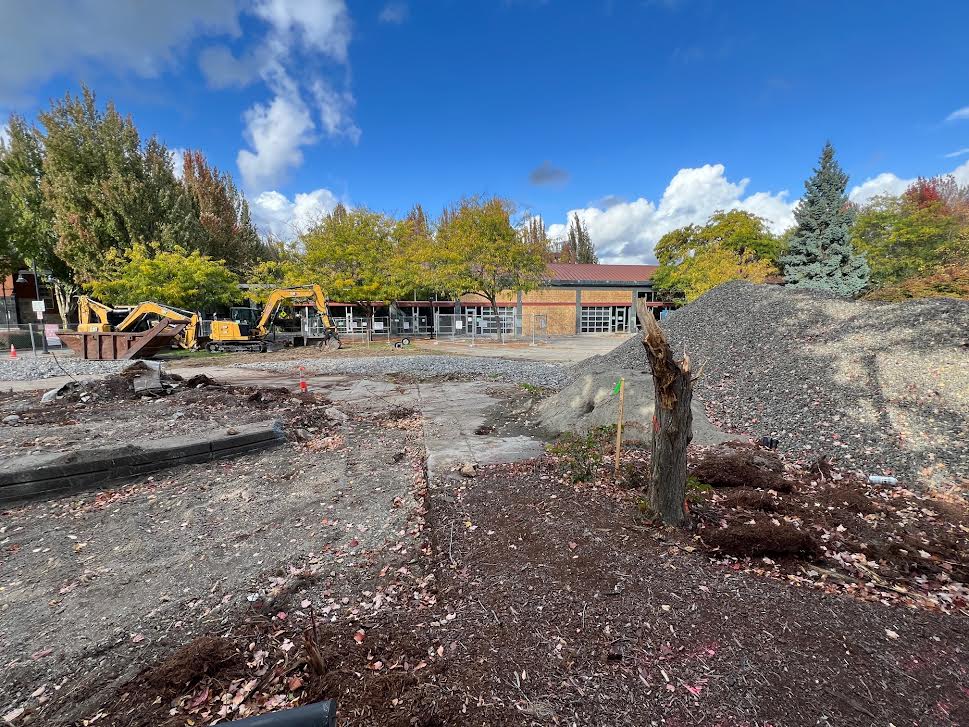
Today, the Piazza and Gateway Park are closed and torn up for construction of a mini soccer pitch, the addition of a million-dollar jumbotron  TV, removal of the water features, a modest “log-pile” playspace, the removal of  77% of the trees in the Piazza, and the addition of more Piazza pavement.  I’m personally not a fan of these changes. I actually feel like they are taking us backwards.

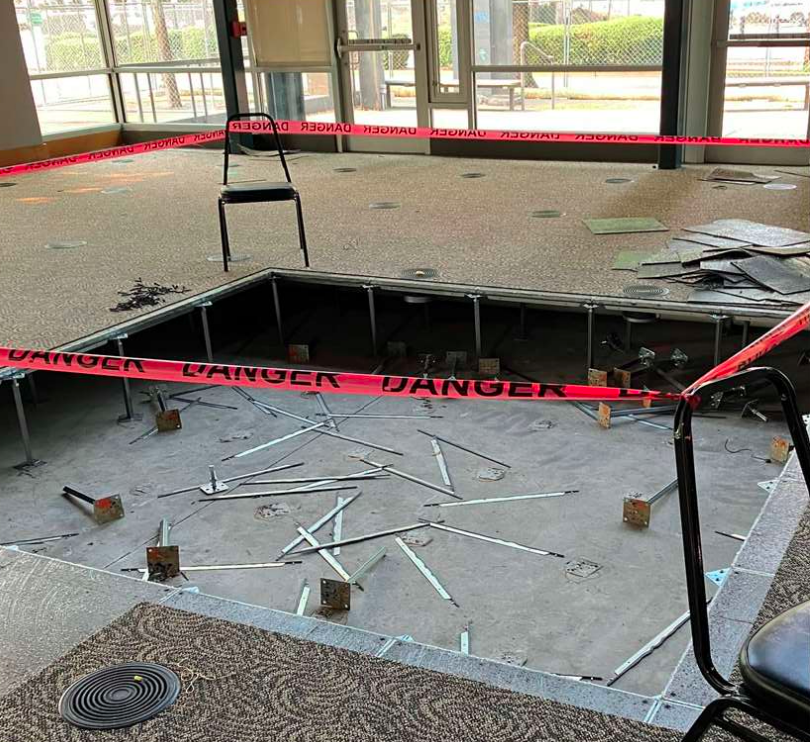
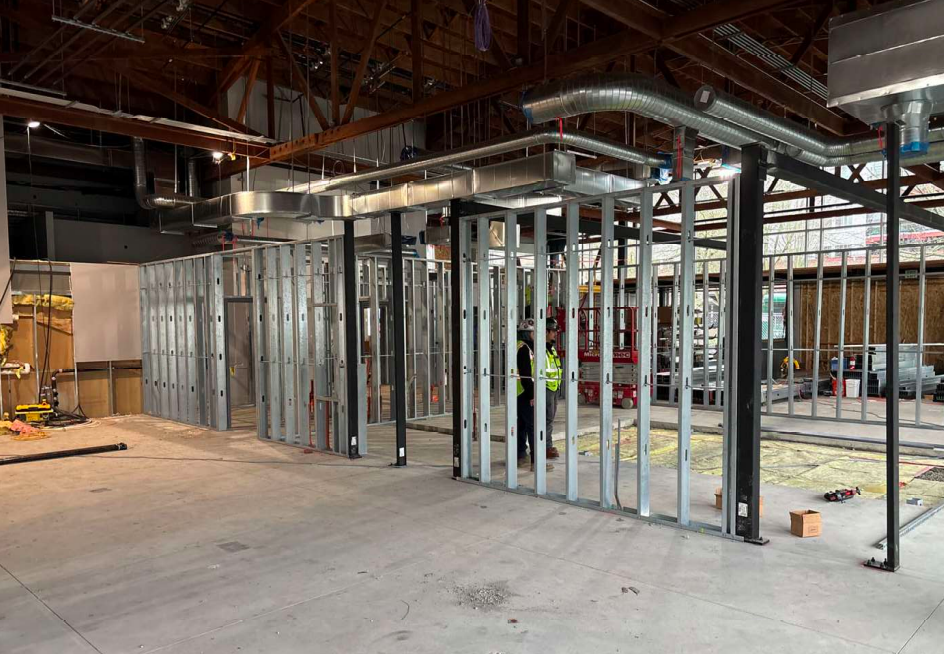
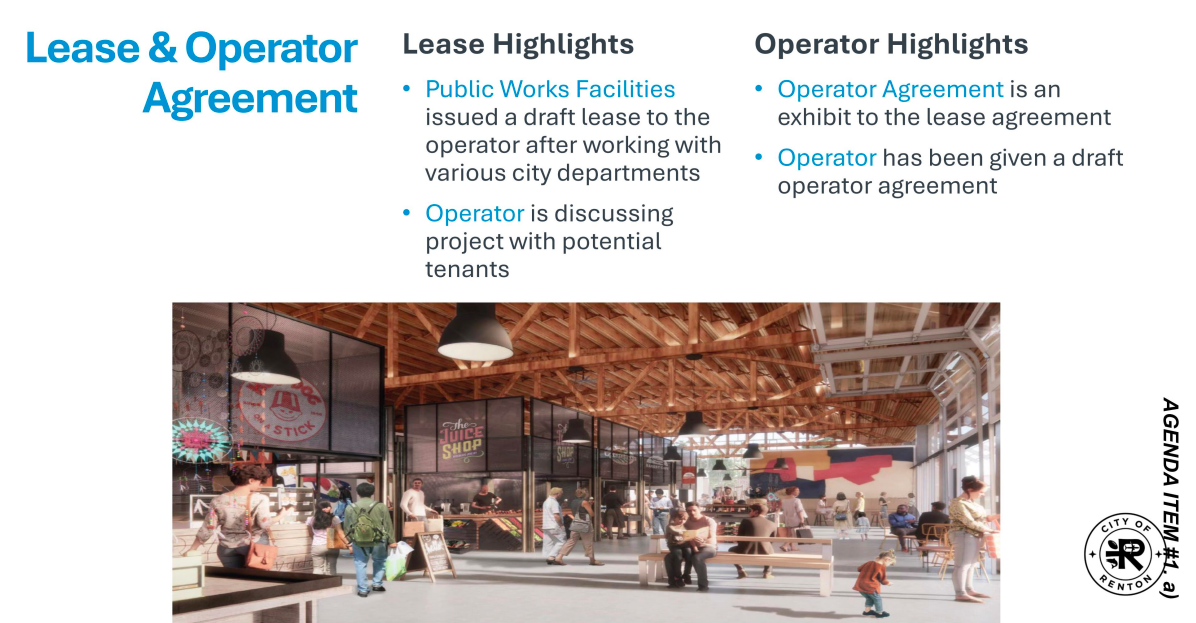
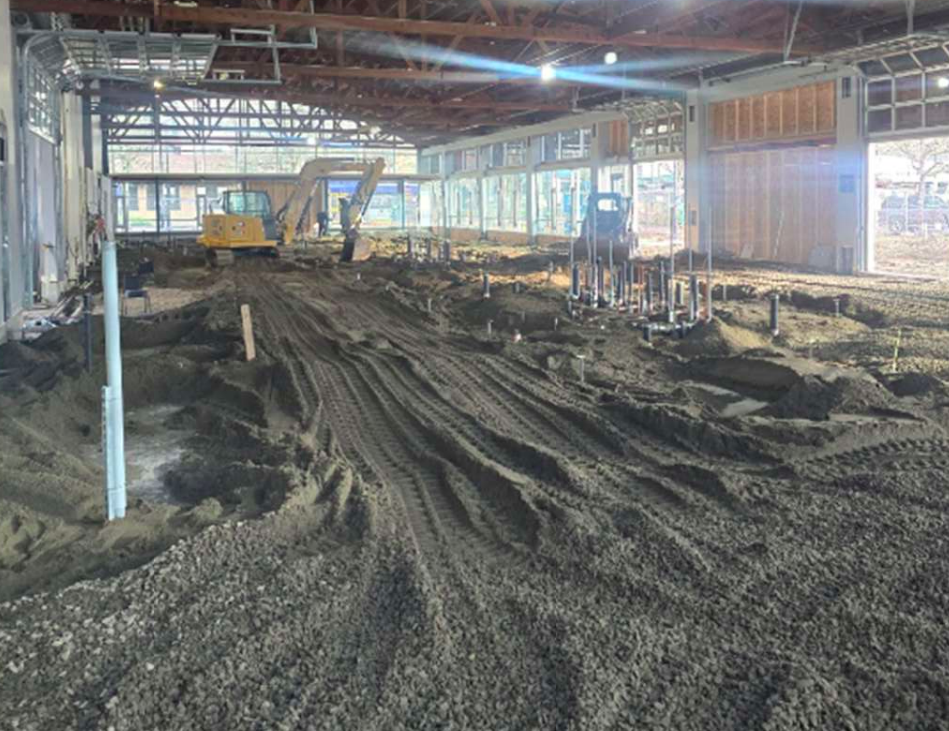
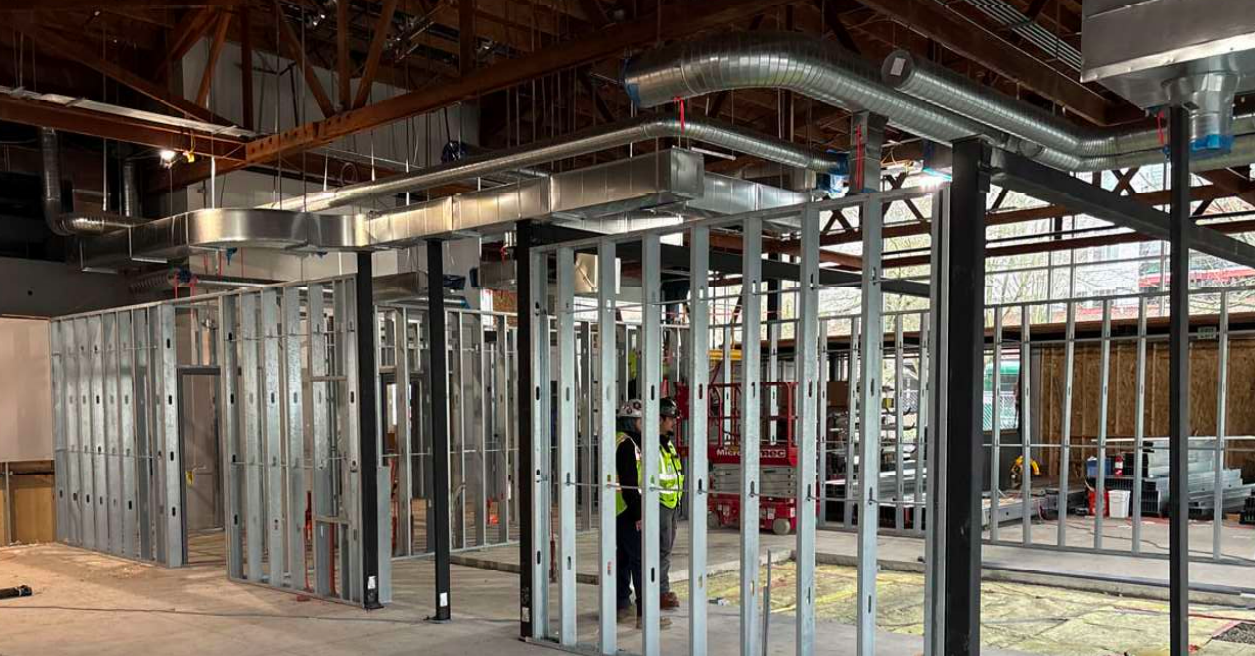
The Pavilion is also being changed, along with the Piazza.  The engineered plenum floor has been thrown away, the crawl space has been filled in with gravel, and a new cement floor has been poured.  Partition walls are being added, and HVAC equipment and ducting is being installed in the bow trusses.  The building is looking more like it did when the car dealer had it. It will host a small meeting room and still-unknown collection of retailers and venders (Hot-Dog-on-a-Stick is shown in one city chart).

All we would have to do is park some cars for sale in the Piazza, play an advertisement on the Jumbotron, and we will have come full circle.

While I would not have chosen these changes, they are well underway, so I can only hope they turn out to be popular long-term.  I ask our Public Works Department and elected officials to dedicate the time, energy and perseverance to making sure their changes are improvements, and that taxpayers get real value for the $12.8 million we are investing.  Maybe one day I’ll decide they were a good idea, but I’m certainly not convinced of that yet.

The “plenum floor” of the Pavilion has been torn out (photo from City presentation)
The crawl space has been filled in with gravel (photo from City of Renton)
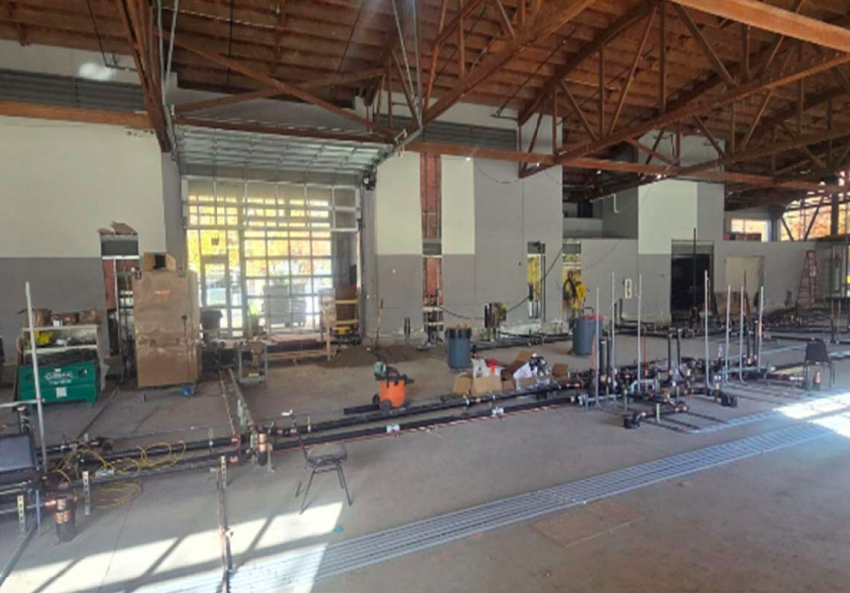
A concrete floor, partition walls, and overhead heating systems are being installed in the Pavilion (photo from City presentation)
The 40-foot-long babbling stream, trees, vegetation, and “Summer Breeze” artwork have been removed from the Piazza to make room for more pavement. (City of Renton photo)


Federal Grant terms might obligate City of Renton to assist Rain City Catering in relocating

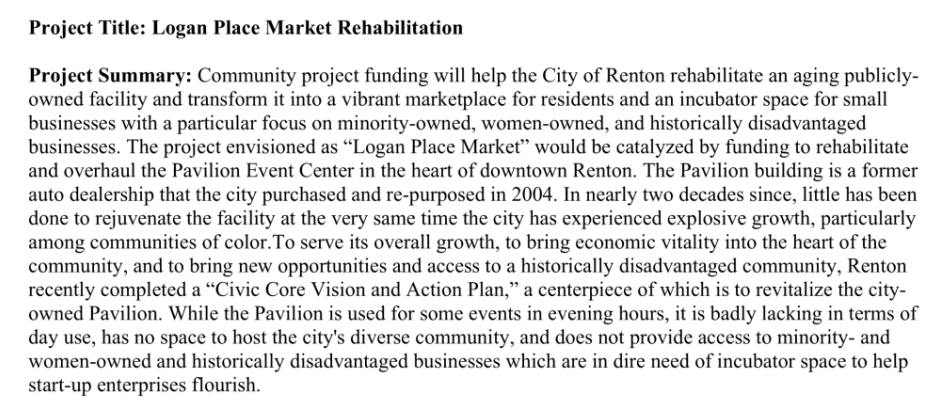
The previously wide-open space of the Pavilion building is being sectioned off by city contractors, to create a new “Market” use. A Federal Small Business Grant is helping fund the project.  The building was previously leased to Rain City Catering and used as an event center.

In a recent blog entry I linked to the Federal  “Terms and Conditions” that Renton committed to when the city accepted a $1.5 million Federal grant to remodel the Pavilion building from an event center to a market place.

The Federal document includes a commitment by Renton to help any displaced businesses with relocation costs (on page 12).  This payment could be actual costs, or a lump sum up to $53,200, at the option of the eligible business.

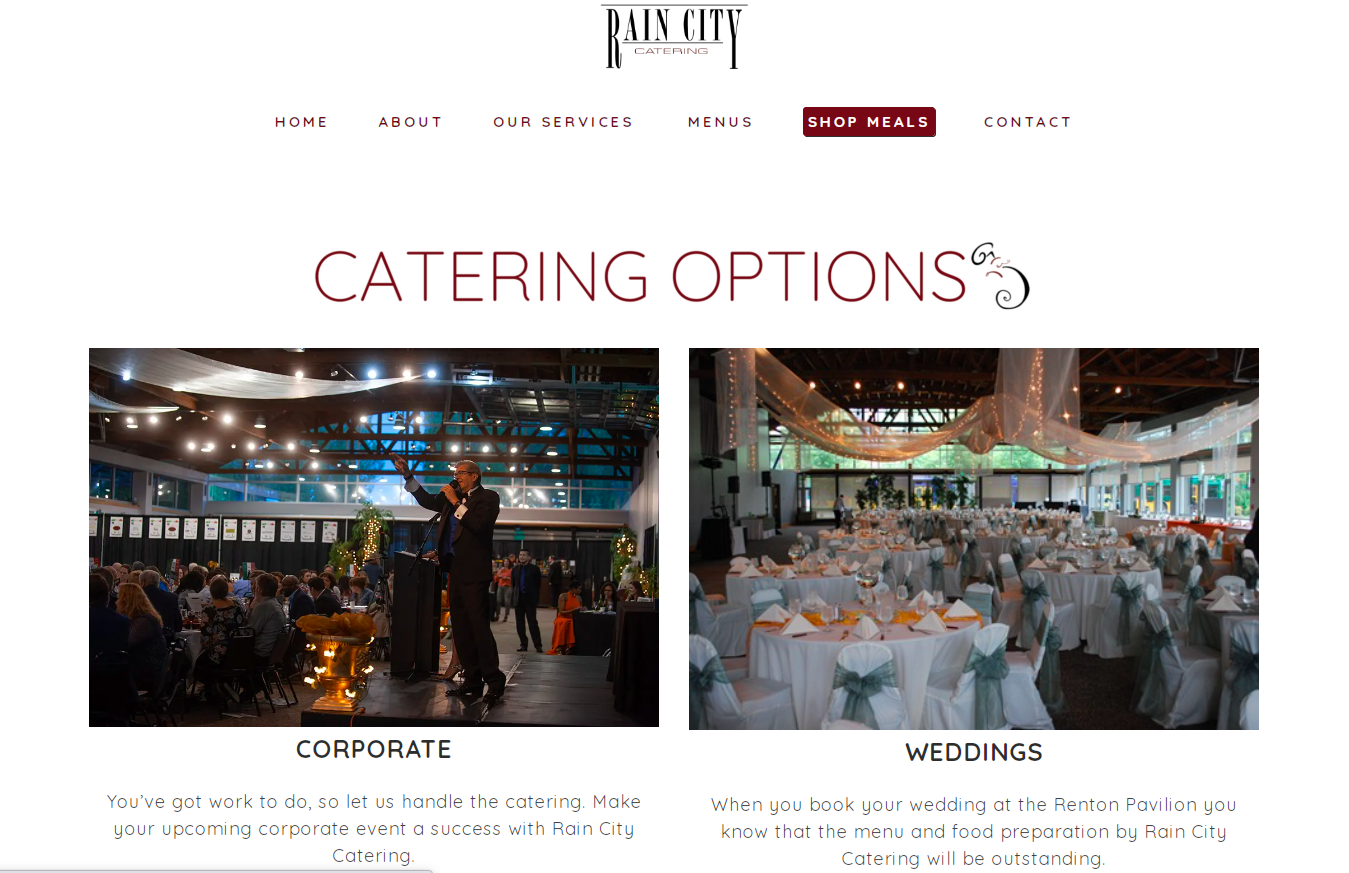
Rain City Catering leased the building for thirteen years.  Their website still features the Pavilion in it’s former event center configuration.

Rain City Catering (King County’s 2024 “Minority-Owned Small business of the Year) was running their event business in the Pavilion for about thirteen years, and then told they would need to vacate because the City was going to renovate the Pavilion into a market.

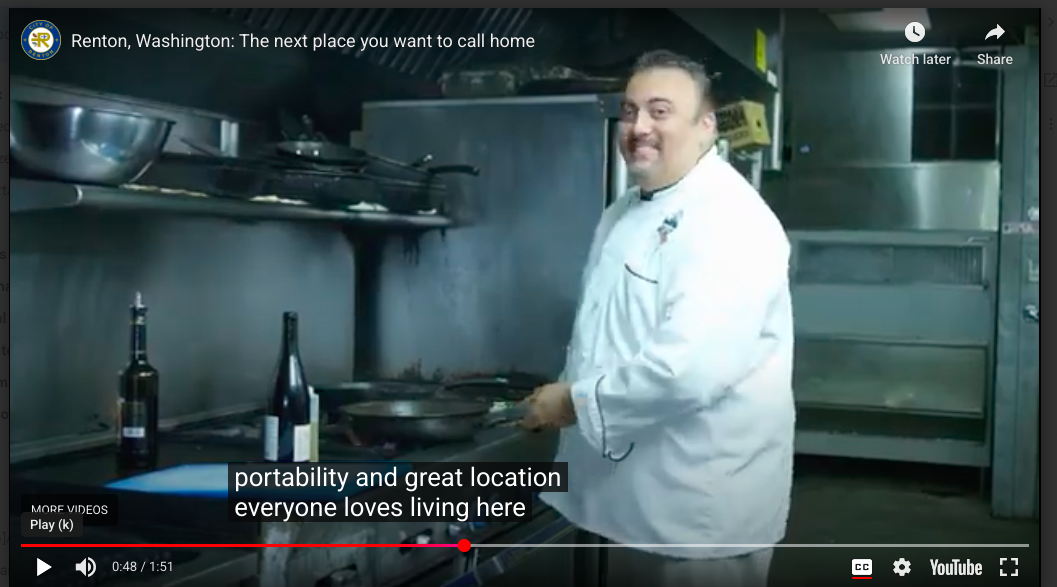
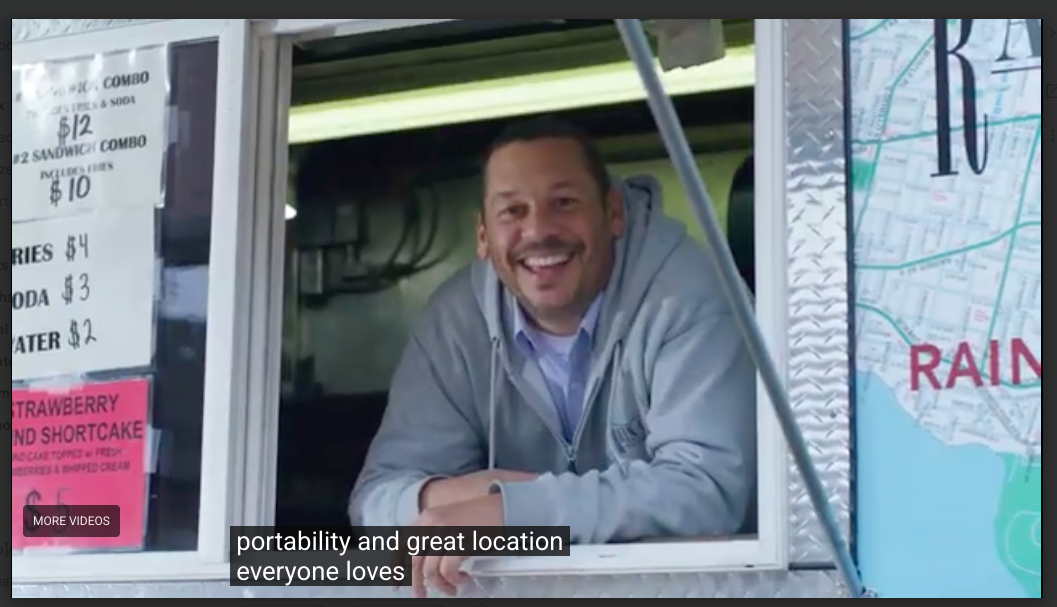
The head chef and partner for Rain City Catering provided a narration for the City’s 2020 promotional video

I contacted one of the partners in Rain City Catering, and he said he does not remember being offered or receiving any relocation assistance.  When I asked him how much he thought they had lost, he said the impact of the displacement of their business left them with canceled and lost business opportunities in the hundreds of thousands of dollars, and an abundance of expensive equipment and furnishings that they have had to dispose of at surplus (garage-sale) prices.  They have been looking (without assistance) for a new facility, and have not found one.

While I’m not an attorney, I can read regulations.  My reading of the referenced federal rules suggests that Rain City Catering should have been considered eligible for compensation.  There was a woman-owned “Night Market” operating in the Pavilion, and it’s possible the owner of that business should receive compensation as well.

The business manager and partner (and also great chef) for Rain City Catering appeared in the Renton promotional video

The City might claim that the Rain City Catering lease expired, and that is why they were displaced.  But that would distort the decision-making record and the timing of the notice to vacate. Rain City Catering’s lease expired specifically because the city was  negotiating a rehabilitation and new use for the building. The applicable regulations suggest that any person who occupies the real property and is in lawful occupancy on the date that negotiations begin for a new federally-funded use “are presumed to be entitled to relocation payments and other assistance set forth in this part…”   They also say evictions can not be “undertaken for the purpose of evading the obligation to make available the payments and other assistance set forth in this part.

Since I’m not a lawyer I’m going to leave  interpretation of the applicable regulations to the readers.  I’ve excerpted some of the key language from the Terms and Conditions of the grant Renton accepted, and the underlying federal regulation that are referenced in the grant and cover displaced businesses.  I recommend that anyone who feels they have been unfairly displaced by a federal project consider consulting with an attorney to learn what your options might be.  (Click below for the details of the regulations)

Continue reading →

Renton Council should reject renting the Pavilion below market rate

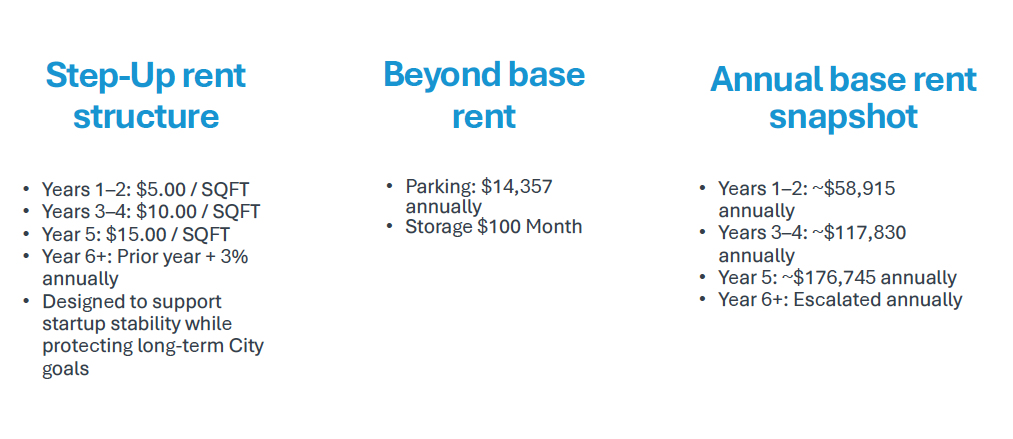
Millions of dollars in taxpayer funds are being spent to renovate the former Pavilion Event Center, including installing new plumbing to meet the specific preferences of a new proposed tenant and his subtenants. No leases are signed. The City is considering renting the newly renovated building to the private tenant/operator for $5.00 per square foot per year, increasing to $15 per year over five years. This is a fraction of the market rate. (The master tenant/operator would keep rents collected from subtenants.)
Renton Council was recently presented with these proposed lease rates for the Pavilion building. Beyond base rent the city would charge rent for 30 dedicated parking spaces at a rate that works out to $1.31 per day per space.  (From last Monday’s Committee of the Whole packet)

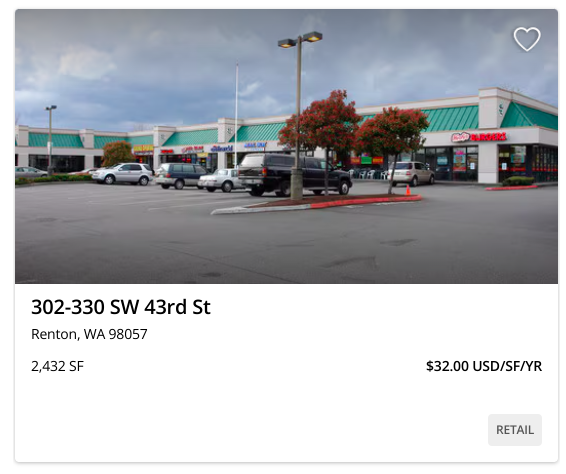
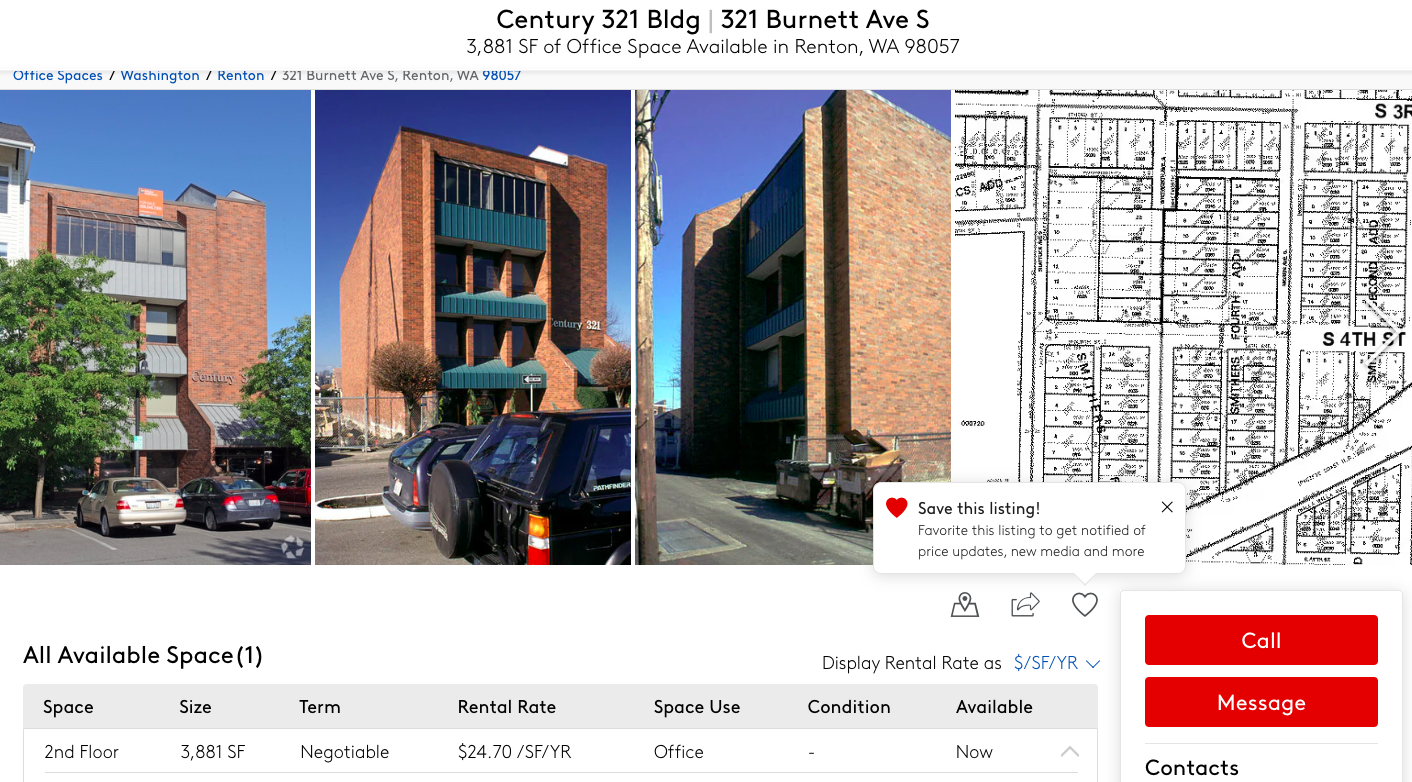
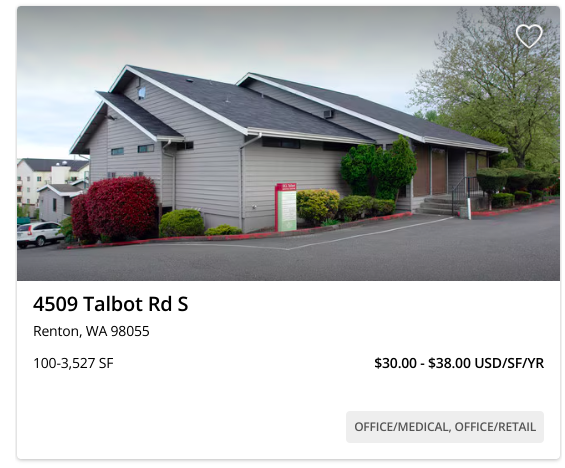
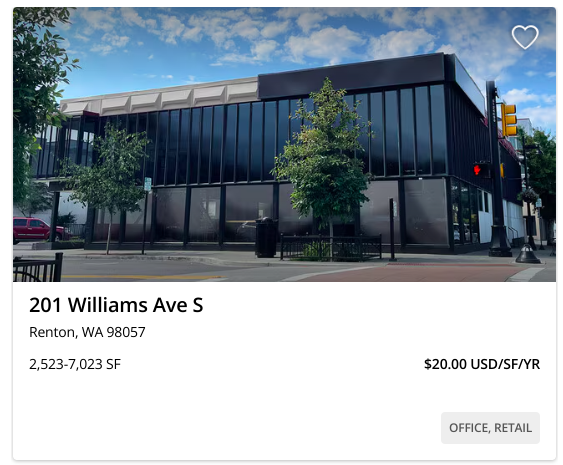
A quick check of public real estate listings shows commercial buildings in Renton, many of them decades old,  are being offered for lease rates of $20-$38 per square foot.

But Renton City Council is being asked to lease our  newly renovated Pavilion building for $5 per square foot.  The rate would rise to $15 over five years, and then 3% annually after that. Since commercial rates will also be increasing 3% per year, the Renton Pavilion will remain at about 50% market rate.

If this building was going to host a non-profit or publicly-owned “Public Market,” this lease rate would be considered highly charitable, but probably legal.  But apparently the city plan is to have a private company rent the building for this give-away price, and then let the private company keep the profits for themselves.

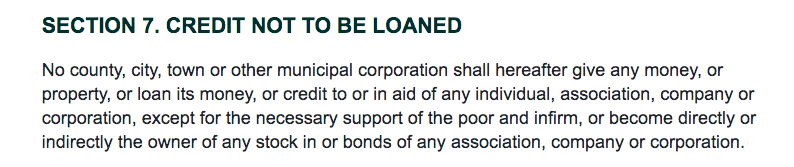
Such an arrangement looks like it violates Washington’s constitution, by using public funds to support a private business.

Washington State Constitution forbids using public money to benefit private business

The fact that the “Renton Market” sounds a lot like a desirable “Public Market” does not fix the issue.

RCW 35.92.040  gives cities Authority to acquire and operate public markets, but the city or a public corporation the city creates is supposed to operate them:

“A city or town may also construct, acquire, and operate public markets and cold storage plants for the sale and preservation of butter, eggs, meats, fish, fruits, vegetables, and other perishable provisions. Whenever the words “public markets” are used in this chapter and the public market is managed in whole or in part by a public corporation created by a city, the words shall be construed to include all real or personal property located in a district or area designated by a city as a public market and traditionally devoted to providing farmers, crafts vendors and other merchants with retail space to market their wares to the public.”

Since the City or a public agency is not operating the Renton Market, it’s no more eligible for public funding than any other business that residents might want in Renton, like a Trader Joe’s, or Whole Foods or Puget Consumers Co-op.  As much as we would like more food choices, Renton and other cities are not allowed to subsidize private companies to get them to locate here.

This Pavilion project started out in 2019 with no subsidy offered.  The Request for Proposals (RFP) made it clear that Renton would entertain proposals from private developers to make improvements to the Pavilion, paid for by the developer, in exchange for a longer lease; the developers would pay market-rate rent.  The subsidies and city-funded tenant improvements were added after the RFP bid was selected.

Taxpayer subsidies of a privately-owned “public market” have not been meaningfully discussed in open-public meetings. A true “Public Market” could be a valuable asset for the city, but the current arrangement does not have the transparent public ownership that a Public Market requires. At Monday’s Committee of the Whole, several Council Members spoke to their desire to see certain types of businesses included in the “Renton Market,” only to be told that their suggestions would be forwarded to the (for-profit) “operator” who  may or may not choose to pursue the Council suggestions.  Council was also told the operator has not yet signed a lease with the city, even while tax money is being used to customize the building to meet the operator’s desires.  This arrangement is unacceptable and should not be getting taxpayer subsidies.

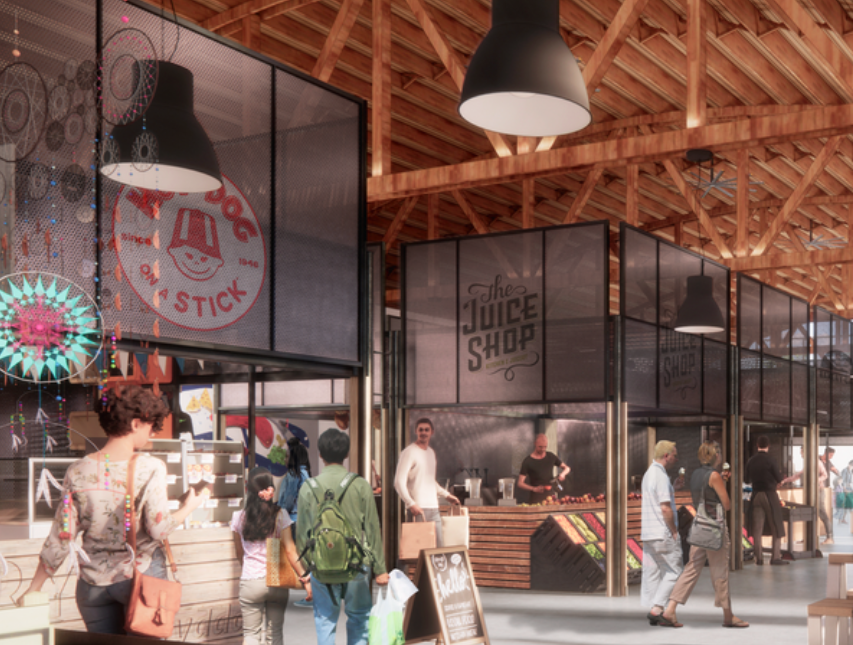
This architectural rendering has been used by the city in official documents to describe their Pavilion plans. The two businesses shown are part of west-coast chains, with the hot dog store having hundreds of locations. While these images might just be notional, a real Public Market should be dedicated to local businesses and preclude large chain stores.

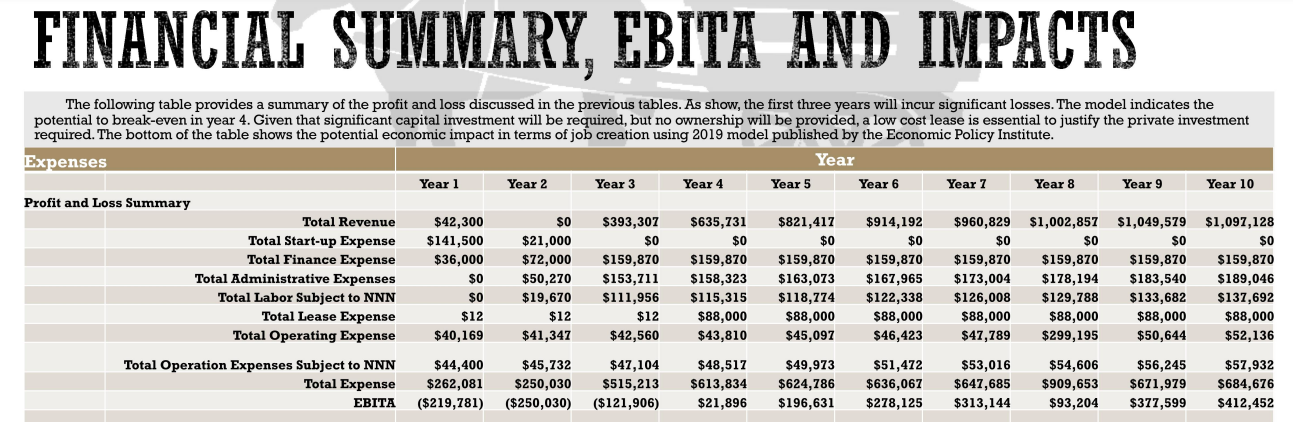
Renton taxpayers are paying about $12.8 million to alter the Pavilion and the adjacent Piazza (which will provide dining space to the Pavilion.) Documents submitted to the City  with the RFP proposal show the “operator” of the market predicting a combined loss of about $500,000 over the first three years, breaking even in year 4, then recovering all his losses and making a profit by the 6th year.  He estimated increasing profitability after that, surpassing $300,000 in year 7, and blossoming to over $400,000 per year by the tenth year.  He would then be eligible for two five-year lease extensions which could bring him another $4 million in profits, or more.

But it would take 70 years of the proposed $176,000 annual rent payments for the taxpayers of Renton to recover the renovation costs.

This looks like the type of public cash/credit giveaway that is forbidden by the constitution.

The selected RFP bidder predicted these estimated financials after making his bid. His estimated earnings before interest, taxes and amortization (EBITA) is shown in the bottom row. This data has not been updated with the latest rent proposal nor does it reflect the enormous investment (including tenant improvements) the city has made in the Pavilion and Piazza. An update of this data would be beneficial to the public.

As one other interesting data point, the “operator” who wishes to rent our newly-renovated city Pavilion building for $5-$15 per square foot happens to own a 65-year-old building a few blocks away from the Pavilion. His building is tax-assessed at $2.1 million (about 20% of what we are spending on updating the Pavilion), and he is advertising that building for lease for $20 per square foot.  Clearly the Pavilion, with its park setting in the heart of downtown, is being subsidized at the proposed lease rate.

The Council is also being asked to lease 30 dedicated parking spaces in the adjacent City Center Parking garage to the operator for about $1.31 per spot per day, which is a bargain.  The garage also provides hundreds of free two-hour spots to the Pavilion’s customers.

I don’t blame the operator for asking for the best deal he can get. He’s in business, and it’s what sensible business people do.  But government officials have to say “no” sometimes.  While a true public market could be a desirable public asset, Renton City Council must say no to a public giveaway to a private business.


$32 per square foot per year is being asked for this commercial space on SW 43rd St
$24.75 per square foot per year is being sought for the downtown second-floor office space
$30-$38 per square foot per year is sought for this Medical office on Talbot Road S.
The proposed “operator” of the pavilion building owns this building on Williams (informally known as the Cheers building) through a holding company. He is seeking $20 per square foot per year in rent


Bay Area Rapid Transit (BART) considering massive service reductions and station closures

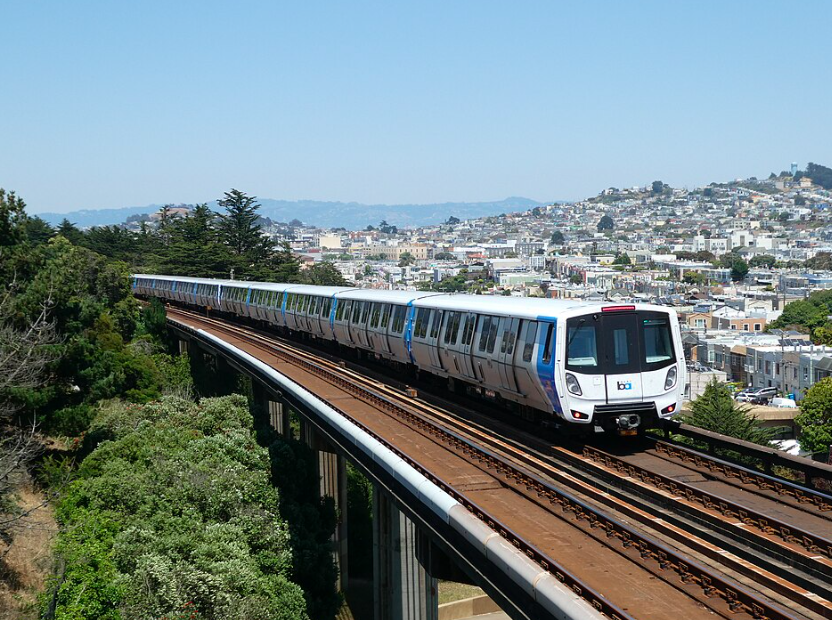
BART train in South San Francisco (Photo from Wikipedia)

I’m even more concerned with Sound Transit’s plans and finances after seeing what is currently happening in the San Francisco Bay Area.

I have family and friends living in the Bay Area that have paid taxes for BART (Bay Area Rapid Transit) for 50 years.  Livermore, the town I was born in, has had a one percent sales tax to pay for BART since 1976, and the closest the rail transit system has gotten has been the Pleasanton/Dublin Station about ten miles away.  It took 20 years of tax payments for Livermore to get this (somewhat distant) access.

Now, because of more work-from-home, BART is thinking of closing this Pleasanton/Dublin station and 14 others, and reducing overall service by more than 60%.

Here is a “Dublin Patch” story with passionate objections about the closures from the former Dublin Mayor, who also chairs the BART board.

The possibility of finally building a station and then closing it a few decades later should be worrisome to everyone who has been waiting for a Sound Transit Link light-rail station. This includes Renton, where we’ve been paying Sound Transit taxes for 30 years, and Sound Transit is supposed to be spending 2-3 million to develop the concept for a future (still unfunded) Renton LINK station.  Sound Transit should tell us how they can be sure the same type of rail station closures won’t be threatened in our area.  Especially, as they are currently in front of the Legislature seeking approval to issue 75 year bonds.

Here is the official word on the BART financial crisis, directly from the official BART website.

I’ve written many blog posts about Sound Transit’s inequitable treatment of Renton, and what should be done about it.   You can find those posts by clicking here.  

Renton City Council is giving away its power

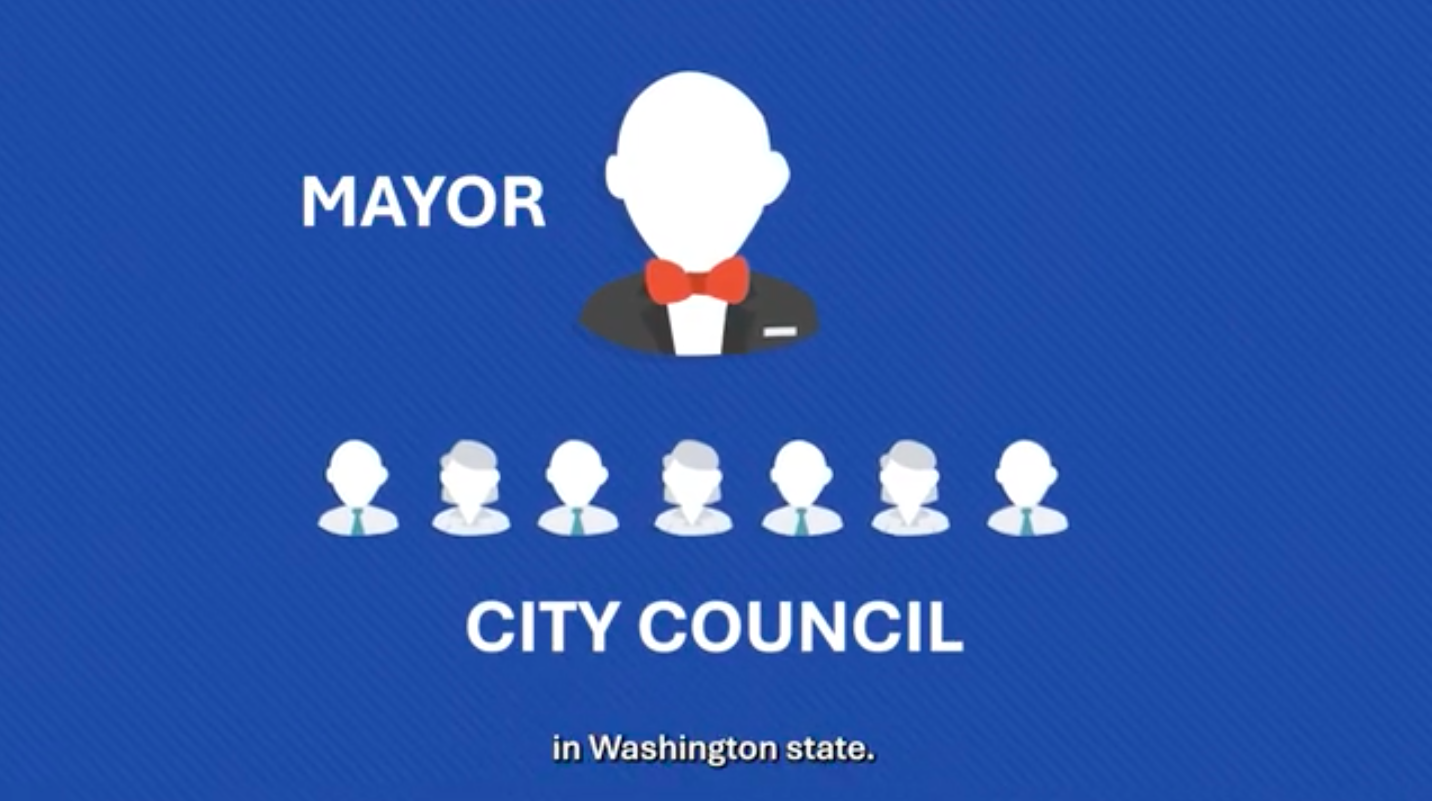
This screenshot from a Renton public information video is an incorrect representation of Council-Mayor form of government. Previous Renton Councils would not have approved a video that made them falsely appear subordinate to the Mayor.

[At last night’s Committee of the Whole meeting, Council Members were trying to learn whether a lease had been extended to a new tenant in the City-owned Piazza building, and they were not getting a straight answer.  Since Renton Council is responsible for leases, this was just the latest episode of Council having relinquished control of an important responsibility. This inspired me to write this blog post.]

Revised Code of Washington 35A.11.020 gives all of the City of Renton’s power to our City Council with these words:

“The legislative body of each code city shall have all powers possible for a city or town to have under the Constitution of this state, and not specifically denied to code cities by law.”

RCW 35A.12.100 lays out the Mayor’s administrative, executive and ceremonial duties, including these words “He or she shall report to the council concerning the affairs of the city and its financial and other needs, and shall make recommendations for council consideration and action.”

But while the Council has been granted all the power by the state, you would not know it by watching a Renton Council Meeting.   And you won’t learn about the Council’s authority from the new public information video that Renton created and published two weeks ago.

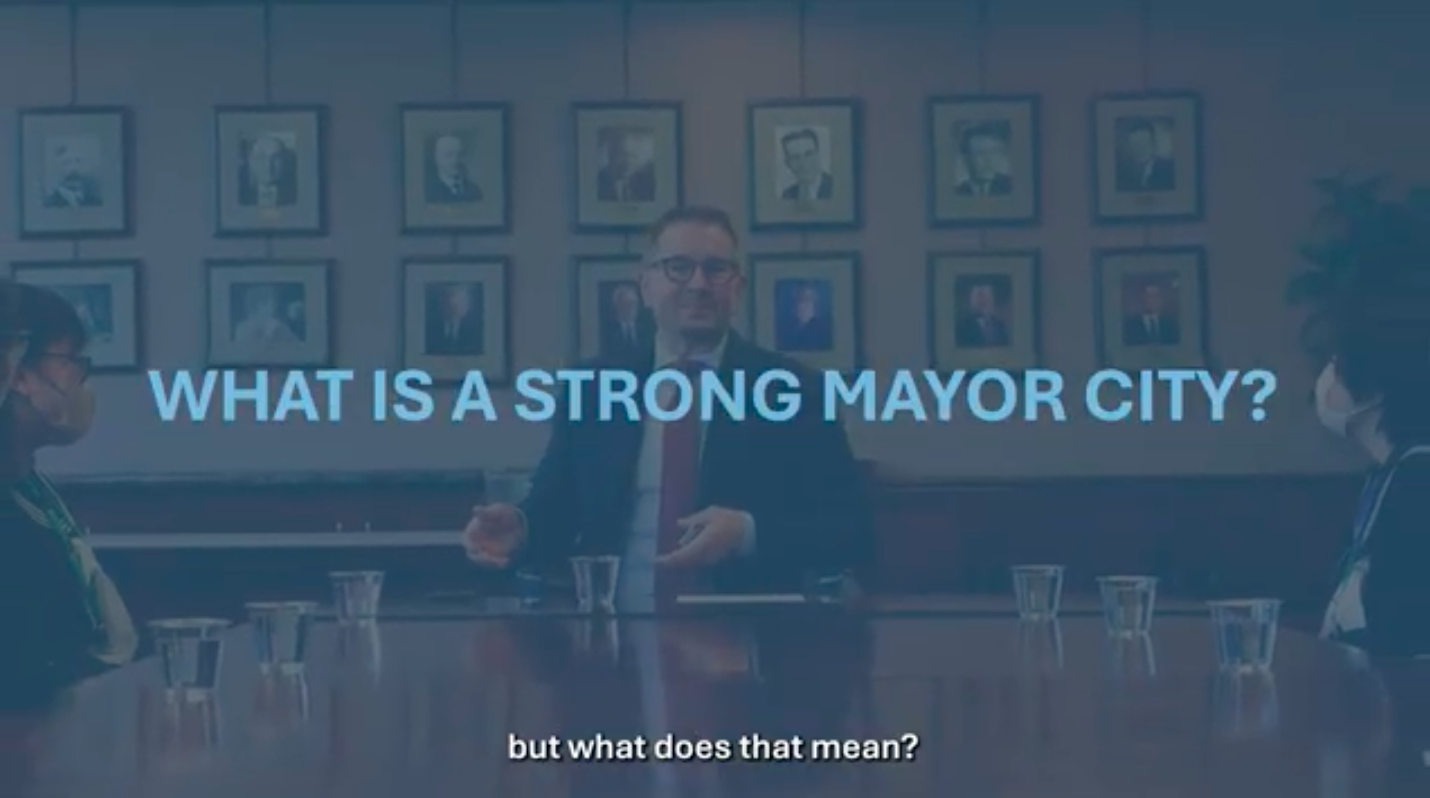
Our current Mayor often refers to Renton’s government as a “Strong Mayor City,”  potentially implying that the Mayor has authority over the Council.  But the Council actually wields the power in Renton’s “Council-Mayor” form of government.  “Strong mayor” is an informal insider term used to differentiate a mayor who provides daily management of  city workers  (in a Council-Mayor system) from a mayor with a more ceremonial role in a “Council-Manager” system.

The new video about Renton Council Meetings uses the “strong mayor” language, even though it does not show up in state law. Renton’s system is legally a “Council-Mayor” system, and the Council wields the city’s ultimate power.

The Renton City Council is a legislative body, not a department of the City that the Mayor runs. And the Council should not let their role be diminished.

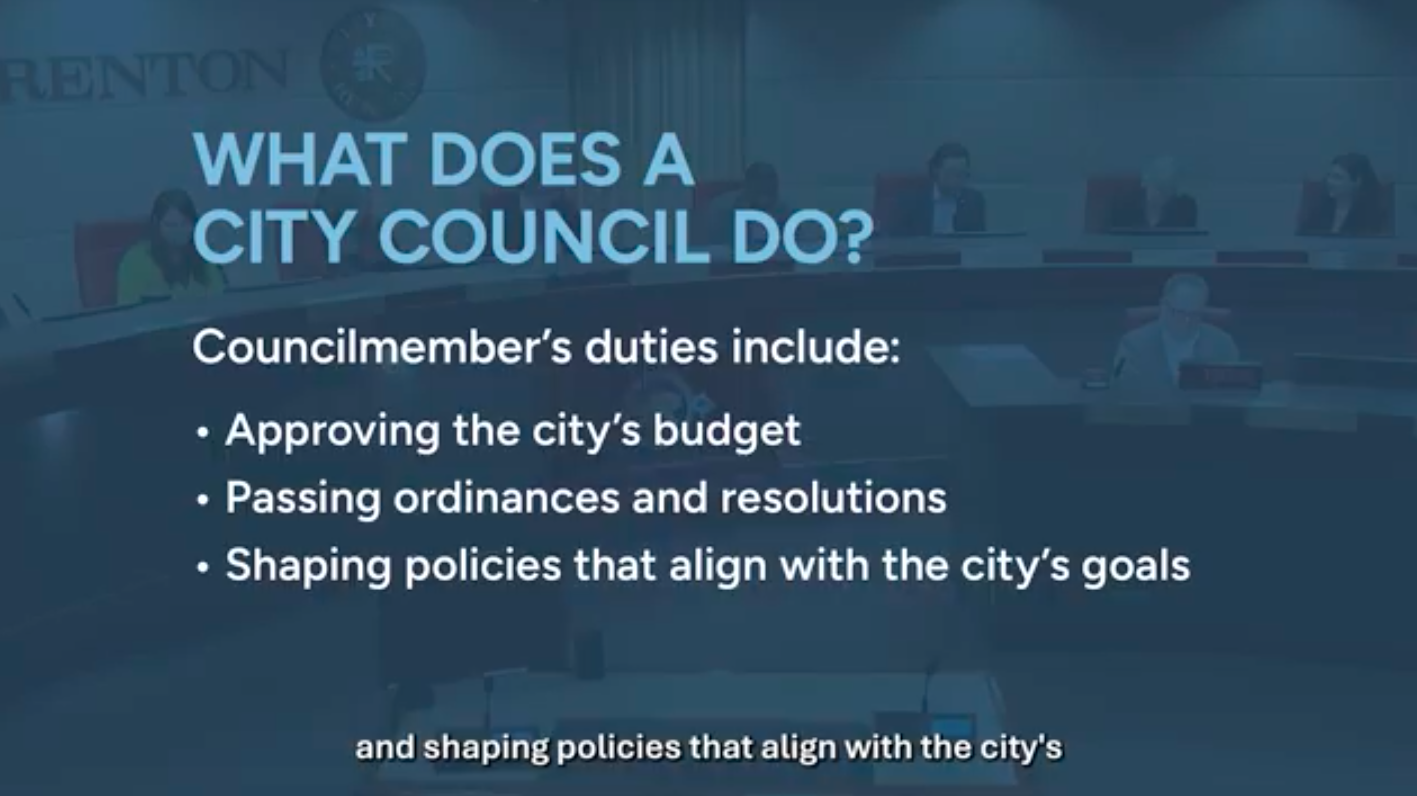
This chart from the new video greatly diminishes the power and responsibilities of the City Council.

Every bullet in the screenshot above from the new City video is misleading.

The Council doesn’t just “approve” the city’s budget; they own the budget.  They set priorities for the budget, review and refine draft budget documents, set tax rates and fees, and hold the Mayor and staff accountable to staying on budget.

They don’t just “pass”ordinances; they determine the need for ordinances, define them, review and debate drafts, decide on penalties for violating them, and then vote on them.

The Council doesn’t just “shape policies that align with the city’s goals,” they define the city’s goals.

Council also has many other authorities given to them by the Revised Code of Washington covering everything from zoning to delivering municipal services.  For example, just half of one sentence of the code gives Council (not the Mayor) control of “the acquisition, sale, ownership, improvement, maintenance, protection, restoration, regulation, use, leasing, disposition, vacation, abandonment or beautification of public ways, real property of all kinds, waterways, structures, or any other improvement or use of real or personal property …”

By law, Council also has authority over the agenda and execution of every Council Meetings.  The Council can alter the agenda and the rules at any time with a majority vote– the Mayor does not get a say in it.

These are, after all, City Council meetings.  Our Mayor has all week to perform his administrative duties and talk with his constituents. But under the open public meetings act, Council Members can only discuss issues and take action in public meetings.  That is why we have scheduled Council Meetings.  The Mayor presides over the meetings as one of his administrative functions, since Council members are part-time, not because he is a boss over the Council.

In fact, the Mayor typically never gets to vote on anything.  About once per year or so the Mayor might get a chance to vote to break a tie, but only if the issue does not involve any spending.

In rare 4-3 split Council decisions the Mayor theoretically has a veto power. But a single Councilmember switching sides can undo the Mayor’s veto, since it only takes five council members to overrides a veto. In 28 years I might have seen maybe one veto.

When I was on Council, we knew it was our meeting.  It was a time to speak to each other about topics of concern to us, and a time to interact with constituents who had not received satisfaction from city staff or the Mayor.

A year ago Renton Council threw away their ability to provide speedy low-cost appeals of hearing examiner decisions, saying they preferred these matters go straight to King County Superior Court.  Past Renton Councils knew this was an option, but always chose to hold onto appeal authority, as one of the many council powers to protect.  This decision by the current Council reflects a broader pattern of the Council stepping away from authorities that past Councils deliberately protected.

Renton’s Council does a disservice to its residents by giving away its power.  While we still pay for eight elected officials, we only get decisions from one of them– the Mayor.   A single individual, even the mayor, will be wrong some of the time.

Council Members can begin to take back their power by asking questions of the Mayor, of staff, and of each other at council meetings.  They should not stop asking questions until they fully understand all the implications of any decision they are making.  And they should not shy from debating these issues with their colleagues during their council meetings.  If the Mayor attempts to shut down the questions or debate, Council should use a “Point of Order” under Robert’s Rules, to remind the Mayor that Council is in charge of the agenda and the meeting.  Any Councilmember can move to suspend the rules to give extra time or seek more data on an important issue, and if four other council members agree, the agenda will change.  Past Council Members have been known to instruct the Mayor “go get us the data…. we’ll wait for it.”

Councilmembers should also study 35A.11.020 to remind themselves of the power they wield.  Then they should publicly engage their council colleagues to use this power wisely and effectively to improve the quality of life for residents and businesses in Renton.

It’s Super Bowl Sunday! Go Seahawks!!!

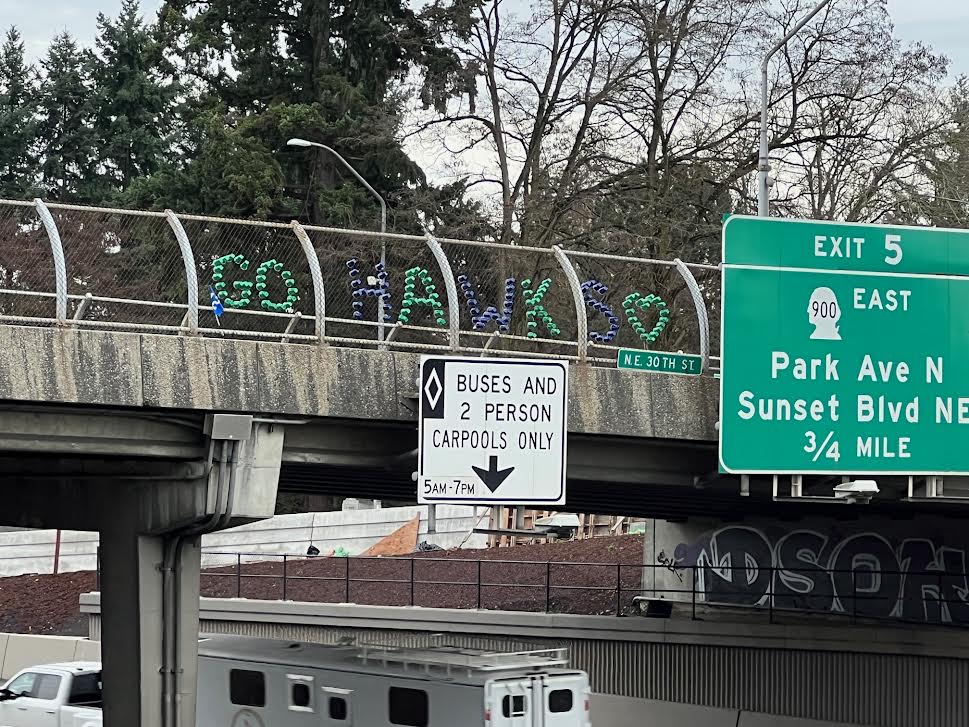
Renton fans of the Seattle Seahawks use green and blue Solo cups to help show their support at the Exit 6 overpass in Kennydale, a mile from the team’s Renton headquarters.

This afternoon at 3:30 the Seahawks are playing the New England Patriots in Santa Clara, California in Super Bowl LX.  The game is broadcast free on NBC, and is likely to be the most watched Super Bowl in television history.  The Super Bowl is widely considered the premier US sporting event of the year.

Our Seahawks have had an amazing season, and are favored to win! Go Hawks!!!

Renton Pavilion financing at risk of becoming a 12.8 million-dollar boondoggle

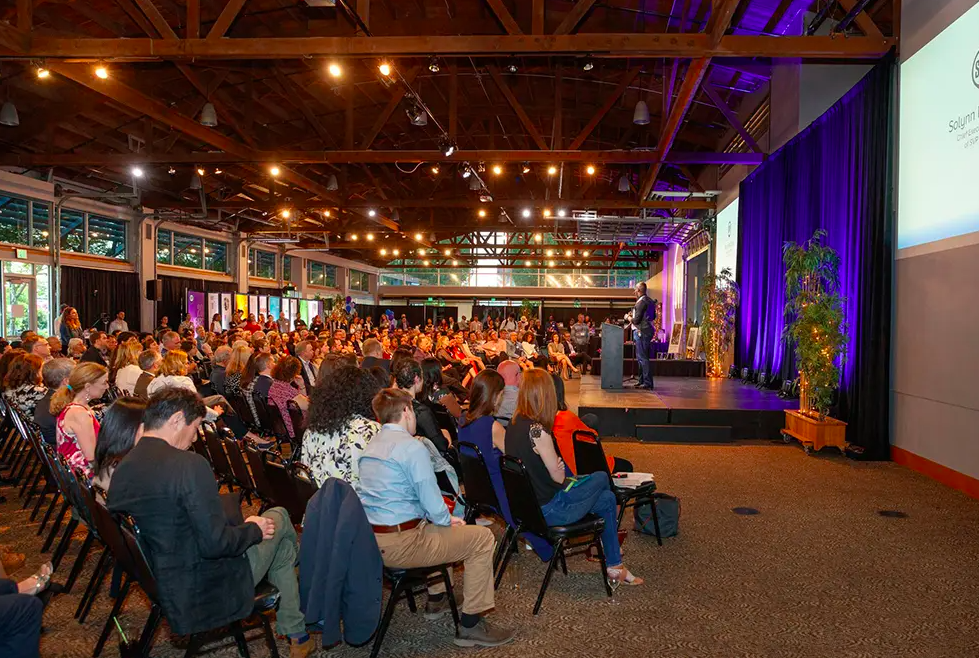
Renton’s Pavilion Event Center sits in our downtown Piazza Park, and has brought hundreds of visitors at a time to Renton’s downtown. In peak years, it’s been responsible for 50,000 visits or more, often travelers in Renton for the first time.

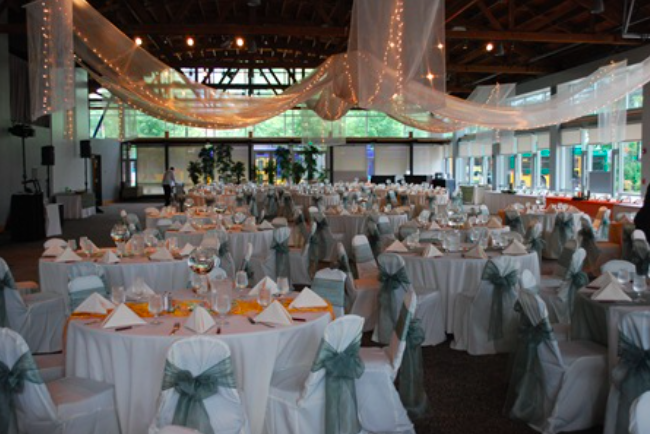
Renton’s Pavilion Event Center brought tens of thousands of visitors per year to downtown Renton during its two decades of operation. Renton brought this facility to life in 2002, when Council purchased this building as part of a Mazda Dealership, and we rehabbed it to host community events.

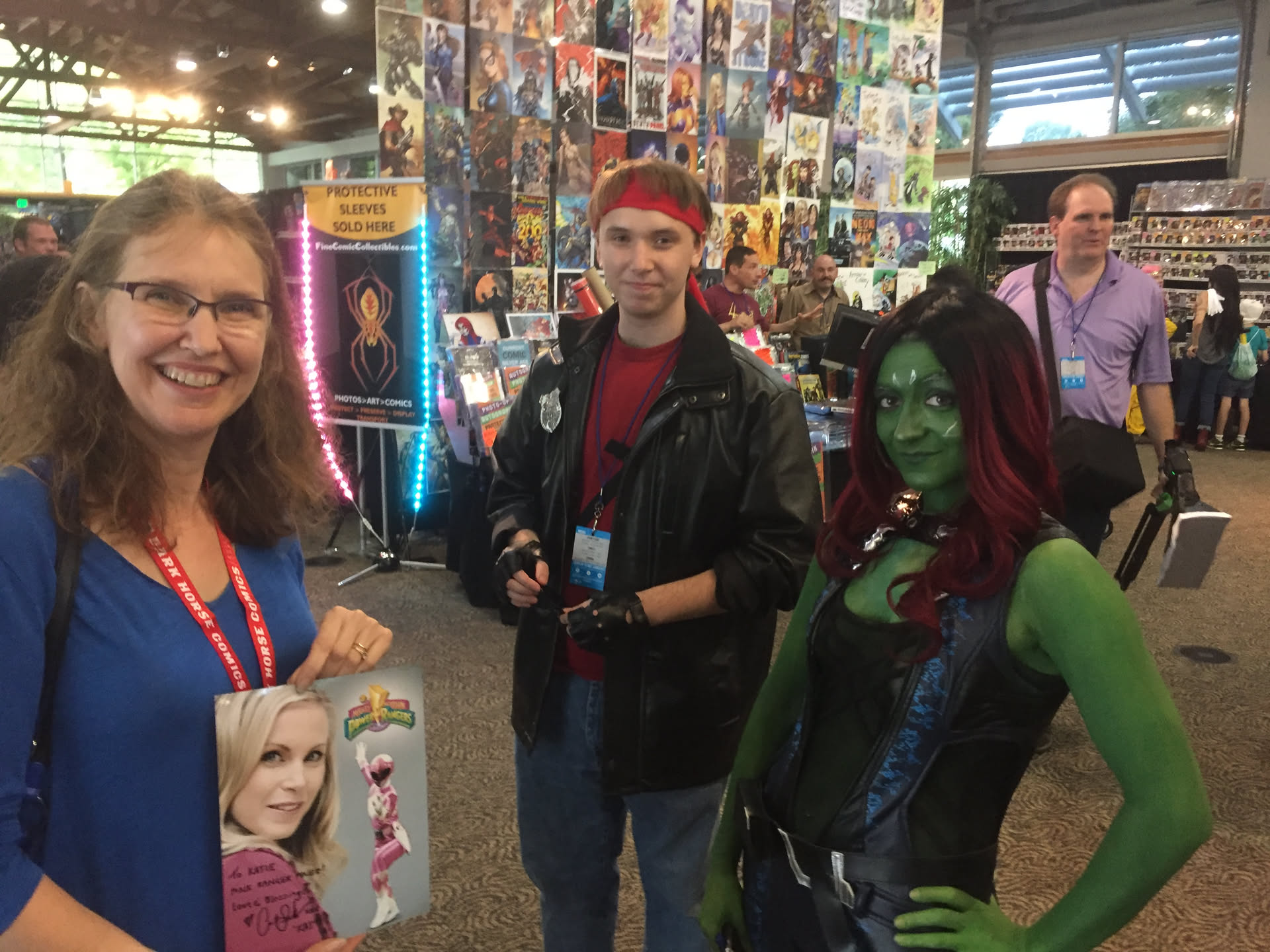
Renton Comic Con at the Pavilion, April 2017

Because we got a good deal on the building and we kept the upgrades reasonably modest, the building became an affordable community asset that has hosted countless events of all types.  Many of these events have brought vendors and customers from other cities, supporting our hotels and restaurants and introducing downtown Renton to new visitors.

Pavilion wedding (Photo Courtesy Rain City Catering)

Nine years ago the city’s operator-partner running the Renton Pavilion Event Center began having to say “No” to anyone hoping to schedule an event for the following calendar year.  Rain City Catering, the Pavilion operator (and King County’s minority-owned small award-winning  business of the year), could have had the popular event hall constantly booked with conventions, large banquets and receptions. But starting in 2017,  the City would not allow them to accept reservations beyond the current calendar year (i.e events had to be held by December 31st of the current year or they were not allowed.)  Weddings and events of 450 people take longer than that to plan

With a seating capacity of 450, the Pavilion provided a large, affordable event location for entertainment, civic, and corporate events. Starting nine years ago, such events could not be scheduled for the following calendar year. (Photo Courtesy Rain City Catering)
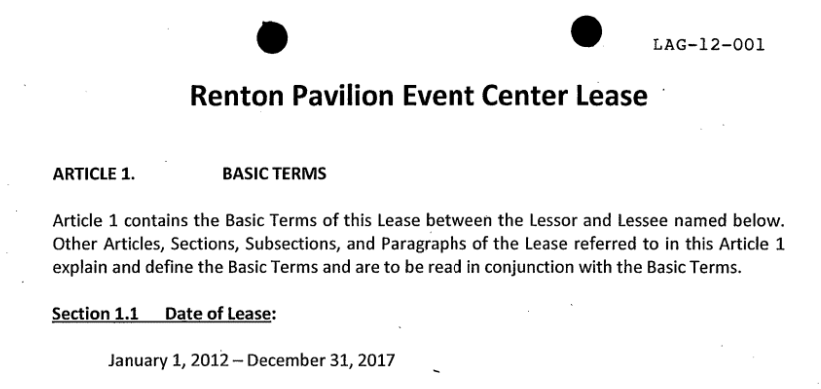
The original Pavilion Lease with Rain City Catering ended in December 2017, so anyone who called wanting to book a wedding in 2018 had to be told “no”.
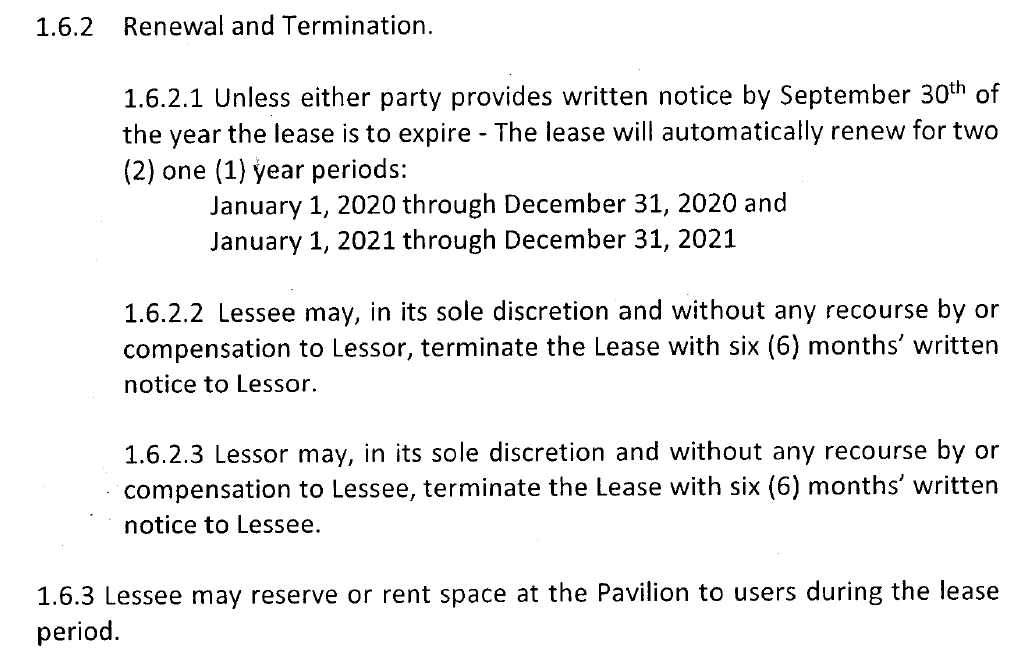
The Rain City Catering lease renewals were contrived such that Rain City could only lease for “one year periods”, and only take reservations for that calendar year. In addition, the City reserved the right to evict them with six months notice and no compensation. Rain City did an admirable job maintaining activity given these harsh lease terms.

Council tried fixing the log-jam six years ago, by initiating an RFP process that would extend a new long-term lease to the operator in exchange for the operator paying for upgrades to the building, and adding some anchor tenants that would ensure daily activity at the building.  We also insisted that they maintain active and vital event space. Unfortunately, RFP activities were slowed by the pandemic.

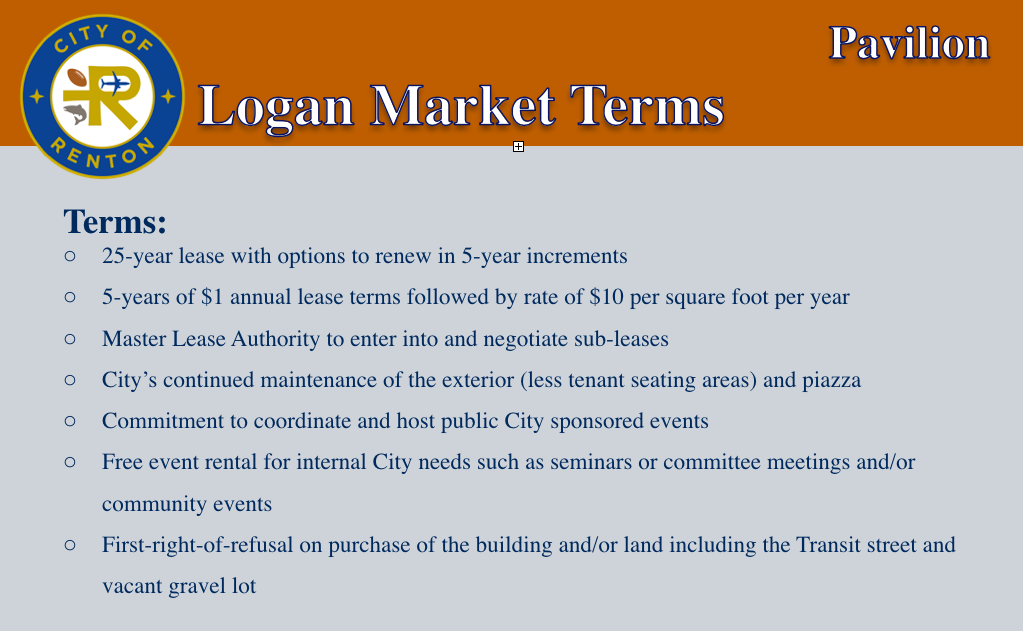
After I retired from Council four years ago, the Mayor and Council selected an RFP response from a new bidder, Dave Brethauer, who asked for a 25 year lease, starting at one dollar per year for the first five years.  The lease would then go up to about $150,000 per year, (a little more than we had been receiving from Rain City Catering ) with small inflation adjustments during the 20 years after that.  Rain City Catering made their own attractive bid, and with a term lease they would have booked more events and paid more annually to the city.  Rain City Catering would have paid for all improvements, and added anchor tenants.  I covered the RFP process in detail in this blog post here.

An excerpt of Dave Brethauer’s RFP response

Dave Brethauer’s winning RFP response asked for additional substantial considerations from the city beyond five years of free rent: first-right of refusal if the Pavilion ever gets sold, and first right of refusal on any potential sale of any other nearby city property, including the Transit Center (which will be vacated by 2028) and the former Big Five site which is currently getting millions of dollars in taxpayer-funded upgrades.  In exchange for the bargain lease and all the guaranteed purchase opportunities, the RFP response implied that Mr. Brethauer would redevelop the Pavilion into an active “Renton Market” at his expense, and it would continue to include significant event space.

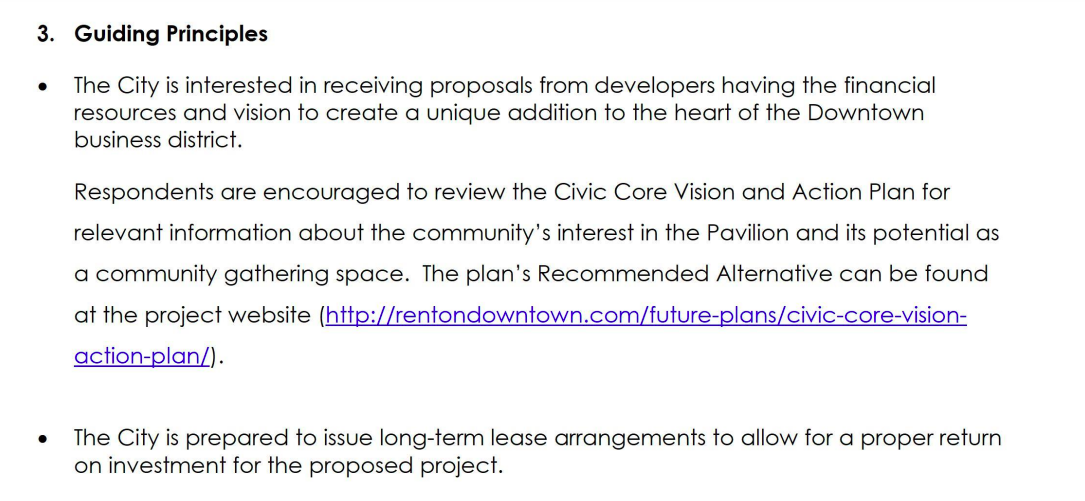
RFP Excerpt: The Developer brings their money and development expertise and Renton will agree on long-term lease with time to get return on their investment.  Full RFP is here.


The Renton Reporter, Renton’s official newspaper, also made it absolutely clear that upgrades would be the responsibility of winning RFP respondent:

“The proposal would leave the renovations, operations and management to the leaseholder. At committee, Mayor Denis Law said that throughout the different proposals the city has received for the 14,770-square-foot structure, there has always been talk of a year-round, vibrant market.

Law told the council that the city is not currently proposing money toward the project, nor would the city operate it.

“We’re not getting into the business to run a market,” Law said.”

(Renton Reporter, May 3, 2019)

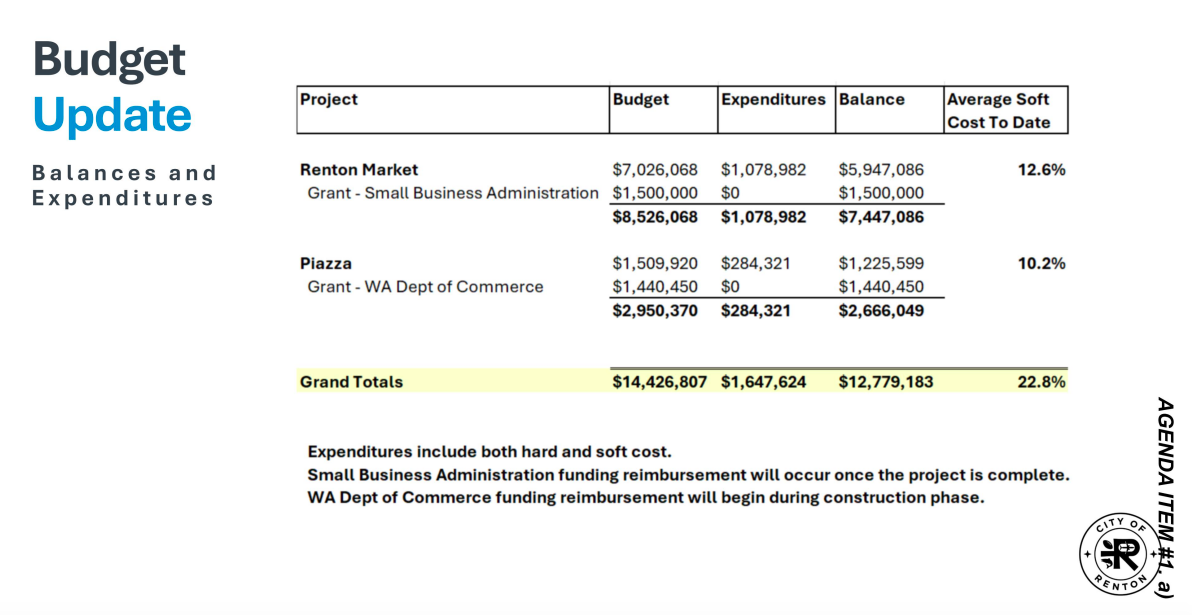
Now, six years later, I can find no Pavilion lease with Mr. Brethauer anywhere on the City’s website.  But the City of Renton is currently engaged in using taxpayer funds to make $12.8 million in upgrades to the Pavilion and nearby Piazza Park, with Mr. Brethauer’s  involvement.


THE PROBLEM:

With $12.8 million in fresh public investments on this already-valuable property, taxpayers are owed a fair-market return on the (virtually brand-new) building.   A $15-18 million-dollar property leased to a private party should generate $1-2 Million dollars per year, far-exceeding the $1- $150,000 per year offered in the 2019 RFP response (when the bidder was supposed to fund the improvements).

Washington State’s Constitution has clear, indisputable language about gifting public money to private businesses or parties.

From Washington State Constitution

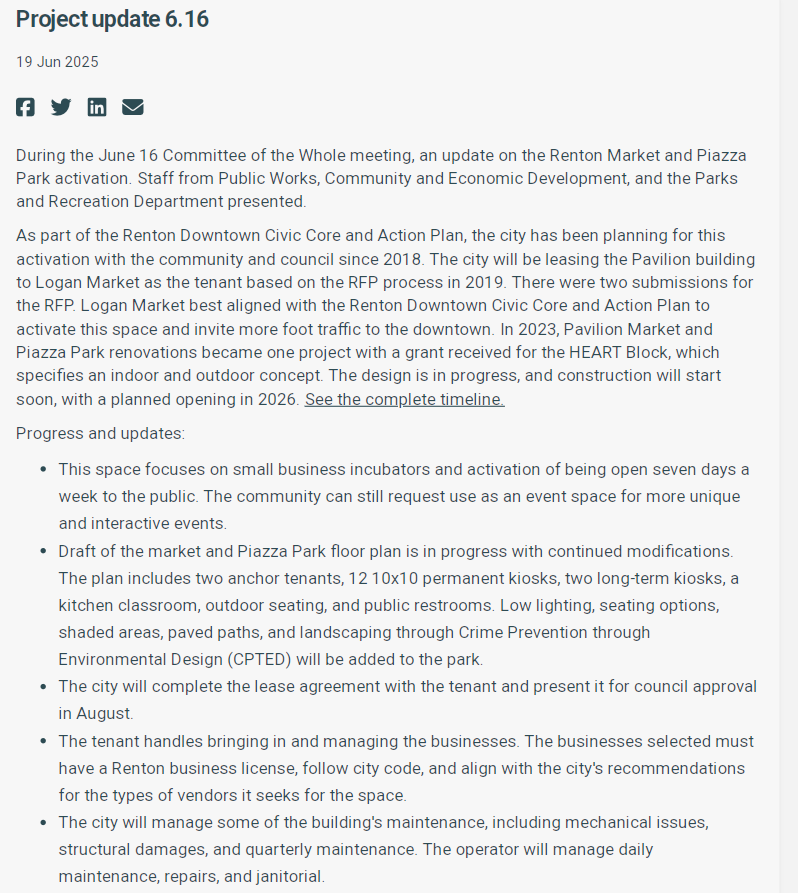
The City’s update from June 19, 2025 says that the City of Renton is building  out the Pavilion consistent with “the RFP process in 2019” (this is NOT consistent with the 2019 RFP process).  Then it says a lease will be finalized in August 2025 (which did not happen) and that the tenant (Mr. Brethauer) will be bringing in and managing the businesses.

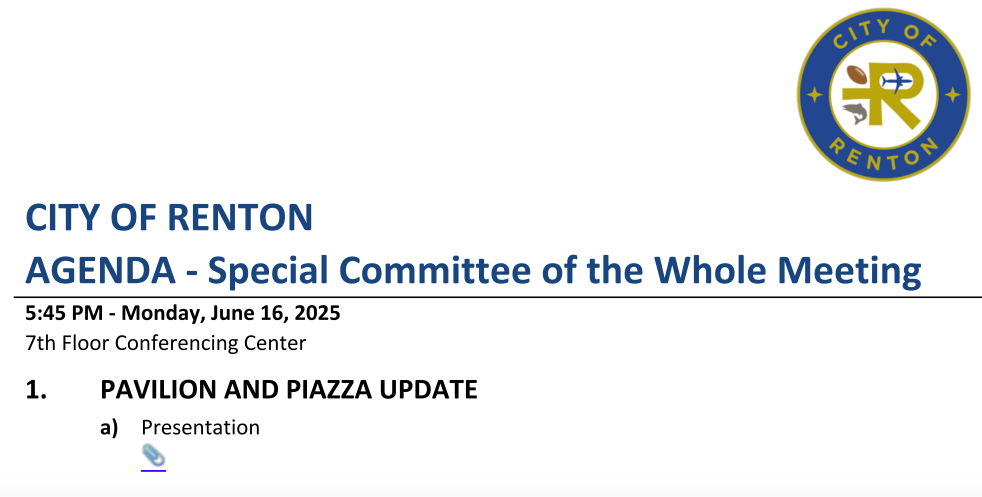
City update from June 2025

We’re six years past the RFP date with no lease, and the selected RFP bidder does not appear to be paying for any of the millions of dollars of work being done.  Clearly the RFP process of 2019 should be considered null and void.

Furthermore, the City has done so much taxpayer work on the building that city leaders are going to have to figure out how to get $100,000 per month out of 12 farmer’s market stalls, two boothes,  and a couple of small start-up anchor tenant to cover a fair rent payment for the city property.

If the property is leased to the winning RFP bidder for what what they wanted in their RFP response,  it will be a crime.  Under our State Constitution, our city is not allowed to subsidize private businesses even if we think they’ll improve our downtown. Giving the market away on a 25-year lease starting out at $1 per year would be unthinkable.  It’s forbidden.

Renton keeps adding value to the deal.  (from recent Council Meeting)


The future of our Piazza Park has regrettably been enmeshed in the “Renton Market Package”  even though the Market was supposed to be paid for by a private developer under the RFP process. We don’t know how much the Pavilion developer is influencing the controversial redesign of the Piazza.

“Public-Private Partnerships” are full of legal and political risks in our state, even when proper and transparent RFP and bidding processes are followed.  And they have not been followed in this case

The city is on a political tightrope that is even more precarious because of campaign donations. A quick review shows Dave Brethauer making substantial campaign donations to the Mayor; while anyone is allowed to make such donations, the Mayor must work hard to ensure any deal is not only fair, but also appears fair to the public.  Full transparency and impartiality are very important when leasing valuable public assets.

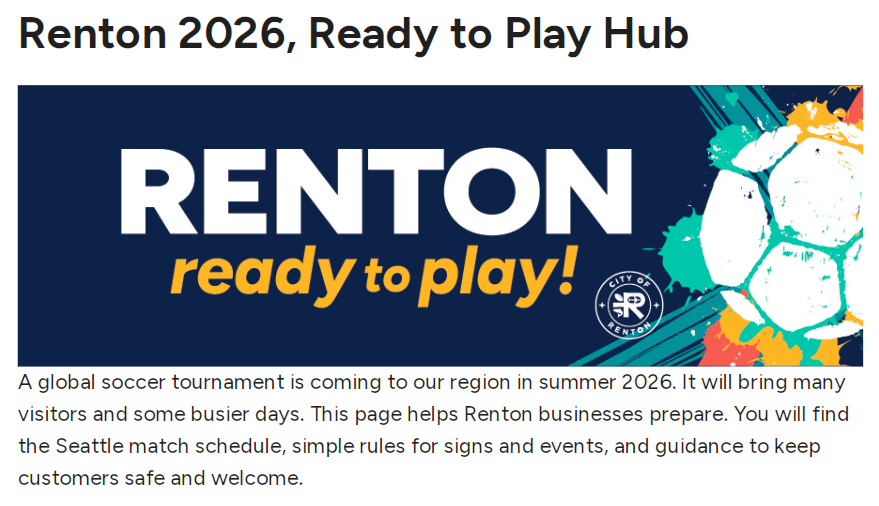
And City officials are now  rushed.  They’ve invited the world to see our city center in June, four months from now.  But without a legal lease for the Pavilion, which is a prerequisite for subleases for the interior booths, it’s hard to imagine the pavilion will be occupied with permanent tenants by the time of the World Cup matches.  And if they rush these leases, they curtail the public’s ability to ensure we’re getting a fair deal for the taxpayer funds invested.  (Each lease and sublease is required to go to Council, then into committee, then back to council, and then get a first and second reading, then go to the Mayor and clerk for signing; it takes weeks.)

One would have to be a superhero to get this done, legally, without unfairly gifting public funds, in time for June occupancy.

Renton Comic Con at our Piazza before it was demolished; the pictured foliage and landscape are currently gone.
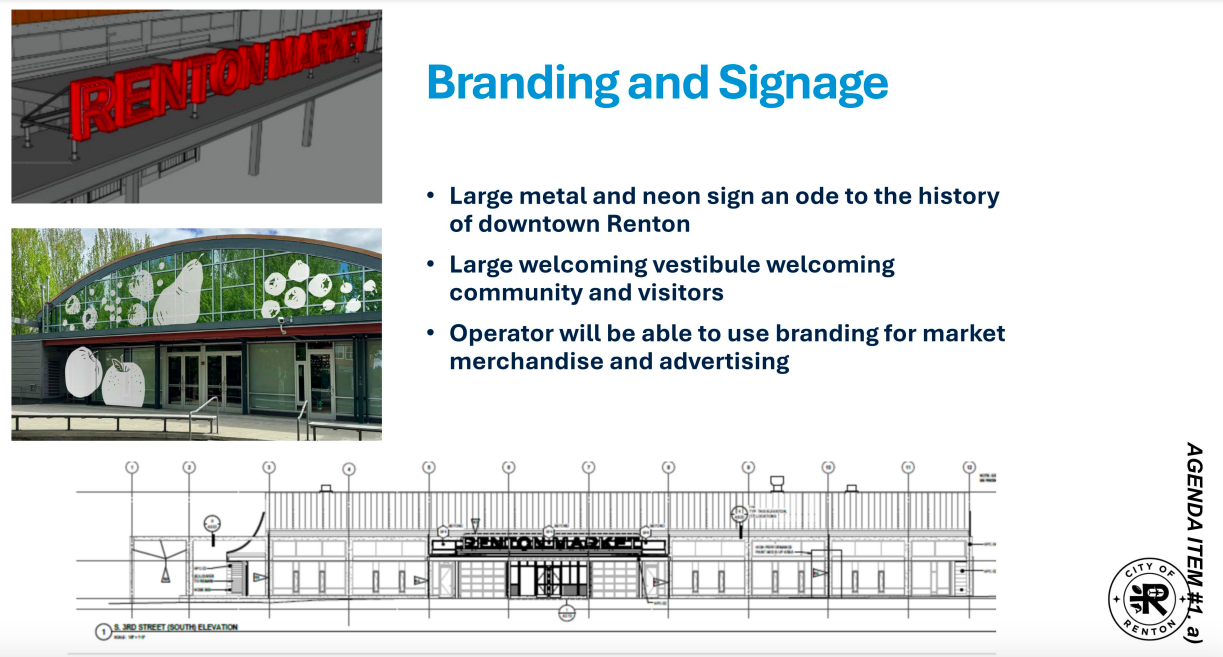
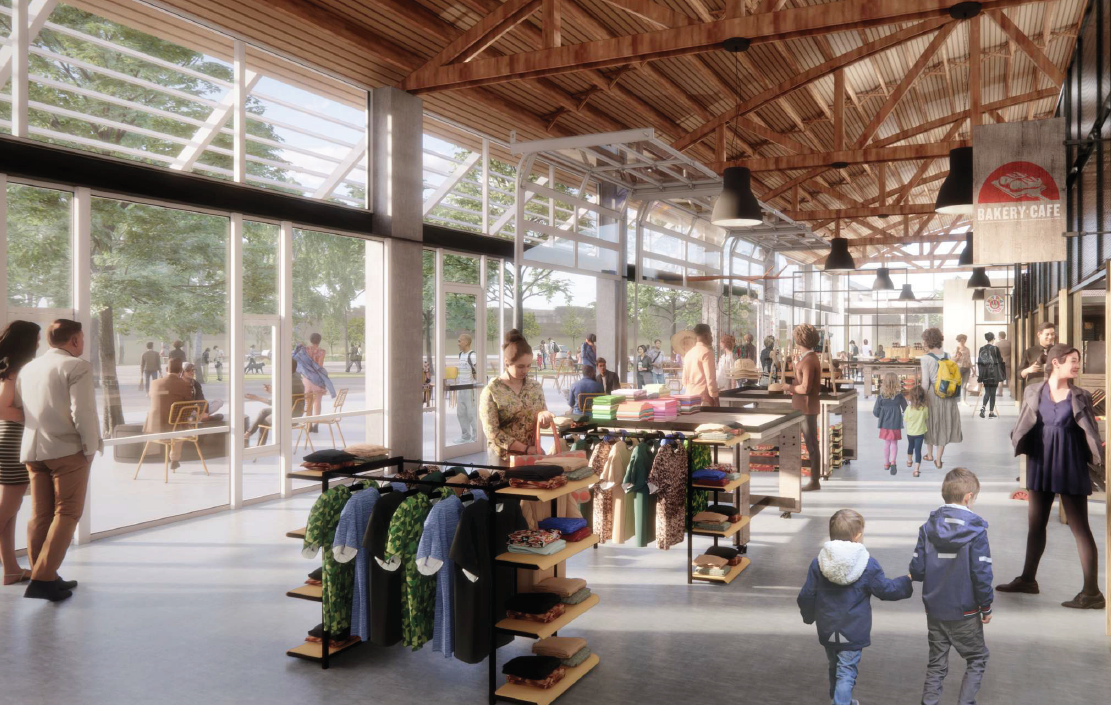
Architects rendering of the new “Renton Market.”  The $12.8 million dollars does not seem to change the building a lot other than permanently preventing large events.   The roll-up glass garage doors are existing, and already open on nice days. We could already hold commercial events in the space.  The adjacent Piazza Park is losing 50 of its 60 significant trees and both of its water features, which gives it a “parking lot” look.


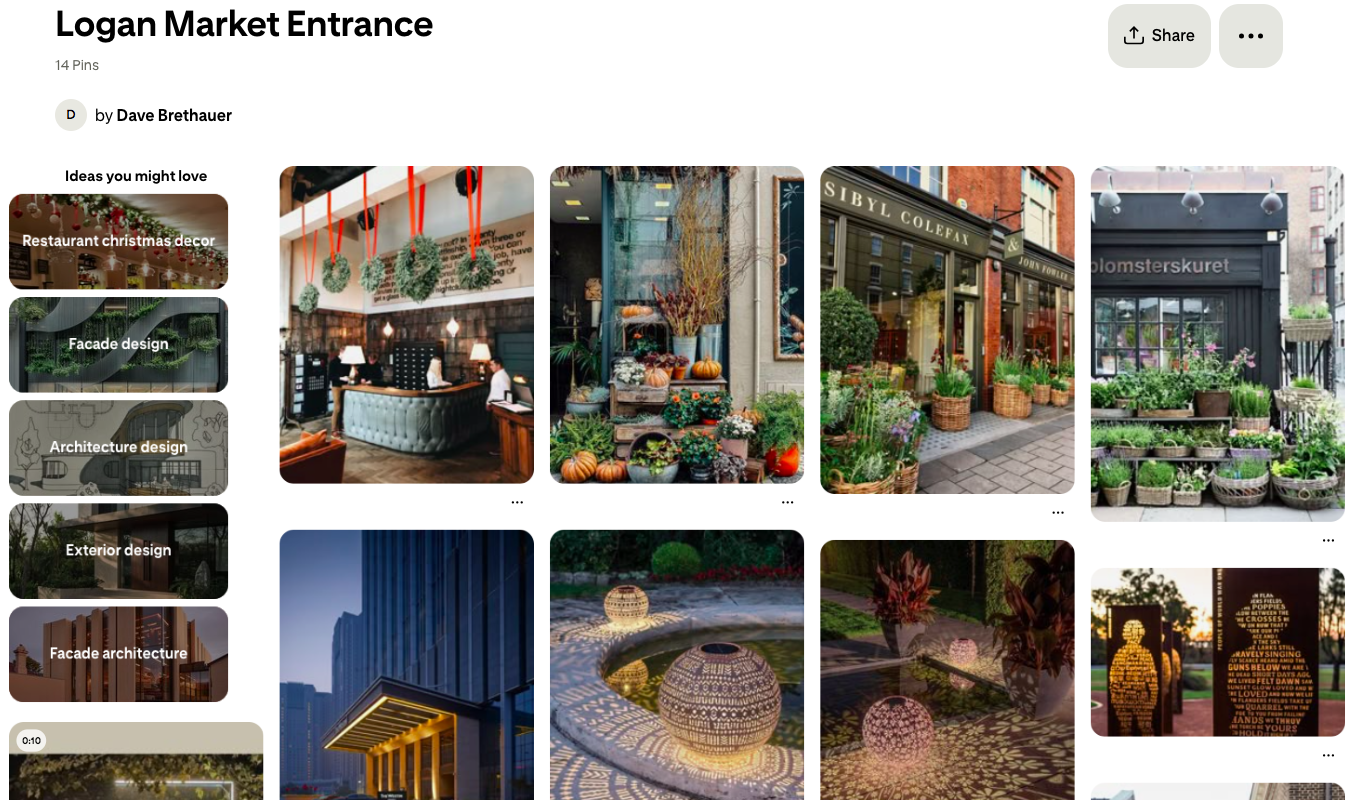
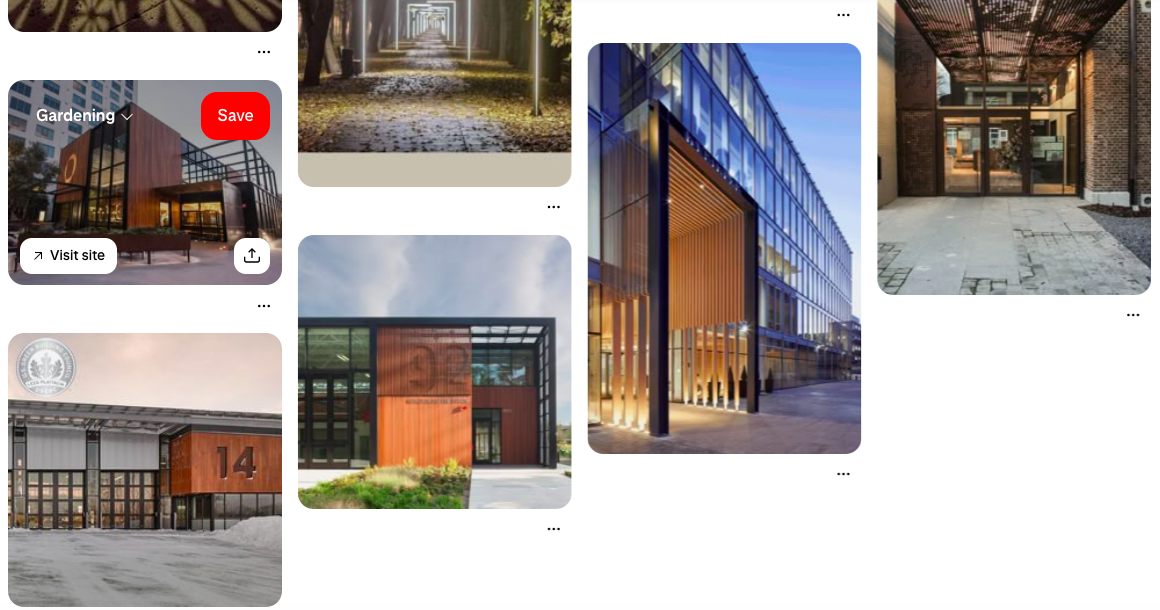
Dave Brethauer’s Pinterest account hints at his involvement in the City’s design.

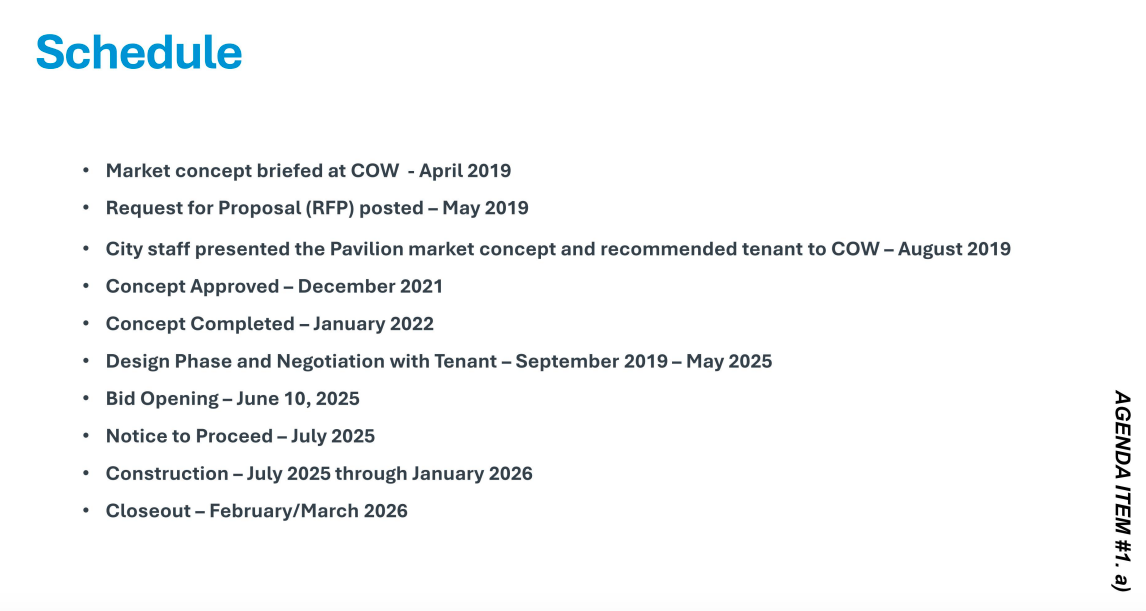
In June the public was told that operator agreements and leases would be forthcoming; where are they?


In June we were told the project would be completed this month or next


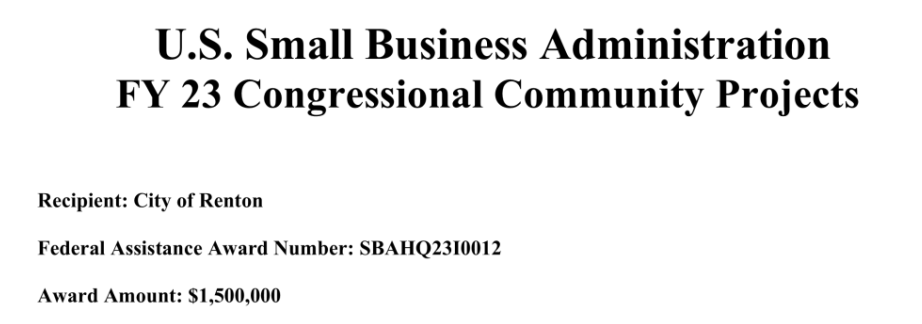
1.5 million dollars of the funding is coming from a federal grant. This is the description Renton provided. (Note that the city evicted the minority-owned business that was leasing and managing the Pavilion and at least one woman-owned business that was holding events in the Pavilion.) The grant comes with 18 pages of restrictions, including statements like “Additionally, no interest in this Award may be conferred upon a third party. ”  The details can be found here.


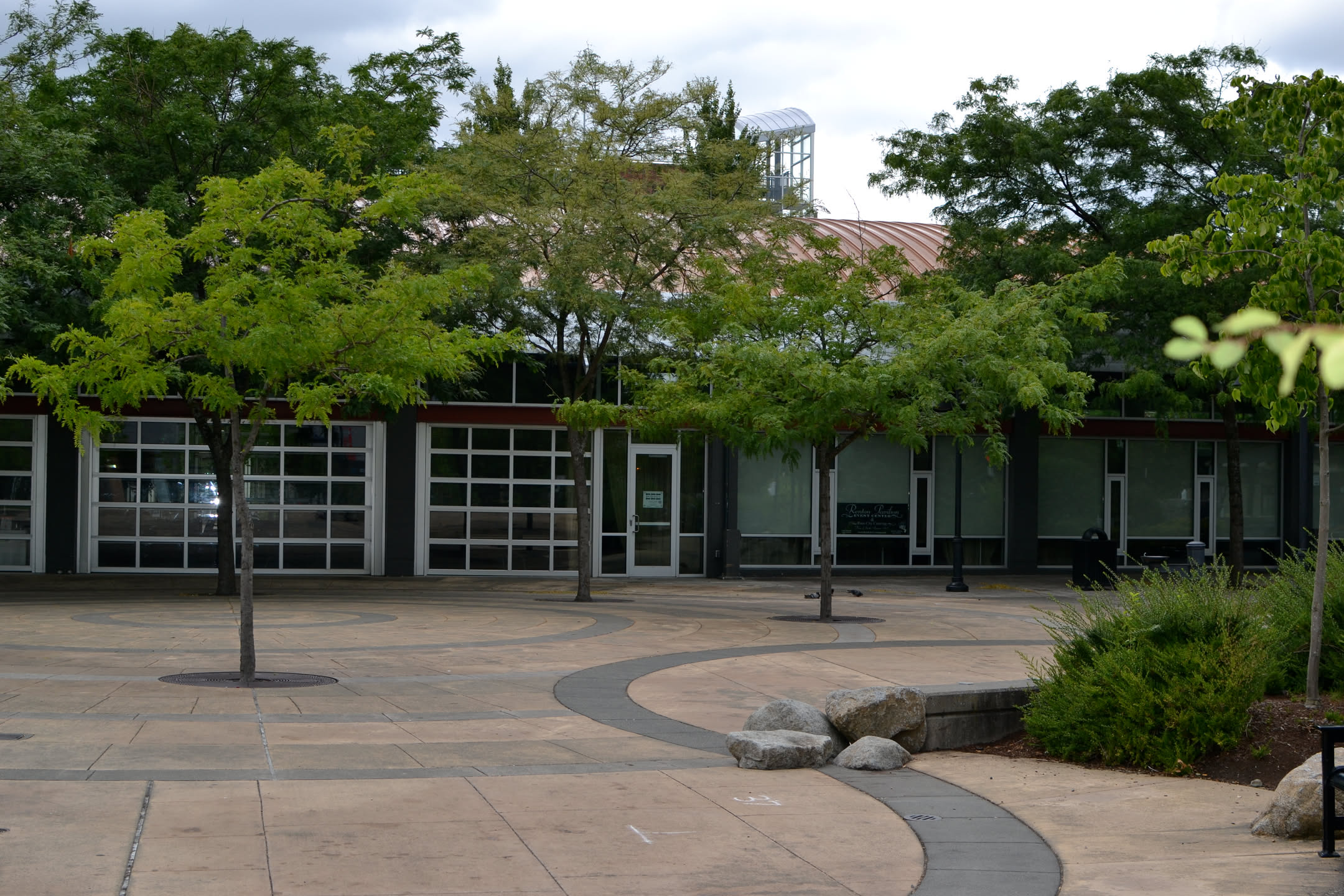
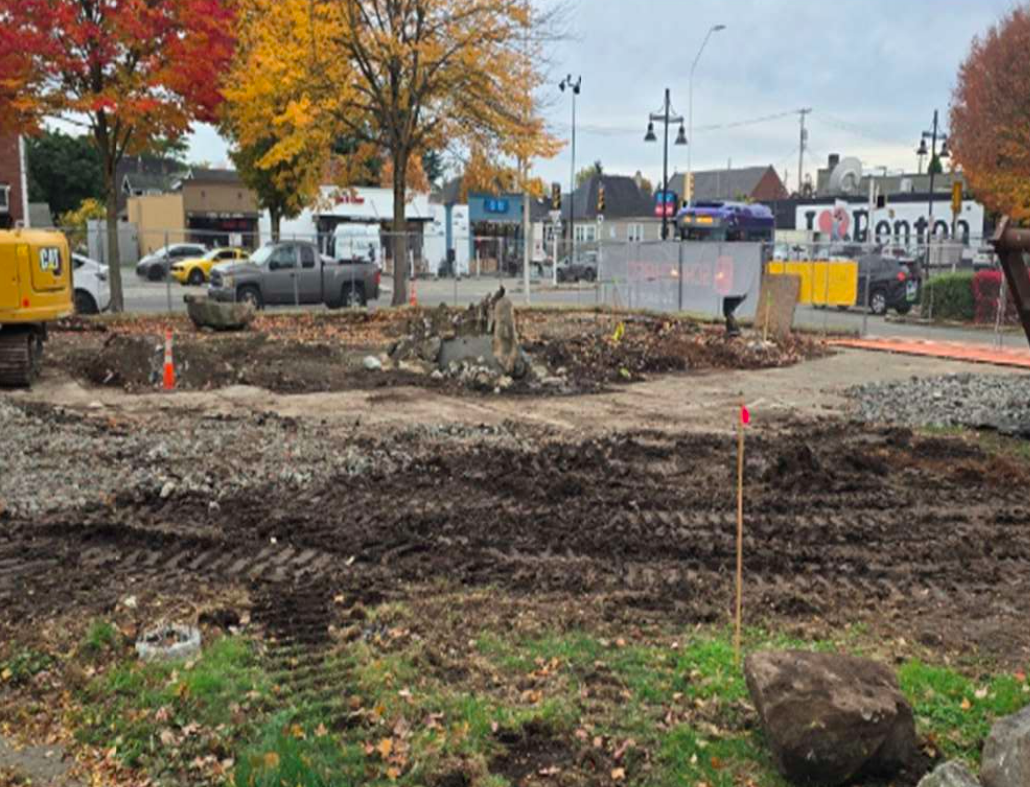
A view of the Piazza today, with four months to go before the World Cup. The Pavilion is in the back, partially boarded up.  I don’t have a photo of the inside. Read more about the Piazza here.

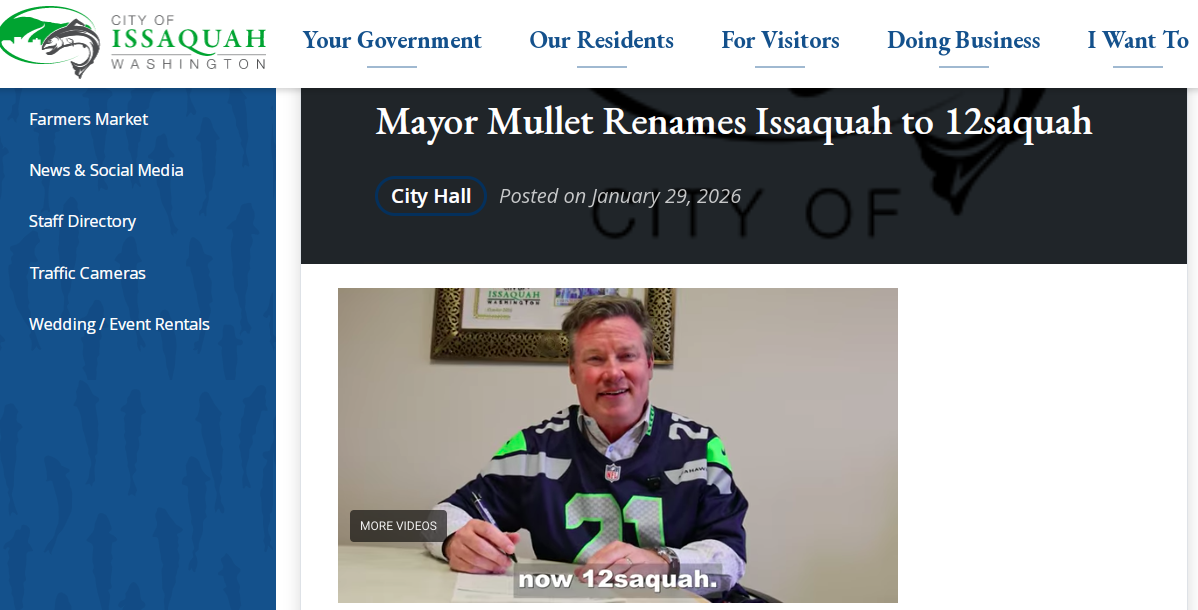
Issaquah renames itself for Seahawks as Renton mulls removing football from logo

The City of Issaquah just announced they are temporarily changing their name to 12saquah in honor of the Seahawks exciting return to the Superbowl.  Meanwhile Renton, the proud home of Seahawks headquarters, has been mulling a proposal since November to remove the football from our City’s logo.

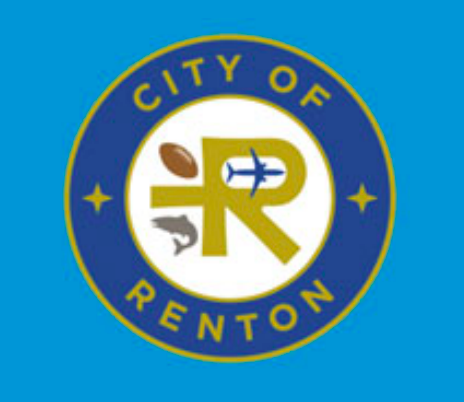
Renton’s current logo includes a football celebrating the Seahawks and our sports/recreation history. A staff proposal would remove it.

[updated 2/3] Fortunately, several Renton Council Members have expressed opposition to the idea,   as have many members of the public. Councilmember Ed Prince, an avid Seahawks fan whose son plays football sport competitively, was very opposed to the logo change. Councilmembers Perez,  Alberson and O’Halloran also expressed concerns about the change. The once seemingly-greased  November 17 proposal from Renton’s communication department recommending the change said the next step would be Council action to officially adopt the new version of the logo removing the football (along with the airplane and the salmon).  Happily at this point at least four Councilmembers seems uninclined to do so.

The logo proposed by Renton Communication Division in November, and still in review, removes the football (along with the airplane and salmon).

Perhaps Seahawks fever might put an end to the idea of doing away with the football once and for all.  Our Seahawks’ triumphant return to the biggest and most-watched event in US sports will certainly help remind the current council why we put the football in our logo in the first place.

And as we near the exciting Superbowl LX, we certainly can’t let our friendly neighbor “12saquah” appear more devoted to the Seahawks than we are in their loving, exuberant hometown of Renton Washington!

The staff presentation (available here) said the next step in revising the logo is formal legislation, which will require Council approval.  The presentation is titled CITY LOGO
Formalization & Refresh, Council Update, suggesting Council may already be onboard.