
 Written by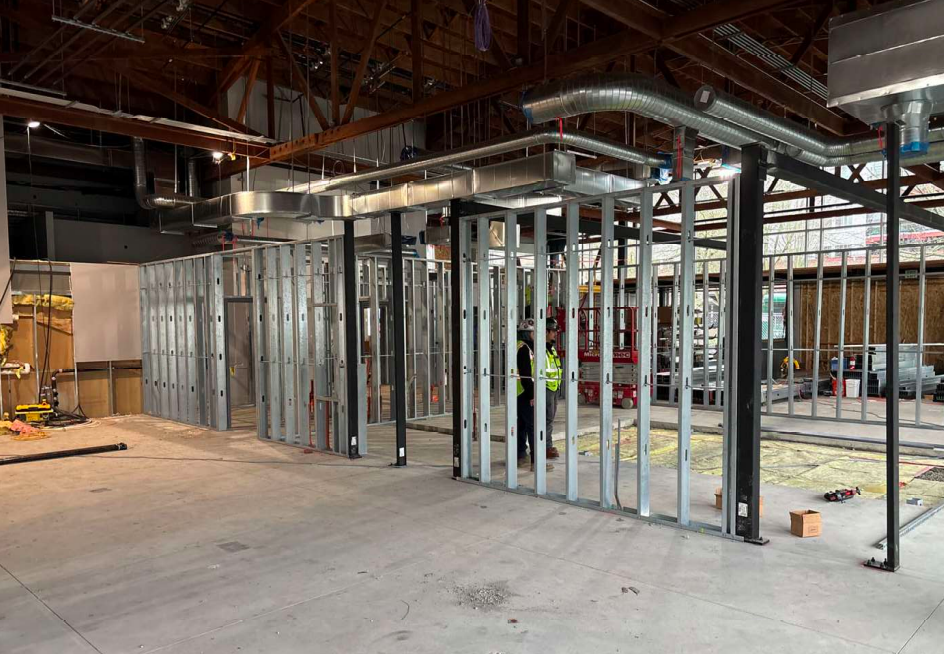
The previously wide-open space of the Pavilion building is being sectioned off by city contractors, to create a new “Market” use. A Federal Small Business Grant is helping fund the project. The building was previously leased to Rain City Catering and used as an event center.
In a recent blog entry I linked to the Federal “Terms and Conditions” that Renton committed to when the city accepted a $1.5 million Federal grant to remodel the Pavilion building from an event center to a market place.
The Federal document includes a commitment by Renton to help any displaced businesses with relocation costs (on page 12). This payment could be actual costs, or a lump sum up to $53,200, at the option of the eligible business.

Rain City Catering leased the building for thirteen years. Their website still features the Pavilion in it’s former event center configuration.
Rain City Catering (King County’s 2024 “Minority-Owned Small business of the Year) was running their event business in the Pavilion for about thirteen years, and then told they would need to vacate because the City was going to renovate the Pavilion into a market.
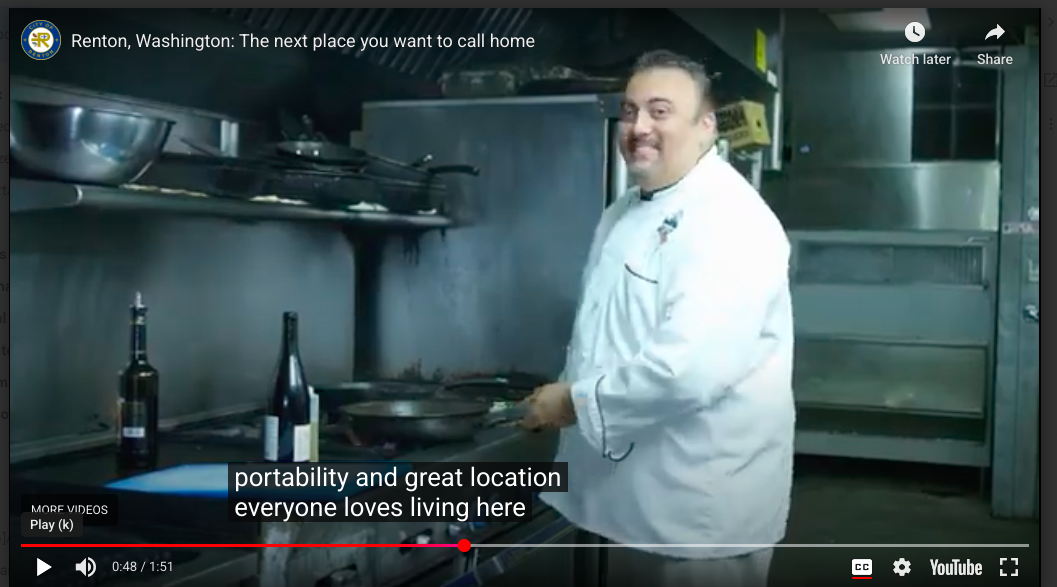
The head chef and partner for Rain City Catering provided a narration for the City’s 2020 promotional video
I contacted one of the partners in Rain City Catering, and he said he does not remember being offered or receiving any relocation assistance. When I asked him how much he thought they had lost, he said the impact of the displacement of their business left them with canceled and lost business opportunities in the hundreds of thousands of dollars, and an abundance of expensive equipment and furnishings that they have had to dispose of at surplus (garage-sale) prices. They have been looking (without assistance) for a new facility, and have not found one.
While I’m not an attorney, I can read regulations. My reading of the referenced federal rules suggests that Rain City Catering should have been considered eligible for compensation. There was a woman-owned “Night Market” operating in the Pavilion, and it’s possible the owner of that business should receive compensation as well.
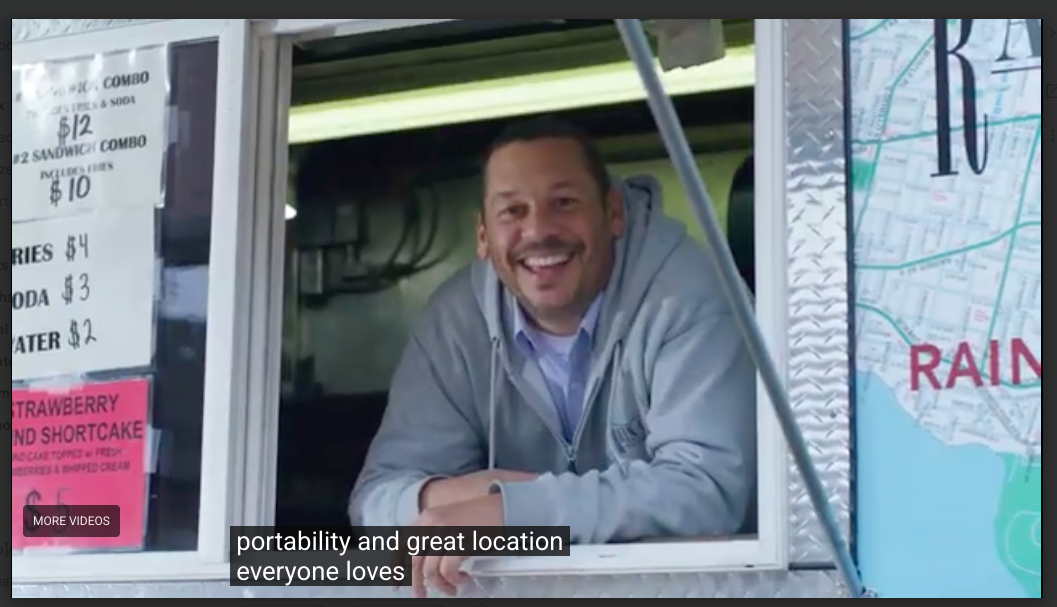
The business manager and partner (and also great chef) for Rain City Catering appeared in the Renton promotional video
The City might claim that the Rain City Catering lease expired, and that is why they were displaced. But that would distort the decision-making record and the timing of the notice to vacate. Rain City Catering’s lease expired specifically because the city was negotiating a rehabilitation and new use for the building. The applicable regulations suggest that any person who occupies the real property and is in lawful occupancy on the date that negotiations begin for a new federally-funded use “are presumed to be entitled to relocation payments and other assistance set forth in this part…” They also say evictions can not be “undertaken for the purpose of evading the obligation to make available the payments and other assistance set forth in this part.
Since I’m not a lawyer I’m going to leave interpretation of the applicable regulations to the readers. I’ve excerpted some of the key language from the Terms and Conditions of the grant Renton accepted, and the underlying federal regulation that are referenced in the grant and cover displaced businesses. I recommend that anyone who feels they have been unfairly displaced by a federal project consider consulting with an attorney to learn what your options might be. (Click below for the details of the regulations)
This is the commitment in the Federal Small Business Association Terms and Conditions that Renton agreed to: (the Recipient is the City of Renton)
“The Recipient and any subrecipients, must, in addition to other statutory and regulatory requirements detailed in these SBA Construction standard terms and conditions and the assurances made to SBA in connection with the Award, comply and require each of its contractors and subcontractors employed in the completion of the Project to comply with all applicable Federal, State, territorial, and local laws, and in particular, the following Federal laws ( and the regulations issued thereunder), executive orders, OMB circulars, OMB Uniform Guidance, and local law requirements….
The Uniform Relocation Assistance and Real Property Acquisition Policies Act of 1970 , as amended 42 U.S.C. § 4601 et seq.), and implementing regulations issued at 49 CFR part 24 (“ Uniform Relocation Assistance and Real Property Acquisition for Federal and Federally Assisted Programs”), which establish uniform policies for the fair and equitable treatment of persons, businesses, or farm operations affected by the acquisition, rehabilitation, or demolition of real property acquired for a project financed wholly or in part with Federal financial assistance.”
This commitment requires compliance with 49 CFR Part 24, which defines displaced persons as
“§ 24.2 Definitions and acronyms”…
“Displaced person means:
…(C) As a direct result of a written notice of intent to acquire, or the acquisition, rehabilitation or demolition of, in whole or in part, other real property on which the person conducts a business or farm operation, for a project. However, eligibility for such person under this paragraph (i)(C) applies only for purposes of obtaining relocation assistance advisory services under § 24.205(c), and moving expenses under § 24.301, § 24.302, or § 24.303.
And it defines small business as:
“Small business means a business having not more than 500 employees working at the site being acquired or displaced by a program or project, which site is the location of economic activity. Sites occupied solely by outdoor advertising signs, displays, or devices do not qualify as a business for purposes of § 24.303 or § 24.304.”
The assurances require Renton comply with this act if the project will result in “displacement”:
Ҥ 24.4 Assurances, monitoring, and corrective action.
(a) Assurances.
(1) Before a Federal agency may approve any grant to, or contract, or agreement with, an agency under which Federal financial assistance will be made available for a project which results in real property acquisition or displacement that is subject to the Uniform Act, the agency must provide appropriate assurances that it will comply with the Uniform Act and this part.”
Subpart C—General Relocation Requirements
§ 24.201 Purpose.
This subpart prescribes general requirements governing the provision of relocation payments and other relocation assistance in this part.
§ 24.202 Applicability.
The requirements in this subpart apply to the relocation of any permanently or temporarily displaced person, as defined at § 24.2(a). Any person who qualifies as a permanently or temporarily displaced person must be fully informed of his or her rights and entitlements to relocation assistance and payments provided by the Uniform Act and this part. (See appendix A to this part, section 24.202.)
(a) Persons required to move temporarily.
(1) Appropriate notices must be provided in accordance with § 24.203 and appropriate advisory services must be provided in accordance with § 24.205;
(2) For persons occupying a dwelling, at least one comparable dwelling, is made available prior to requiring a person to move, except in the case of an emergency move as described in § 24.204(b)(1), (2), or (3) (see appendix A, to this part, section 24.202);
(3) Similarly, if a person’s business will be shut down due to a project which either requires the occupant to vacate the property or which denies physical access to the property, it may be temporarily relocated and reimbursed for all reasonable out of pocket expenses or must be determined to be permanently displaced at the agency’s option;
If a person or business is being displaced, they are supposed to be notified of their relocation options and payments as follows:
Ҥ 24.203 Relocation notices.
(a) General information notice. As soon as feasible, a person who may be displaced or who may be required to move temporarily shall be furnished with a general written description of the agency’s relocation program which does at least the following:
(1) Informs the person that he or she may be displaced (or, if appropriate, required to move temporarily from his or her unit) for the project and generally describes the relocation payment(s) for which the person may be eligible, the basic conditions of eligibility, and the procedures for obtaining the payment(s);
(2) Informs the displaced person (or person required to move temporarily from his or her unit, if appropriate) that he or she will be given reasonable relocation advisory services, including referrals to replacement properties, help in filing payment claims, and other necessary assistance to help the displaced person successfully relocate;”
The terms and conditions require the City to plan for for any displacements:
Ҥ 24.205 Relocation planning, advisory services, and coordination.
(a) Relocation planning. During the early stages of development, an agency shall plan Federal and federally assisted programs or projects in such a manner that recognizes the problems associated with the displacement of individuals, families, businesses, farms, and nonprofit organizations and develop solutions to minimize the adverse impacts of displacement.”
The City is supposed to provide relocation assistance advisory services to displaced persons and businesses:
“(c) Relocation assistance advisory services —
(1) General. The agency shall carry out a relocation assistance advisory program which satisfies the requirements of title VI of the Civil Rights Act of 1964 (42 U.S.C. 2000d et seq.), title VIII of the Civil Rights Act of 1968 (42 U.S.C. 3601 et seq., as amended.), and Executive Order 11063 (3 CFR, 1959-1963 Comp., p. 652), and offer the services described in paragraph (c)(2) of this section. If the agency determines that a person occupying property adjacent to the real property acquired for the project is caused substantial economic injury because of such acquisition, it may offer advisory services to such person.
(2) Services to be provided. The advisory program shall include such measures, facilities, and services as may be necessary or appropriate in order to:
(i) Determine, for nonresidential (businesses, farm, and nonprofit organizations) displacements, the relocation needs and preferences of each business (farm and nonprofit organization) to be displaced or, when determined to be necessary by the funding agency, temporarily displaced and explain the relocation payments and other assistance for which the business may be eligible, the related eligibility requirements, and the procedures for obtaining such assistance. This shall include a personal interview with each business. At a minimum, interviews with displaced business owners and operators should include the following items:
(A) The business’s replacement site requirements, current lease terms and other contractual obligations and the financial capacity of the business to accomplish the move.
(B) Determination of the need for outside specialists in accordance with § 24.301(g)(13) that will be required to assist in planning the move, assistance in the actual move, and in the reinstallation of machinery and/or other personal property.
(C) For businesses, an identification and resolution of personalty and/or realty issues. Every effort must be made to identify and resolve personalty and/or realty issues prior to, or at the time of, the appraisal of the property.
(D) An estimate of the time required for the business to vacate the site.
(E) An estimate of the anticipated difficulty in locating a replacement property.
(F) An identification of any advance relocation payments required for the move, and the agency’s legal capacity to provide them.”
“(iii) Provide, for nonresidential moves, current and continuing information on the availability, purchase prices, and rental costs of suitable commercial and farm properties and locations. Assist any person displaced from a business or farm operation to obtain and become established in a suitable replacement location.
(iv) Minimize hardships to persons in adjusting to relocation by providing counseling, advice as to other sources of assistance that may be available, and such other help as may be appropriate.
(v) Supply persons to be displaced with appropriate information concerning Federal and State housing programs, disaster loan and other programs administered by the Small Business Administration, and other Federal and State programs offering assistance to displaced persons, and technical help to persons applying for such assistance.”
After negotiations for a new project have begun, like the negotiations with a new master lease holder of the Renton Market, eviction of an existing tenant does not eliminate the need to compensate them.
Ҥ 24.206 Eviction for cause.
(a) Eviction for cause must conform to applicable Federal, State, and local law. Any person who occupies the real property and is in lawful occupancy on the date of the initiation of negotiations is presumed to be entitled to relocation payments and other assistance set forth in this part unless the agency determines that:
(1) The person received an eviction notice prior to the initiation of negotiations and as a result of that notice is later evicted; or
(2) The person is evicted after the initiation of negotiations for serious or repeated violation of material terms of the lease or occupancy agreement; and
(3) In either case the eviction was not undertaken for the purpose of evading the obligation to make available the payments and other assistance set forth in this part.”
Moving Expenses:
“Subpart D—Payments for Moving and Related Expenses
§ 24.301 Payment for actual reasonable moving and related expenses.
(a) General.
(1) Any owner-occupant or tenant who qualifies as a displaced person (defined at § 24.2(a)) and who moves from a dwelling (including a mobile home) or who moves from a business, farm, or nonprofit organization is entitled to payment of his or her actual moving and related expenses, as the agency determines to be reasonable and necessary.”
Some of the covered moving expenses are:
“(g) Eligible actual moving expenses.
(1) Transportation of the displaced person and personal property. Transportation costs for a distance beyond 50 miles are not eligible, unless the agency determines that relocation beyond 50 miles is justified.
(2) Packing, crating, unpacking, and uncrating of the personal property.
(3) Disconnecting, dismantling, removing, reassembling, and reinstalling relocated household appliances and other personal property. For businesses, farms, or nonprofit organizations this includes machinery, equipment, substitute personal property, and connections to utilities available within the building; it also includes modifications to the personal property, including those mandated by Federal, State, or local law, code, or ordinance, necessary to adapt it to the replacement structure, the replacement site, or the utilities at the replacement site, and modifications necessary to adapt the utilities at the replacement site to the personal property.
(4) An agency may determine that the storage of personal property is a reasonable and necessary moving expense for a displaced person or person required to move temporarily under this part. Agencies may approve a payment for storage when the process of relocating from the acquired site to the replacement site is delayed for reasons beyond the control of the displaced person. Storage may not be longer than 12 months, starting at the date of vacation from the acquired site and ending when the replacement site becomes available. Agencies may approve storage for more than 12 months in unusual instances as justified, documented, and approved by the agency.
(5) Insurance for the replacement value of the property in connection with the move and necessary storage.
(6) The replacement value of property lost, stolen, or damaged in the process of moving (not through the fault or negligence of the displaced person, his or her agent, or employee) where insurance covering such loss, theft, or damage is not reasonably available.
(7) A displaced tenant is entitled to reasonable reimbursement, as determined by the agency, for actual expenses not to exceed $1,000, incurred for rental replacement dwelling application fees or credit reports required to lease a replacement dwelling.
(8) Other moving-related expenses that are not listed as ineligible under paragraph (h) of this section, as the agency determines to be reasonable and necessary.
….
(12) Any actual, reasonable, or necessary costs of a license, permit, fee, or certification required of the displaced person to operate a business, farm, or nonprofit at the replacement location. However, the payment may be based on the remaining useful life of the existing license, permit, fees, or certification.
(13) Professional services as the agency determines to be actual, reasonable, and necessary for:
(i) Planning the move of the personal property;
(ii) Moving the personal property; and
(iii) Installing the relocated personal property at the replacement location.
(14) Relettering signs, replacing stationery on hand at the time of displacement or temporary move, and making reasonable and necessary updates to other media that are made obsolete as a result of the move. (See appendix A to this part, section 24.301(g)(14).)
(15) Actual direct loss of tangible personal property incurred as a result of moving or discontinuing the business or farm operation. The payment shall consist of:
(i) If the item is currently in use, the lesser of:
(A) The estimated cost to move the item up to 50 miles and reinstall; or
(B) The fair market value in place of the item, as is for continued use, less the proceeds from its sale. To be eligible for payment, the claimant must make a good faith effort to sell the personal property, unless the agency determines that such effort is not necessary.”
“§ 24.304 Reestablishment expenses—nonresidential moves.
In addition to the payments available under §§ 24.301 and 24.303, a small business, farm, or nonprofit organization is entitled to receive a payment, not to exceed $33,200, for expenses actually incurred in relocating and reestablishing such small business, farm, or nonprofit organization at a replacement site.
(a) Eligible expenses. Reestablishment expenses must be reasonable and necessary, as determined by the agency. They include, but are not limited to, the following:
(1) Repairs or improvements to the replacement real property as required by Federal, State, or local law, code, or ordinance.
(2) Modifications to the replacement property to accommodate the business operation or make replacement structures suitable for conducting the business.
(3) Construction and installation costs for exterior signing to advertise the business.
(4) Redecoration or replacement of soiled or worn surfaces at the replacement site, such as paint, paneling, or carpeting.
(5) Advertisement of replacement location.
(6) Estimated increased costs of operation during the first 2 years at the replacement site for such items as:
(i) Lease or rental charges;
(ii) Personal or real property taxes;
(iii) Insurance premiums; and
(iv) Utility charges, excluding impact fees.
(7) Other items that the agency considers essential to the reestablishment of the business.
“§ 24.305 Fixed payment for moving expenses—nonresidential moves.
(a) Business. A displaced business may be eligible to choose a fixed payment in lieu of the payments for both actual moving and related expenses, as well as actual reasonable reestablishment expenses provided by §§ 24.301, 24.303, and 24.304. Such fixed payment, except for payment to a nonprofit organization, shall equal the average annual net earnings of the business, as computed in accordance with paragraph (e) of this section, but not less than $1,000 nor more than $53,200. The displaced business is eligible for the payment if the agency determines that:
(1) The business owns or rents personal property which must be moved in connection with such displacement and for which an expense would be incurred in such move and the business vacates or relocates from its displacement site;
(2) The business cannot be relocated without a substantial loss of its existing patronage (clientele or net earnings). A business is assumed to meet this test unless the agency determines that it will not suffer a substantial loss of its existing patronage;
(3) The business is not part of a commercial enterprise having more than three other entities which are not being acquired by the agency, and which are under the same ownership and engaged in the same or similar business activities;
(4) The business is not operated at a displacement dwelling solely for the purpose of renting such dwelling to others;
(5) The business is not operated at the displacement site solely for the purpose of renting the site to others; and
(6) The business contributed materially to the income of the displaced person during the 2 taxable years prior to displacement. (See § 24.2(a).)
There was a “Night Market” business that was operating in the Pavilion building as well, and their may have been other businesses. This next section could potentially apply to other businesses:
(b) Determining the number of businesses. In determining whether two or more displaced legal entities constitute a single business, which is entitled to only one fixed payment, all pertinent factors shall be considered, including the extent to which:
(1) The same premises and equipment are shared;
(2) Substantially identical or interrelated business functions are carried out and business and financial affairs are commingled;
(3) The entities are held out to the public, and to those customarily dealing with them, as one business; and
(4) The same person or closely related persons own, control, or manage the affairs of the entities.”

I remember the owner of Rain City Catering/Market, was the “Citizen of the Year” for the first River Days after COVID (2022). He’s a Civic-minded chap, and somehow- we can hope and pray the issue is resolved fairly.
This “renovation” of the Pavilion is becoming a Zoo. I’m not thrilled about it- so the Pain better be worth it. How many more issues are going to pop-up with this mess?!
Yes, the owners of Rain City Catering continue to be outstanding contributors and role models in Renton’s business community, even while Renton has pushed them out of their landmark event location and headquarters. In addition to their thirteen years of providing the vital Pavilion venue for our community’s celebrations, weddings, conferences, milestone events, and memorials, they also provide their surplus food to our community feeding programs. Their partner and head chef Jeremy Bryant is among our region’s top chefs, and has received accolades for his excellent work as the Mariners head Chef. And below is a “Visit Renton” post about partner Kenny Rogers from Valentines Day four years ago.
Some city officials are saying that turning the Pavilion into a Market was the plan from the beginning, which is not true. When purchased, this building was always intended to be used either as an event center or a public market, and Council chose an event center back in 2002. In 1997 the Seattle Times covered the story and said “In addition, the city will redevelop a 15,000-square-foot building on the site for possible use as a public market or festival and banquet hall.”
The City had every opportunity to build a Public Market building at the former Big Five site (where the million-dollar television and mini-soccer pitch are now being installed). Renton had seriously considered this location for either a library or a public arts and crafts building when we purchased the Big Five site. (And thankfully the library remained over the river.)
As recently as my blog post on this topic 11 months ago, Renton could have chosen to spend the 12.8 million dollars to build an all-new Farmers Market building at what is now being called “Legacy Square.” The comments on that blog carry a lengthy discussion on this point.
Rain City Catering was offering to remodel the Pavilion at their cost to include a permanent public coffee house, to keep the building and its restrooms open 7 days a week. For the money we taxpayers are spending today, we could have had both a vital Pavilion Event Center AND a Public Market, anchored by a green Piazza with shade trees and fountains and summer market venders. Between a new Public Market, and the coffee house in the Pavilion, and the private “Rain City Market on the east side of the Piazza, we would have had an outstanding market complex, with eyes on the Piazza and enough restrooms to cure the Piazza’s recent cleanliness challenges. A long lease at the event center would have meant we were bringing in hundreds of new visitors every night to come find our gorgeous Market complex.
And the World Cup soccer games could be shown on a projection screen inside the Pavilion, where people could sit comfortably and dine while watching games, enjoying either Market snacks or fine dining from Rain City Catering.
There would be no mad scramble for completion, since the Piazza and Pavilion were ready to go before the excavators came.
I’ve added a photo of the plaque we affixed to the Pavilion when we kicked off it’s life as an event center. The award-winning Mithun Architects (designers of REI’s flagship store) had overseen the design, including installation of an expensive crawl space/plenum floor that allowed conditioned air to be distributed throughout the entire building without requiring HVAC ducting throughout; this preserved the open space, unobstructed glass, and visible truss work while providing quiet air circulation to make it desirable for large events.
Keeping the original truss work was cool. It wasn’t easy. With the rat warrens being setup now, it’s a moot point.
There is a real and serious rat problem downtown I’ve heard, from a South Renton neighbor. Is that what you’re talking about Anonymous?
Marcie P
There’s also a plaque honoring Marge Richter…..where is it?
Time for the Public Works director to be replaced!