 Written by
Property taxes on the Garden Plaza buildings on Park Avenue have dropped by almost half a million dollars as the buildings crumble to the ground. The blight is impacting nearby properties, like the new Southport offices, where property taxes have dropped over a million dollars since 2021. This tax burden shifts to homeowners and renters, making housing increasingly unaffordable.
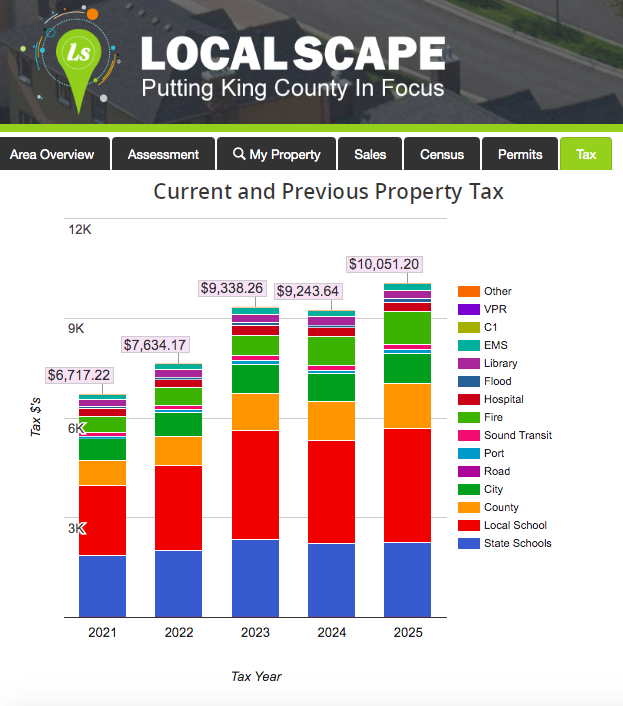
This graph shows the past five years of property taxes on my Renton Highlands home. This data can be easily generated for any property in Renton by using the “King County Tax Transparency Tool.”
Like many other Renton homeowners, I’ve seen my property taxes surge 50% in just four years. My 1959 one-story home has a tax-assessed value of $1,003,000, just one percent higher than the King County average assessment of $997,538. But the annual taxes are $3,334 higher than they were four years ago. and they’re likely to go much higher.
In 2001 Washington voters, concerned about being taxed out of their homes, approved initiative 747 to put a “1% cap” on the amount a taxing district could increase taxes. But this cap doesn’t apply when voters approve the increase, and (when applicable) the cap only applies to total taxes collected by a jurisdiction, not to individual properties. So some property owners can see big tax increases when other see reductions, even when the jurisdiction holds to a 1% increase overall. And taxes still go up even when region-wide property values drop. Hence, my 50 percent higher tax bill over four years could become a new pattern, regardless of whether property values go up or down in the future.
What would it look like if this rate of increase was the “new normal”? If we see 50% increases every four years, the way we have in the past four, this is our 20 year outlook:
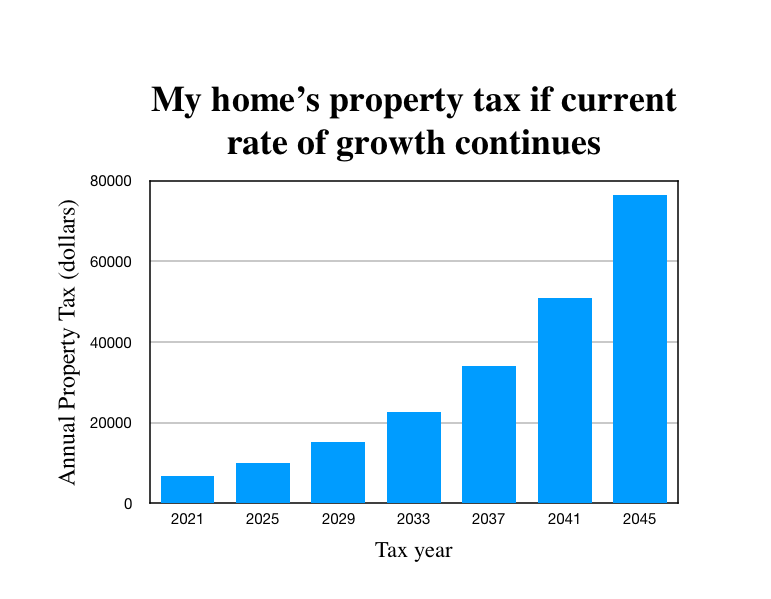
My home’s property tax if we continue with 50% growth every four years
At the current rate of growth, in twenty years my home’s property taxes would be almost $80,000 per year, heavily impacting my retirement planning. People still working would also struggle– few homeowners could pay a mortgage and support a family with an $80,000 property tax payment. And renters will have the $7000 monthly tax bill added to their rent.
While this looks ridiculous, it could happen if local officials do not relearn the discipline of belt-tightening. The first step will be to admit they have a problem.
The City of Renton portion of my taxes has gone up 39% in the past four years, from $653 to $905. In a Q13 Fox report today, Mayor Pavone erroneously told David Rose: “Property taxes have gone up, but it has nothing to do with the City of Renton.” The Mayor was mistaken. Even with the voter-approved “1% cap” on total annual increases in city property tax collections, residential taxes can go up sharply when taxes drop on business properties like the ruined Park Avenue buildings and the former Red Lion Hotel. A friend of mine who heard the Mayor’s statement quipped, does that mean we don’t have to pay Renton’s increased taxes?
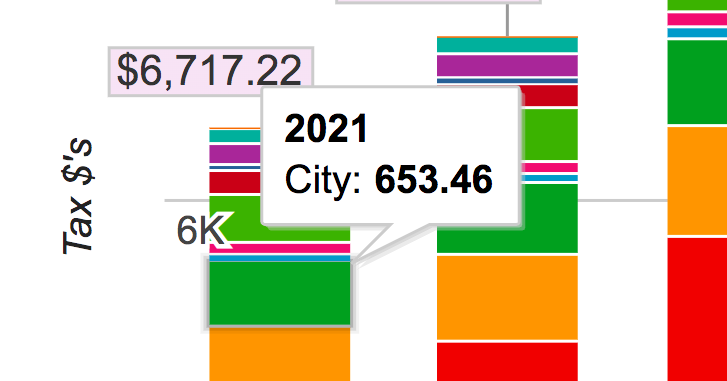
By hovering the cursor over the bars on King County’s Tax Transparency tool, one can quickly see the individual contributors to the taxes. My City of Renton property tax was $653 in 2021, the year I retired from City Council.
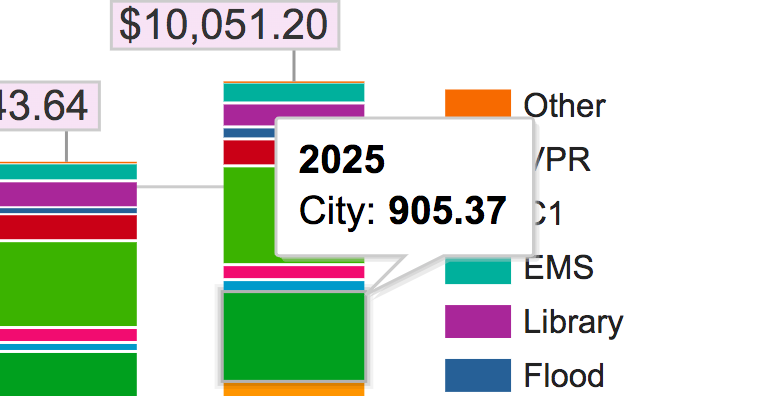
My City of Renton property tax increased to $905.37 by 2025, a 39% increase in four years.
Taxes across all taxing-districts are rising fast, with no end in sight. After a new King County Parks bond was approved in last month’s primary, Renton School District and Valley Medical Center are both asking Renton voters for more money in this November’s general election. The City of Renton is working on its own Park Bond ballot issue for next year, and Sound Transit feels they are about $30 billion dollars short, and talking about going to the polls for more. The other taxing districts will not be far behind. Our property tax increases are far out-pacing most people’s wage growth, and if our taxes keep rising at the current pace fewer and fewer people will qualify for home purchases or leases. Many more of our current residents will become unhoused.
It doesn’t have to be this way. We were able to actually lower city taxes in the past by diligently managing every penny of our tax revenues, and ensuring we maintained a thriving business climate. Our elected officials must focus on solving problems using the record amounts of money taxpayers are already giving them, not by constantly asking for more.
[Note: updated on September 20 with new second paragraph summarizing state tax structure and “1% cap,” in response to a question by “GoRedhawks!” in the comments ]

Straight ticket liberal concerned about taxes? That’s funny.
There’s no ideology that means being blind to bad spending or high taxes. Wasteful spending of our taxes screws over the very services we need like healthcare, education, or infrastructure.
I think there’s common ground in this.
I want my tax dollars used smartly, not thrown away, so we can have results without breaking the bank.
If property taxes continue to rise at this rate to make up for the short sighted decisions made by the city, I will either be on the couch of a friend (if they have one) or I’ll be in line at the library to use the bathroom with everyone else.
[Note from Randy Corman: This question by GoRedhawks is so important that I added a new second paragraph to my blog post to address it. Readers should be advised this was asked before that explanation of our tax structure was included]
Am I missing something here? Property taxes have gone up because home prices have gone up. Your home has probably gone up $400,000 in value in five years so of you are paying more in property taxes.
Let’s pretend your house had a 2021 appraised value of $700k. Your home value has increased $300k or 43% in 4 years.
Would it be ok to say property taxes would also go up by about 43%? That means your payment of $653 should grow to be $933. You actually paid $905. You are actually paying less property taxes now to the City than expected?
What is wrong with my assessment here?
Thanks Go Redhawks! for the important question. I’m sure others are wondering the same thing.
The property tax process in our state is so complicated that I’ve seen Finance Directors become exasperated trying to explain it to experienced lawmakers, sometimes for the second or third time. Here’s my quick summary:
Voters in our state became concerned about rising property taxes forcing everyone from their homes, so in 2001 they approved Initiative 747 which implemented a “1 % cap” on how much taxing districts can increase their total property tax collections from one year to the next without voter approval.
The implementation of this cap gets rather complicated, because the 1% cap applies to total collections by a district, not the collection on any specific property, and there are a variety of exceptions to it. Most importantly, a taxing district can exceed the 1% if voters approve it. Also, they can exceed the 1% with the addition of new construction property added to the tax rolls. And they can exceed the 1% if they have “banked capacity” from earlier years in which they did not increase property tax by the full 1%.
Once a total amount of tax is determined for a district within these constraints, then the tax assessed values (the estimated fair market value of each property) will guide how much of the total tax is collected from commercial properties vs. residential properties. For example, if commercial properties fall in value while residential properties increase, homeowners will pay an increasing share of the taxes. (This is one of several reasons that it’s valuable for cities to maintain a thriving business base.)
This Department of Revenue article explains it in more detail.
My major concern is that these taxing districts are continually going to voters asking for substantial increases in our taxes, and while each individual request might sound okay, the end result could tax many people out of their homes. I’m also concerned that we’ve neglected code enforcement for some gateway business properties, depressing commercial values, and the result has shifted the tax burden to residents.
It’s hard to keep track of how all these tax increases add up with time and how residents are getting impacted vs businesses. This tax transparency tool is a good way to do it.
Thanks again for asking the question.
If mortgages is didn’t have escrow accounts and renters got a separate bill for property taxes, this nonsense would go away.
I think when people finally go a year without any money at the end of the month in their bank account, they’ll begin to wake up and wonder.
Here’s a potential NEW TAX Renton Council will be voting on at Monday’s (9/22/25; 7PM) Council meeting.
CRIMINAL JUSTICE PURPOSES SALES TAX
AGENDA – Finance Committee Meeting
4:00 PM – Monday, September 22, 2025
7th Floor Council Conference Room/Videoconference
a) AB – 3928 Executive Services Department recommends adoption of an ordinance implementing a one-tenth of one percent (0.1%) sales and use tax, as allowed by ESHB 2015 (Section 201 of Chapter 350, Laws of 2025), for criminal justice purposes.
Agenda Bill:
https://renton.civicweb.net/FileStorage/9BD479745F1E41D0B837DEF2AE286387-Criminal%20Justice%20Purposes%20Sales%20Tax.pdf
Presentation: https://renton.civicweb.net/FileStorage/EAE3DB842ACA4DC2BD58E705F2A784D3-COR%20-%20ESHB%202015%20Ordinance%20-%20Finance%20Committee%20-%2009.pdf
This is just a way to let Carmen Rivera wash her “defund the police” demands.
The next revision of her campaign materials will certainly use this.
You losers will get Carmen and learn to like it. You’re not doing anything but blogging.
This ugly attitude does nothing to uplift the Renton community, or improve the candidate’s chances of reelection.
Carmen Rivera is a dedicated ally and advocate for the LGBTQIA+ community, with unwavering support for Black trans women and all marginalized identities. She champions inclusive policies and resources, including affirming healthcare and support for chestfeeding pregnant individuals, to uplift and empower every member of our diverse communities.
That’s true… when she isn’t trying to beat or harass them.
Thanks Marcie for bringing up this potential sales tax increase for Public Safety. Here are my thoughts on this.
This tenth-of-a-percent sales tax would increase Renton’s sales tax revenue from around 38 million dollars to about 41 million dollars. It also will unfortunately keep Renton at one of the highest sales tax rates in the state, at 10.4 percent, similar to some nearby cities. (The lowest tax cities in the state are at about 7.7 percent.)
For comparison, if Renton could wave a magic wand and get retail businesses to sell 10% more goods and services, the city could get a similar boost in revenues. But it’s not easy to get a 10% increase in sales, and crime in our business districts works against this goal.
If the money truly adds to public safety, and can help reduce assaults, burglaries, and shoplifting in our business districts, it could be worth it. But we need to be sure the Council adds these funds to the current public safety budget, and does not just replace the public safety budget with this money and then spend general fund money somewhere else.
If this tax is implemented, a good five-year goal would be to boost our retail business by 50%, so that City of Renton get’s five times as much additional money as this tax increase offers– and then roll back this new tax to try to work to lower our sales tax rate again.
If I was still on Council I would want to talk this through with other Council Members and the public, and make sure we had a solid plan and agreement on how the money would be used.
50 years of liberal tax and spend idiocy got us here, more isn’t going to help.
Even at 9% we were driving to Portland to batch our large purchases.
Liberal just means that they care about liberty. It’s in the name. /s
Increase business by 50%? You kidding? I can’t even talk the franchise folks into even looking at a Renton location. They gave me a choice, MP, Issy, Bellevue, but not Renton. And if I don’t like it, I can sell the territory rights back to them and move on.
I understand your reaction, and I recognize that Renton is not pulling in businesses the way we were ten years ago. You could well be right that we could not hit such an aggressive target.
I suggested a 50%-over-five-years goal for a few reasons: (1) Our Council should have a stretch-goal to keep them focussed on growing our business sector; (2) We’re still coming out of the pandemic, and should be expanding to catch up to where we were were; (3) Ideally, successful small businesses should each be growing in revenue by 5%-15% per year (I recognize external forces are working against them); (4) Our current growth capacity calls for tens of thousands of more residents, and we should have businesses and sales tax revenue to go with them (during the 28 years I was on City Council, our city population increased by 250 %, about 8 % per year)
Sorry for being anonymous, but taxation in WA has gotten so bad that we’re moving part of our corporation out of state.
So who’s the council member that supports this nonsense?
I’m calling on all current council members to back Mary Clymer.
Ed Prince and Armando Pavone have stepped up to do what’s right for Renton.
Unlike Carmen Rivera, Mary is the obvious reasonable choice. She hasn’t demanded to defund the police and hasn’t engaged in domestic violence.
Ed Prince deserves another four years of Carmen. Maybe Carmen will slap him around a bit.
Interesting choice of words there, Anon.
Right? Council members who don’t publicly support Mary Clymer shouldn’t expect future support from me.
Where were you when these tax increases were happening, Randy? I don’t remember you holding them back.
I was always working to hold down taxes. Here is a blog post on the topic. https://www.randycorman.com/?p=8876
The biggest one was the RFA, and you successfully advocated for it with the fig leaf that the “people voted for it.”
Ah yes…. The you voted for this stuff even though the people you pay to understand this stuff didn’t tell you that your taxes would jump though the roof excuse.
Just to clarify, our total property tax bills obviously did go up during the 28 years I was on City Council, but the rate of increase was much less than it is today. Over the 28 years my property taxes went from approximately $2,500 to $6,700, a rate of increase of about 3.4 % per year. Our Renton City portion of this tax (the part I had direct control over) grew more slowly, but Sound Transit, Schools, King County, the Hospital and others pushed it to the 3.4 % level.
The overall rate of increase has been about 13% per year since I retired from City Council. If the rate of increase had been 13% per year during the 28 years I was on Council my $2,500 tax bill would have increased to about $35,000 from 1994-2021. My taxes rose to only one-fifth this level because some of us were being extremely frugal with taxpayers’ money and monitoring carefully how every penny we collected was beings spent. That’s the type of discipline we should all be insisting on from all our public officials.
So who’s the council member that supports this nonsense?
It’s not easy finding property tax data online that goes back more than five years. I have found this report that shows average property taxes for the King County portion of the tax going back ten years, and it validates what I have been observing: In the five years prior to 2021, King County tax increased approximately even with inflation. Since 2021, the increases are running sharply ahead of inflation, at an accelerating rate. I think we are seeing this trend across most taxing authorities that comprise our property tax. Here is the report with this data. The blue line is inflation, the black line is the King County portion of our property taxes for a median home. (The orange line is a reference if the taxes followed the assessed value of homes, as if I-747 had not passed limiting taxes to one percent).
More homeless will drive regular people away, and that will keep us elected! This is a good thing!