
 Written by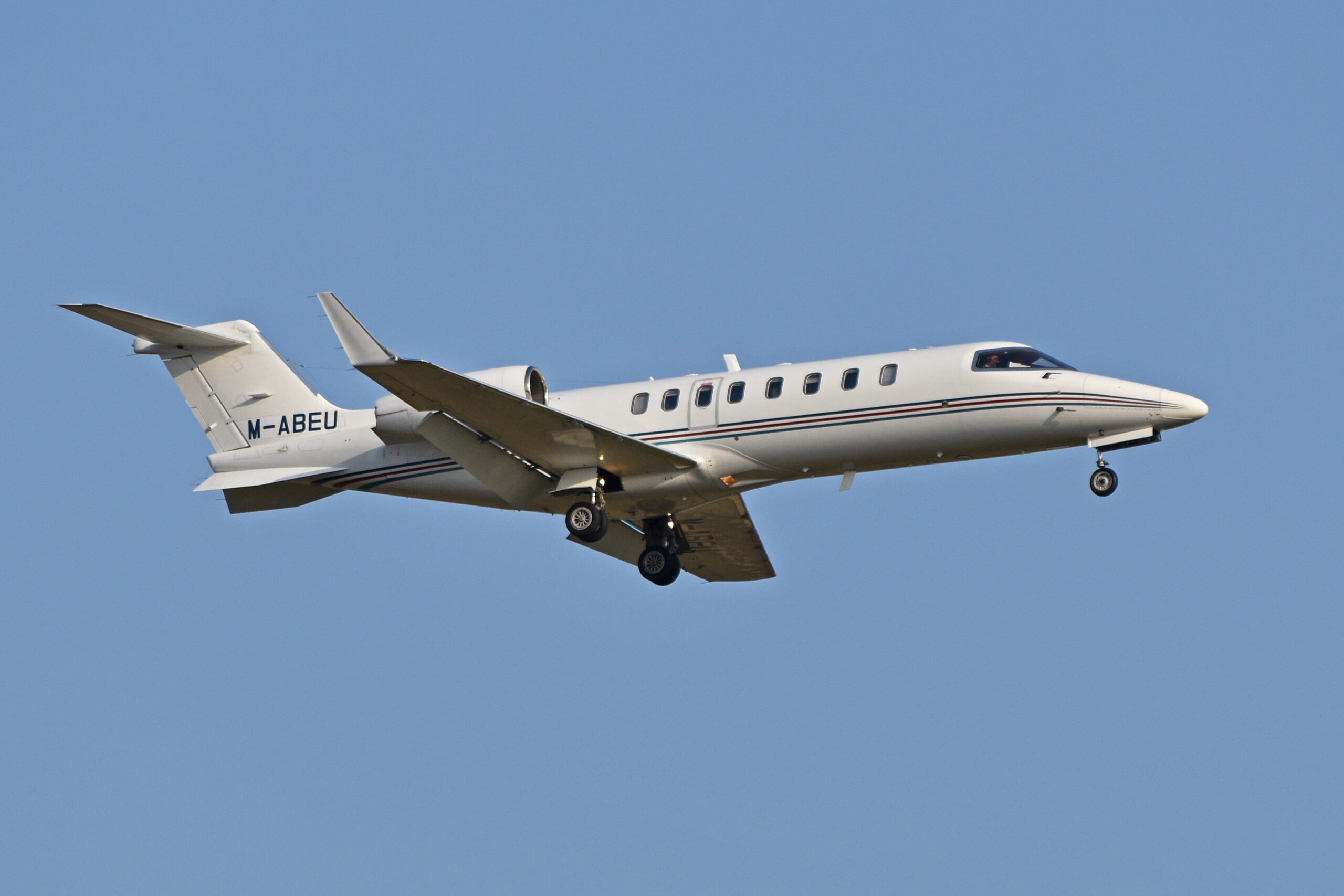
A Wikimedia Commons image of a Learjet 45. There were two Learjet 45 arrivals in Renton overnight, along with several other business jet arrivals and departures.
In previous posts I shared that Renton airport was being actively marketed as a business jet center for the first time, and that we were going to start getting round-the-clock jet operations if we didn’t stick to our Airport Sustainability Management Plan.
The Mayor responded by publishing his “Plane Speak” memo which included the nonsense assertion that the airport would be closed when the tower was closed (something that isn’t true and would not be allowed by FAA). Here is a quote from the memo: “Will Renton Municipal Airport be opened up to 24/7 jet traffic? No, any business operations will be subject to the air traffic control tower operation hours – from 7:00 AM to 8:00 PM in winter; and 7:00 AM to 9:00 PM during summer.”
After hearing some jet activity last night, I took a look at the flight tracker to see how much traffic we are starting to get on a typical night.
The FlightAware flight tracker shows five business jet arrivals in Renton last night. A Cessna Citation from Milwaukee at 9:51 PM, A Gulfstream G200 from Chicago at 12:31 AM, A Learjet 45 from Anchorage at 2:56 AM, A Bombardier Challenger 600 from Bakersfield (Meadows Field) at 1:00 AM, and a Learjet 45 from Juneau at 12:52 AM.
There were also two overnight departures, a Learjet 45 left for Juneau at 2:26 AM, and a Bombardier Challenger 600 departed for Portland at 1:40 AM.
There were no propeller aircraft operating at these hours; only jets in Renton in the middle of the night.
As we get into the summer months and residents begin leaving windows open at night, the noise from these jets will likely become a bigger issue. If residents become concerned, they should write to the Council at council@rentonwa.gov, and ask the Council to adhere to the Renton Airport Management Sustainability Plan to keep our community airport from turning into a regional jet center.


Renton airport arrival data for last night, pulled from Flight Aware flight tracker
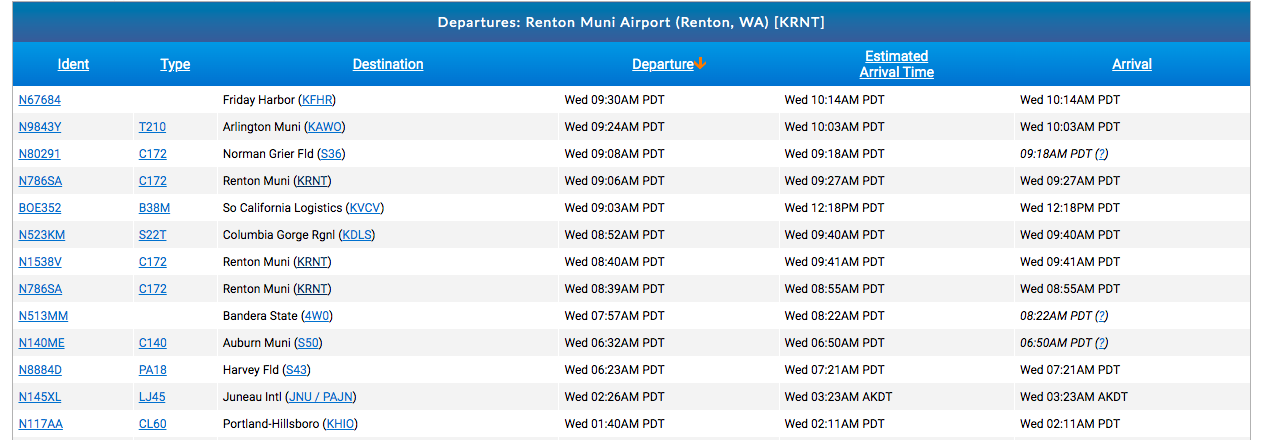
Renton airport departure data for last night, pulled from Flight Aware flight tracker


Looks like 5 of those 7 flights were air ambulance and/or organ transplant flights to save lives.
https://www.guardianflight.com/about/overview
https://www.aeroair.com/transplant
It also appears the remaining 2 flights were due to temporary construction closures of Everett Paine Field and Boeing Field since both of those aircraft repositioned to those airports the next day.
Two of the operations appear to be jets that are too big for routine use of our runway. If they did this every night, FAA rules would require that Renton extend the runway into Renton High School.
The Gulfstream G200 appears to have a balanced field length of about 7000 feet, about 1600 feet more than we have on our 5,382 foot runway. Depending on how loaded the airplane was, if an engine quit on takeoff there would have been minimal to no chance to recover.
The Challenger 600 balanced field length is 6200 feet, about 800 feet more than we have at Renton airport. Again, this airplane would have had minimal chance to recover if an engine quit on takeoff.
These jet airplanes land and takeoff at around 140 MPH compared to a propeller planes typical speed of about 40 MPH. These high jet speeds on a 5,382 foot runway leave no margin for errors.
The Renton School District is about to spend half a billion dollars building a new school on the land that would be needed for a runway extension.
Boeing Field has a runway about 10,000 feet long, and Seatac’s runways are 9,000-12,000 feet. These are much safer and more appropriate for regular private jet traffic.
We can’t keep encouraging more business jets without considering the impacts to the safety and well-being of the Renton community.
From my knowledge, Renton has never had a GA business jet accident. Whereas, there have been several piston aircraft accidents over the past two years alone, one just this past month. Don’t quite get the negativity towards GA business jet operations at Renton, especially the live saving operations.
Business jets are noisy, and they will trigger an airport expansion with just a few more flights.
It’s ok not to want our city resources to go to the crazy rich people who just used our town as a landing pad.
Are you suggesting the airport should not support life-saving flights for patients and/or organ transplant tissue?
I’m saying nothing of the sort. In fact, I’ve always been proud of the fact that Renton Airport provides a number of life saving services, including rescue helicopters and more recently as a base for Lifeflight air ambulance services. These uses are all vital to the public health and consistent with our past policies and our Renton Airport Management Sustainability Plan.
I’m saying that we need to be careful not to invite regular jet landings from jets that have a balanced field length that exceeds the length of Renton Field. While these jets can operate from Renton on an occasional basis (as in the case of an emergency), when the total of these operations added to the total Boeing operations exceeds 500 in a year, Renton will likely be required to extend our runway length by 800 feet as nearly happened in 2019. This puts the runway into the new high school, that taxpayers are paying a half-billion dollars for.
In addition, when the balanced field length equals the runway length, there are only two seconds of margin for the flight crew to react in the event of an engine-out on takeoff without overrunning the airfield. If the balanced field length exceeds the runway length, there may be insufficient time to react. This would not be a good practice for regularly conducting flights in an urban airport, regardless of how critical the flights are. If a flight is critical for life saving, it should be flown out of an airfield that is long enough for a safe takeoff and landing.
I’m happy that Renton was available temporarily, but Renton citizens also deserve safety in the long term.
I can scarcely forbear my glee at the thought of metamorphosing your poxy little aerodrome into the veritable business-jet portal that my eminent clientele so richly demand.
Randy can you point me in the direction of where you’re getting the balanced field length requirements from? I’d like to educate myself on the topic. Are the stated figures at max gross takeoff weight, etc? Thanks
Thanks for asking, Anonymous. The balanced field length is a valuable reference for how compatible an airplane of a certain size is with specific fields, but like all things in aviation there are many factors that impact it. I just did a quick search, and I like the way this online pilot journal describes it.
The balanced field length for each model of aircraft can usually be found with a google search, by looking for manufacturer’s data or sales data. It’s typically expressed for the max gross weight on a dry runway on a normal temperature day at sea level. Partially loaded airplanes will have a shorter balance field, but a wet runway, a hot day, (or a non-sea-level airport which does not apply in Renton) can result in a longer balance field. Because there are so many calculations that go into the specific safety of a specific jet at a specific airport for a specific set of weight and environmental conditions, the FAA has published airport design advisory materials requiring airports to be sized accordingly for any category of aircraft that are making more than 500 operations per year. When I was on Council in 2019 we did a deep-dive into these requirements when the FAA nearly required we extend Renton Field for the increased number of Boeing 737 deliveries, and only backed off because deliveries fell due to the pandemic and Boeing’s reduced production rates.