
 Written by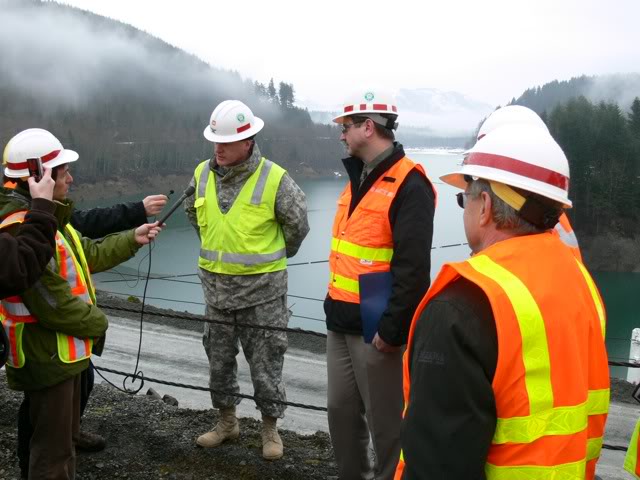
Photo: In March the Corps of Engineers briefed us on problems with the abutment of the Howard Hanson Dam
Word just came down from the Army Corps of Engineers that they will be dropping the water level behind Howard Hanson Dam due to very fast seepage through the abutment adjacent to the Dam. You can read a lot more detail on this abutment issue in my March blog on this topic here.
The new report further emphasizes the potential risk of flooding along the Green River when the rains return in the fall. All businesses and residents in the potential flood plain are encouraged to obtain flood insurance if it is at all possible.
Here is today’s status from the Corp of Engineers:
___________________________________________
Engineers continue caution at Howard Hanson Dam; conservation pool levels being brought down
June 23, 2009
Contact: Casondra Brewster 206-764-6958 or Public Affairs 206-764-3750
SEATTLE – Testing in conjunction with the conservation pool rise at Howard Hanson Dam is ongoing. With the recent findings and observations at higher levels in the reservoir pool, Engineers are concerned that the right abutment is showing signs of internal erosion.
The U.S. Army Corps of Engineers, Seattle District, has been in the midst of testing during its traditional summertime conservation pool raise. The pool reached an elevation last week of 1,169.2 feet and engineers saw renewed reasons to believe that the abutment is still weakened.
Of particular concern is the recent dye testing that shows that water is moving through the right abutment very fast at higher pool elevations. These tests indicate that there are preferential flow paths within the natural materials of the right abutment that could lead to internal erosion within the right abutment if water is held at these higher elevations for extended periods of time.
“This phenomenon continues to be troubling,” said Mamie Brouwer, Program Manager. However, there is no visual distress of the right abutment that has been observed, she said.
Although data collected below 1,157 feet seems to stay within normal ranges, elevations going higher seem to cause more seepage and uncertain water paths through the abutment.
Therefore, the Corps of Engineers has decided to release water from the dam over the course of the next two weeks, to bring the pool level down to 1,155 feet above sea level. This operation will result in reservoir outflows that are not expected to exceed 1,200 cubic feet per second based on current weather and hydrologic forecasts, which is within established thresholds. Residents along the river will not see significant changes in the river flows over the next two weeks
Around-the-clock monitoring continues, as will other data-collection processes during the pool draft.
“We do not understand how the water is traveling through the abutment,” Brouwer said. “We know that what we may be seeing fits the traditional definition of internal erosion.”
The Seattle District’s immediate objective is preparing for the upcoming fall/winter flood season. Preparations include continuing with plans to construct an interim seepage barrier wall and improving the drainage tunnel to control seepage through the most critical part of the right abutment, and continuing to monitor the pool throughout the draft. Simultaneously, the team has initiated test borings, geotechnical modeling and analysis to support planning for a long term repair project to address seepage.
Meanwhile the Seattle District Commander, Col. Anthony O. Wright, wants the downstream community residents to know that the risk for higher flood levels is significantly increased compared to what they are typically used to, until such time as the issues with the dam’s right abutment can be resolved.
“I can’t stress enough our number one mission here is public safety,” Wright said. “We will continue to keep Green River Valley leaders and first responders informed. We ask that residents contact their community leaders and get as much information as possible on how to prepare for such a contingency.”
Wright was referring to the Corps’ efforts of working closely with King County and the downstream cities of Auburn, Kent, Renton and Tukwila to prepare for the fall/winter flood season with the increased risk of higher-than-standard flows from the dam.
“Regardless of the possibility of increased flow rates from the dam,” said Dam Safety Program Manager, Rob Romocki, “It truly is important for the communities to understand that this is a river valley and the potential for flooding exists even when Howard Hanson Dam has full operational capacity and the levees work as they should. So, it’s easy to see the risk increasing when the dam has a lowered operational capacity.”
Information on flood preparedness may be found at: http://www.kingcounty.gov/safety/prepare/FloodPlan_GRiverBasin.aspx
Updates regarding the dam may be found at: http://www.nws.usace.army.mil .

“It truly is important for the communities to understand that this is a river valley”
Yeah right, many of the people that live and work around here weren’t here before the Howard Hanson Dam was built. So with the flooding controlled they chose to move in closer to the river. This should prove an interesting winter for many.