Council changes policy at worst possible time for North Renton residents, denying them Council representation

In a quasi-judicial hearing, Renton Council would look for errors in the building application process. Renton Council just decided to no longer conduct these hearings, after the North Renton neighborhood had been told for years that it would happen.


The Renton City Council swiftly made a major policy change at their last Council meeting, sending all land-use appeals to King County Superior Court instead of the Renton City Council.

While the council may have had good intentions with the change, they followed a flawed implementation process that left the North Renton neighborhood feeling betrayed and put in an unfair position.

For three years the Council has told North Renton residents that residents can’t discuss the Logan Six project with Council because it would eventually be sent to the Council for a quasi-judicial review.  At that time, the Renton Council, acting as judges, would formally review all aspects of the entire record of the project and make sure that residents had not been victimized by any errors in the process.  But after three years of telling North Renton residents this, a mere month before the long-awaited quasi-judicial hearing by Council would occur, the Council surprised virtually everyone by canceling their role in the appeals process and all future appeals processes.  Many North Renton residents understandably now feel hurt and betrayed.

The City made at least three errors in their implementation of this policy change that led to this betrayal.  (The policy change may have been reasonable, except for these errors.)

(1) The Council should have given the public better awareness and opportunity to comment on this policy.

This policy change was made swiftly, gliding through Renton’s Planning Commission and then two readings on Renton City Council in less than a month’s time.  Unless Renton residents were carefully monitoring the Planning Commission, which very few do, they would have missed virtually all discussion on this topic.  The group most severely impacted, those concerned about the Logan Six project (which many feel is too large with too little parking), did not have awareness this was coming.

Policy decisions benefit immensely from public input, and this change is so far-reaching that Council should have given ample time for the public to be notified and give input to council.  This is a change that has been discussed by Council in decades past, and has positive and negative ramifications, which the public could have been educated on, and commented on, with leads to my second complaint about the process:

(2) The administration should have presented both pros and cons of the policy change to the Planning Commission and City Council.

The Planning Commission was given a staff statement to base their deliberations on, which gave a positive account of how this change would improve communication between Council and residents concerned about a nearby project. Council would not have quasi-judicial constraints on their communication with residents during the life of the project (i.e. not every communication would have to be formal and on-the-record).

But the administration left out the negative consequences of the change– the reasons that Council has never changed this policy in past decades:  The quasi-judicial council review gives residents an easy and efficient way to appeal Hearing Examiner decisions, that does not require the extraordinary time, complexity and expense of going to Superior Court.  In addition, the Council appeal process ensured that the legislative body itself, the very ones setting the rules and codes, made a thorough review of all documents, and then a determination regarding whether the rules– that they had set– had been followed.  Without this Council review, residents and the King County Superior Court are left to try to try to surmise for themselves what the legislative intent is for specific rules, while residents typically must pay attorneys somewhere between $20,000 – $100,000 to represent them.

The Planning Commission and Council should have been presented with both sides of this argument.  Then Council should have notified the public of a possible change with a press release, and held it long enough to give ample opportunity to hear from residents and builders.  They could have scheduled a council public hearing on the topic, since the existing policy has been in place for many decades, and the change is so far reaching.  An open public discourse regarding this change would have assured that all factors were taken into consideration.  No matter what the final policy choice, Council, residents, and home builders would have understood the rationale without suspicion.

(3). Most important of all, Council should have set the policy for new applications, but not changed the policy mid-process for projects in work. 

They especially should not have changed the process for a project just a month away from it’s Council review, after refusing to discuss the project with residents for three years.  This amounts to a complete denial of legislative representation for the residents impacted.


Until Sound Transit and Metro better serve us, Renton should rework our parking standards

Looking east across the site of the proposed Logan Six development (field in lower third of photo), toward the adjacent historic homes in the North Renton neighborhood.  Residents are concerned their neighborhood streets will be inundated with cars from the 100-unit Logan Six, which they fear has too little parking for its size. They are also worried about traffic in and out.


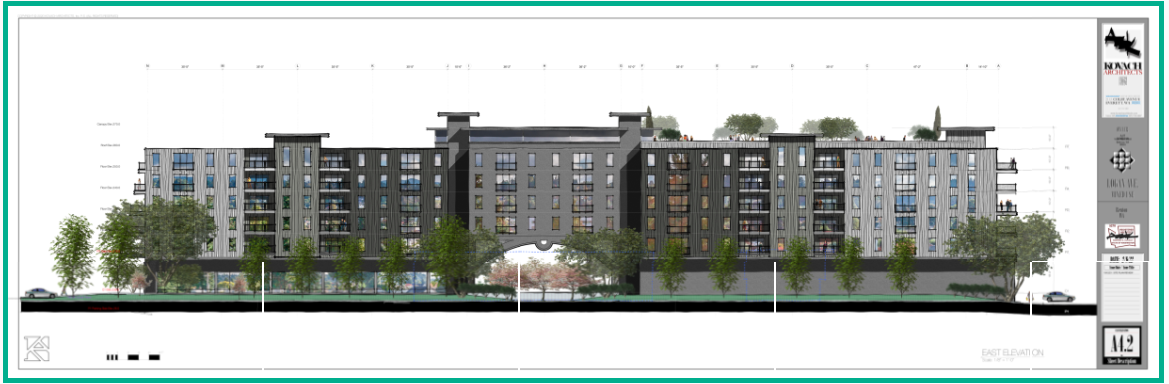
Architects rendering of proposed Logan Six Development. The project includes 1, 2, and 3-bedroom apartments, but has only one parking spot per unit.


North Renton residents have brought the long-simmering issue of Renton’s parking requirements back to the forefront. They are rightfully concerned about parking in their neighborhood.  As the new Logan Six project makes its way through the process, it would be a good time for Renton Council and staff to reevaluate our parking standards to prevent the kinds of parking controversy that this project has generated.

For decades, King County Metro and other transit advocacy groups have encouraged Renton to reduce our parking requirements.  Ten years ago  King County Metro Transit concluded a lengthy study capturing their recommendations for “right sized parking” in their service area.  The goal of the study was to encourage transit use and lower housing costs by avoiding “overbuilding”of parking.

The recommendations were controversial, because Metro was encouraging Renton and other suburbs to reduce our number of parking spot requirements to Seattle levels, even though our level of transit service was nowhere near as good as Seattle’s.  Some of Renton’s Planning Commissioners, Council members,  and staff embraced the recommendations, and some of us didn’t.

Continue reading →

Deathtrap buildings on Park Avenue unsecured a month after Public Safety Chair assured public they would remain secured

Open sections in the chain link fence around the site give quick access to the dangerous buildings.

A month ago the North Renton Neighborhood turned out in force at a Renton council meeting, to beg for action in resolving the hazards and blight caused by the dystopian Park Avenue Buildings.  These formerly beautiful office buildings were allowed to swiftly fall into ruin over the past 18 months.

When the damage begun in 2023, many of us encouraged the city to save the multi-million dollar building complex by repairing the property  at owner expense through the enforcement and abatement process defined Renton’s Code Section 4-5-130 .  To meet code, the buildings needed some windows replaced, water dried out, some lights left on, and ideally (with owner coordination) a caretaker or non-profit tenant to keep the buildings looking occupied…the precise steps any good homeowner would take before an extended trip away from home.  The City could take the action to abate the building, and the expense could be billed to the owner and/or placed as a lien on the property.  The money would also come back to the city through property taxes many times over (as opposed to losing all property tax associated with the building, which is ultimately what happened).

Continue reading →

Park Avenue office buildings, sold by Boeing in 2021, are vandalized and heading toward ruin

The glass doors on 500 Park Avenue have become plywood. And the beautiful glass wrapped staircases that jet out in front of the building, giving the building distinction, have been repeatedly damaged by vandals.


Those of us who worked for Boeing have great memories of the sprawling company office campus in North Renton, with some of the nicest buildings being 535 N 6th street and 500 Park Avenue North.  Both buildings, built in the 1980s, offered excellent work spaces and conference rooms, easy parking, and nice views.  Thousands of us either worked-in or visited these warm, inviting engineering and logistics centers, sometime around the clock when big projects were in-work,  letting ourselves in using our badges that functioned like key-cards.  Boeing always cared for them meticulously, the way the company oversees all of its properties.  Company employees affectionately referred to the buildings by their company codes;  the larger one was the 10-16 and the smaller one the 10-13.

500 Park Avenue North from near the larger building at 535 N 6th street


These buildings were sold by Boeing to an LLC owned by a San Diego Company in 2021 as part of a property consolidation , and unfortunately the buildings have been vacant ever since.  During that time Renton started seeing worsening crime problems throughout the area. Renton also saw dramatic increases in the number of people experiencing homelessness in Renton, a challenge actually made worse by the King County Regional Homelessness Authority. The agency bussed hundreds of chronically homeless individuals from downtown Seattle to Renton hotels, and when an individual broke too many rules, the Authority would evict them out of their hotel space and onto Renton streets.

While Boeing never would have let it happen under their watch, the buildings under new ownership are beginning to look abandoned, with broken windows on all sides, doors that appear boarded up and barricaded, metal gratings and fixtures stolen for scrap, and HVAC and electric service stripped of parts.

Two weeks ago there was a fire on the first floor of the taller building, and the Renton Fire Authority extinguished the flames and rescued two people and a dog from the roof.  It’s obvious that people have been entering these buildings without authorization.  Broken windows have been covered with wood to block intruders, but it does not appear that anyone is currently doing fire repair and remediation work, like drying out the interior before mold sets in.  The other building, the 10-13, is missing some of it’s upper windows, letting the elements get in.

Renton Regional Fire Authority put out a fire in 535 Park Ave North on June 11, and rescued two people and a dog from the roof of the building


Continue reading →