Hi, I'm Randy Corman, Renton City Councilmember. I am the most senior member of the council, currently in my 25th year (I have been elected seven times). I pay for this website with my own funds. Please recognize that all views expressed in my journal entries are my own, and not the official position of Renton City Council, other councilmembers, nor the city of Renton. Thanks for reading.
Sarah Becker asks for Council assistance regarding the taking of property near Renton High School
Many long-time residents are being forcibly evicted from their homes by a new ballfield being built with the rebuild of Renton High School. These residents have been seeking assistance from Renton’s Council and Mayor in recent City Council meetings. City officials keep ducking the spotlight, either saying nothing or insisting it’s the School District’s jurisdiction. This is a shirking of their responsibility, for half a dozen reasons.
Many Renton School supporters feel they are being “Gaslighted” when told by district leaders that they voted to expand Renton High School into the neighborhood, taking 40 homes and businesses
Summary: Renton voters were not told before the election that homes and businesses would be taken if the 2022 Renton High School bond issue passed. And the District has attempted to confuse the public about this by changing the description of the bond issue on their website after the election.
Like the majority of Renton voters, I’ve always voted “YES” when asked for more funding by the Renton School District. Our children are our future, and they deserve the best start in life that we can give them.
But about a year ago I had an unexpected online disagreement with the husband of a School Board member, when I learned about the neighborhood that is being forcibly taken and destroyed to support the school expansion. He seemed to think it was common knowledge that the mass condemnations were going to happen, and I said I was not in favor of it. I had thought the school was going to move if we approved the bond issue. His comments sent me to the School District’s website to get my facts straight.
Well, it turns out, the School District CHANGED the details of what we voted for, after the election.
Bob Baker has been working to Save the Cedar River. His organization can be found here
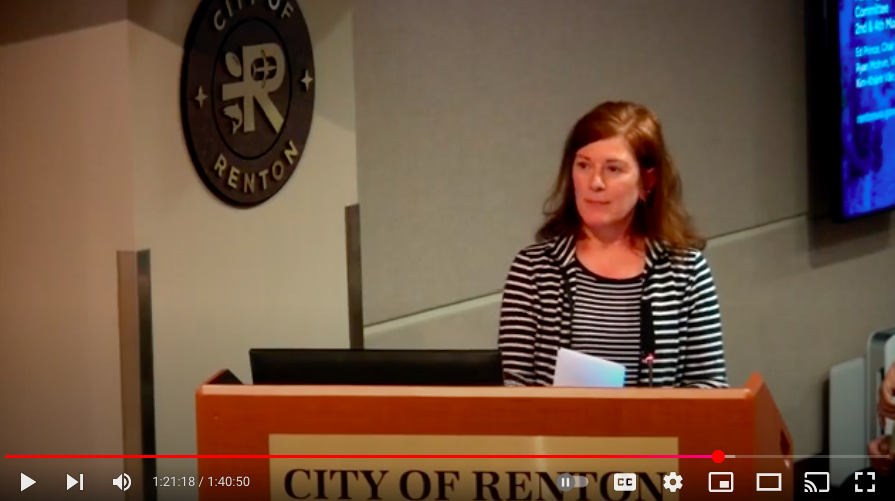
Bob Baker, who manages the Save the Cedar River effort, gave testimony in last night’s Council Meeting. The meeting can be viewed here. Mr. Baker’s testimony begins at about one hour and 25 minutes into the meeting.
“Thank You for this opportunity to address the council and Mayor.
Eight years ago I joined a group of concerned citizens to stop a hot asphalt plant with RAP (recycled asphalt) from destroying the Cedar River, and ruining the Quality of life for thousands of citizens. The more I learned about the effects this facility would have on not only my community, but those from Maple Valley, through Renton and into Skyway I vowed to make this my lifes priority.
I sought Experts who specialize in the immediate and lasting effects of Ashalt Plants, especially RAP. The results were staggering. We talked to experts throughout the US, OSHA and even the UK to get the proper training on how These plants effect Air, Ground, Water, Human Quality of Life, Fish and Wildlife, Traffic, even plant life. We sought help from elected officials, including each of you. In fact I have a video of at least four of you giving a thumbs up to support this issue, including the use of city funds to stop the possibility of an Environmental Disaster.
But, after your re-election when we sought your assistance, you turned your back on us, even after you saw scientific evidence and a letter from your water district 90 asking the County to stop the plant due to the damage it will cause to their Aquafer. But why I am here is the fact that last Monday Councilman James Albertson made the comment that the scientific evidence was being considered “misinformation”. Now we may never know why Council has turned their backs on their own citizens an myself, but I take it personally that you would publicly label this evidence Misinformation.May I ask who has given you this misguided information? I have a list of my experts that I will share with you if needed. Please feel free to contact them.
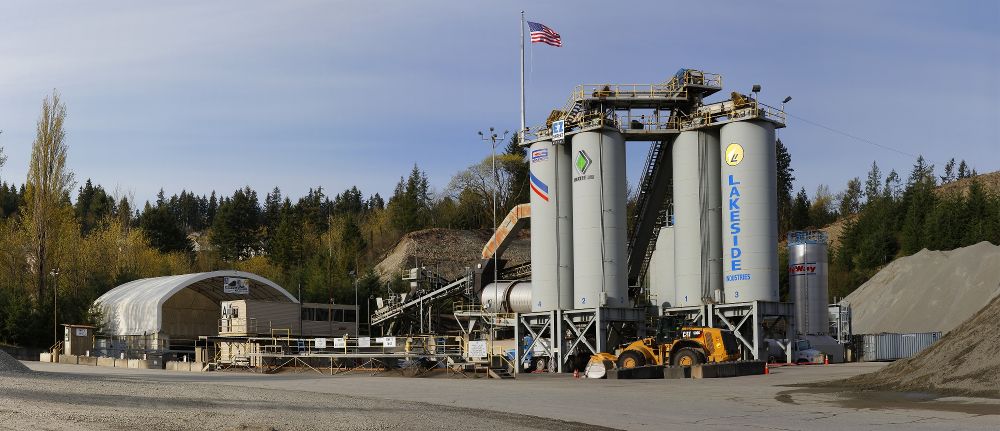
The Council President seemed to be defending the placement of an asphalt plant in this sensitive natural area next to the Cedar River and over Renton’s sole-source aquifer
A reader wrote to me and said their friend wrote to City Council about the asphalt plant. Their friend got a lengthy response from the Council President, and they asked for my thoughts on this letter. I said it had some similarities to the message that the Public Works Director had put out a few days earlier, but no longer had the sections that I had easily debunked in this blog post. This letter offered a new set of arguments, probably also promulgated by Renton’s Public Works Director. These argument are equally wrong.
The note the reader sent from the Council President is shown in sections in red below, and my responses are in green. My responses are not copyrighted so, please feel free to send them back in response to his letter.
Council President: As part of the internal environmental review, the Public Works Department evaluated the potential contamination risk to the city’s drinking water sources by the proposed site activities and determined the risk should not cause concern for the following reasons:
The city’s Maplewood Wells do not pump from the shallow Cedar Valley Aquifer. The Maplewood Wellfield is drilled into the deep production aquifer (confined aquifer) that is encountered from approximately 135 to 345 feet below ground surface. The Maplewood Wells are located approximately 3.2 miles from the proposed Asphalt Plant .
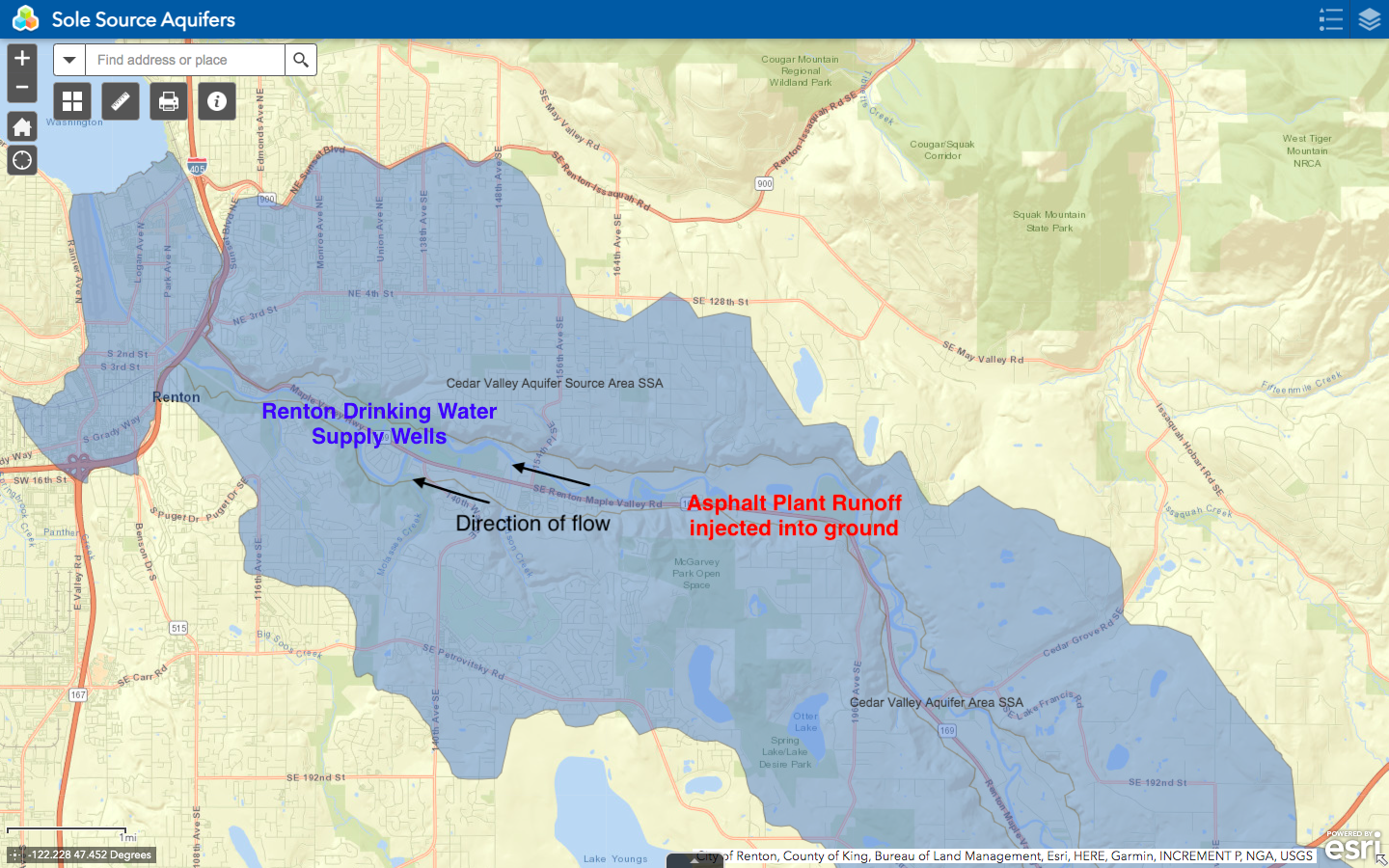
Randy’s response: Renton’s wellfield monitoring study makes it clear that the aquifer is an underground river that flows from Cedar Valley recharge areas (including near the Asphalt plant) to the Maplewood Golf Course wellfield area, and then to the areas near our downtown wells. Water can easily move underground, and the dissolved contaminants like benzene and heavy metals will not be completely filtered out.
We’re not pumping fossil water out of our aquifer. We’re pumping water that has accumulated in the aquifer recharge zone during the last decade or so. The water is not sealed off from the surface, or else the aquifer would be empty. Renton is pumping billions of gallons per year from the aquifer. We don’t need to intentionally introduce heavy metals and other contaminants from new and recycled asphalt into it. We should remain assertive about protecting our recharge zones with whatever means we have available.
“Where’s the Poison? The battle of wits has begun.” A memorable scene from “Princess Bride”
I found a city response about the asphalt plant online, but it has not yet been spread very broadly. I’m refraining from linking it at this time, because I’m not sure it deserves the high exposure it would get from my blog. (I think it should be rescinded.) But in case anyone has found it, here is my rebuttal.
In a recent memo on the Asphalt Plant, Renton’s Public Works Director, Martin Pastucha, addressed the existential risk of the Asphalt Plant poisoning Renton’s sole source aquifer, calling the risk “relatively low.” Relative to what? Is this the kind of confidence we should be basing the future of our city and the health of our children and grandchildren on?
But it’s worse than that. The Public Works Director based his vague non-assurance on a map of our “ten-year wellhead protection zone”, and relied on it being 1.75 miles away from the proposed asphalt plant. He implies, contrary to the data, that the water could never travel 9,200 feet through porous sand and gravel underground, even though Renton’s Maplewood Wells are downhill and sucking hundreds of millions of gallons of water per year– like giant drinking straws.
If Mr. Pastucha had ever bothered to read the report that formed the foundation of Renton’s “ten-year wellfield protection zone” he would have read this important statement:
“It is important to recognize that the aquifer limits shown in Figure 2-5 do not necessarily represent distinct boundaries that separate geologic materials containing groundwater. ” This is followed by the explanation that “the aquifer appears to extend several miles upgradiant of the bedrock narrows (near Renton’s wells)”
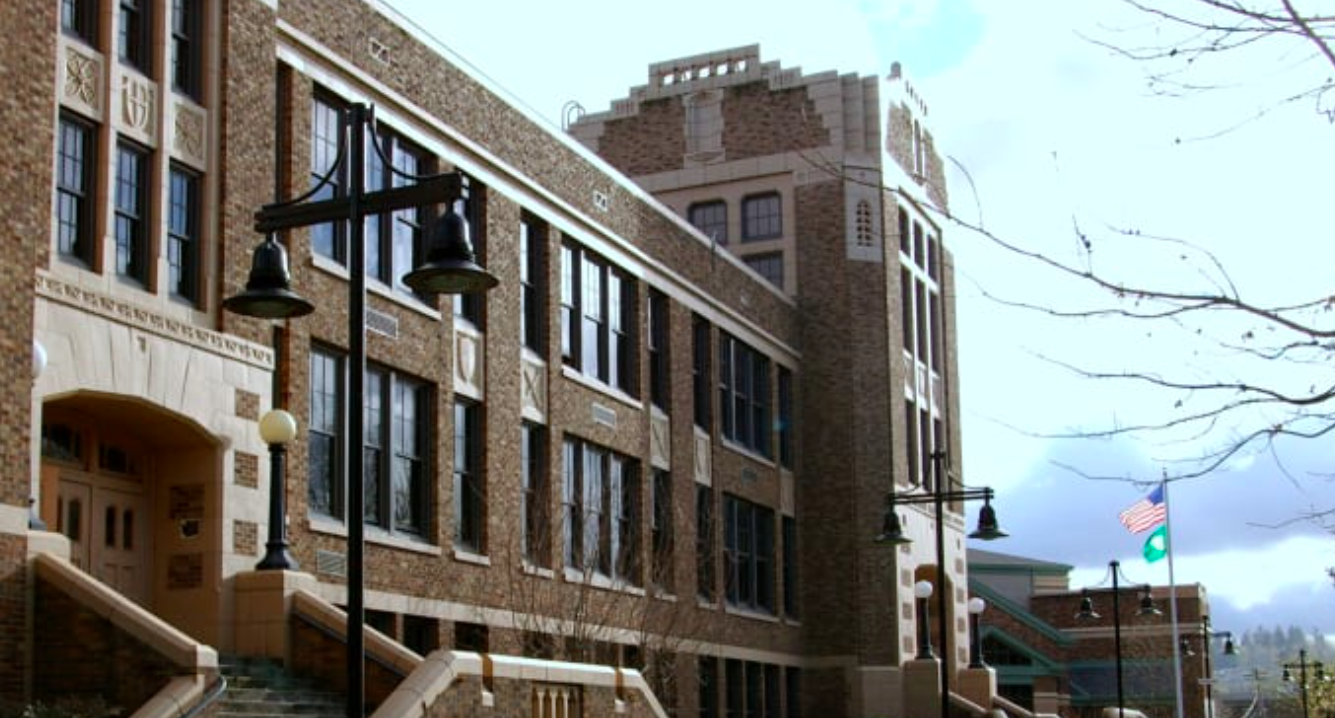
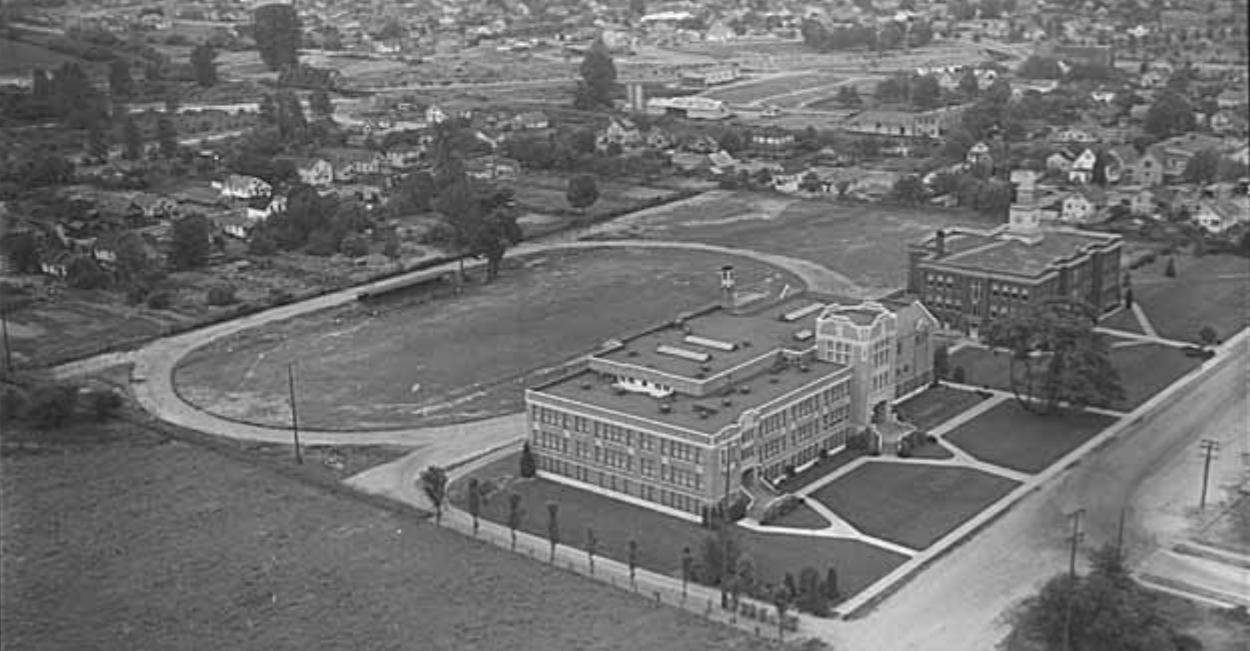
Renton High, 1938. Ten years later Renton Memorial Stadium was built on 17 acres nearby, to provide the high school with a football and track stadium. The School Board voted this week to use eminent domain to enlarge this school site into the neighborhood around it.
I’ve been writing about eminent domain on two topics, the Renton School District and the proposed Asphalt Plant. In this post I share some of my personal background being on both sides of eminent domain actions, and discuss a little about when I think it is an appropriate tool.
Being on the receiving end:
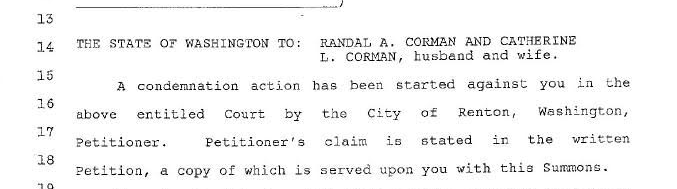
My wife Cathy and I were on the receiving end of a condemnation action in 1988. We challenged the “public necessity” in Superior Court and won, but that does not always happen. The experience led to my 28-year service on Renton City Council.
I have been impacted by an eminent domain action directed at me and my wife in the past. That experience helps me understand what it is like being the subject of an eminent domain taking. Our trial also helped set a judicial precedent on the definition of “necessity,” that, according to my attorney, was cited in many later cases.
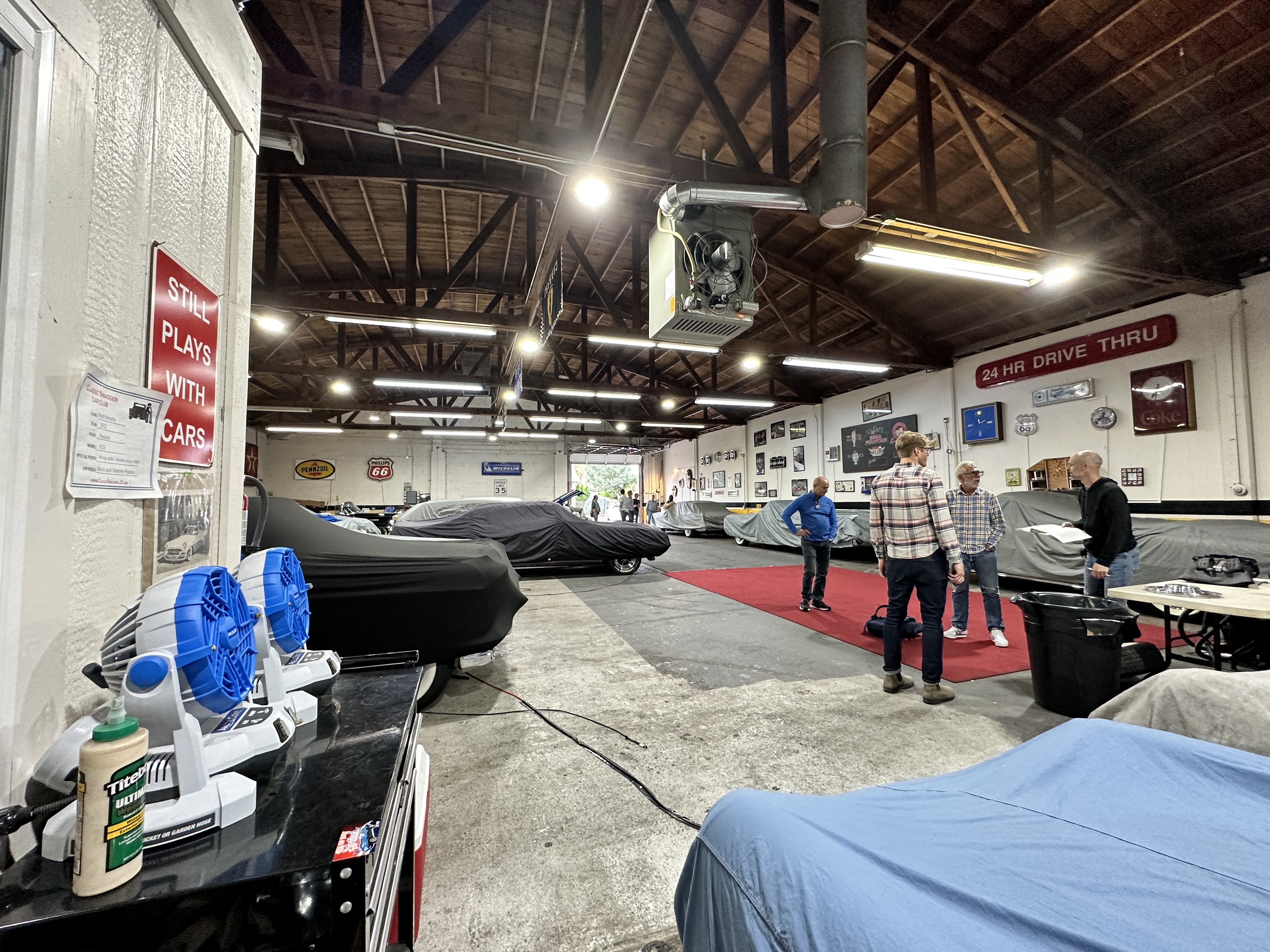
Billy O’Neill, “Dale Chihuly’s right hand man,” (in white sneakers) selecting the large facility on Airport Way for his decorative glass making studio. The venue was going to teach youth and adults the art of Chihuly style glass making. The large open-bay building features the same old-growth historic bowstring-trusses that caused our city council to save the Pavilion building in the 1990s.
It was a dream come true for Renton’s Arts Community, our youth, and our Economic Development department. A world-class glass studio was relocating to Renton, headed up by the vice-president and operations manager of Chihuly’s workshop in Seattle. Billy O’Neill, who Seattle Times calls Dale Chihuly’s right hand man, was working on a gift for Renton that would have taught new generations of Rentonites how to create beautiful glass sculptures and containers. Mr. O’Neill has served on the Seattle Arts Commission, as secretary on the Executive Board of Directors of the Seattle International Film Festival (SIFF) and on advisory boards for the Seattle Sounders and other non-profits– a perfect fit in Renton. He was instrumental in creating Chihuly’s Garden of Glass at Seattle Center.
But the exciting glass art studio fell victim to a School District Eminent Domain taking, along with numerous other businesses and homes, with no acknowledgment by the School Board of the glass studio’s extraordinary significance.
The business, called “Glass Eye” already has a permanent sales location at Pike Place Market, which would have soon been selling the Made in Renton glassworks. We would have a new Made-in-Renton products we could share with visitors and far-away family, to replace our much-missed Uptown Glassworks.
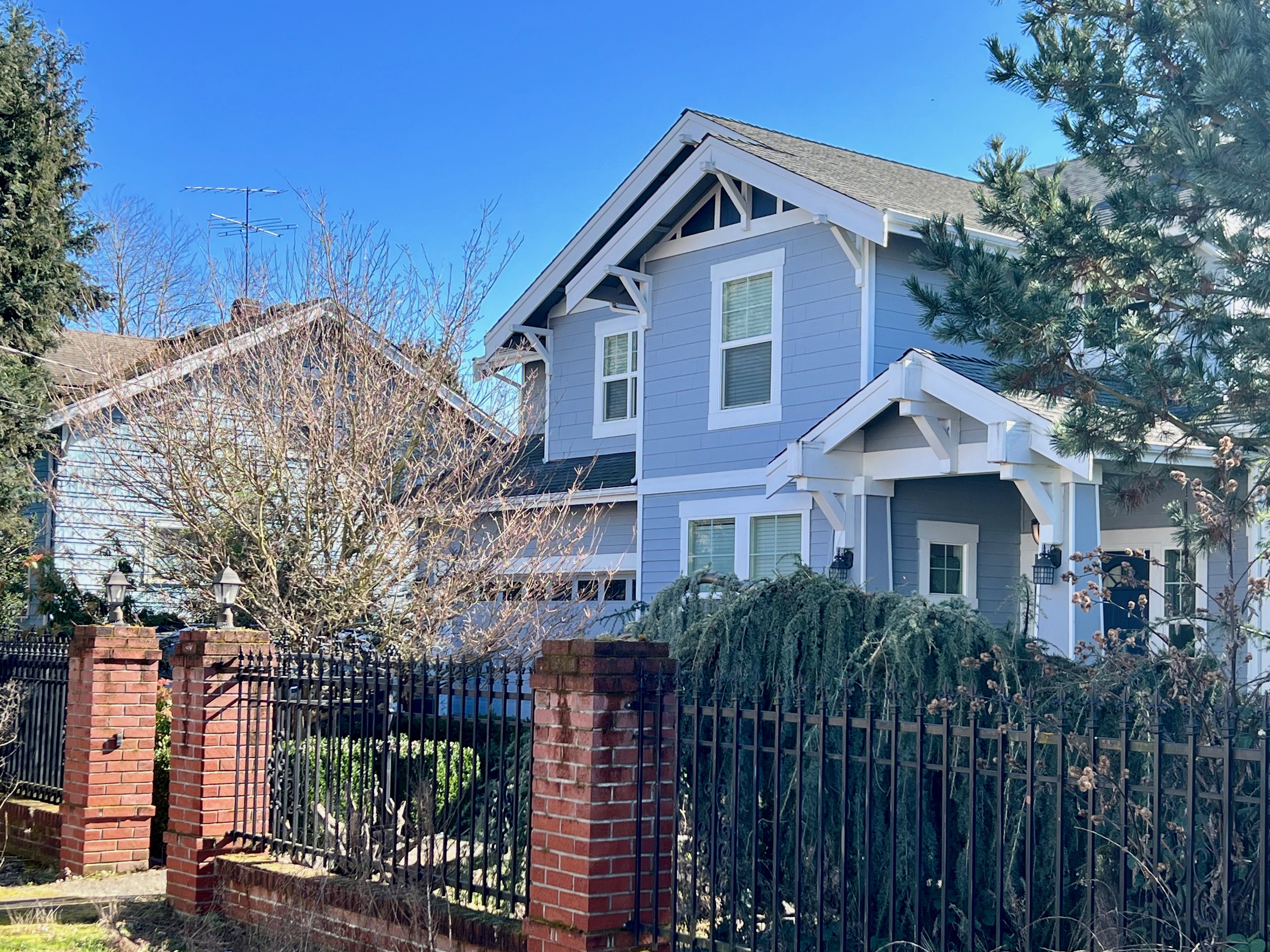
A home on Tillucum Street in Renton; one of many that the School District is attempting to purchase to build a new softball field
As I’ve discussed previously in this article concerning Renton Airport, the Renton School District has been buying up properties north and east of Renton High School to expand the school’s site.
Some owners of homes and business owners have reached an agreement with the district– reluctantly in some cases. The map below shows the status of the purchases to date. Some of the early agreements were commercial or rental properties, which are somewhat easier to price.
But there are many homeowners shocked and saddened that the district is pressing them to turn over their homes. Some of them have preserved the property in their families for many years, and some are families who financially stretched to buy a home of their own. This neighborhood’s residents have have been part of the fabric of our downtown for decades, and many are deeply rooted in our schools, clubs and other organizations. For most, their homes are not just a roof and four walls on a lot– they are their histories, futures, hopes, dreams, and connections.
Important! The two-day Council offsite Feb 27-28 is at Maplewood Golf Course, Magnolia room, not at Renton City Hall. The public is welcome to attend, and there should be comfortable seating. However the public will typically not be allowed to comment at the meeting.
The City has reworked their website, and the new version currently is missing an enormous amount of important information.
For instance, Public Meetings are not properly identified on the new Council Calendar. There is a two-day council off-site that is occurring tomorrow and Friday but not found on the calendar. I’ve attached the agenda below.
At Monday’s council meeting, a Council member essentially characterized this data as misinformation, and said that an Administrative press release would be issued by the Mayor’s office with more details about why this scientific data was misinformation.
I’m looking forward to critiquing this issue paper, if it ever comes out. I have doubts about whether it will, because I don’t believe the City of Renton will be able to find an engineer who values their reputation and license and is willing to guarantee that Renton’s water will never incur pollution threats from the asphalt plant. The city may be able to find “story tellers,” willing to say the plant is going to always be safe, but the scientific reports will prevent conscientious engineers from doing it. Partially treated runoff being injected into our aquifer recharge zone is bad enough. But add in the additional risks, from landslide,fire, floods, earthquakes, and coal mining sinkholes, all familiar events in this area, and the asphalt plant is an obvious poor engineering fit on this aquifer recharge zone.
RCW 8.12.030. Every city and town …within the state of Washington, is hereby authorized … to condemn land or property… either within or without the limits of such city …for the purpose of protecting such supply of fresh water from pollution.
But on the other hand, I strongly recommend the City reconsider issuing such a press release. At the end of the day, residents need their Council to step up and purchase this site to protect our water supply. Every day the Mayor’s communication specialists spend writing a fictional story about why the plant is not a bad thing, it costs the city more money that could be spent on purchasing the site. Furthermore, by creating such a document, it will become a lobbying tool for the applicants of the asphalt plant, regardless of how much of a scientific farce it is.
Citizens to Save the Cedar River, an organization that has spent $300,000 opposing this plant, report that the plant would have already been stopped if Renton had provided an amicus brief (a friend-of-the court statement) opposing the plant. They say Renton would not do it, and I don’t know if this was the decision of the Mayor, or someone whispering into his ear. If the Administration now issues a press release which pretends their hands are tied, I hope this press release includes an explanation of why they passed on this very clear opportunity to protect our aquifer for future generations. Such an explanation will take a while as it requires some very creative storytelling.
And this time, please include the author of the press release. Residents and our City Council deserve to know specifically who is misleading them.
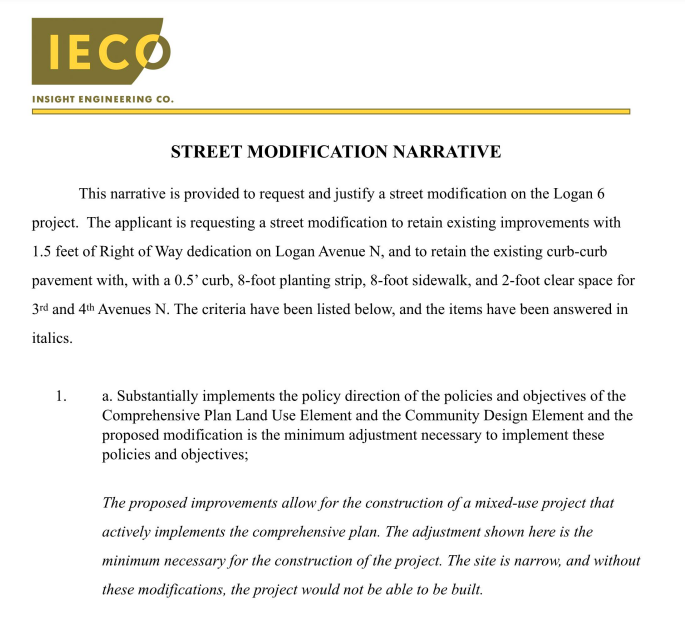
The initial submittal for Logan Six in 2022 included a street modification request. Final line of item 1: “The site is narrow, and without these modifications, the project would not be able to be built.” Council could have questioned the scale of the project on the record.
At last night’s council meeting, a Council Member told the audience that the State of Washington forced Renton to approve the Logan Six development with only one parking spot per unit.
While the State of Washington did implement parking regulations in 2020 that could potentially supersede a city’s parking regulations, the state standards specify a minimum standard of one spot per BEDROOM, as opposed to the lesser standard of one spot per unit that Renton has imposed on Logan Six. Here’s the State law on this topic. (Presumably the 0.75 spots per unit applies to studio “no-bedroom” units)
Cities planning under RCW 36.70A.040—Minimum residential parking requirements.
In counties and cities planning under RCW 36.70A.040, minimum residential parking requirements mandated by municipal zoning ordinances for housing units constructed after July 1, 2019, are subject to the following requirements:
….
(3) For market rate multifamily housing units that are located within one-quarter mile of a transit stop that receives transit service from at least one route that provides service at least four times per hour for twelve or more hours per day, minimum residential parking requirements may be no greater than one parking space per bedroom or .75 space per unit. A city or county may establish a requirement for the provision of more than one parking space per bedroom or .75 space per unit if the jurisdiction has determined a particular housing unit to be in an area with a lack of access to street parking capacity, physical space impediments, or other reasons supported by evidence that would make on-street parking infeasible for the unit.
Reason 2: the Council probably had an easy opportunity to stop this project after the first submittal in 2022 if they had wanted to. In the initial submittal for the project, the applicants provided a letter making it absolutely clear that they were concerned the site might be too small for the project.
In the relatively brief two page letter, the applicant says they need a Street Modification because of their overly narrow site. Then they say three times that without this modification, they could not build the project. Here are some excerpts:
“STREET MODIFICATION NARRATIVE
This narrative is provided to request and justify a street modification on the Logan 6 project. The applicant is requesting a street modification to retain existing improvements with. 1.5 feet of Right of Way dedication on Logan Avenue N, and to retain the existing curb-curb. pavement with, with a 0.5’ curb, 8-foot planting strip, 8-foot sidewalk, and 2-foot clear space for. 3rd and 4th Avenues N…..
The site is narrow, and without. these modifications, the project would not be able to be built….
The modification also allows for the project to be built at all, given the narrowness of the site….
The shown modification is required for the building to be done without incurring additional. costs. The site is narrow and if much more were given, the project would likely not pencil….”
Any of Renton’s eight elected officials could have questioned the requested modification, on the record, and consequently questioned whether the project may be too large and dense for the site. Even the rules governing quasi-judicial hearings do not bar Council members from asking questions about a project, on the record. Since the developer said three times they were concerned the project would not fit on the site, this would have been an opportune time to scale it to a better size.
Instead, Council did not ask any questions and City Staff appear to have approved the modification request, enabling the project to go forward.
So no, the State did not require this project to take its present form, pushing the street boundaries set for the zone with consequent minimal parking. That appears to be just a story.
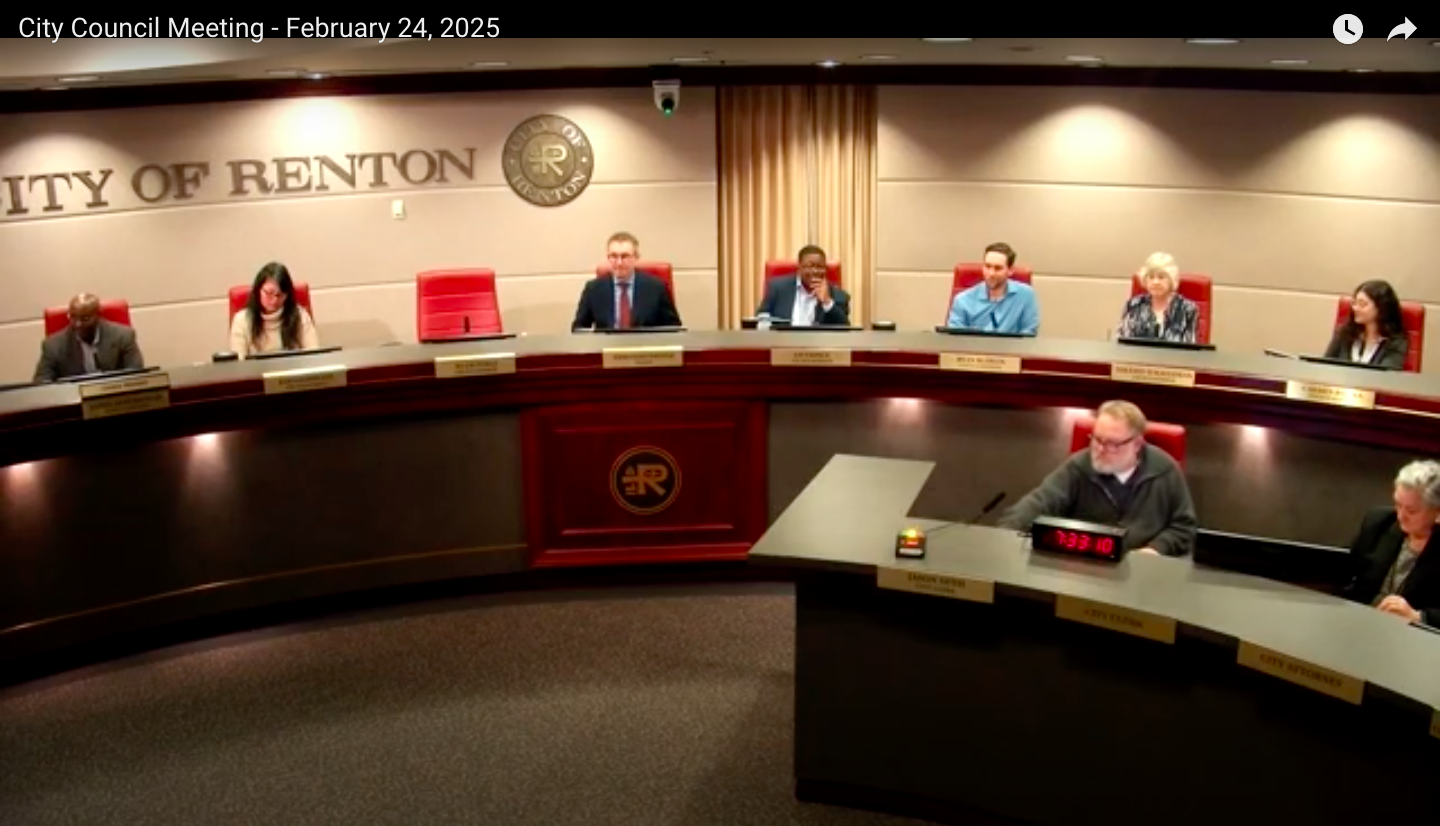
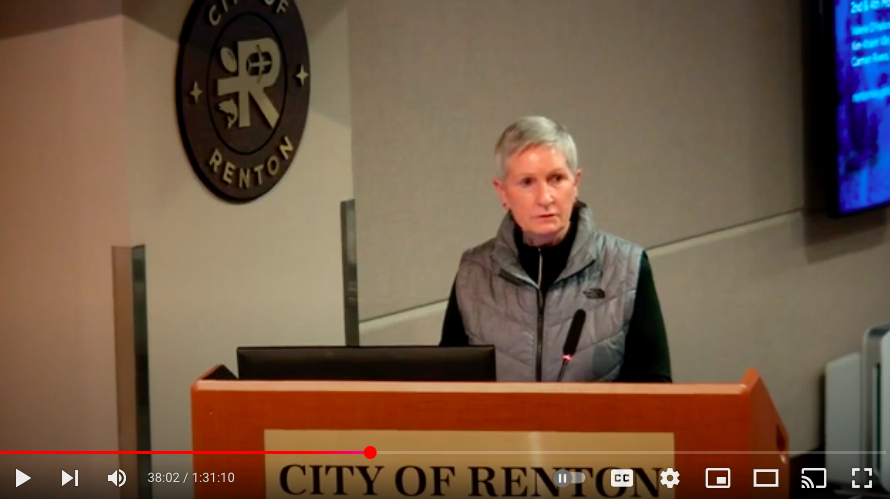
As several controversial projects and long-festering problems reached a boiling point in last night’s Council Meeting, residents urgently requested more detailed and specific information, and intervention from their elected officials. But at the meeting and its aftermath, it’s clear that most residents felt they were just getting a story from the council, not the facts.
This appears to have been by design by the City, and it failed pretty spectacularly last night.
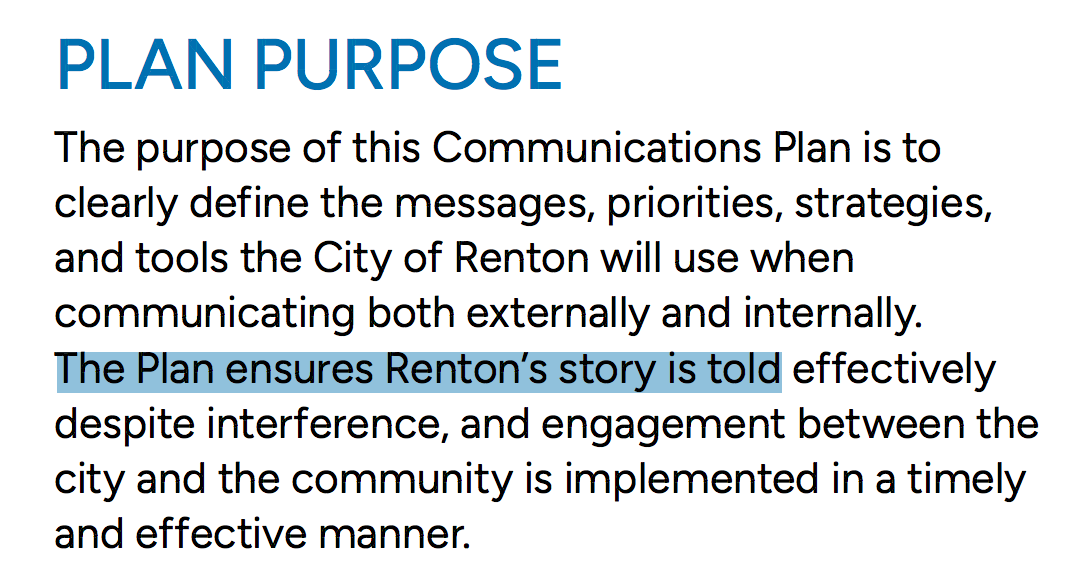
The Council has recently adopted a new communication plan and funded two additional new communication positions in the Mayor’s office (adding to several already there). The plan literally focuses on “storytelling”, and very little on providing comprehensive information and easy-to-find public records.
Perhaps “Storytelling” has a place in a marketing campaign, but this Communication and Engagement plan provides the structure for government officials and city employees to communicate with their constituents. We’re looking for data and assistance, not a story. Large companies get in trouble when they tell stories to their regulators.
Last night’s Council Meeting featured a large number of residents speaking out on a broad selection of topics. They shared the concerns about the controversial Logan Six project, the taking of homes for Renton High, the derelict Sixth and Park buildings, the Asphalt Plant, open drug use near Sartori Elementary school, the general condition of downtown, and other issues.
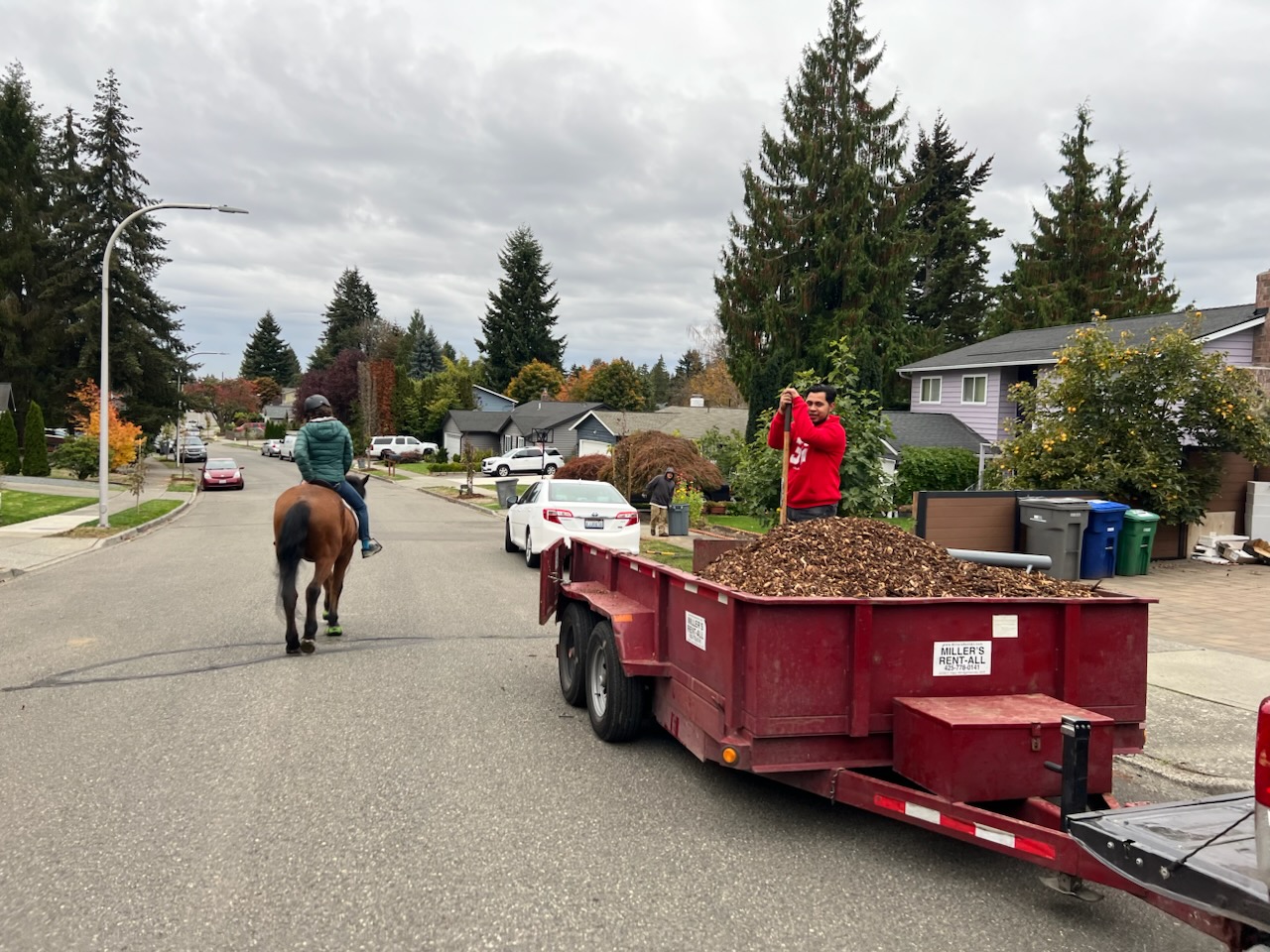
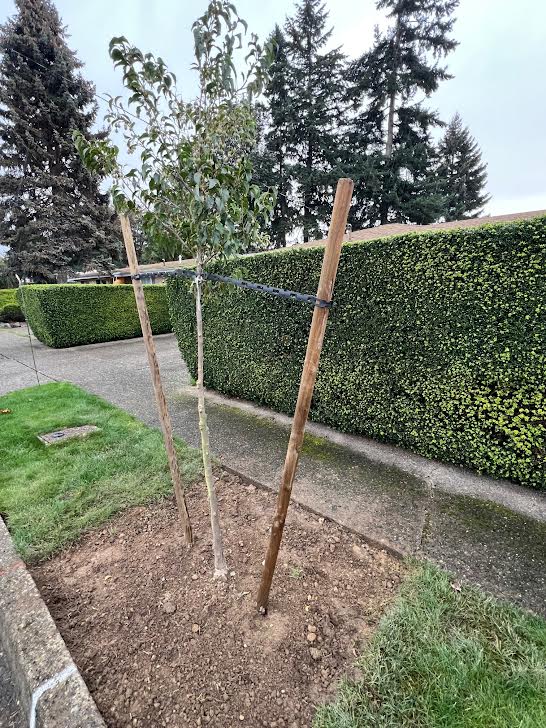
A landscape contractor working for Renton takes a break from mulching around his newly planted street trees to greet us and our horse Zeus, last October 17.
I’m way overdue to share a purely positive story on this blog, and there is no shortage of such stories to tell. Our City and our region are teeming with caring, beauty, hard work, and achievement.
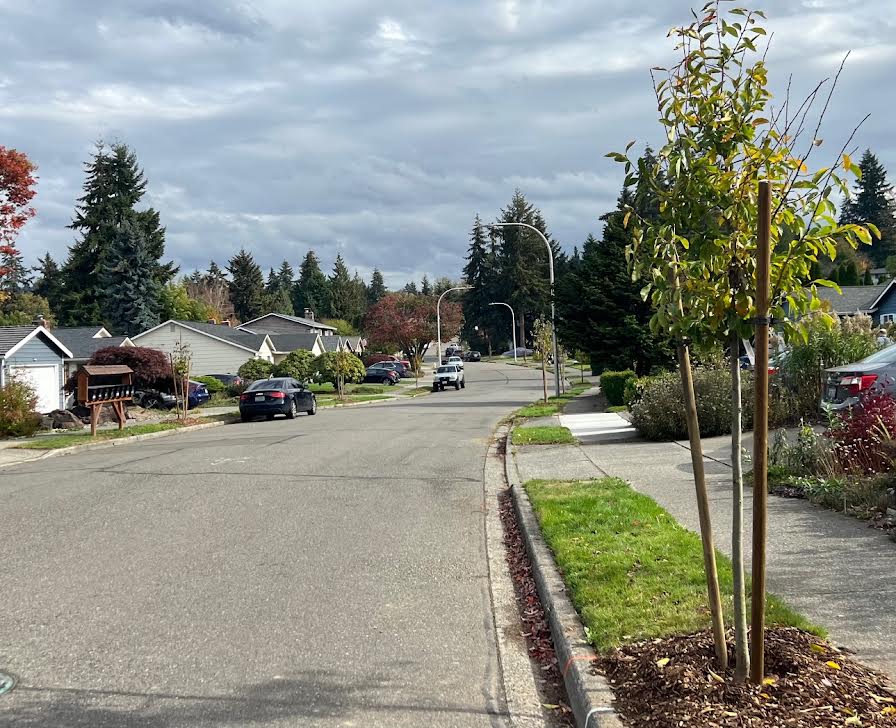
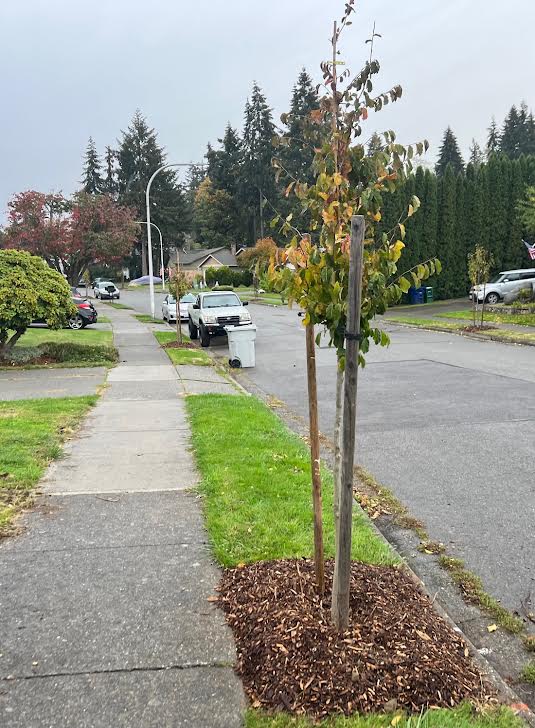
Last October our City’s arborist and street department planted some lovely new street trees along NE 23rd Place and NE 24th Street, not far from my home, in the North Renton Highlands. This was just one of their ongoing planting projects. I caught the work in progress when I was out on a walk.
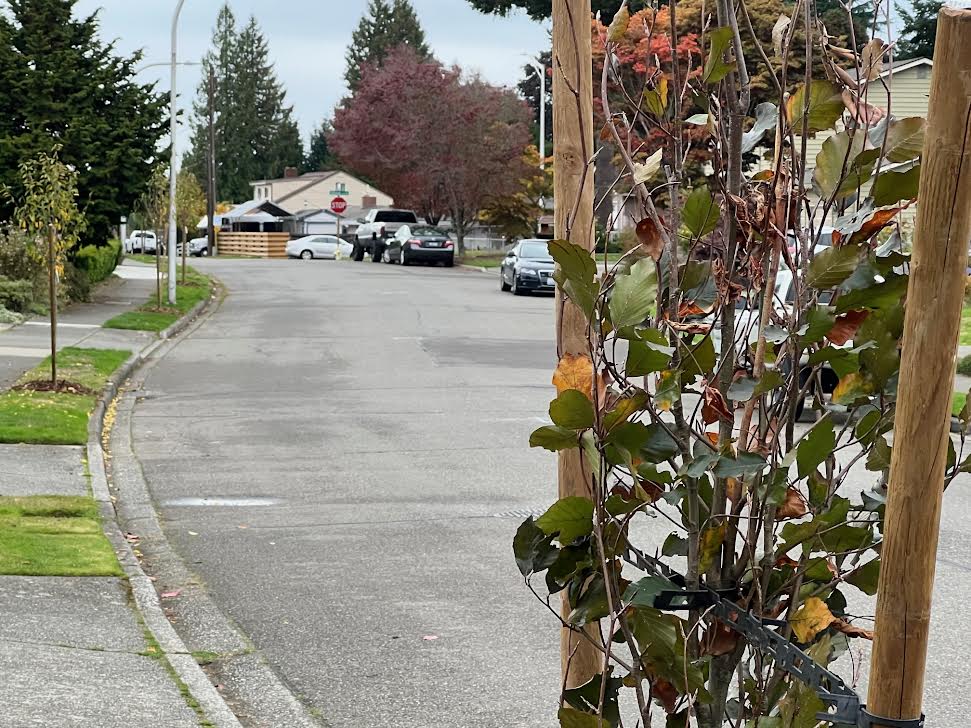
The trees consisted of Japanese Snowbell and Persian Parrotia, and they will noticeably add to the street canopy as they mature. Most of the neighbors were excited to see the trees, although there were a couple concerns from residents who had landscaped the planting strip just the way they liked it. Hopefully when the trees bloom this spring everyone will be as pleased as I was to see them.
These trees were planted as part of Renton’s Urban Forestry program, overseen by Urban Forester Ian Gray and Inspecting Arborist Gabriella Golzarian. This neighborhood was a good candidate for the new street trees, as it had city-owned planting strips on both sides of the street, and didn’t already have trees in these strips.
This spring they are planning to plant some trees near Redmond Avenue Northeast and Shelton Avenue Northeast between Northeast 10th Street and Northeast 12th Street on the Renton Highlands.
Renton’s Urban Forestry website reminds us that there are many advantages to maintaining a healthy tree canopy:
Improves air quality by filtering pollutants and producing oxygen
Helps fight climate change
Helps control flooding and soil erosion
Provides and improves wildlife habitat
Provides shade and decreases heating and cooling costs
Increases real estate values
Attracts shoppers and other business activities
Reduces crime rates
Improves mental and physical health
Enhances community spirit
To learn more about Renton’s Urban Forestry program you can click here
Newly planted trees line a block of NE 23rd Place, one tree per home, in Renton Highlands.
New street tree on NE 24th Street, prior to mulching.
In a quasi-judicial hearing, Renton Council would look for errors in the building application process. Renton Council just decided to no longer conduct these hearings, after the North Renton neighborhood had been told for years that it would happen.
The Renton City Council swiftly made a major policy change at their last Council meeting, sending all land-use appeals to King County Superior Court instead of the Renton City Council.
While the council may have had good intentions with the change, they followed a flawed implementation process that left the North Renton neighborhood feeling betrayed and put in an unfair position.
For three years the Council has told North Renton residents that residents can’t discuss the Logan Six project with Council because it would eventually be sent to the Council for a quasi-judicial review. At that time, the Renton Council, acting as judges, would formally review all aspects of the entire record of the project and make sure that residents had not been victimized by any errors in the process. But after three years of telling North Renton residents this, a mere month before the long-awaited quasi-judicial hearing by Council would occur, the Council surprised virtually everyone by canceling their role in the appeals process and all future appeals processes. Many North Renton residents understandably now feel hurt and betrayed.
The City made at least three errors in their implementation of this policy change that led to this betrayal. (The policy change may have been reasonable, except for these errors.)
(1) The Council should have given the public better awareness and opportunity to comment on this policy.
This policy change was made swiftly, gliding through Renton’s Planning Commission and then two readings on Renton City Council in less than a month’s time. Unless Renton residents were carefully monitoring the Planning Commission, which very few do, they would have missed virtually all discussion on this topic. The group most severely impacted, those concerned about the Logan Six project (which many feel is too large with too little parking), did not have awareness this was coming.
Policy decisions benefit immensely from public input, and this change is so far-reaching that Council should have given ample time for the public to be notified and give input to council. This is a change that has been discussed by Council in decades past, and has positive and negative ramifications, which the public could have been educated on, and commented on, with leads to my second complaint about the process:
(2) The administration should have presented both pros and cons of the policy change to the Planning Commission and City Council.
The Planning Commission was given a staff statement to base their deliberations on, which gave a positive account of how this change would improve communication between Council and residents concerned about a nearby project. Council would not have quasi-judicial constraints on their communication with residents during the life of the project (i.e. not every communication would have to be formal and on-the-record).
But the administration left out the negative consequences of the change– the reasons that Council has never changed this policy in past decades: The quasi-judicial council review gives residents an easy and efficient way to appeal Hearing Examiner decisions, that does not require the extraordinary time, complexity and expense of going to Superior Court. In addition, the Council appeal process ensured that the legislative body itself, the very ones setting the rules and codes, made a thorough review of all documents, and then a determination regarding whether the rules– that they had set– had been followed. Without this Council review, residents and the King County Superior Court are left to try to try to surmise for themselves what the legislative intent is for specific rules, while residents typically must pay attorneys somewhere between $20,000 – $100,000 to represent them.
The Planning Commission and Council should have been presented with both sides of this argument. Then Council should have notified the public of a possible change with a press release, and held it long enough to give ample opportunity to hear from residents and builders. They could have scheduled a council public hearing on the topic, since the existing policy has been in place for many decades, and the change is so far reaching. An open public discourse regarding this change would have assured that all factors were taken into consideration. No matter what the final policy choice, Council, residents, and home builders would have understood the rationale without suspicion.
(3). Most important of all, Council should have set the policy for new applications, but not changed the policy mid-process for projects in work.
They especially should not have changed the process for a project just a month away from it’s Council review, after refusing to discuss the project with residents for three years. This amounts to a complete denial of legislative representation for the residents impacted.